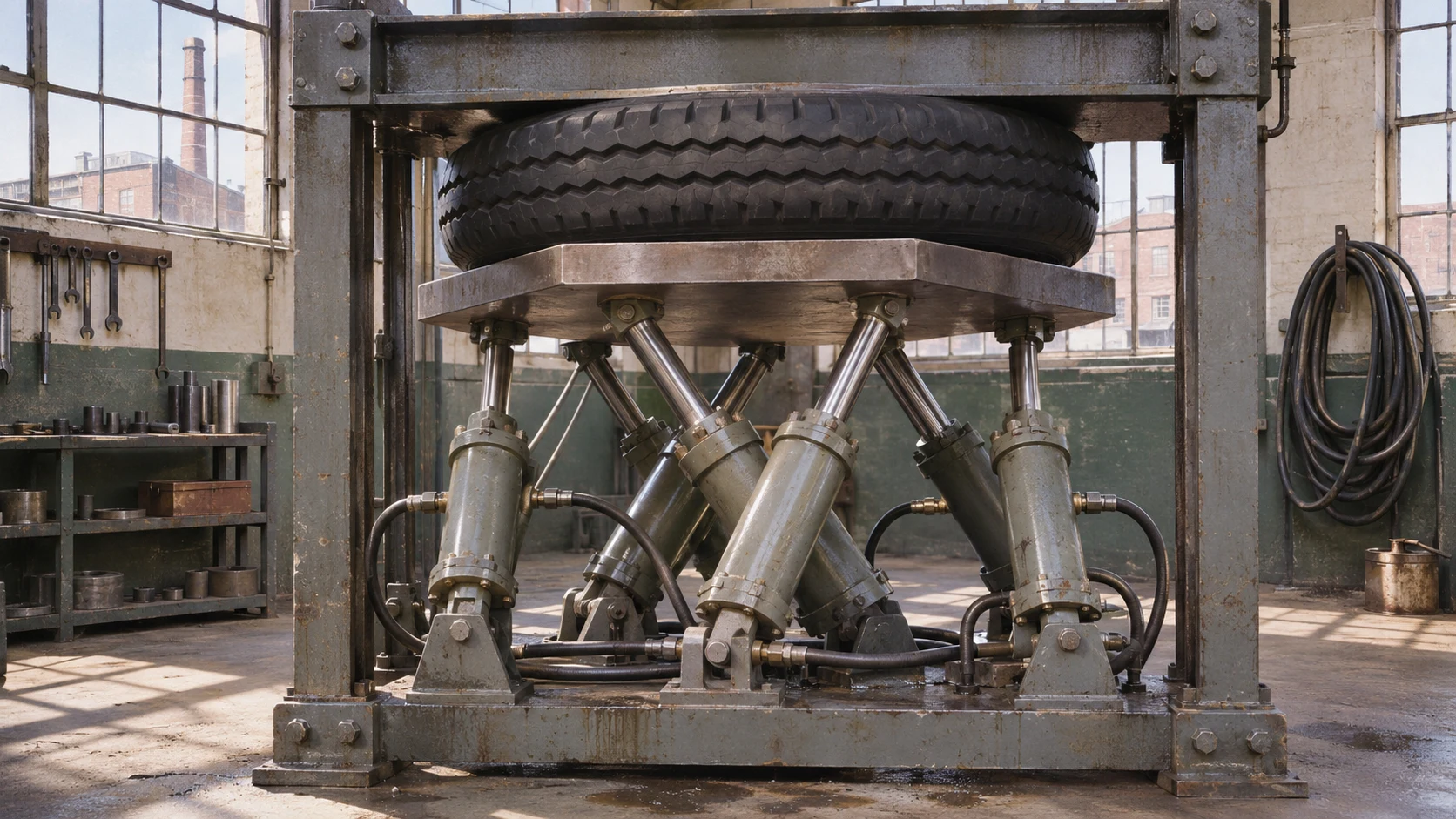
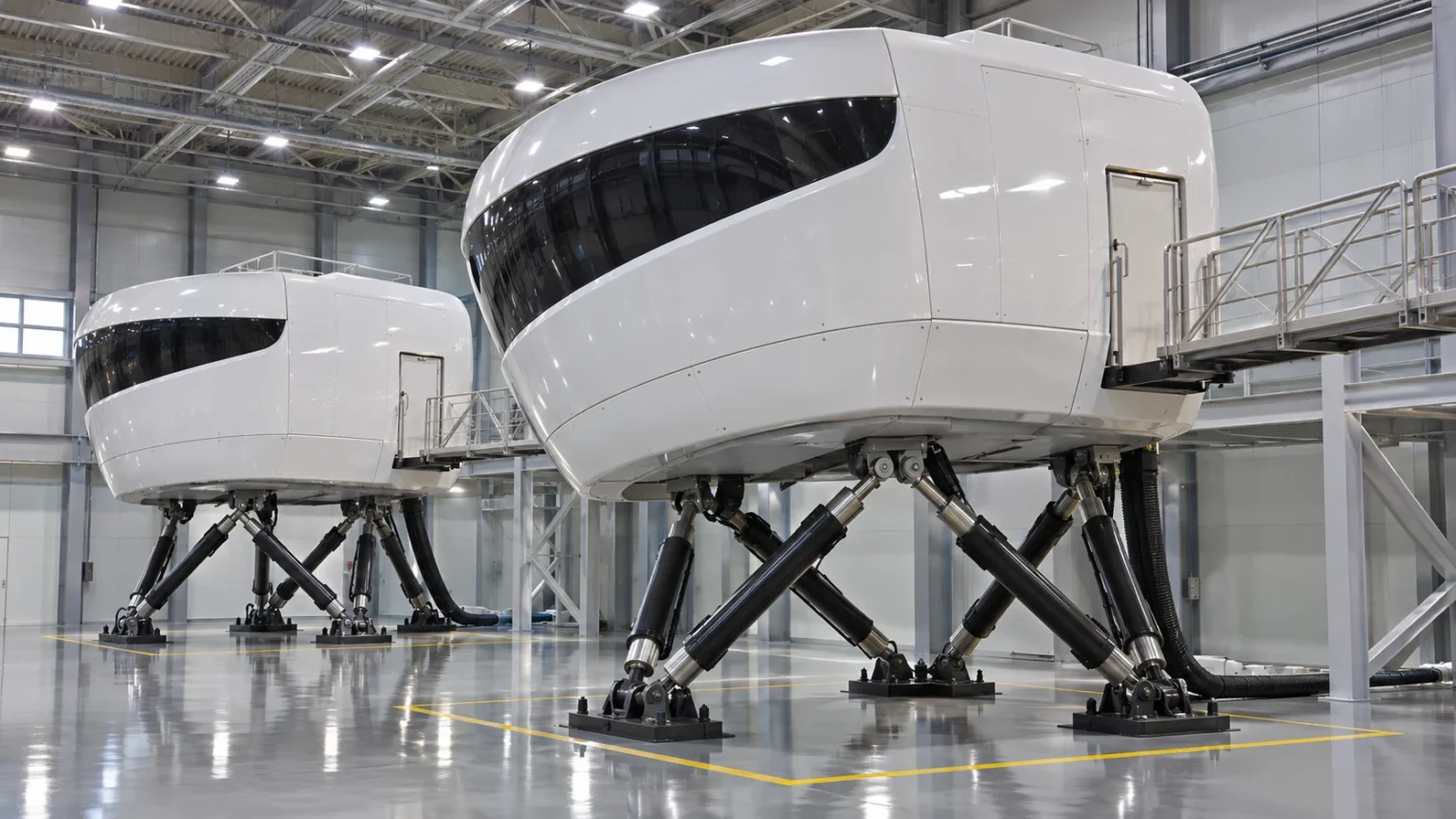
Before flying a real aircraft, pilots practise take-offs and landings countless times in flight simulators on the ground. A large box-shaped cockpit tilts and shakes so the body feels pushed around just as in real flight, and if you look underneath, you will find six thick, crisscrossing legs holding the cockpit up. This device is the ‘Stewart Platform’, regarded as a classic parallel mechanism in robotics.
Put simply, a Stewart Platform is ‘a device that supports a top plate on six legs of adjustable length and moves that plate to any desired position and tilt by changing the leg lengths together.’ It took its name when the British engineer D. Stewart presented it in a 1965 paper. Because Eric Gough built the same layout earlier, it is also called the ‘Gough–Stewart platform’, and because it has six legs it is often called a ‘Hexapod’.
In this article, we will look in turn at how the Stewart Platform came about, the six motions created by its six legs, the strengths and weaknesses of parallel structures compared with serial robots, and where it is used, from flight simulators to spacecraft docking.
How Six Legs Move a Single Plate
1. From Tyre Tester to Flight Simulator
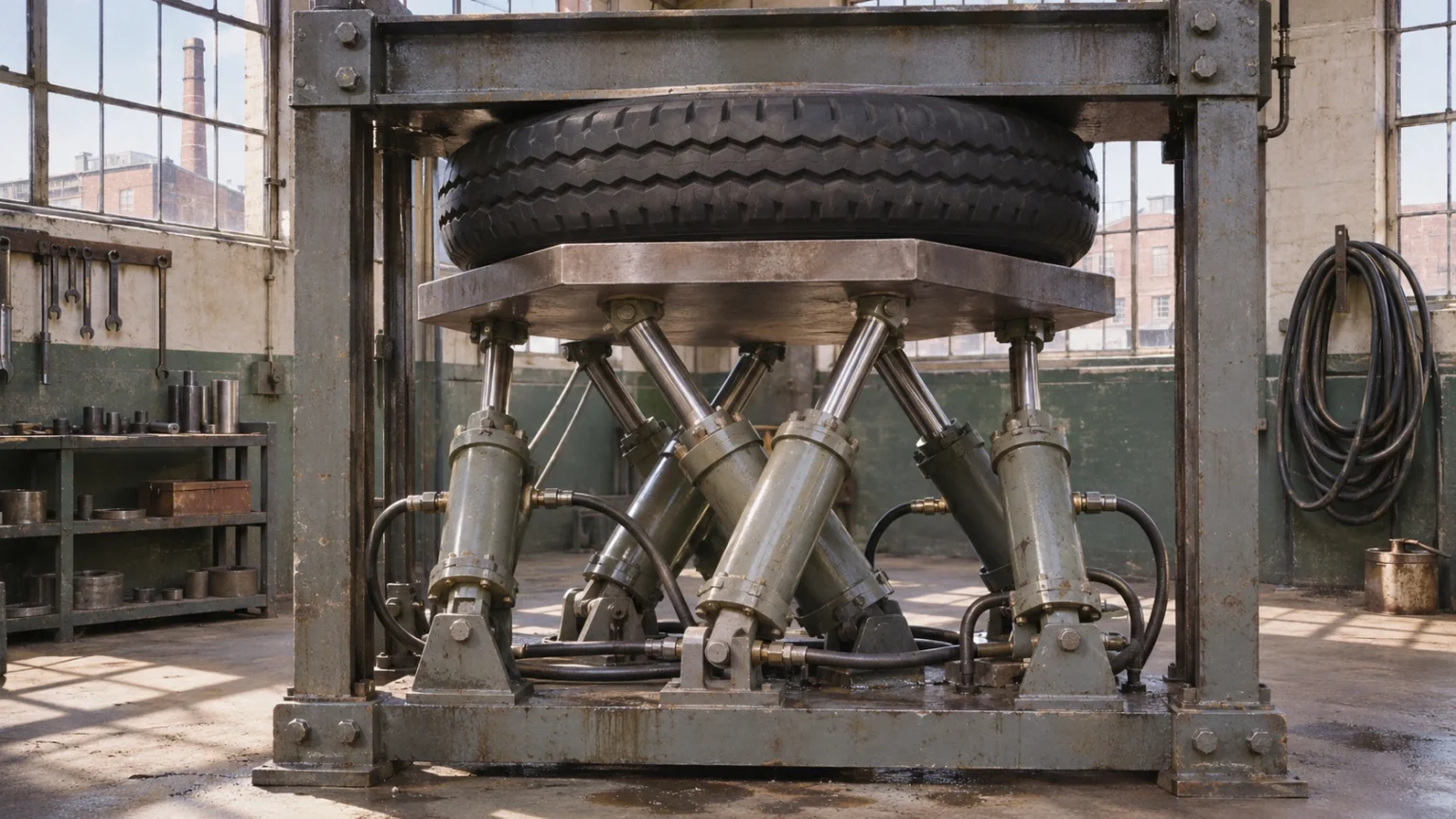
The history of this device begins not with aircraft but with car tyres. Around the same time, several engineers arrived at the same structure for different purposes.
(1) Gough’s universal tyre-testing machine
Eric Gough, an engineer at the Dunlop tyre factory in Britain, wanted to test how tyres hold up when forces act on them from several directions at once, so he built a ‘Universal Rig’ whose plate rested on six legs of variable length. The machine went into operation in 1954 and was used until the factory closed in the late 1980s; today it is kept by the Science Museum in Britain.
(2) Stewart’s 1965 paper
In 1965, Stewart published “A Platform with Six Degrees of Freedom” in the proceedings of Britain’s Institution of Mechanical Engineers and suggested uses such as flight simulators. As the paper became widely read, the device took his name, but because his original design differed slightly from today’s form, some argue that the credit should be shared.
(3) The same structure born separately in the United States
The American engineer Klaus Cappel independently built the same hexapod structure in the early 1960s, before Stewart’s paper appeared, and patented it. He licensed it to flight simulator companies and built the first commercial hexapod motion simulators. For this reason, the robotics researcher Ilian Bonev concluded that the contributions of all three men deserve recognition.
2. Six Motions Created by Six Legs
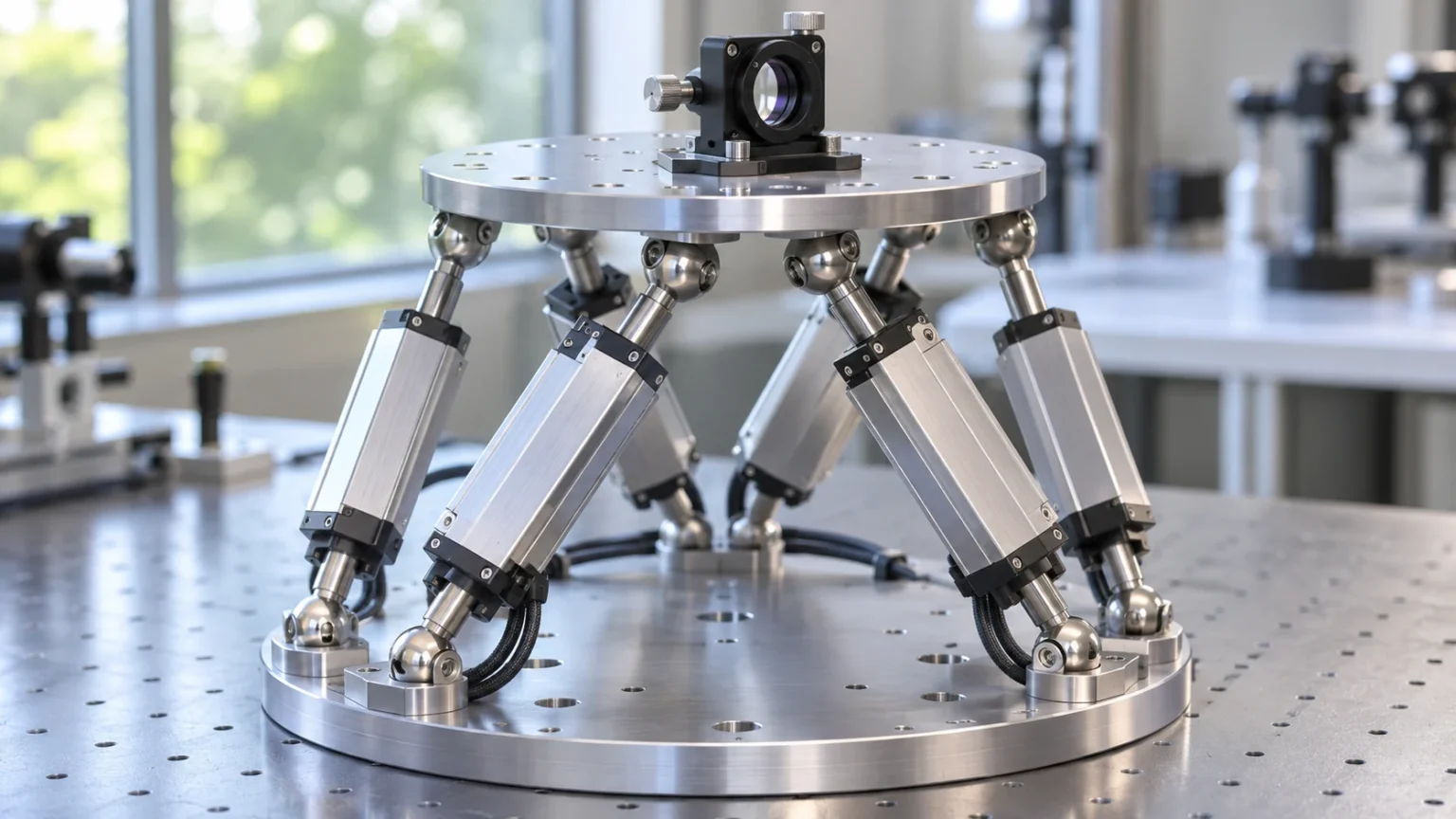
A Stewart Platform consists of a base plate below, a moving plate above, and six legs connecting the two. Each leg is a device that can lengthen and shorten, such as a hydraulic cylinder or an electric linear actuator, and both ends are attached to the plates by joints that can bend in several directions. Depending on how the lengths of the six legs are combined, the top plate can produce all six motions possible in space, that is, six degrees of freedom.

- Forward–back movement (Surge): The top plate glides forward or backward without tilting.
- Left–right movement (Sway): The top plate shifts to the left or right while staying level.
- Up–down movement (Heave): The six legs lengthen or shorten together, so the whole top plate rises and falls.
- Side tilt (Roll): The top plate tilts sideways around an axis running front to back, giving the feeling of an aircraft lowering one wing.
- Front–back tilt (Pitch): The front of the top plate lifts or dips around an axis running side to side, giving the feeling of the aircraft’s nose rising and falling.
- Turning (Yaw): The top plate rotates in place around a vertical axis, giving the feeling of the nose swinging left or right.
Inverse kinematics, which starts from the desired pose of the top plate and finds the leg lengths, gives a single answer straight away from simple formulas. Forward kinematics, which works out the pose of the top plate from the six leg lengths alone, is very difficult: research in the 1990s showed that in the general case up to 40 different poses are possible for the same leg lengths.
3. Strengths and Weaknesses of Parallel Structures Compared with Serial Robots

The robot arms commonly seen in factories are serial robots, whose joints run in a single chain from shoulder to fingertip. By contrast, a structure in which several legs jointly hold a single plate, like the Stewart Platform, is called a parallel robot.
(1) Sharing the load
In a serial robot, each joint must also carry the weight of the arm segments and motors attached beyond it. In a parallel structure, the six legs share the load, so the machine can handle heavy objects for its size and can shake even a heavy simulator cockpit quickly.
(2) Errors that do not pile up
In a serial robot, the small errors at each joint add up as you move toward the fingertip. In a parallel structure, an error in one leg is not amplified by passing through other joints, and the whole structure is rigid, so it is used to position telescope mirrors and precision machining equipment.
(3) A small workspace and singularities
On the other hand, the legs easily bump into one another or reach their length limits, so the range of motion is small for the machine’s size, and large tilts are difficult. In certain poses a singularity also appears, where the top plate cannot resist force in some directions and wobbles, so designers set the range of motion to avoid such poses.
4. From Flight Simulators to Spacecraft Docking
The Stewart Platform is used wherever something must be tilted and shaken precisely.
(1) Flight and driving simulators
High-end flight simulators for pilot training place a replica cockpit and a multi-screen visual system on a Stewart Platform to produce motion in all six directions. Driving simulators often mount the platform on a larger travel system to imitate short bursts of acceleration, while sustained acceleration is suggested by gently tilting the occupant so that gravity does the work.
(2) Spacecraft docking and walkways over rolling seas
Docking mechanisms that follow the International Docking System Standard (IDSS), and their predecessor LIDS, use a Stewart Platform to align the interfaces of two spacecraft. The Ampelmann system, developed in the Netherlands, cancels out the motion of a ship rocked by waves so that the gangway to an offshore structure stays steady.
(3) Medicine and research
The Taylor Spatial Frame used in orthopaedics connects two rings placed around a bone with six struts, and by changing the strut lengths little by little it corrects bent bones and complex fractures. It is also used for earthquake simulation, biomechanical testing such as spinal studies, and pointing satellite dishes and telescopes.
When several legs hold a single plate together, it can move more rigidly and precisely. The simple idea that changing the lengths of just six legs can create any position and tilt is the first step to understanding the Stewart Platform.