From one angle, library and information science may look static and simple, but when you look at it closely, even classification alone cannot be mastered by memorization; it requires a considerable ability to apply what you know. Buying the Korean Decimal Classification (KDC) in book form, which lays out the detailed classification scheme, costs a hefty several hundred thousand won, and searching the internet only gets you so far, so you end up needing a classification book.
Hoping to help even a little in this situation, I have compiled the 100 divisions of the KDC division table and the 1,000 sections of its section table so that they can be consulted at any time. The KDC is the book classification system used mainly in public libraries and school libraries, so it may be helpful not only to people studying library and information science but also to anyone who uses libraries often.
Before getting into the main content, to aid understanding, I will start with a brief explanation of what the division table and the section table are.
First, the numbers in the classification table consist of a total of 1,000 numbers from 000 to 999, and when further classification is needed, the classification continues into decimal places called subdivisions. These levels are called main classes, divisions, sections, and subdivisions, and they can be summarized simply as follows.
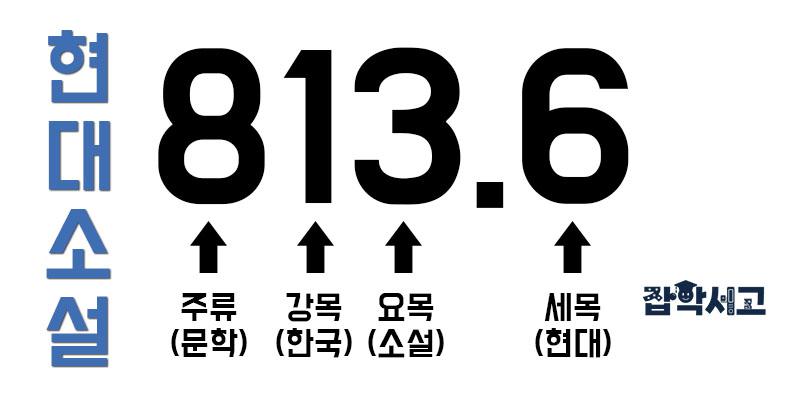 Details of main classes, divisions, sections, and subdivisions
The main class refers to the first of the three digits and is broadly divided into 10 classes from 0 to 9; the division is the second digit, giving 100 divisions; and the section is the third digit, giving 1,000 sections. Subdivisions are laid out in more detail in the KDC book, but since the number of possibilities becomes too large, this article covers only the division table and the section table.
This is based on the 6th edition of the KDC, and some parts may be revised if a 7th edition comes out. Blank cells in the tables are numbers that are not currently in use.
1. Division Table
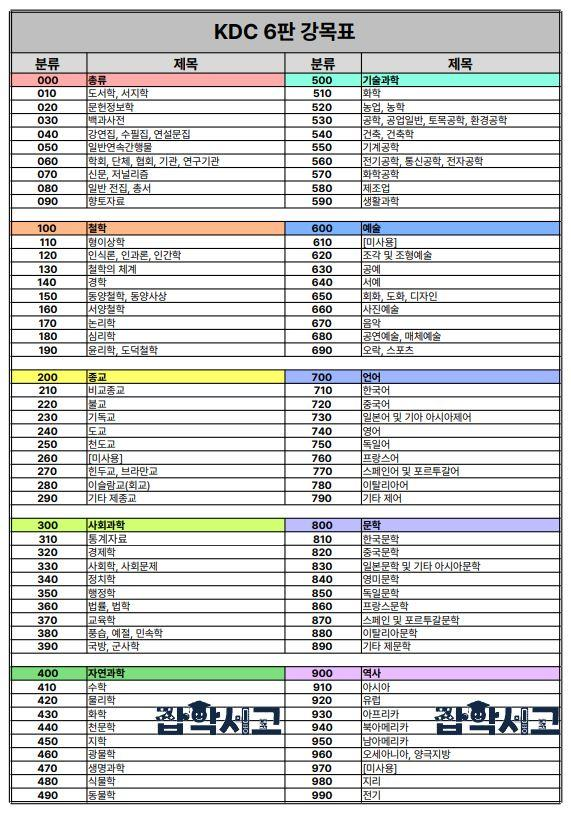 KDC 6th edition division table
The division table splits each main class, the first digit, into 10 subordinate parts. The main classes of the Korean Decimal Classification (KDC) are 000 - General Works / 100 - Philosophy / 200 - Religion / 300 - Social Sciences / 400 - Natural Sciences / 500 - Technology / 600 - Arts / 700 - Language / 800 - Literature / 900 - History, and the division table breaks each of these down in more detail.
2. Section Table
2-0. General Works (000–099)

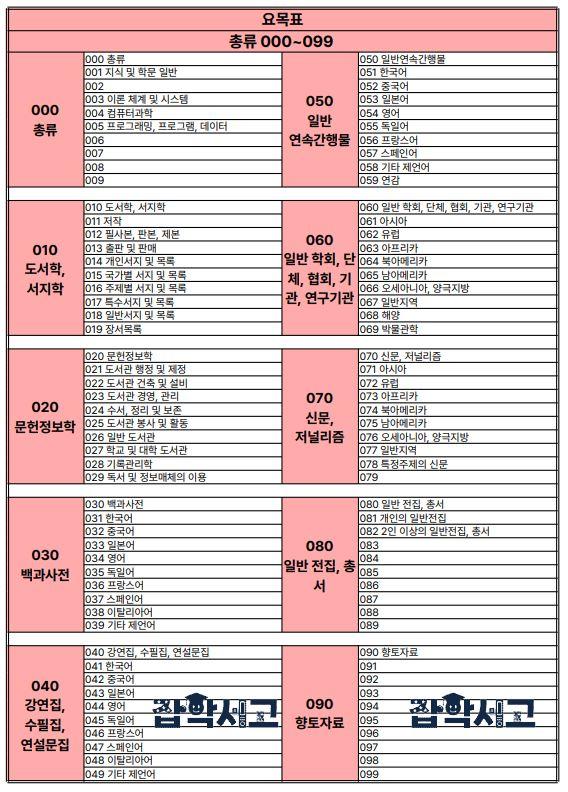 Section table: General Works
General Works classifies items that do not belong to other divisions, items with so many subcategories that they are separated by an alternative method, or items belonging to certain divisions (030, 040, 050, 080) recognizable through the mnemonic features of the standard subdivision table. A distinctive feature is that library and information science is the only academic discipline included in General Works.
Standard Subdivision Table - -01 Philosophy and theory / -02 Miscellany / -03 Dictionaries, quotation dictionaries, abbreviations / -04 Lectures, essays, speeches / -05 Serial publications / -06 Organizations and management / -07 Teaching, research methods, education, and educational materials / -08 Collections, complete works, selected works / -09 History and geographic subdivision
※ When adding a standard subdivision, if zeros overlap at the front or the same number already exists, you must add or remove an extra 0 at the front.
Example)
300 + -03 = 303
310 + -03 = 310.3
311 + -03 = 311.03 (basic)
311.03 (duplicate) + -03 = 311.003
2-1. Philosophy (100–199)

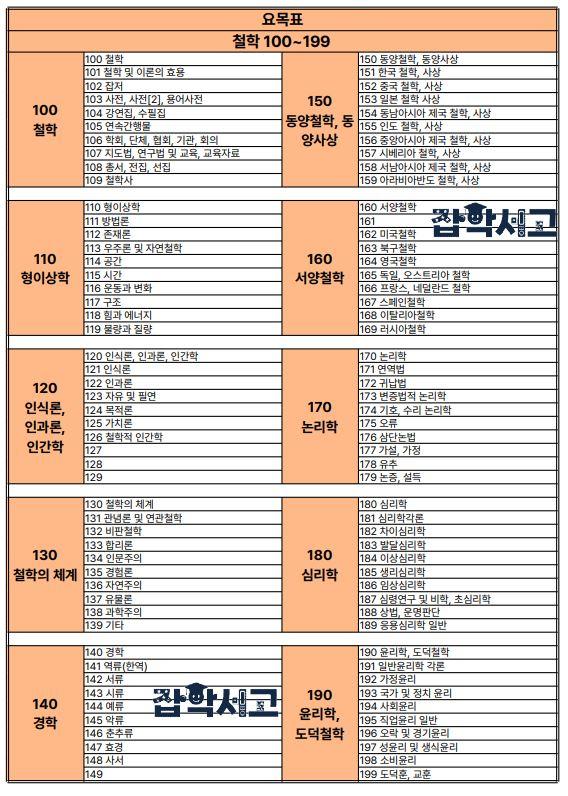 Section table: Philosophy
The 100s classify Philosophy. Books on various philosophical theories, Eastern and Western philosophy, psychology, logic, morality & ethics, and so on are classified here.
2-2. Religion (200–299)
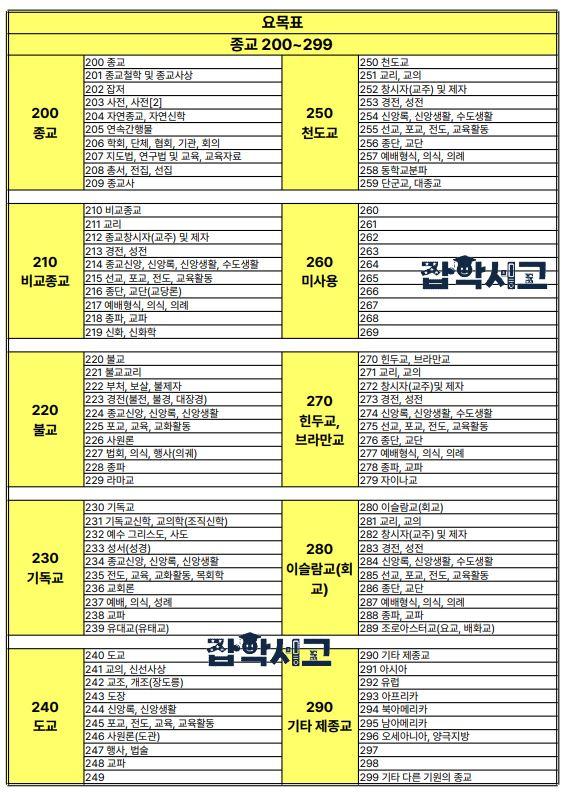 Section table: Religion
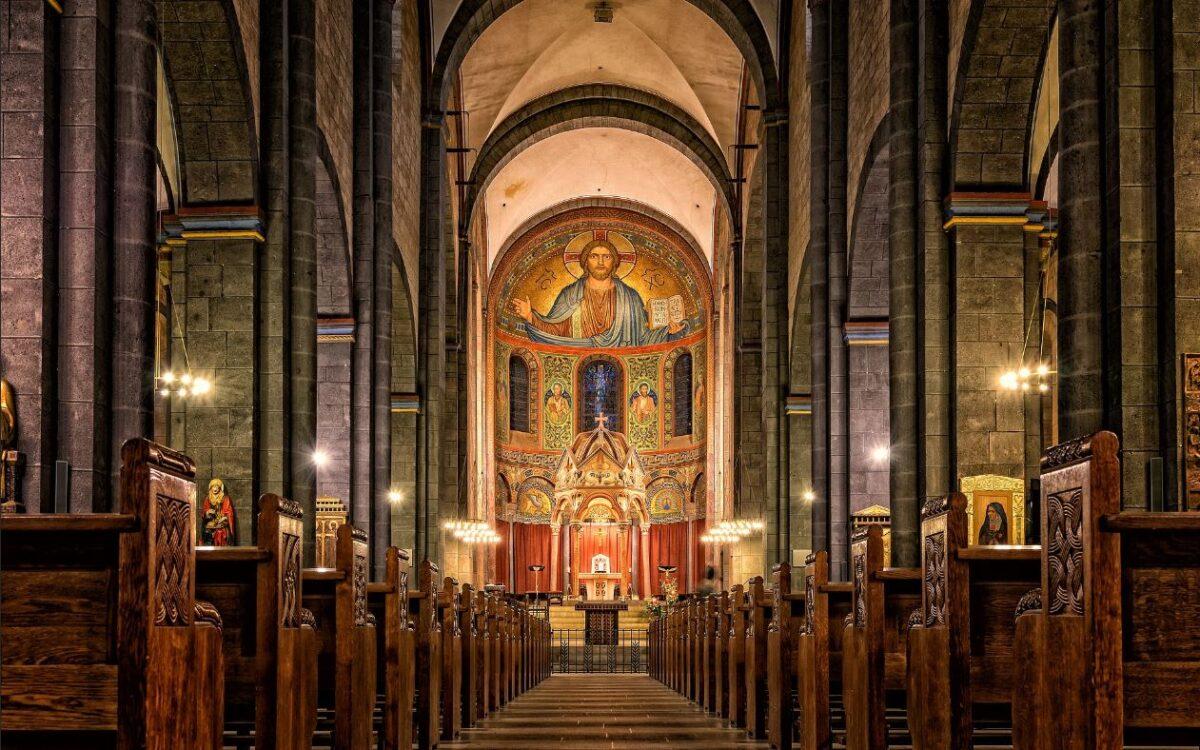
The 200s, Religion, classify all books on religion, including the world’s three major religions: Christianity, Buddhism, and Islam.
< Note >
Common Subdivision Table for Religions - -1 Doctrines and dogma / -2 Founders of religions and their disciples / -3 Scriptures and sacred texts / -4 Religious faith, records of faith, religious life / -5 Missions, proselytizing, evangelism, educational activities / -6 Religious orders and denominational bodies / -7 Forms of worship, rites, rituals / -8 Sects and denominations
2-3 Social Sciences (300–399)

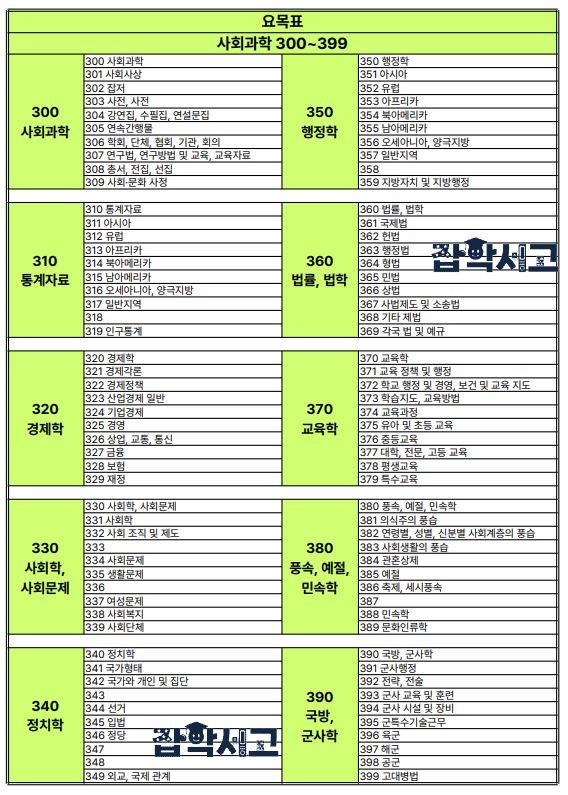 Section table: Social Sciences
The 300s, Social Sciences, classify books on national politics and public administration, books on issues emerging in society, and books on education, economics, and more. In many cases, classification must go beyond the section level into detailed subdivisions, such as general subject subdivisions and special subject subdivisions that combine with other fields.
2-4. Natural Sciences (400–499)
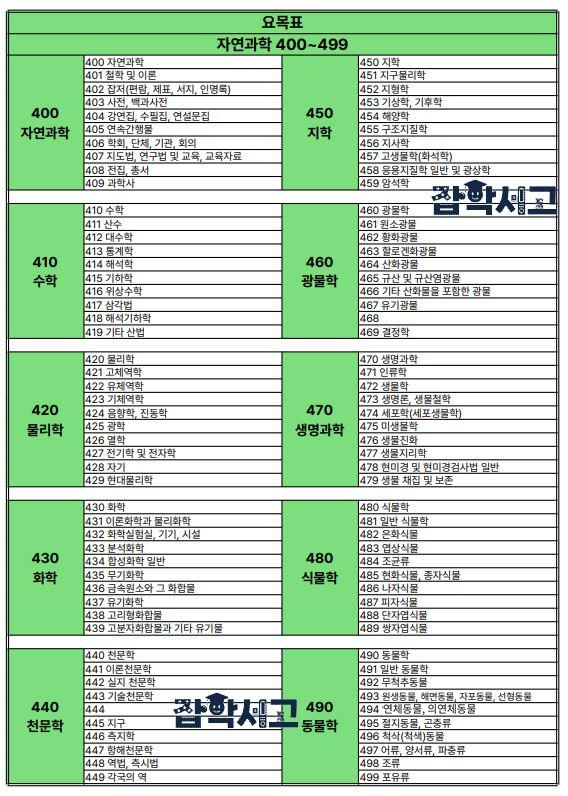 Section table: Natural Sciences
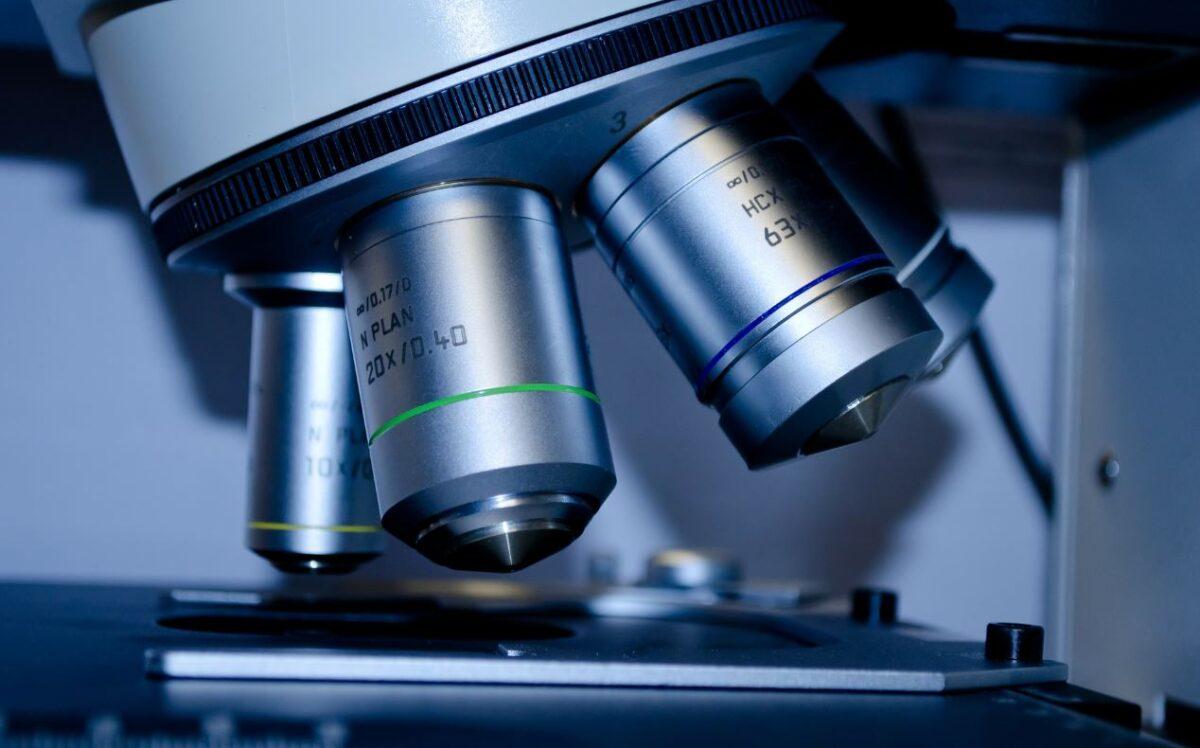
The 400s are assigned to Natural Sciences. Put simply, as common sense suggests, everything related to nature, such as animals, plants, astronomy, and geology, belongs here, and it is easy to understand if you think of mathematics as having been added. However, care is needed not to confuse chemistry with chemical engineering, which belongs to Technology.
2-5. Technology (500–599)

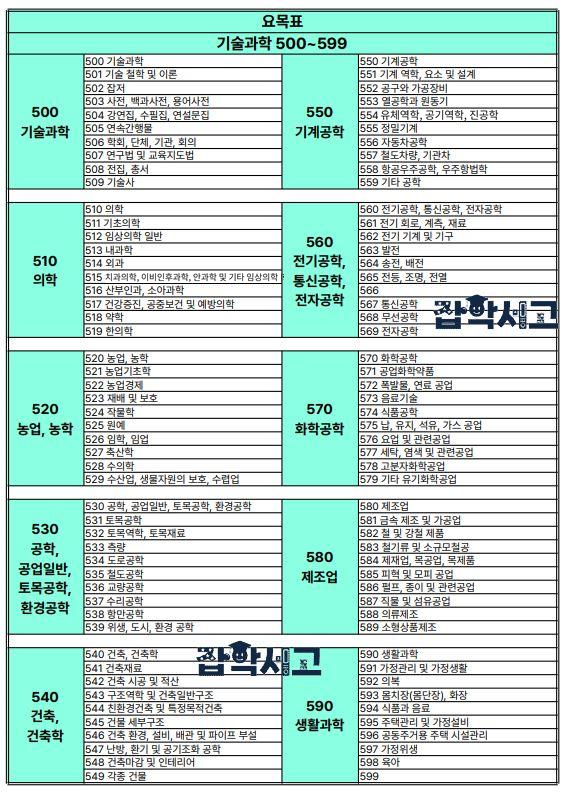 Section table: Technology
The 500s, Technology, can be seen as mainly covering cutting-edge scientific fields. However, besides science and engineering fields such as electrical, electronic, mechanical, and chemical engineering, there are also fields related to everyday life, such as agriculture and human ecology, and these can easily cause confusion.
2-6. Arts (600–699)
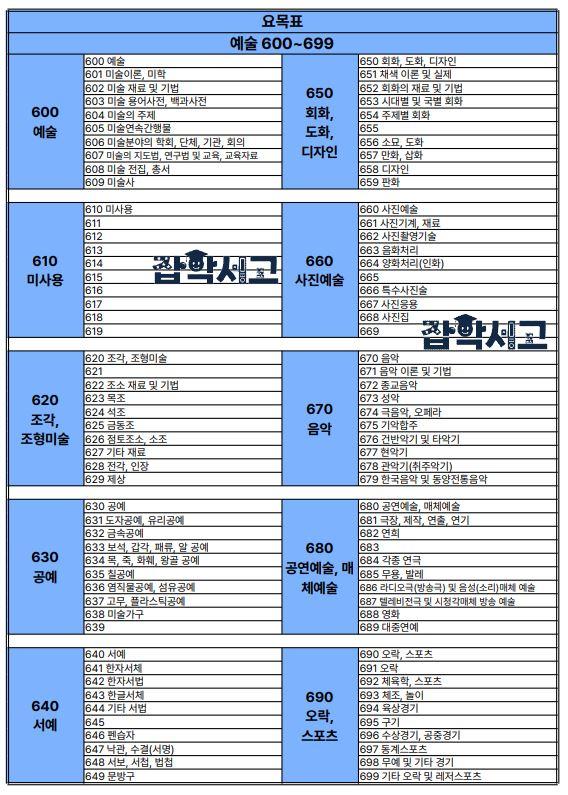 Section table: Arts
From the 600s, Arts , onward, classes can be distinguished relatively easily without much risk of confusion. This is because each part of the arts is clearly divided, and the field of art itself is very distinct.
2-7. Language (700–799)
 Section table: Language
A distinctive feature of the 700s, Language, is that the language subdivision table is applied to the second digit and the common language subdivision table to the third digit. The language subdivision table and the common language subdivision table, which are applied throughout, are as follows.
Language Subdivision Table - -1 Korean / -2 Chinese / -3 Japanese / -39 Other Asian languages / -4 English / -5 German / -59 Other Germanic languages / -6 French / -7 Spanish / -79 Portuguese / -8 Italian / -9 Other languages / -928 Russian
Common Language Subdivision Table - -1 Phonology and writing systems / -2 Etymology / -3 Dictionaries / -4 Vocabulary / -5 Grammar / -6 Composition / -7 Readers, interpretation, conversation / -8 Dialects
2-8. Literature (800–899)
 Section table: Literature
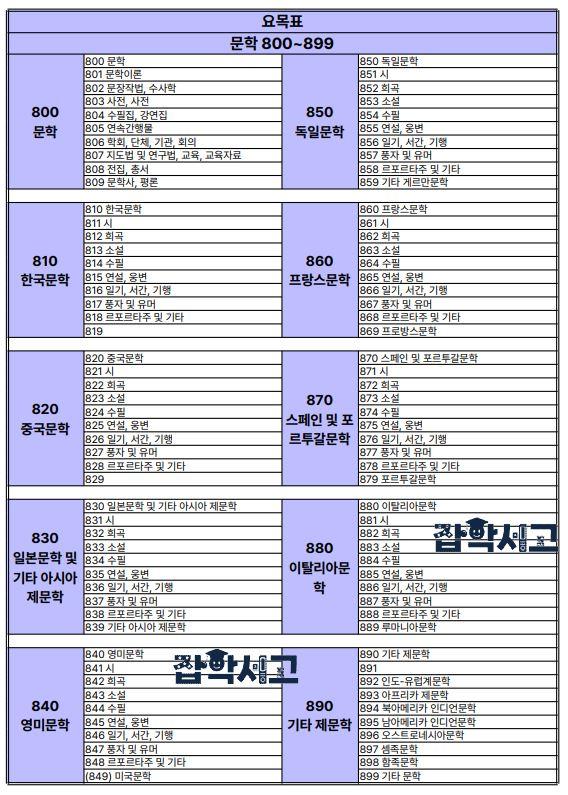
In the 800s, Literature, the language subdivision table is applied at the division level, the literary form subdivision table at the section level, and the period subdivision table at the subdivision level, in that order. The section table above applies only up to the literary form subdivision table; the KDC book additionally instructs that a period subdivision can be added.
Language Subdivision Table: see the 700s above
Literary Form Subdivision Table - -1 Poetry / -2 Drama / -3 Fiction / -4 Essays and short pieces / -5 Speeches and oratory / -6 Diaries, letters, travel writing / -7 Satire and humor / -8 Reportage and miscellany
2-9. History (900–999)
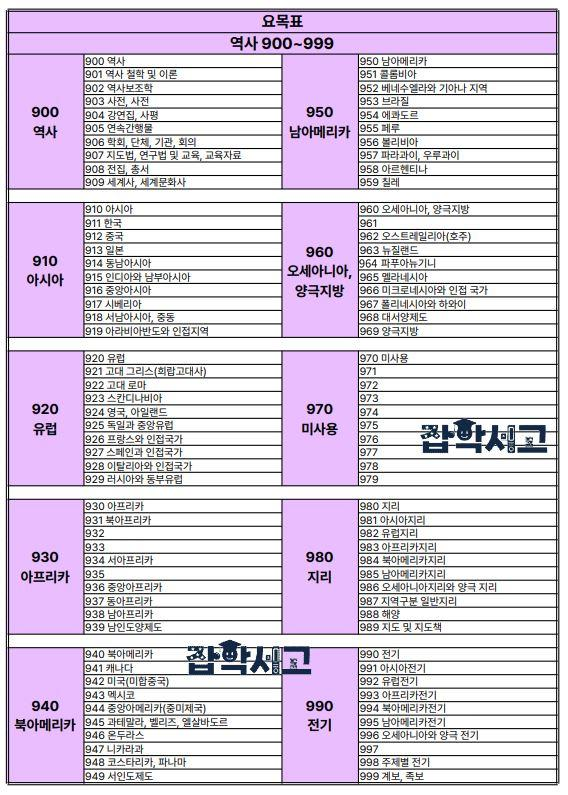 Section table: History
The last group, the 900s, History, is, put simply, the range of numbers for classifying books on the history of each country, great figures, and geography. In particular, 980 Geography and 990 Biography can, as alternative methods, classify the geography and great figures of various countries. It is a convenient range for placing anything related to history, and even when a book doesn’t belong here, going to this range of numbers often leads to instructions to move to another number and classify it by the standard method.
< Note >
Main Geographic Subdivision Table - -1 Asia / -11 Republic of Korea / -12 China / -13 Japan / -14 Southeast Asia / -15 India & South Asia / -16 Central Asia / -2 Europe / -24 United Kingdom, Ireland / -25 Germany, Central Europe / -26 France and neighboring countries / -27 Spain and neighboring countries / -3 Africa / -4 North America / -41 Canada / -42 United States / -43 Mexico / -5 South America / -6 Oceania, polar regions / -8 Oceans / -81 Pacific Ocean / -84 Indian Ocean / -85 Atlantic Ocean
※ When a geographic subdivision needs to be added but there is no instruction for geographic subdivision, you must add 09 first and then add the geographic subdivision.
Example) Korea -0911, China -0912, United States -0942
In this post, I covered the Korean Decimal Classification (KDC). This GK Library site has many materials related to library and information science, so I hope it will be an opportunity for you to gain plenty of related information, including the Korean Decimal Classification table.