In this post, I want to explain the concept of the call number, which is essential in every library, and how to read one. I begin in the hope that this article will help you learn what elements make up a call number, a concept that is hard to make sense of when you first see it.
★ What Is a Call Number?
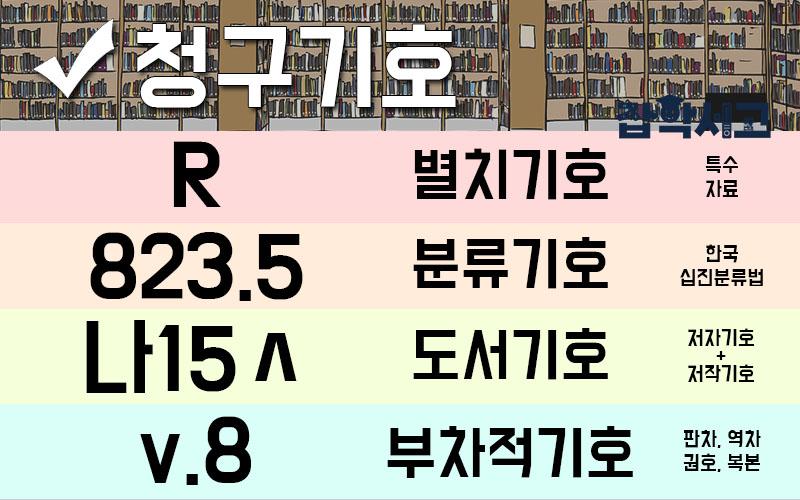 The concept of a call number and its components
A call numberis the unique code attached to the spines of the books held in most libraries. It tells you where an item is located and distinguishes it from other items. A call number can therefore be called the address assigned to each book.
It is broadly made up of a location mark, a classification number, a book mark, and additional marks. What you usually see in a reading room are the classification, book, and additional marks, leaving out the location mark.
* Location Mark
A location markis a mark placed at the very top of the call number for special materials, most typically dictionaries and reference works such as encyclopedias, abstracts, and indexes, as well as serials, old and rare books, and theses and dissertations.
The most common example is the 'dictionaries' group, which carries the location mark 'R'; materials with this mark cannot be borrowed. The various location marks can be summarized briefly as follows.
Reference materials(dictionaries, handbooks, abstracts) – 'R' or 'Cham'
Serials – 'P' or 'Jeong'
Theses and dissertations – 'T' or 'Hak' (doctoral = 'Bak' / master's = 'Seok')
Old and rare books – 'O' or 'Go' (valuable materials: 'R' or 'Gwi')
Children's books – 'C', 'A', or 'Yu'
Local materials – 'L' or 'Hyang'
1. Classification Number
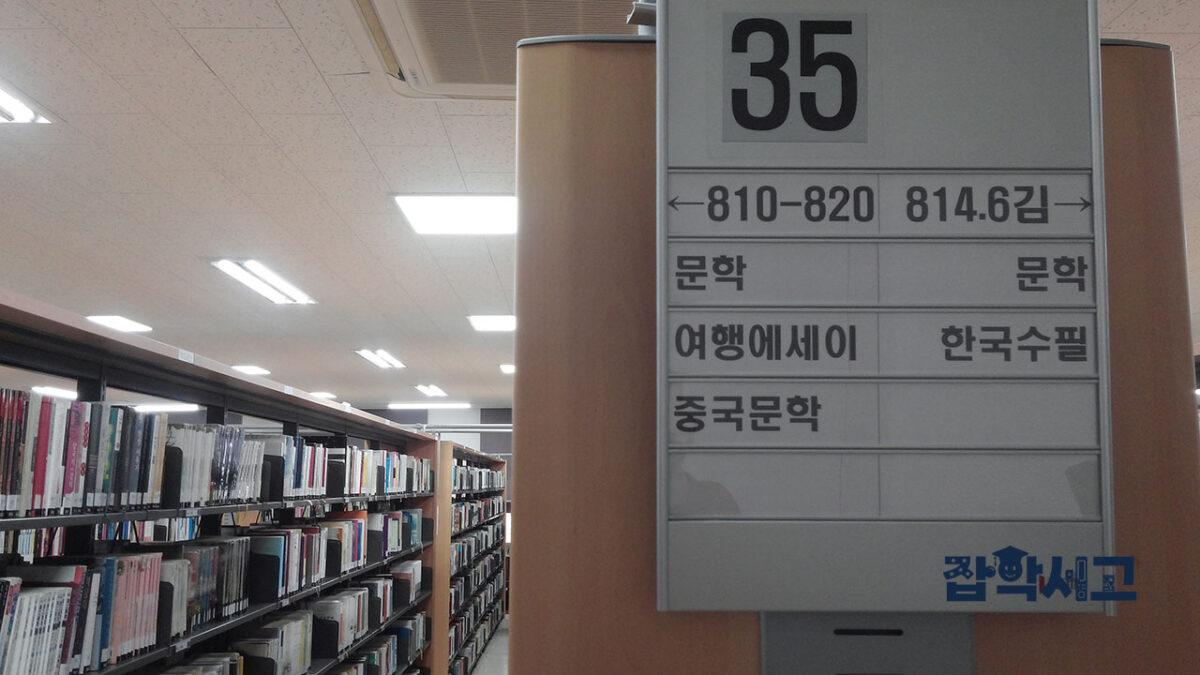 Library shelves
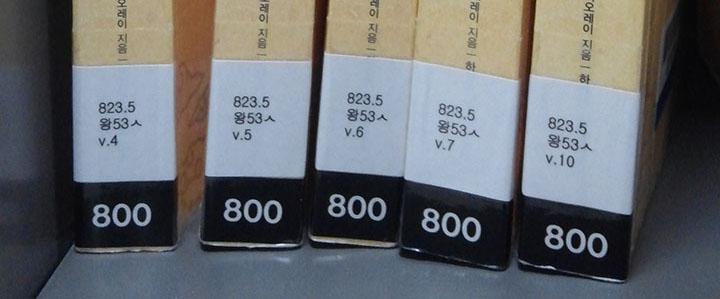 A classification number attached separately at the very bottom of a book's spine
The classification numberdivides books by subject from 000 to 999 based on the Korean Decimal Classification. In fact, the classification number is the most important element when finding a book by its call number, which is why the number range is attached in slightly larger print at the very bottom of the spine.
You can find the details and explanations of the Korean Decimal Classification table, which is based on the Korean Decimal Classification system, in the material linked below.
 Go to the Korean Decimal Classification table article
2. Book Mark
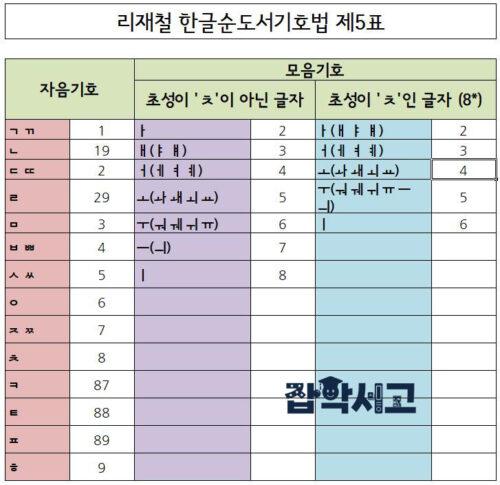 Table 5 of Lee Jae-cheol's Korean Alphabetical Book Mark System
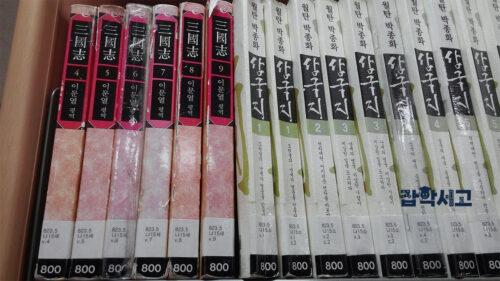 Example of a library call number for Romance of the Three Kingdoms
In truth, the hardest part of a call number to understand and decipher is the book mark. With the classification number you can at least roughly tell that books are sorted by fixed numbers according to subject, but a mark beneath it such as <Kim12o> is just a string of characters unless you know the principle behind it.
The structure behind this is set out in what is called the Korean Alphabetical Book Mark System. As an example, let us analyze the book mark of a book called Romance of the Three Kingdoms (Samgukji).
Na15se / Na15so
A book mark is applied in the order of author mark + work mark. The 'author mark' refers to the person who wrote the book, and the 'work mark' refers to the book's title. But since all of this cannot fit on a narrow spine, only part of it is taken, based on the first letters.
In the case of Romance of the Three Kingdoms above, the original author is Na Gwan-jung (Luo Guanzhong). So the author's surname 'Na' is written first, and the next syllable 'Gwan' becomes '15' under the author mark system, using the initial consonant g = 1 and the vowel wa = 5. It will make sense if you refer to the table above. In other words, the first syllable, the surname, is written as it is, and the consonant and vowel codes of the second syllable are used. The second syllable is turned into the code because too many people share the same surname if only the first syllable were used.
The final work mark is normally the first syllable of the book's title or its initial consonant. For Romance of the Three Kingdoms (Samgukji), it could be 's' or 'Sam', though there may be some differences depending on each library's policy. Even in the case of Romance of the Three Kingdoms used as the example, this is because so many related books have been written.
3. Additional Marks
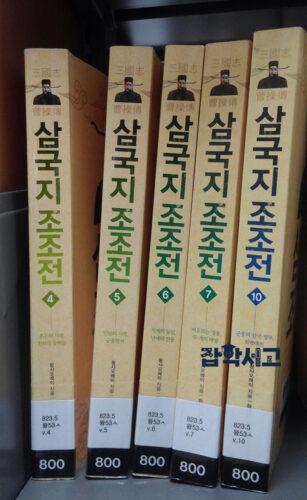 Call number for Romance of the Three Kingdoms: The Story of Cao Cao
Additional marksare, as the name says, marks used in a supporting role. They are the last marks, written on the line after the book mark, and the most commonly used are the volume number and the copy mark.
The volume number shows which volume a book is when it consists of several volumes, and the letter 'v' is used for it. If Romance of the Three Kingdoms consists of 10 volumes, the marks run from v.1 to v.10, and to find volume 8 you look for v.8.
A copy mark is used when the same library holds duplicates of the same book: 'c' is added to the copies purchased later, increasing the number as c.2, c.3, and so on. In other words, it indicates a duplicate book in that library.
That covers the call numbers used in libraries. The call number is an essential concept in libraries, and staff and users find and arrange books in the reading room through call numbers, classification numbers, and so on. What this material introduces is only the basics of call numbers, but I believe it will clear up your questions when using a library.