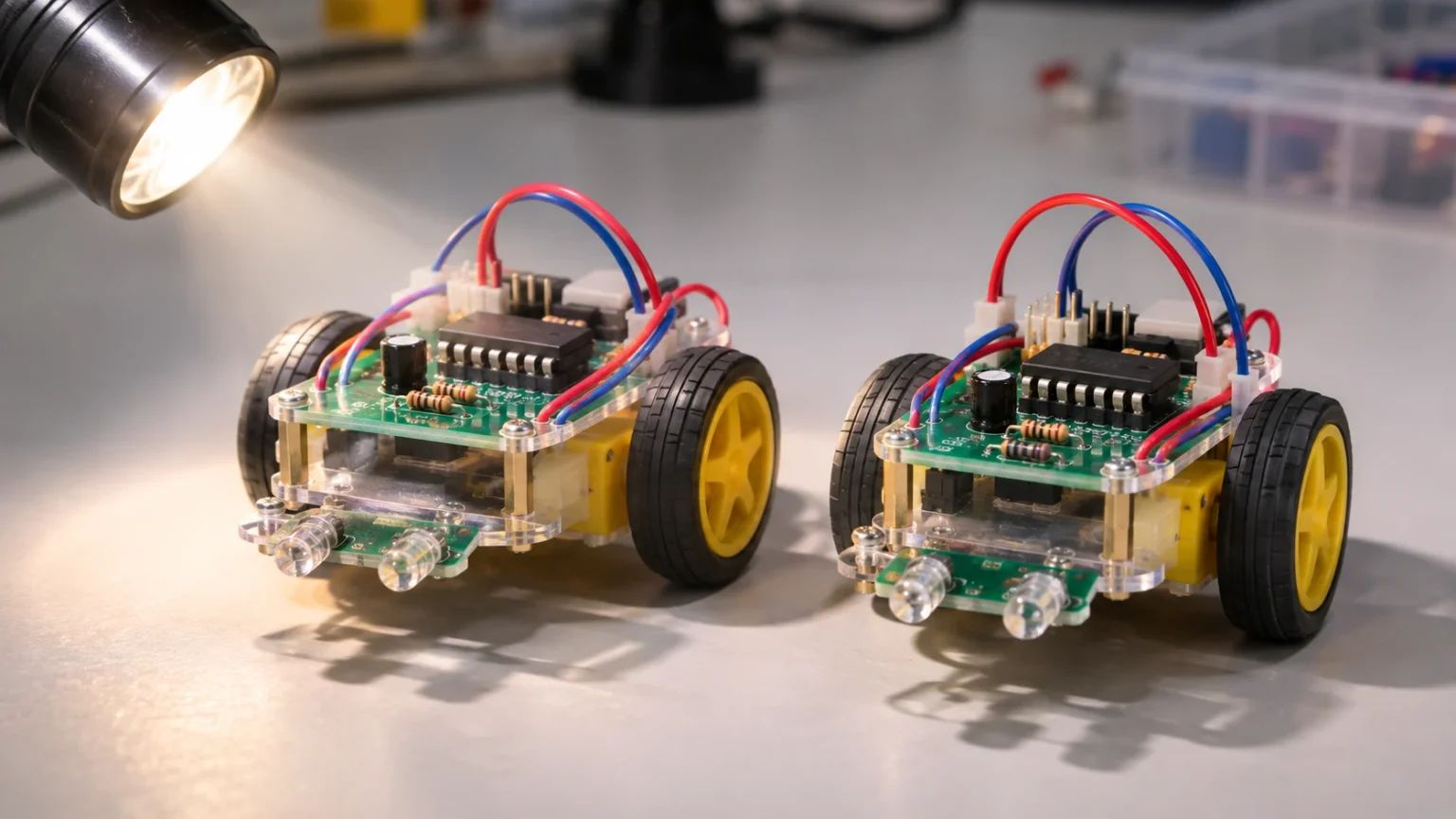
Shine a flashlight across a desk, and one toy robot scurries away from the light while another charges straight at it. Would you believe that the two robots have identical parts and differ only in which way two wires are plugged in? Simple machines like these, imagined by a neuroscientist as thought experiments, are called ‘Braitenberg vehicles.’
Braitenberg vehicles are, simply put, ‘imaginary little robots whose sensors are wired directly to their wheels, so that the wiring alone produces behaviors that look like fear, aggression or love.’ They were introduced by the Italian-born neuroscientist and cyberneticist Valentino Braitenberg in his 1984 book Vehicles: Experiments in Synthetic Psychology, published by MIT Press.
In this article, we will look in turn at how Braitenberg vehicles came about, the four classic vehicles and key terms shown in a diagram, how they are used in robotics and education, and the ideas and limits this experiment left behind.
Personality made from two wires: Braitenberg vehicles
1. How Braitenberg vehicles came about
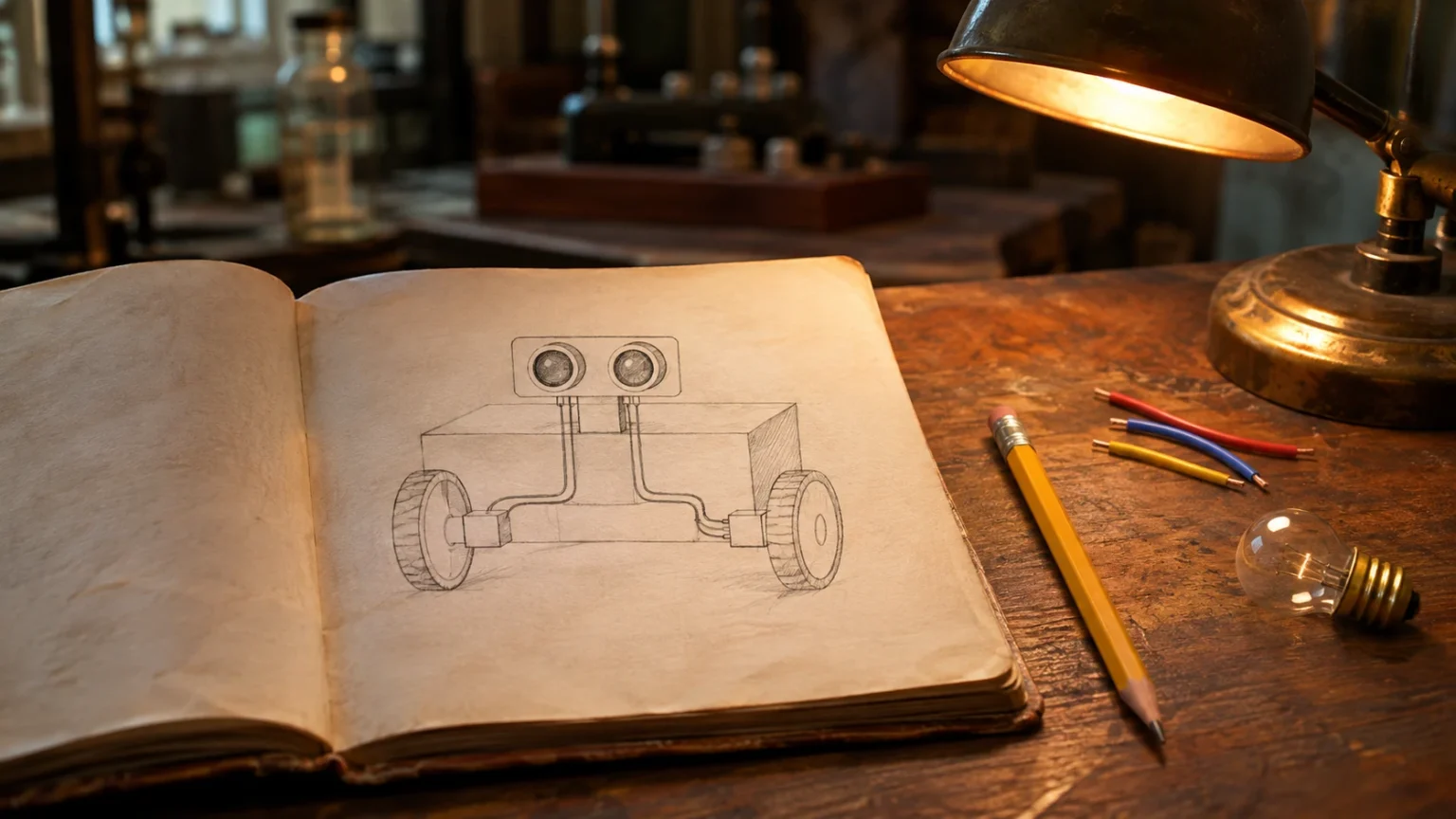
Braitenberg was born in Bolzano, Italy, in 1926, co-founded the Max Planck Institute for Biological Cybernetics in Tübingen, Germany, in 1968, and served as one of its directors until he retired in 1994. Having spent his life studying the wiring of the brain, he suggested that instead of dissecting the complex brain head-on, we could build very simple machines one at a time and think about how behavior arises.
(1) Experiments built in the mind
The vehicles in the book are not machines built in a factory but thought experiments. Readers connect sensors and motors on paper, imagine how each machine would move, and follow along step by step.
(2) Vehicle 1, the simplest
The first vehicle has one sensor driving one wheel. The stronger the temperature or light it senses, the faster it goes, so it rushes through warm places and slows down in cold ones, as if it liked the cold. If friction on the floor is uneven, its path wobbles this way and that, and observers even sense a restless, lifelike quality.
(3) Fourteen ever more complex types
The book builds such vehicles up to 14 types in all. The early ones show simple reactions such as following or avoiding light, while later ones imagine structures that mimic more complex mental functions such as memory, concepts and thinking.
2. The four vehicles and key terms in a diagram
Vehicles 2 and 3 share the same body: two sensors at the front and two wheels at the back. They differ in only two ways: whether the wires connect each sensor to the wheel on the same side or cross over to the opposite wheel, and whether stronger light makes the wheel turn faster or slower.
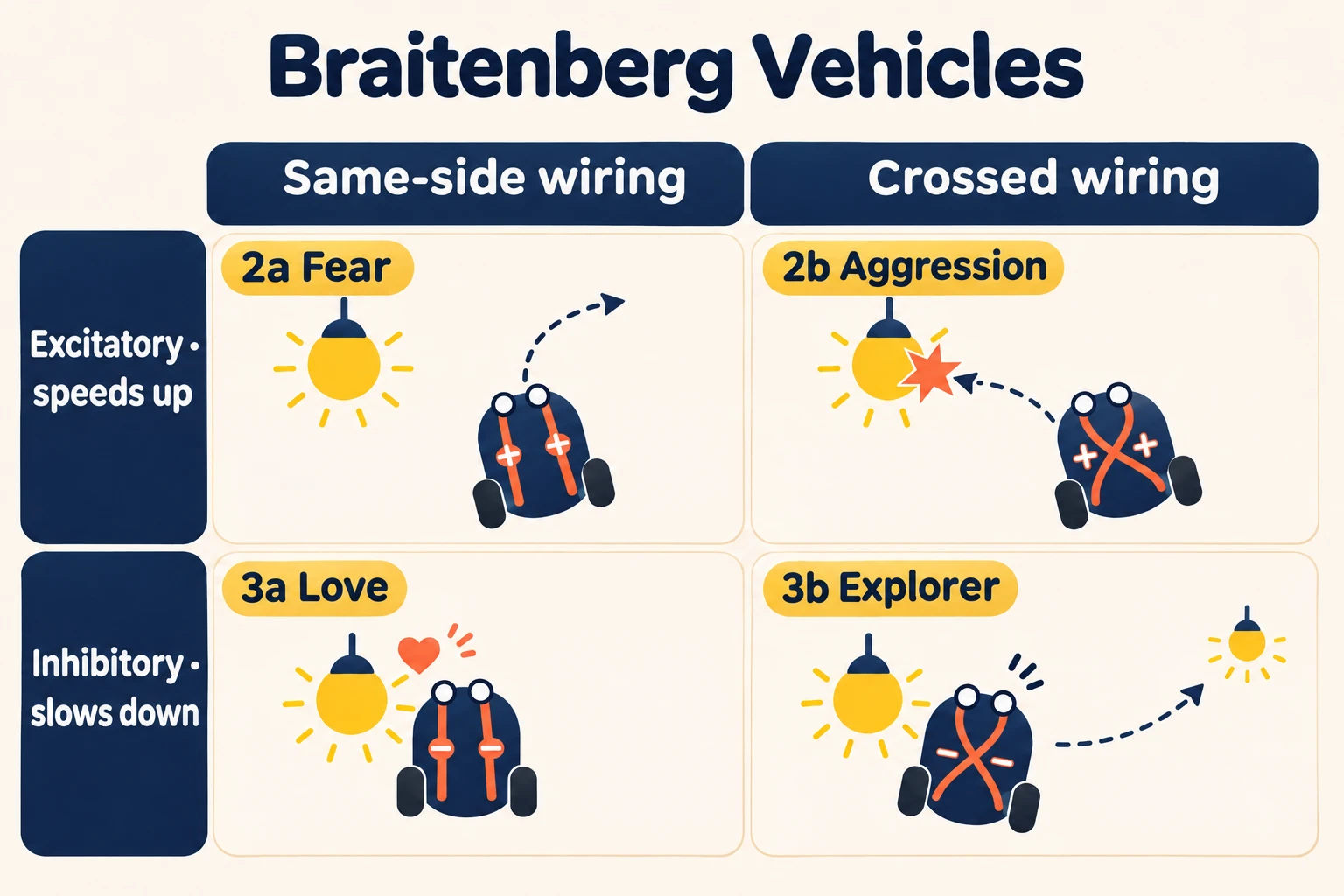
- Ipsilateral connection: wiring in which the left sensor drives the left wheel and the right sensor drives the right wheel.
- Contralateral connection: wiring in which the wires cross so that the left sensor drives the right wheel and the right sensor drives the left wheel.
- Excitatory connection: a connection in which a stronger stimulus makes the wheel turn faster.
- Inhibitory connection: a connection in which a stronger stimulus makes the wheel turn slower.
(1) Vehicle 2a, the coward
In a vehicle wired same-side and excitatory, the wheel nearer the light spins faster, so the body turns away from the light. Because it runs from the light, it was given the name ‘Fear.’
(2) Vehicle 2b, the attacker
If the wires are crossed, the wheel farther from the light speeds up, so the body turns toward the light and goes faster as it gets closer, finally crashing into the source. That is why it is called ‘Aggression.’
(3) 3a and 3b, the lover and the explorer
If the same wiring is made inhibitory, the vehicle slows down as it approaches the source. Vehicle 3a, with same-side wiring, stops beside the light facing it and is called ‘Love,’ while 3b, with crossed wiring, stops with its back to the light and then leaves in search of stronger stimuli, earning the name ‘Explorer.’
3. Uses in robotics and education

Braitenberg vehicles began as thought experiments, but their parts are so simple that they were easy to turn into real robots. Because all you need are two light sensors and two motors, they have long served as a first hands-on exercise in labs and classrooms.
(1) A starting point for reactive robots
Reacting directly to sensor values without drawing maps or making plans resembles the thinking behind behavior-based robotics, such as the subsumption architecture, which stacks simple behaviors in layers.
(2) Analog circuit robots
Analog robots that follow light using only transistors and sensors, without a microcontroller, such as BEAM robots, often use this kind of wiring. Even without a program, the circuit itself creates the behavior.
(3) Coding education and simulators
With educational robot kits and computer simulators, students change one line of wiring and see for themselves how the behavior changes. A single line of code that feeds the left sensor value into the right motor is, in effect, a crossed connection.
4. The ideas and limits Braitenberg vehicles left behind

People watching the vehicles often say they got scared, got angry or fell in love. Yet inside there are no emotions or goals, only a few wires. From exactly this gap, Braitenberg drew an important lesson about understanding behavior.
(1) Uphill analysis, downhill invention
The book presents the idea of the ‘law of uphill analysis and downhill invention.’ Working out the inner structure from outward behavior alone is hard, like climbing uphill, but building a simple structure yourself can produce surprising behavior easily, like rolling downhill.
(2) The mind supplied by the observer
Names like fear and love were given not by the vehicles but by the people watching them. This shows how readily people read intentions and emotions into even simple movements.
(3) The limits of simplicity
Wiring sensors directly to wheels cannot plan a route in real environments full of obstacles or with changing goals. That is why today’s robots add functions such as mapping and path planning on top of such a reactive layer and use them together.
In the end, what Braitenberg vehicles show is that behavior that looks complex does not necessarily come from a complex mind. The simple idea that the direction of a single wire can change a personality is the first step toward understanding Braitenberg vehicles.