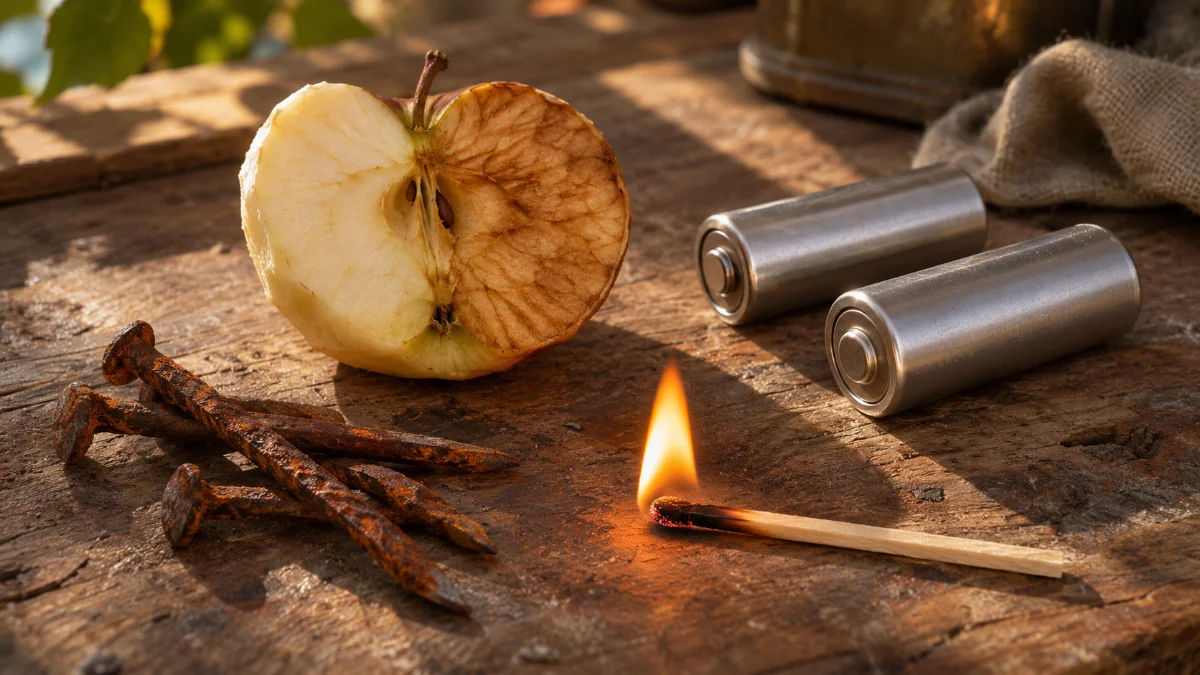
A rusty nail, an apple turning brown, a burning match, and the battery that powers your phone. These four look nothing alike, yet all of them are the result of the same chemical reaction.
A redox reaction, simply put, is ‘a reaction in which one substance loses electrons while another gains them.’ The word redox is short for reduction–oxidation; the term once referred only to reactions with oxygen, but today it is defined more broadly by the movement of electrons.
In this article, we will look in turn at the three criteria that separate oxidation from reduction, why the two reactions always come in pairs, examples from everyday life, and some common misconceptions.
A Pair of Reactions That Trade Electrons
1. Three Criteria for Oxidation and Reduction
The definitions of oxidation and reduction have widened step by step as chemistry developed. The explanation changes depending on which lens you use, but the three criteria never contradict one another.
(1) Gaining oxygen is oxidation, losing it is reduction
In the late 18th century, the French chemist Antoine Lavoisier showed that substances combine with oxygen in the air when they burn. So at first, combining with oxygen was called oxidation. Conversely, when black copper oxide (CuO) is heated in hydrogen, it loses oxygen and turns back into red copper; losing oxygen in this way is called reduction. The word reduction itself comes from the idea of ‘bringing back’ a metal from its ore.
(2) Losing hydrogen is oxidation, gaining it is reduction
Many reactions do not involve oxygen directly, so hydrogen is sometimes used as the yardstick. When hydrogen sulfide (H₂S) reacts with oxygen to form sulfur (S) and water, hydrogen sulfide loses hydrogen and is oxidized, while oxygen gains hydrogen and is reduced.
(3) Losing electrons is oxidation, gaining them is reduction
The broadest criterion is electrons. When sodium (Na) meets chlorine (Cl₂) to form sodium chloride, sodium gives up one electron to become Na⁺, and chlorine takes that electron to become Cl⁻. No oxygen or hydrogen is involved, yet sodium is oxidized and chlorine is reduced. English-speaking students remember this with the phrase ‘OIL RIG’ (Oxidation Is Loss, Reduction Is Gain).
2. Oxidation and Reduction Always Happen Together
Electrons given up by one substance do not vanish; another substance always takes them. That is why neither oxidation nor reduction ever happens alone, and the two are grouped together as a redox reaction.
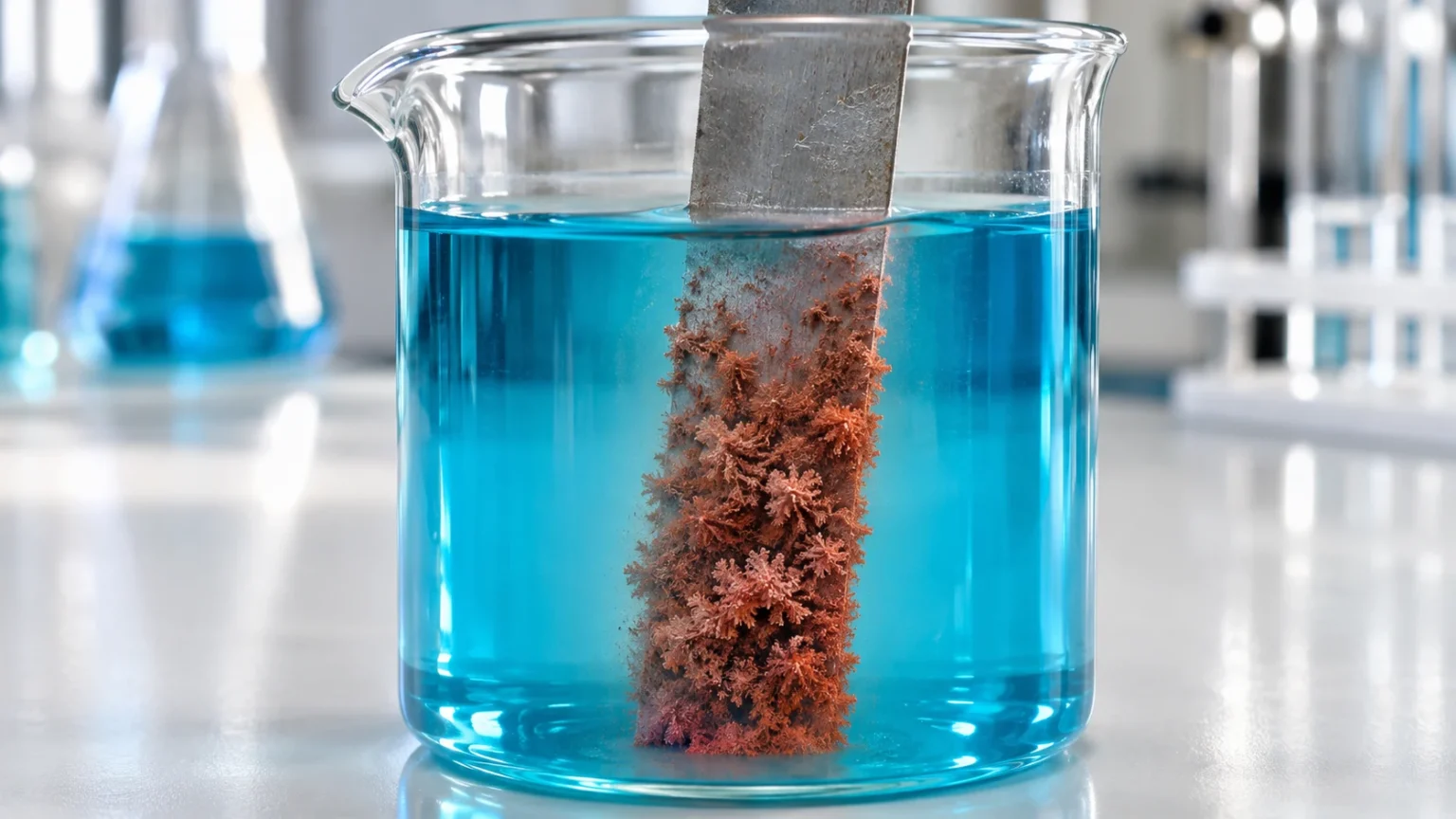
Placing a zinc strip in a blue copper sulfate solution shows this clearly. Zinc (Zn) gives up two electrons, becomes zinc ions (Zn²⁺), and dissolves, while copper ions (Cu²⁺) in the solution take those electrons, turn into red copper, and cling to the zinc strip. As the copper ions decrease, the blue color of the solution gradually fades.
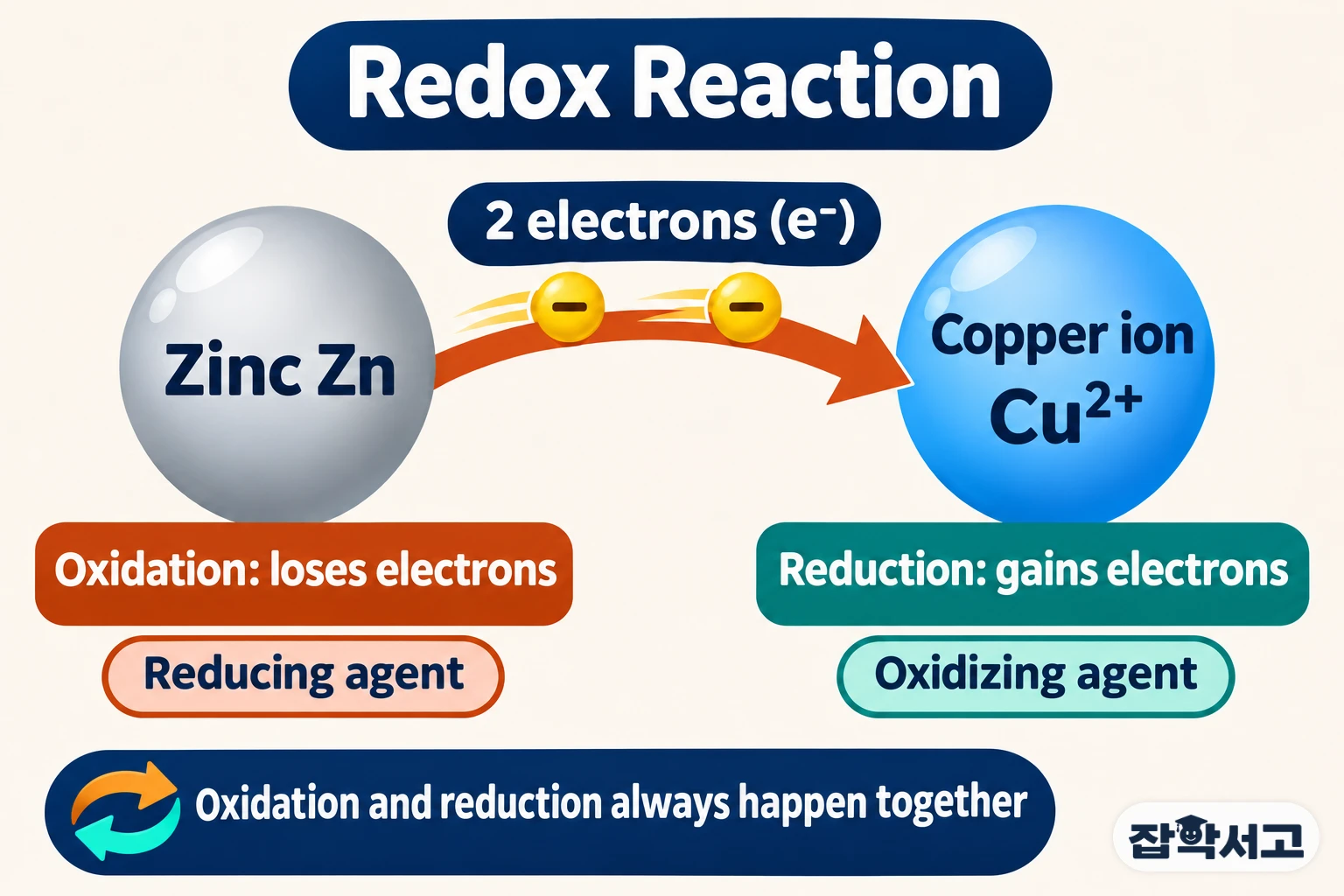
- Oxidation: A change in which a substance loses electrons; reactions that gain oxygen or lose hydrogen also belong here.
- Reduction: A change in which a substance gains electrons; reactions that lose oxygen or gain hydrogen also belong here.
- Oxidizing Agent: A substance that oxidizes another while being reduced itself; oxygen, chlorine, and bleach are typical examples.
- Reducing Agent: A substance that reduces another while being oxidized itself; in the zinc strip experiment, zinc is the reducing agent.
- Oxidation Number: A number showing how many electrons an atom has, in effect, lost or gained; if it rises after a reaction, that is oxidation, and if it falls, that is reduction.
Tracking oxidation numbers reveals who gave up electrons and who received them, even in complicated reactions. The oxidation number of an element in its pure form is 0, oxygen in compounds is usually -2, and hydrogen is usually +1. In the zinc strip experiment, zinc goes from 0 to +2 and the copper ions go from +2 to 0, so the numbers themselves confirm what was oxidized and what was reduced.
3. Redox Reactions in Everyday Life
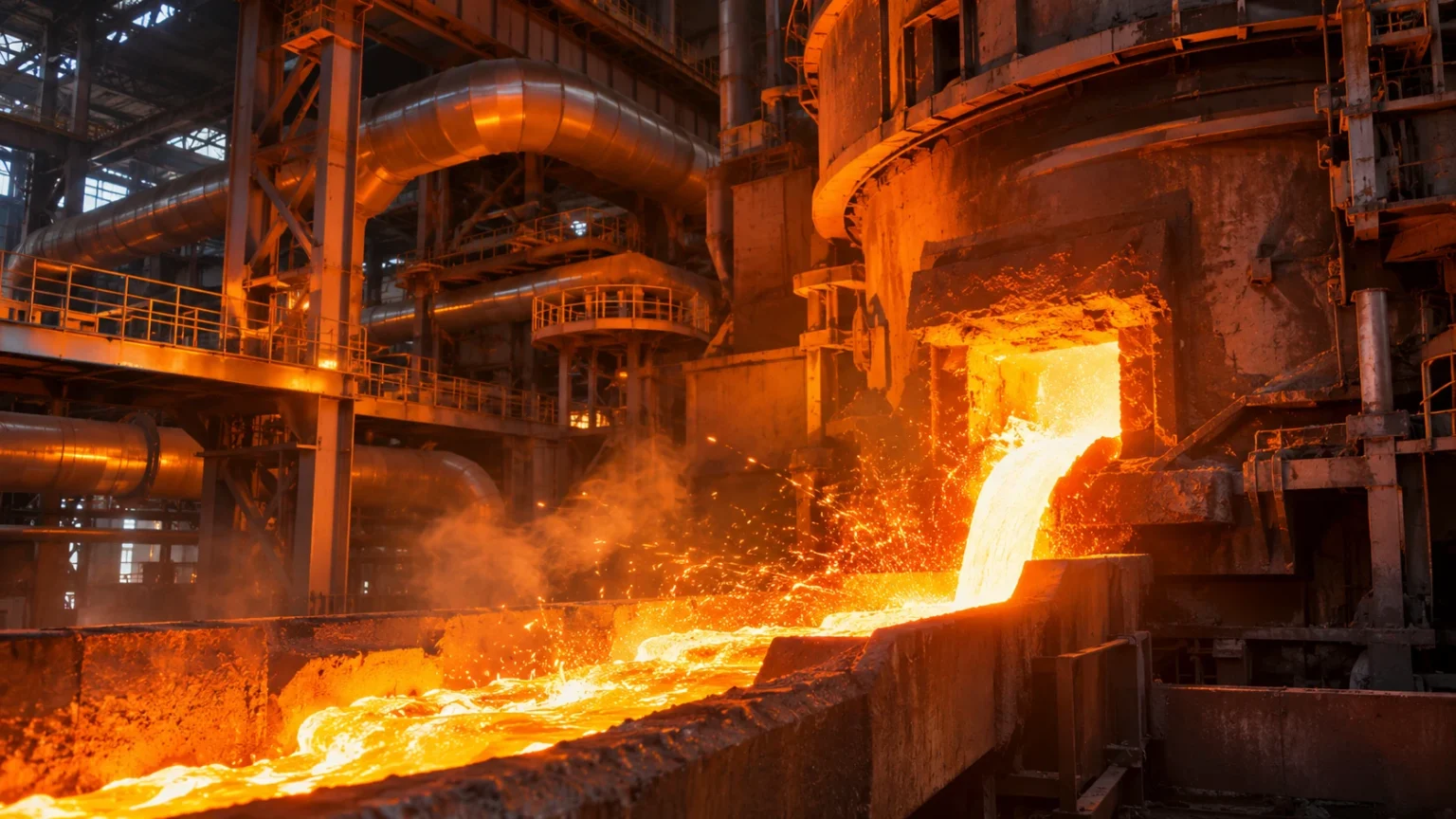
Redox reactions happen more often in daily life than in the laboratory. Every time we breathe, light a fire, make steel, or make a phone call, electrons are on the move.
(1) Iron rusting
When iron meets water and oxygen, it loses electrons and is oxidized into red rust, a hydrated iron oxide (Fe₂O₃·nH₂O). Rust forms faster near the sea because salt water conducts electricity well and helps electrons move. This gradual damage of a metal reacting with its surroundings is called corrosion.
(2) Steelmaking: getting iron from ore
In a blast furnace, reduction takes center stage instead. When iron oxide (Fe₂O₃) in iron ore meets carbon monoxide (CO) from coke, it is stripped of oxygen and becomes iron, while carbon monoxide gains oxygen and becomes carbon dioxide. As an equation, this is Fe₂O₃ + 3CO → 2Fe + 3CO₂.
(3) Combustion, respiration, and photosynthesis
When wood or gas burns, the fuel combines with oxygen and is oxidized, giving off light and heat. Cellular respiration in our bodies is also a slow combustion that oxidizes glucose to obtain energy. Photosynthesis in plants works the other way around: it reduces carbon dioxide to make glucose and oxidizes water to release oxygen.
(4) Dry cells and batteries
Dry cells and phone batteries are devices that split oxidation and reduction between two electrodes. Electrons released by the substance oxidized at one electrode travel through a wire to the other electrode and reduce the substance there; this flow of electrons is the electric current. In an alkaline battery, zinc is oxidized and manganese dioxide is reduced.
4. Three Common Misconceptions

Because redox reactions are so familiar, many misunderstandings surround them. These are also points students often get wrong on exams.
(1) There must be oxygen for oxidation
Oxygen is just the best-known player in oxidation, not a requirement. As with sodium and chlorine or zinc and copper ions above, losing electrons is oxidation even with no oxygen at all.
(2) An oxidizing agent is the substance that gets oxidized
Because of the name, this is the most common mix-up. An oxidizing agent oxidizes something else, so it accepts electrons and is itself reduced. Conversely, a reducing agent is oxidized as it reduces something else.
(3) Oxidation is always bad
Rust and spoiled food give oxidation a bad reputation, but our bodies get their energy thanks to oxidation. ‘Antioxidant’ does not mean eliminating oxidation; it means slowing down unwanted oxidation. Lemon juice keeps a cut apple from browning as quickly because the vitamin C (ascorbic acid) in it acts as a reducing agent and slows the discoloration.
A rusty nail and a battery are ultimately telling the same story. Whenever one side gives up electrons, another side must receive them, and that single sentence sums up the redox reaction.
Recommended Reading