In a restaurant kitchen, a cook uses the same hand to hold a knife, lift a ladle, and carry a plate. A robot arm, however, does its work with a single tool at the end of its wrist, so what it can do depends entirely on which tool is attached. No matter how precisely the arm moves, it is useless on a factory floor if it cannot grip anything at the end.
Put simply, an end effector is a device attached to the end of a robot arm that carries out the actual work, such as gripping or processing an object. In human terms, it is the hand and the tool in the hand combined, and in the field it is also called end-of-arm tooling (EOAT), meaning the tool that sits at the tip of the arm. Swap only this part, and the same robot arm can weld one day and pack boxes the next.
This article walks through what an end effector is and where it attaches, the types of grippers and process tools, how tools are swapped and the standard that governs the flange, and finally the criteria for choosing a suitable tool.
The Device That Works at the End of the Robot Arm
Where Does the End Effector Attach?
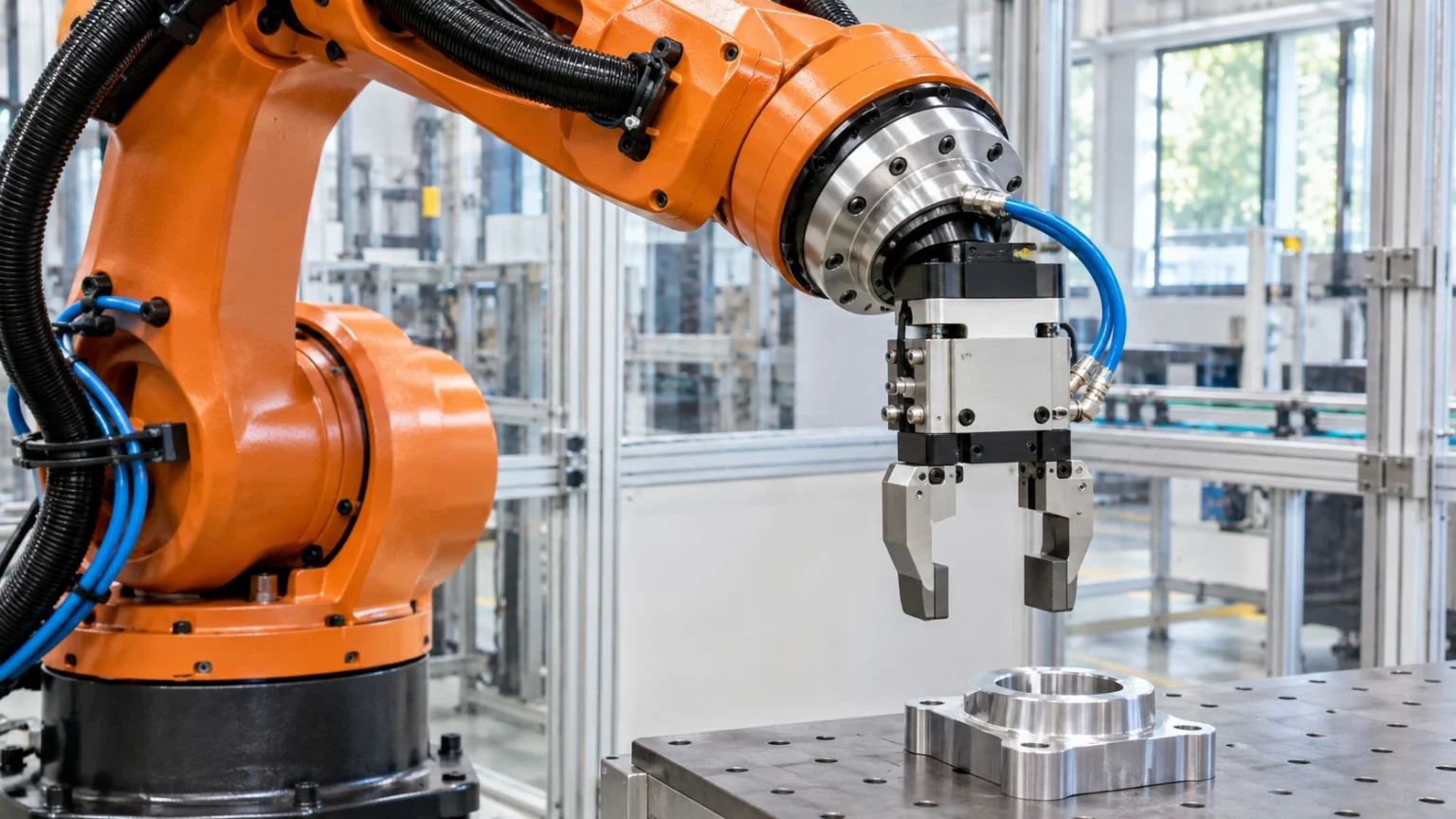
An industrial robot arm is a structure of several joints and links, and behind the last joint there is a round mounting surface. This surface is called the wrist flange, and the end effector is bolted onto it. Once the arm has set the position and posture, the device at the end actually reaches the object and finishes the job.
(1) The role of the arm
It moves the joints to bring the end point to the desired position and orientation. The arm is the part responsible for where to go.
(2) The role of the end effector
At the spot where the arm arrives, it grips, presses, attaches, or sprays. It is the part responsible for what to do.
End effectors fall broadly into grippers that hold objects, process tools that work on objects, and sensors that gather information about the surroundings. Even with the same arm, a different device at the end makes it work like a different machine.

The “effector” in the name means “something that produces an effect.” It is called that because it is the final point where the motion created by the arm causes a real change in an object, and it is also the point where the robot meets the world directly.
Grippers, Divided by How They Hold
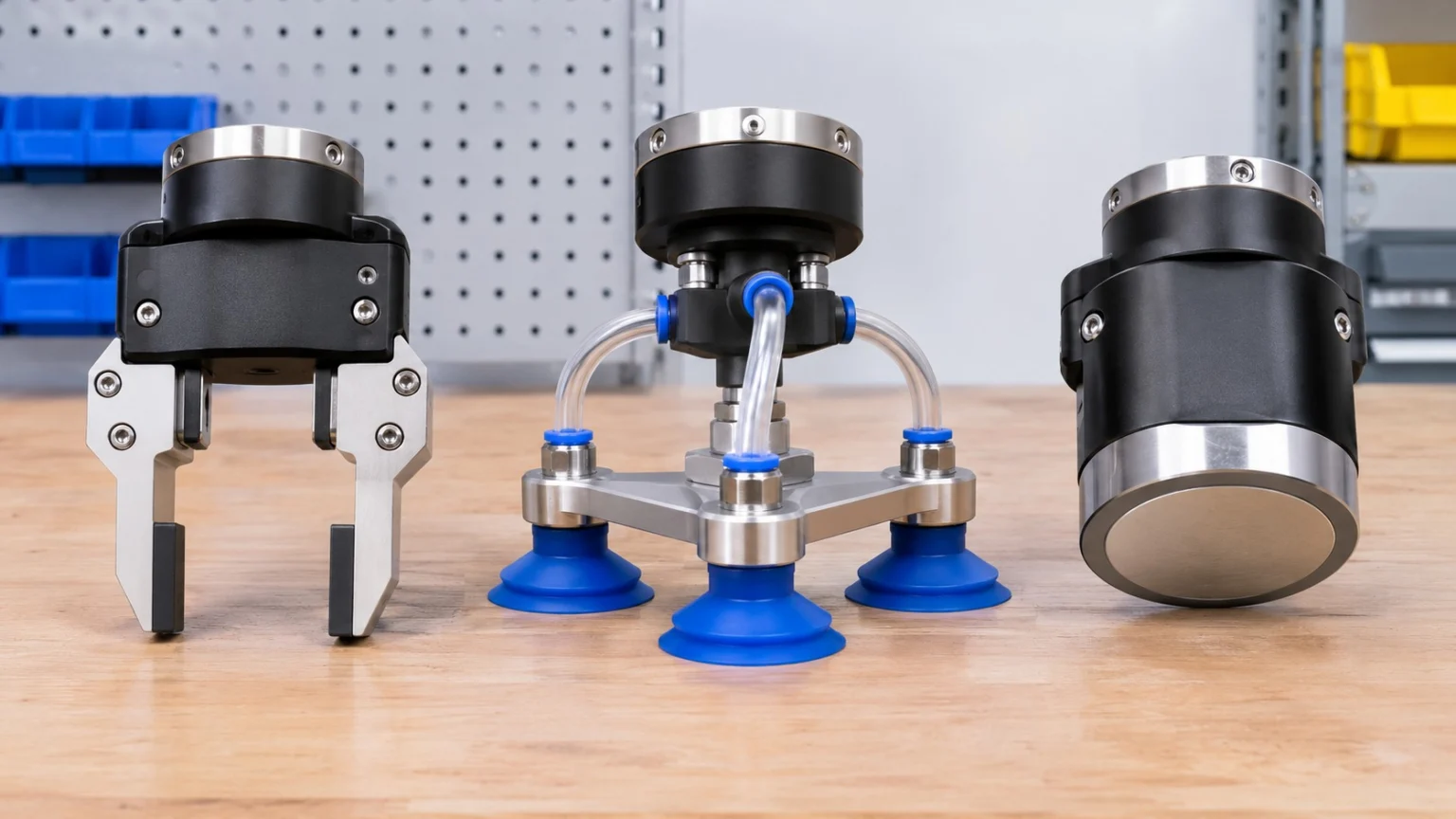
A gripper is an end effector that picks up and releases objects, and it is divided into three main types by the way it holds them.
- Mechanical gripper: It presses directly on an object with two or more fingers or tongs. A form in which two fingers open and close in parallel is common, and it is widely used to move parts of a consistent size and shape.
- Vacuum gripper: It removes the air inside a suction cup and pulls the object onto its surface. It suits objects with flat, airtight surfaces, such as boxes, glass panels, and steel plates.
- Magnetic gripper: It attaches iron-based objects using the force of a magnet. It is used to move steel sheet, and it cannot be used with objects that are not made of iron.
For example, when moving a tray of eggs, squeezing hard with fingers risks breaking them, and the uneven surface can let air leak from a suction cup. That is why a design tailored to the object is needed, such as fingers that wrap around it with a soft material or several small suction cups. When choosing a gripper, you also check how strongly it grips, how far the fingers open, and how long a single movement takes.
Process Tools and Sensors That Work Without Gripping

Not every end effector holds objects. Attach a device that acts directly on an object, such as for processing or inspection, and the robot arm instantly becomes a specialized machine.
(1) Process tools
Typical examples are a welding torch, a sprayer that spreads paint, a driver that tightens screws, and an abrasive tool that smooths a surface. For these devices, what matters is not moving objects but traveling along a surface at a steady speed and spacing.
(2) Sensors
A camera is attached to check a product for flaws, or a force sensor is attached to check how strongly it makes contact. Like the sense in your fingertips, the arm gains eyes and a sense of touch.
A dedicated tool that does only one job is fast and simple but cannot be used for anything else. By contrast, a general-purpose hand with many fingers can handle a wide variety of objects, but it is harder to control and tends to be expensive. Finding the balance between the two is the heart of end effector design.
Recently, fingers made of soft material that wrap around objects have also come into use. They can gently hold objects of all different shapes without much attention to force control, which has drawn interest in settings that handle fruit and food.
How Tools Are Swapped and How to Choose
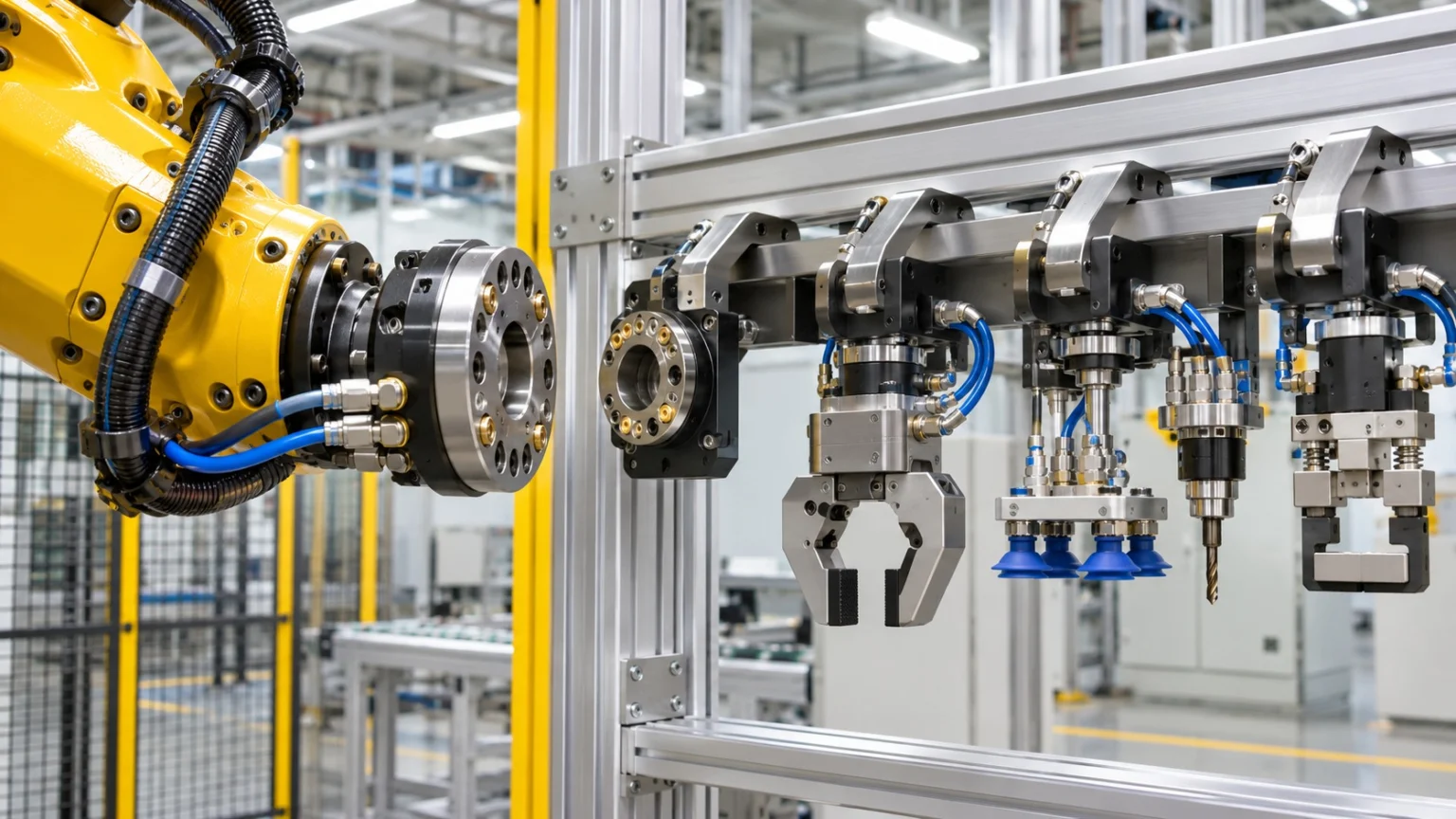
For one robot to handle several processes, it must be able to swap its tools. For this, a tool changer placed between the robot wrist and the tool lets a person, or the robot itself, exchange tools. The changer joins not only the mechanical connection but also compressed air and electrical signals. As a result, the same robot can change its job, picking and moving things in the morning and tightening screws in the afternoon.
There is also a standard to match when mounting a tool on a robot. The international standard ISO 9409-1 specifies the diameter of the wrist mounting surface, the layout and number of bolt holes, and the position of the pin holes used for alignment. Thanks to this, tools from different manufacturers can be mounted the same way as long as their mounting surfaces follow the same standard, and the pin holes keep the same orientation when the tool is reattached. However, this standard covers only the dimensions of the mounting surface and does not set the weight that can be lifted.
(1) Look at the object
First check its size and shape, its weight, whether the surface is smooth or rough, and whether it is fragile.
(2) Look at the task
Consider how fast it moves, how accurately it must place things, and how many times a day the same job repeats.
(3) Look at the environment
Whether there is oil, dust, or heat, and whether it works close to people, changes which approach is safe and durable.
The precision of the arm only has meaning when the device at the end works properly. Weighing the object, the task, and the environment first, and then choosing the right hand, is the first step in selecting an end effector.