
This time, we will look at the concepts of deduction and induction, which are used in a wide range of research fields. When you first encounter the words deduction and induction, they can feel quite unfamiliar and confusing, since they are not terms we often use in everyday life.
Generally, if you search for deduction and induction and read about the theory, it is explained in rather difficult language and is hard to understand. However, because these are important concepts you will often encounter in research and survey work, I will try to explain them in the simplest terms possible so they are easy to understand.
Deduction
 Understanding deduction easily
First, deduction is a method of applying a generally known theory to a particular phenomenon and drawing a conclusion about it. Looking at the dictionary definition of deduction, it refers to “drawing a conclusion from a proposition according to rules of inference.”
The logical progression of deduction proceeds in the order of <hypothesis setting → operationalization → observation and experience → verification>. A simple example of this progression is as follows.
All people die (major premise) → Cao Cao is a person (minor premise) → Therefore, Cao Cao dies (conclusion)
Because deduction conducts research on the basis of existing theory, it has the advantages of being low-cost and efficient, but because it relies on existing research, it has the characteristic of making it difficult to propose a theory for the first time.
Induction
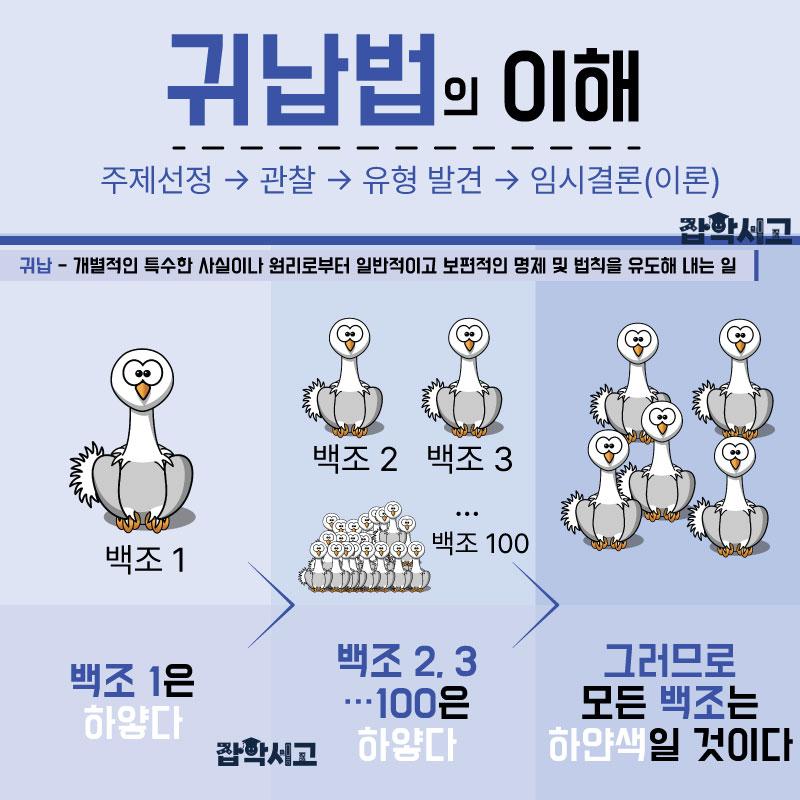 Understanding induction easily
Induction is a method of collecting data through observation and experience and drawing a conclusion from the tendencies and relationships that emerge from the collected data. The dictionary definition of induction is “deriving general and universal propositions and laws from individual, specific facts or principles.”
The logical progression of induction proceeds in the order of <topic selection → observation → pattern discovery → tentative conclusion (theory)>, and an example is as follows.
The color of swans (topic selection) → Swan 1 is white → Swan 2 is white … Swan 7 is white … Swan 100 is white (observation) → Therefore, all swans must be white. (discovery and conclusion)
A characteristic of induction is that once a certain amount of data has been collected, you can grasp general patterns and conduct research efficiently, but without a theoretical background it shows limitations in selecting appropriate variables.
The Relationship Between Deduction and Induction
 A complementary relationship
Although deduction and induction differ in their research methods and characteristics, they also have a complementary relationship. A theory produced by deduction can serve as a guide for observation in induction, and what is observed and experienced through induction can supplement the theories of deduction.
In deduction, if the premises given at the outset are true, the conclusion is necessarily true as well. In induction, however, the conclusion may be true with high probability, but there is no guarantee that it is necessarily true. Since deduction and induction are both important methods for reasoning and reaching conclusions, you should be able to choose between them appropriately depending on the situation.
With that, we have taken a brief look at deduction and induction, concepts frequently used in scientific research methods in the social sciences, natural sciences, and other fields. Deduction takes a top-down approach based on known principles, while induction works from the bottom up on the basis of observation and experience.
I hope this article has helped you firmly grasp the concepts of deduction and induction, which are important but not easy to understand and often confusing.