Does it change the taste whether you pour the milk or the tea first? Most people would say it makes no difference, but in 1919 a scientist at a research station in England insisted that it clearly did. This brief disagreement led to the most famous experiment in the history of statistics: the Lady Tasting Tea.
Put simply, the Lady Tasting Tea is ‘a way of checking, with an experiment planned in advance, whether a result is too unlikely to come from chance alone.’ The statistician Ronald Fisher introduced it in his 1935 book “The Design of Experiments,” and today it is regarded as a starting point for hypothesis testing and randomized experiments.
In this article, we will look in turn at the cup of tea that started it all, the design of the eight-cup experiment, the 70 possible combinations and the 1.4% probability, and what this experiment left for research today.
Proving It with Eight Cups of Tea
1. A Cup of Tea at Rothamsted
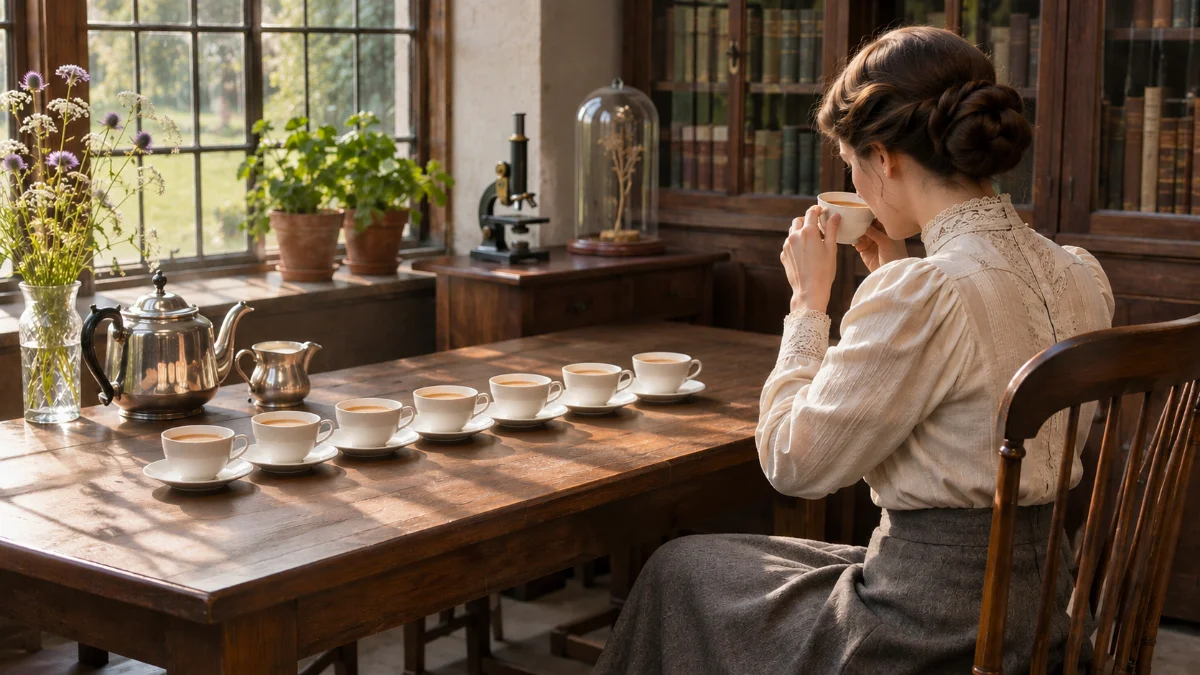
The story takes place at Rothamsted Experimental Station in England. In 1919, Fisher, who worked there, handed a colleague a cup of tea, and that is where it all began.
(1) Milk first, please
The person who received the tea was Muriel Bristol, a scientist who studied algae. Bristol declined the cup, saying she preferred tea with the milk poured in first, and Fisher scoffed that the order of pouring could not possibly change the taste.
(2) Let’s test her
William Roach, a colleague who overheard the conversation, spoke up: “Let’s test her.” Fisher and Roach worked out together how to check whether Bristol could really tell the difference. A few years later, in 1923, Roach married Bristol.
(3) Turning an argument into a question
The heart of this story is that, instead of arguing over who was right, they turned the dispute into a question that could be settled by looking at results. Deciding before the experiment how to tell ‘a lucky guess’ from ‘real discrimination’ is where the story begins.
2. Designing the Eight-Cup Experiment
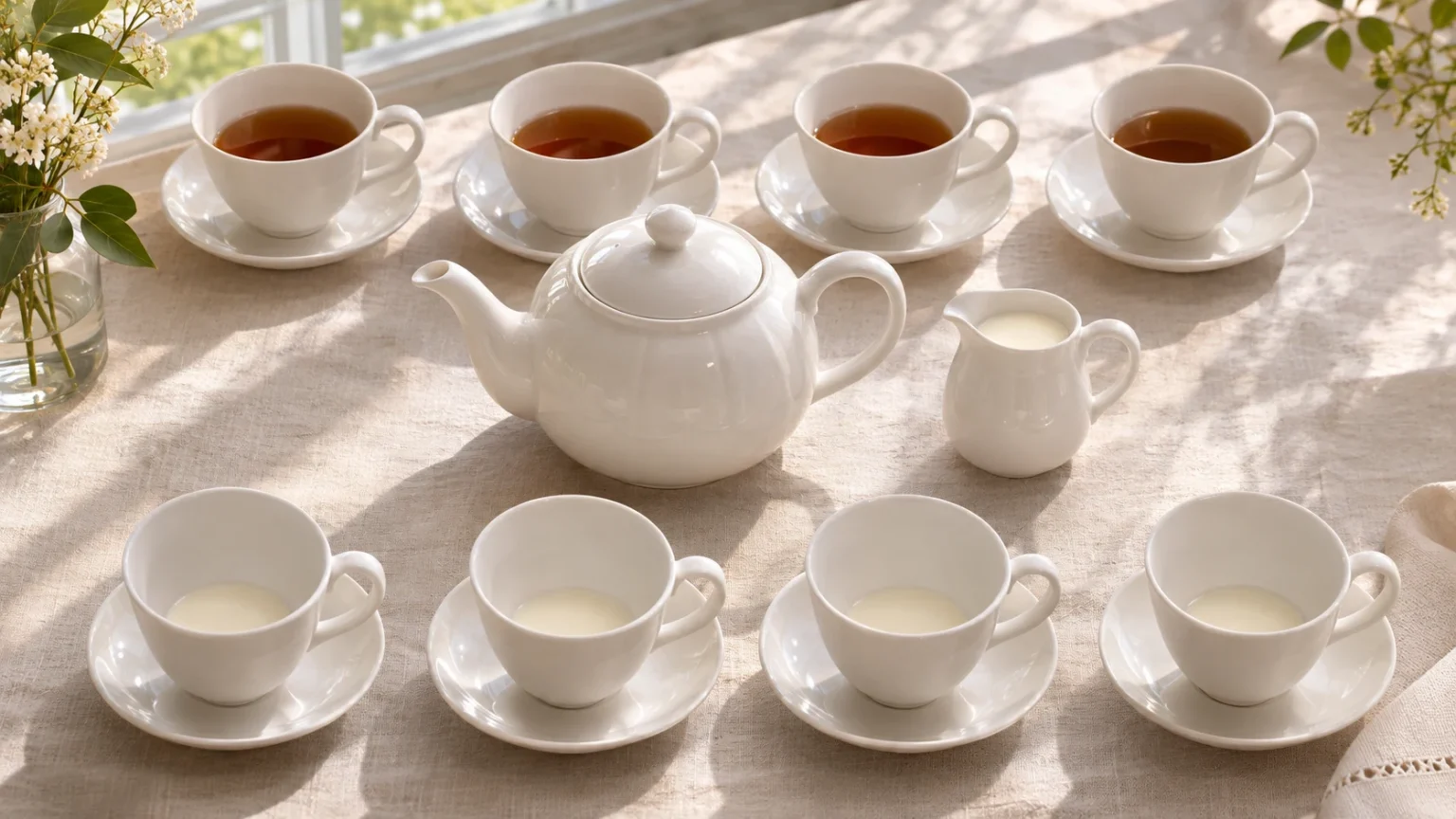
The experiment Fisher described in “The Design of Experiments” is simple. Of eight cups, four have the milk poured first and four have the tea poured first, and they are served in random order. The taster knows this setup in advance and, comparing the cups, picks out the four that had milk poured first.
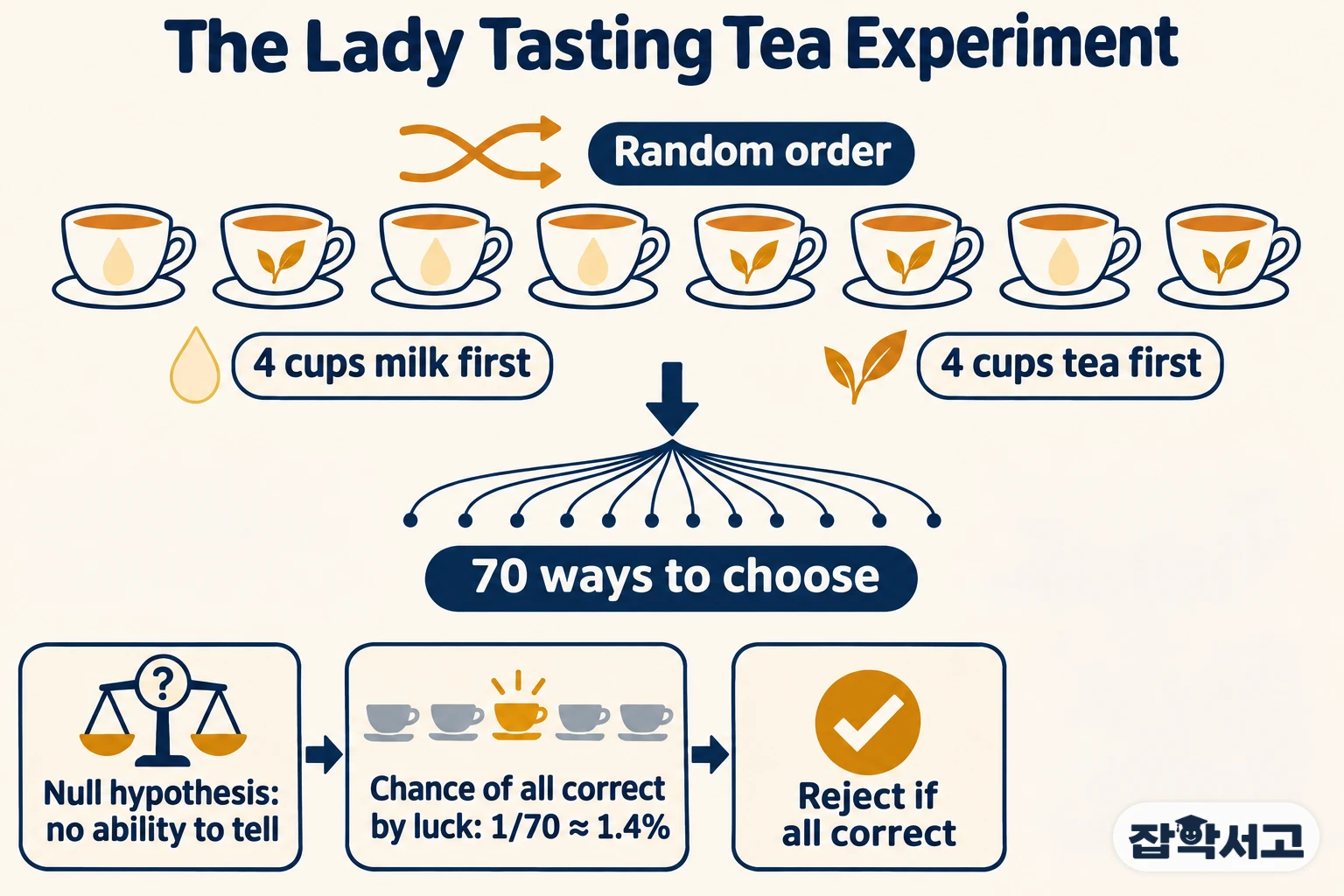
- Null hypothesis: The assumption that the taster has no ability to tell the cups apart; the experiment checks whether there is enough evidence to discard it.
- Randomization: Leaving the order of the cups to chance so that other clues, such as a cup’s position or serving habits, do not mix into the result.
- Significance level: The probability threshold for judging that a result is hard to explain by chance; 5% is commonly used.
- Hypergeometric distribution: The probability distribution followed by the number of correct cups when choosing four out of eight; the method that uses this calculation is Fisher’s exact test.
The key point is that the experiment was designed so that the probability of a correct answer could be calculated before it began. Because the order was randomized, it is possible to count exactly ‘which results would appear, and how often, if there were no ability to tell.’
3. 70 Combinations and 1.4%
Imagine someone with no ability to tell the difference choosing four cups at random. There are 70 ways to choose four cups out of eight, and only one of them is correct.
(1) Getting them all right
The chance of getting all four right by luck is 1/70, about 1.4%. That is smaller than the commonly used 5% threshold, so if this happens, the explanation that ‘she was just lucky’ can be set aside.
(2) What if she got only three?
There are 16 ways to get exactly three of the four right, a probability of about 22.9%, and the chance of getting three or more right is 17/70, about 24.3%. Since that happens by chance about once in every four tries, it is hard to treat as evidence. So Fisher decided to reject the null hypothesis only if all eight cups were sorted correctly.
(3) The actual result
In his 2002 book “The Lady Tasting Tea,” statistician David Salsburg reports, based on what his colleague H. Fairfield Smith told him, that Bristol identified all eight cups correctly. Roach also recalled that she got more than enough right to prove her case.
4. What It Left for Today’s Experiments

The tea experiment was a small episode, but the ideas in it became the backbone of countless experiments today, from clinical trials of new drugs to A/B tests on websites.
(1) Random assignment
Leaving to chance what goes where reduces the room for a researcher’s expectations or unnoticed differences to creep into the result. Fisher stressed the same principle in the agricultural trials at Rothamsted.
(2) Disproof, not proof
Fisher wrote that the null hypothesis is ‘never proved or established, but is possibly disproved’ through experimentation. In other words, failing to identify all eight cups does not establish that there is no ability to tell.
(3) How many cups are enough?
With only eight cups, only a perfect score counts as evidence. Fisher also discussed the benefits of more trials and repeated experiments, and today’s practice of deciding the sample size in advance comes from the same concern. You can read more about setting up hypotheses in our article on null and alternative hypotheses.
The simple idea of ‘counting what results chance alone would produce before arguing about it’ is the first step to understanding the Lady Tasting Tea.