When we pick up a cup from a table, we do not stop to ask how many degrees to turn the shoulder or bend the elbow. Once we decide to send the hand to the cup, the joints settle on the right angles on their own. A robot has to do the same job by calculation, and that calculation—working backward from where the fingertip must go to the joint angles that get it there—is Inverse Kinematics.
Put simply, inverse kinematics is the problem of finding how far each joint must turn or extend so that the hand or tool at the end of a robot arm lands at a desired position and orientation. The robot’s work happens at the fingertip, but the motors sit at the joints, so inverse kinematics—the link between the two—runs through almost every step of moving a robot arm.
In this piece we will look in turn at the difference between forward and inverse kinematics, the awkward property that solutions may be many or none, the methods used to solve the problem, and how it is used in the field.
The Calculation That Turns a Fingertip Goal into Joint Motion
Forward Kinematics and Inverse Kinematics: What Is the Difference?
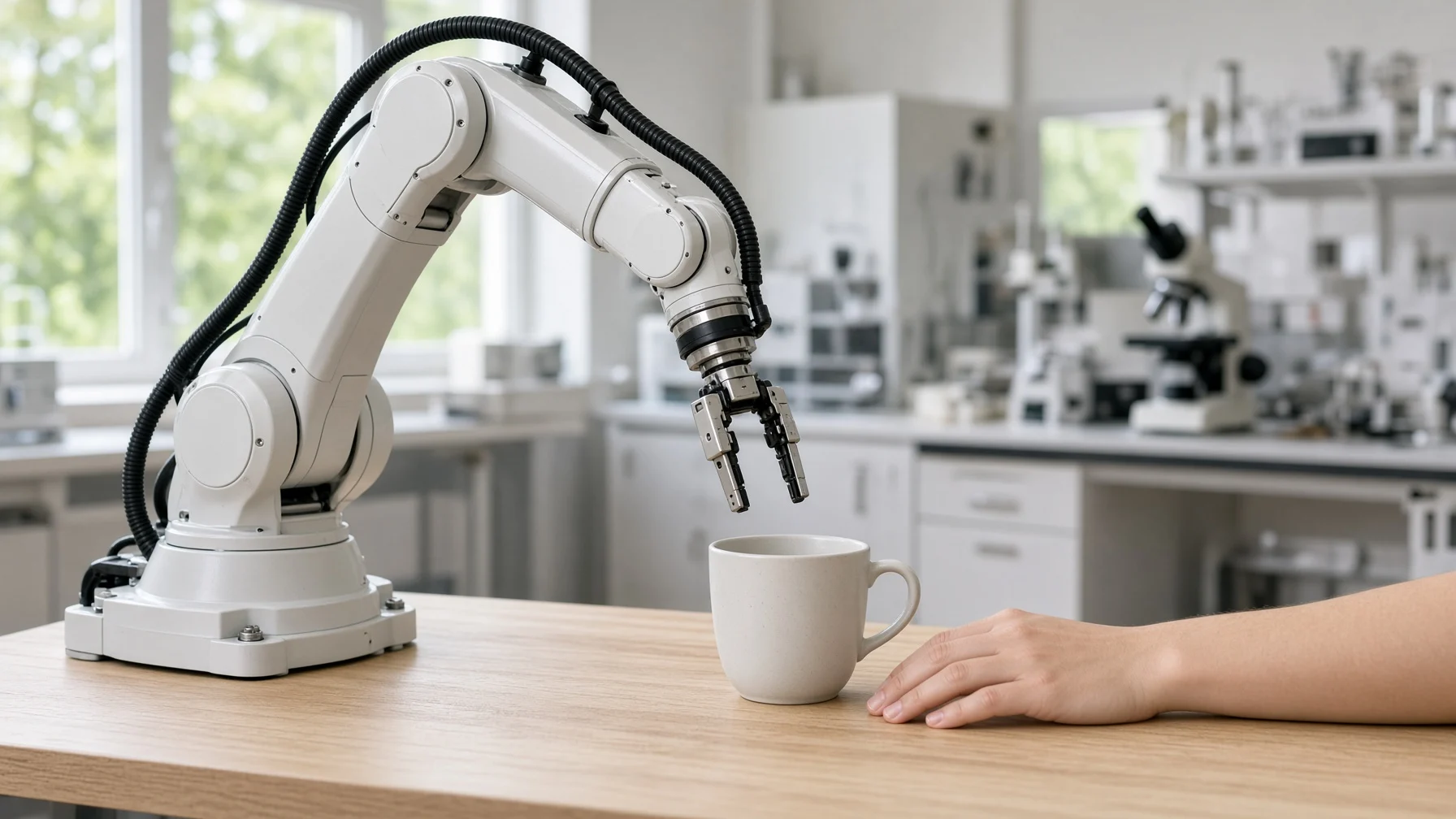
A robot arm is a chain of rigid rods called links, joined by joints. The part at the very end of that chain that actually grasps an object or performs a weld is called the end effector.
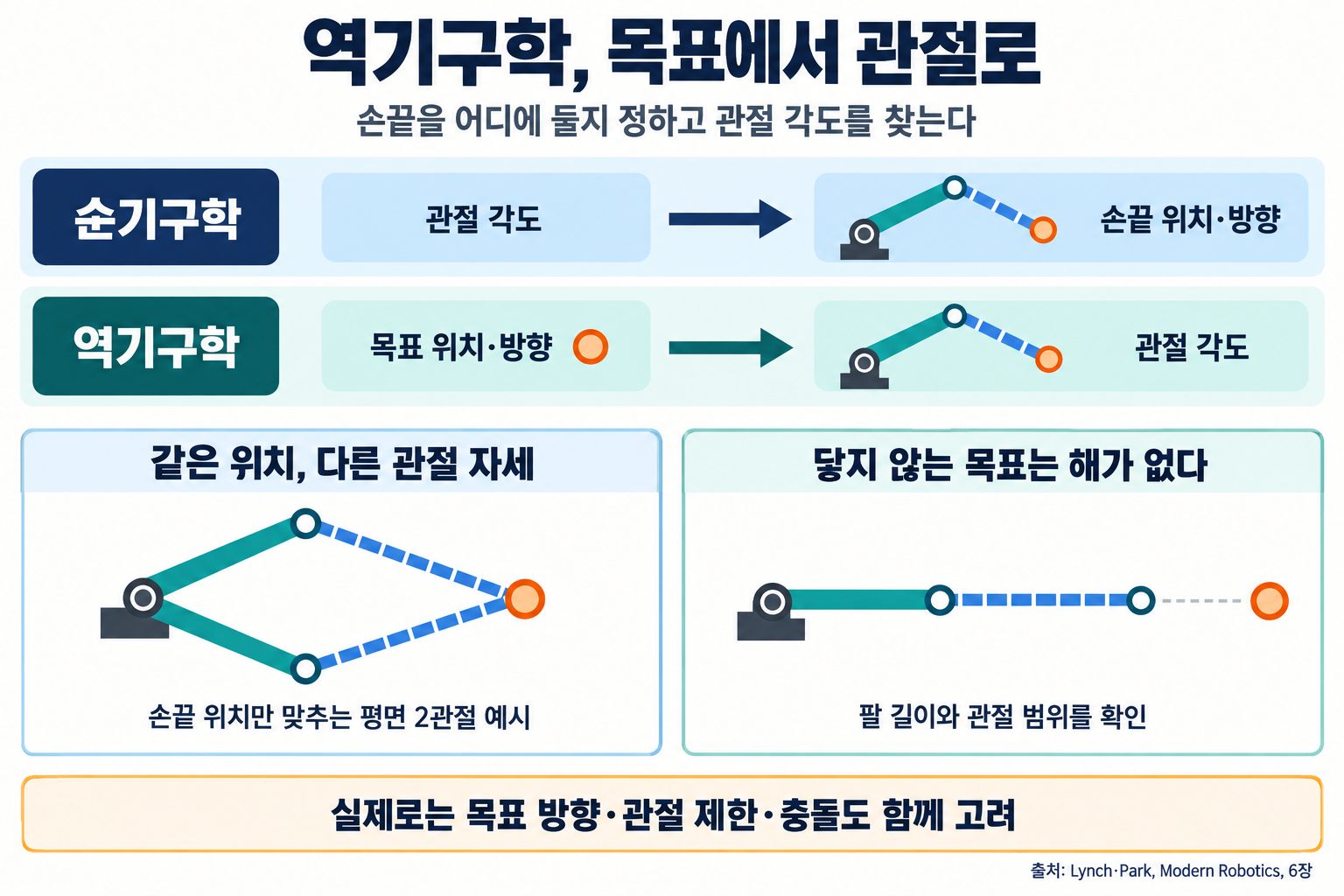
(1) Forward Kinematics
This is the calculation that finds where the fingertip is when every joint angle is known. You simply chain the link lengths and angles together with trigonometry, so the answer comes out clean and unique.
(2) Inverse Kinematics
Conversely, this is the calculation that starts from a fixed fingertip position and orientation and works backward to the joint angles. Commands people give robots are usually fingertip-based—“go above this screw”—so in real work inverse kinematics is used far more often.
In human-arm terms, forward kinematics asks, “If I bend the shoulder 30 degrees and the elbow 90 degrees, where does the hand reach?” Inverse kinematics asks, “To put my hand on the cup handle, how many degrees must I bend the shoulder and elbow?” Forward kinematics follows the arithmetic straight through, but inverse kinematics must solve nonlinear equations that entangle several joints, so it is much harder.
A Tricky Problem with Many Solutions—or None
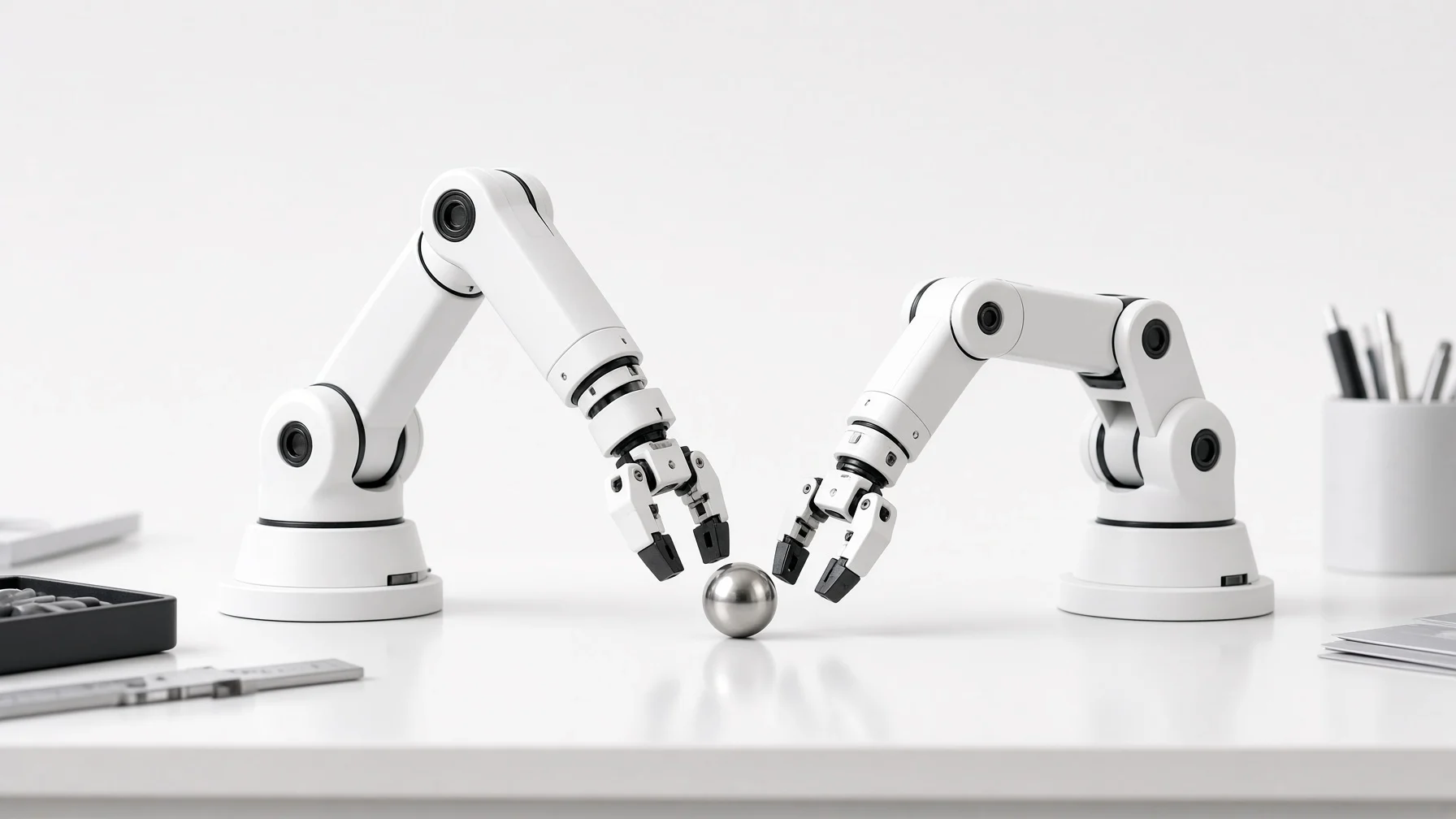
Inverse kinematics is hard not only because of the amount of calculation. For the same target, the number of answers changes from case to case.
(1) Multiple solutions
Even when picking up the same cup, you can raise the elbow or lower it. Among industrial six-axis robots, those whose three wrist axes meet at a single point can have as many as eight solutions for one pose.
(2) Infinitely many solutions
When a robot arm has more degrees of freedom than it needs—such as a seven-joint arm—you can keep the fingertip fixed and still swing the elbow around, producing endless answers. Such a robot is called a redundant robot.
(3) No solution
A place the arm cannot reach, or a direction the joints cannot bend, has no answer no matter how hard you calculate. The space the fingertip can reach is called the workspace.
- Singularity: In a pose where the arm is fully stretched or two joint axes line up, the fingertip cannot move in certain directions, and near that pose even a small fingertip motion forces the joints to whip around sharply.
Two Branches of Methods for Solving Inverse Kinematics
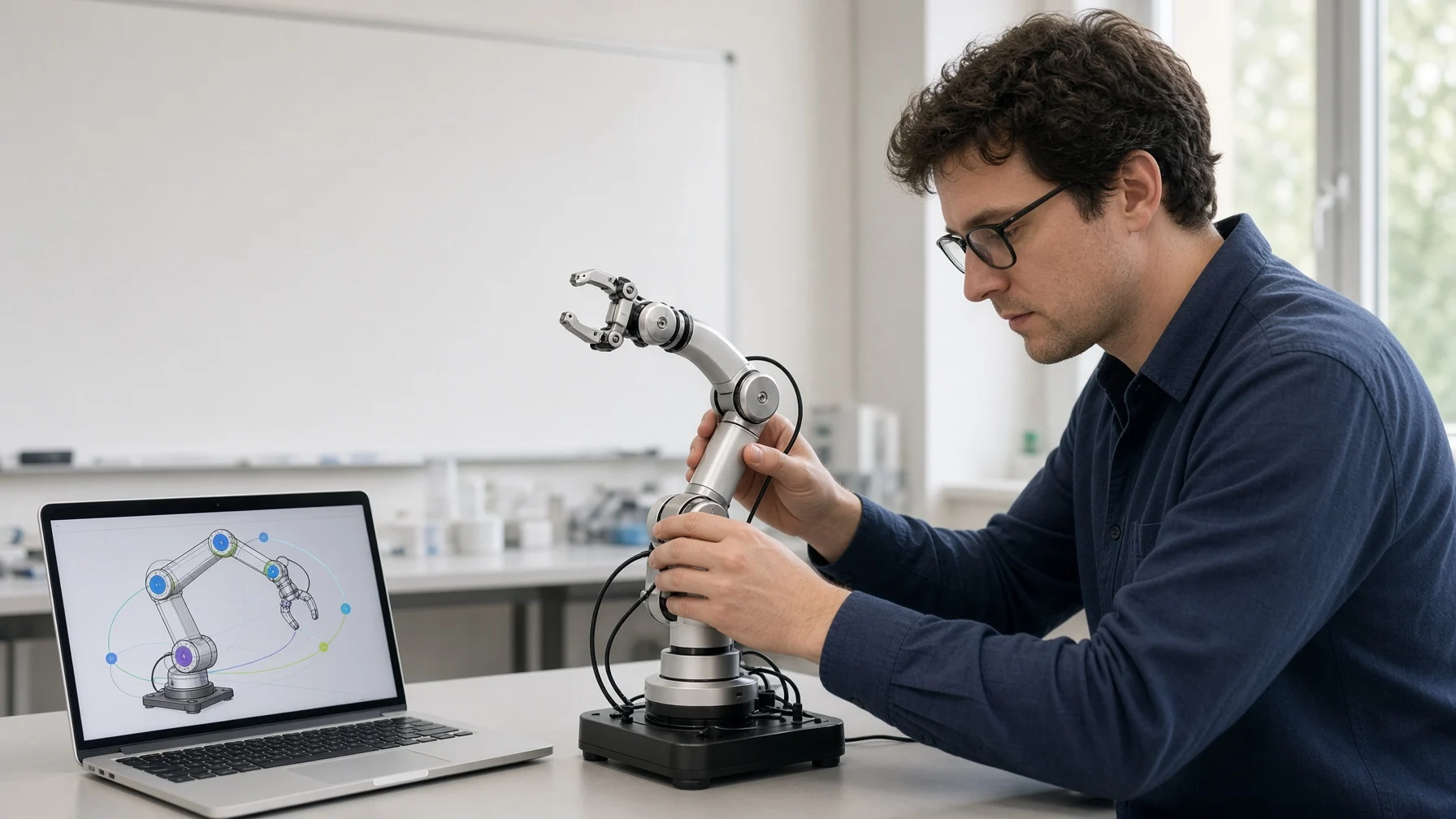
Methods for solving inverse kinematics fall into two broad paths: solving it in one shot with equations, and approaching the target little by little.
(1) Analytical Method
Using the robot’s geometry, joint angles are obtained directly from formulas. In 1968, Donald L. Pieper of Stanford University showed that a six-axis robot whose three wrist axes meet at a point can be solved in closed form by separating wrist position from hand orientation. That is why so many industrial robots are built with that kind of wrist.
(2) Numerical Method
Starting from a guessed pose, you gradually shrink the gap to the target. A common approach iterates with the Jacobian matrix, which describes how much the fingertip moves when a joint moves a little, and it works for robots of any structure. Depending on the starting pose you may land on a different answer, and near singularities the calculation tends to wobble, so remedies such as damped least squares—deliberately damping the motion for stability—are used alongside it.
- Heuristic Method: Simple rules are repeated to get an approximate solution quickly—for example Cyclic Coordinate Descent, which turns joints one by one to match the target, or FABRIK (Forward And Backward Reaching Inverse Kinematics), published in 2011.
Inverse Kinematics in the Field
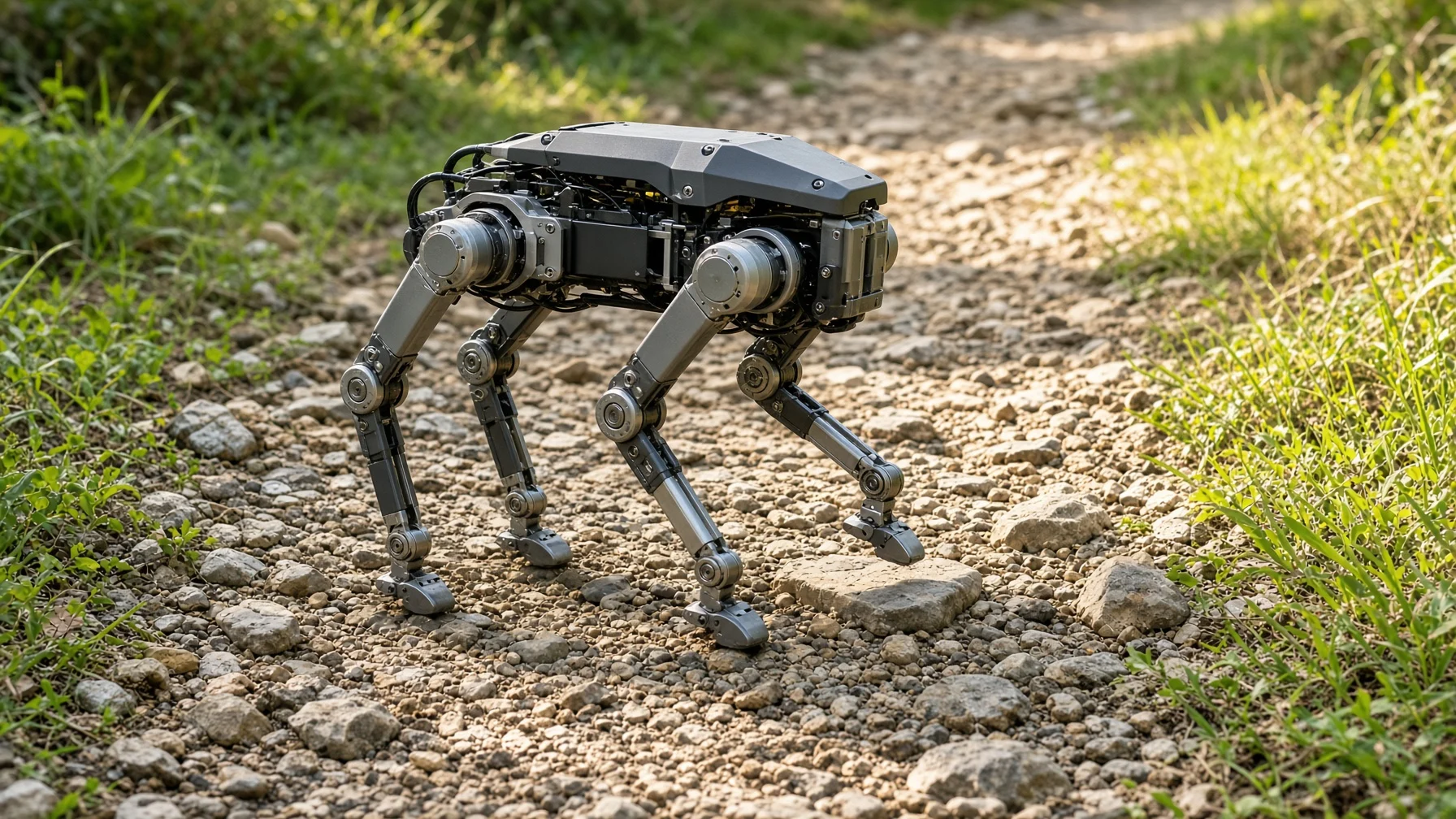
Inverse kinematics is used wherever a fingertip or foot tip must be sent to an exact place—from the factory floor to characters on a screen.
- Industrial Robot: When a weld seam or paint path is specified in fingertip coordinates, the controller converts it into joint angles at every instant and drives the motors.
- Legged Robot: The next foothold is chosen first, then knee and ankle angles are computed with inverse kinematics so the robot can walk on uneven ground.
- Surgical Robot: A doctor’s hand motion on a control device is mapped to a target pose for the tip of a slender instrument inside the body, and the joint angles that produce that pose are computed in real time.
- Computer Animation: When a game character climbs stairs, the foot tip is locked to the ground and the leg joints are solved automatically so the foot neither sinks through the floor nor floats in midair.
Inverse kinematics is the calculation that starts from the goal the fingertip must reach and works backward to the joint angles. Solutions may be many or none, and singularities are a trap, yet thanks to geometry-based formulas and iterative computation, today’s robot arms, walking robots, and on-screen characters can move naturally.
Before worrying about each joint one by one, clearly decide the goal the fingertip must reach: that is the first step toward precise robot motion.