
When you watch thriller movies, you often come across scenes in which the hero and the villain risk their lives chasing a single briefcase. Yet when the film is over and you think about it carefully, you realize that the story was perfectly entertaining even though you never found out what was inside that briefcase. What held the audience's attention was not the object in the case but the chase and tension surrounding it.
In film studies, a story device like this, which matters more than anything to the characters but whose identity hardly matters to the audience, is called a “MacGuffin.” The MacGuffin is a unique device in that it acts as the engine that pushes the story forward, yet never becomes the star of the story itself.
This article walks step by step through how the name MacGuffin came about, the explanation Hitchcock left behind, the conditions a MacGuffin meets, representative examples in film, and how it differs from similar story devices.
How the MacGuffin Works and How It Is Used
The Origin of the Name and Hitchcock's Explanation
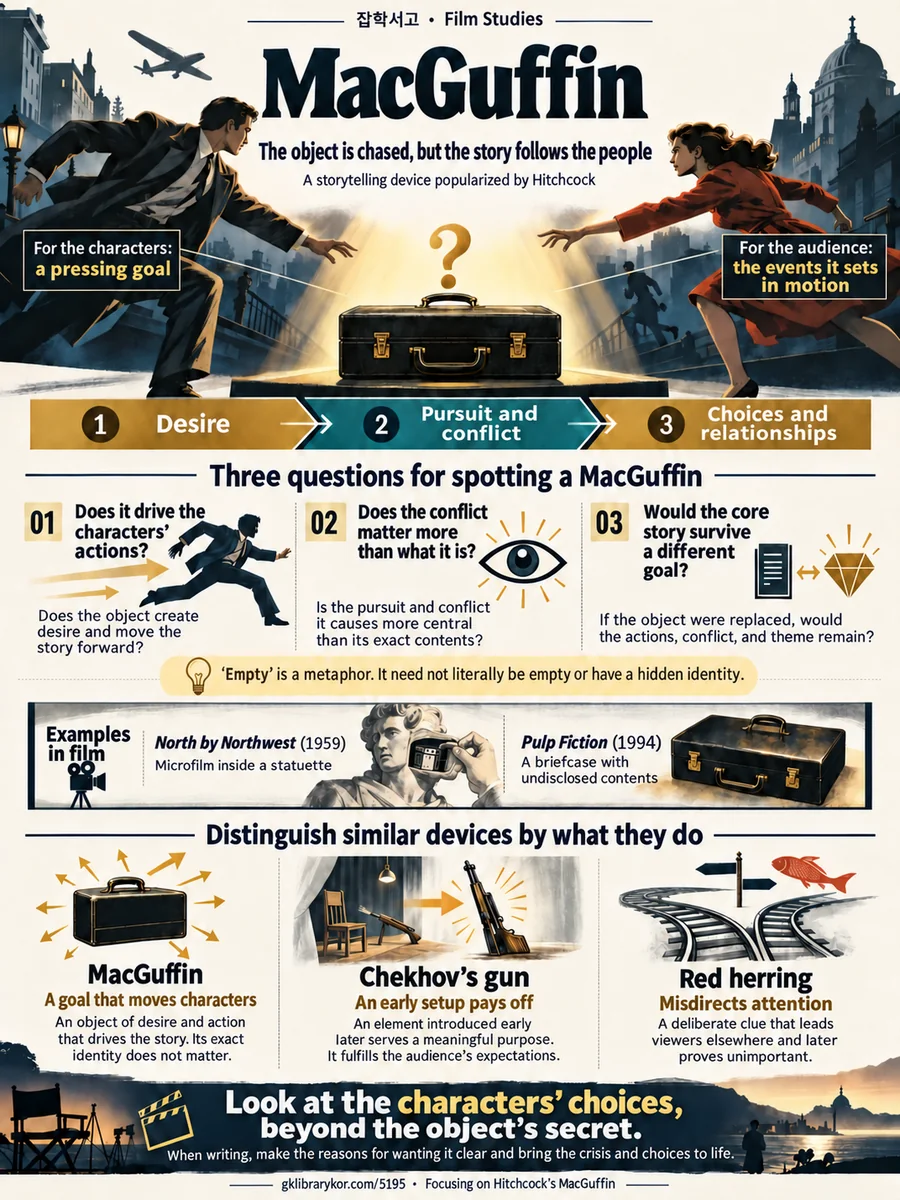

The person who popularized the term MacGuffin was Alfred Hitchcock, the master of suspense films. The word is known to have first been used by screenwriter Angus MacPhail, who worked with Hitchcock. In a long 1962 interview with French director François Truffaut, Hitchcock explained the MacGuffin with the following joke, and the interview was published as a book in 1966.
Of two men on a train, one points to a package on the luggage rack and asks what it is. The other answers that it is a MacGuffin, an apparatus for trapping lions in the Scottish Highlands. When the first says there are no lions in the Scottish Highlands, the other retorts that, in that case, it's no MacGuffin either. With this story, Hitchcock wanted to show that a MacGuffin is practically nothing at all, and that a name is all it needs.
In the same interview, Hitchcock added that in stories about crooks it is usually a necklace, and in spy stories it is usually secret documents, that serves as the MacGuffin. The characters do everything they can to get their hands on the object, but the audience has no trouble following the story even without knowing exactly what it is. For Hitchcock, the MacGuffin was a pretext for getting the story started, and the real fun of the film lay in the suspense that pretext brought about.
Three Conditions of a MacGuffin

It doesn't matter whether a MacGuffin looks like documents, jewels, or money. What matters is the role it plays in the story. A device that can be called a MacGuffin generally meets the following conditions.
(1) It is vital to the characters
Both the protagonist and the other side struggle to obtain or protect it. This desire creates the events of chasing and being chased.
(2) Its identity doesn't matter to the audience
Rather than what exactly the object is, the audience cares about what danger the characters fall into because of it and how they get out.
(3) Replacing it with something else leaves the story unchanged
If swapping the secret documents for jewels would hardly change the flow of the film, the object can be considered a MacGuffin. That is why a MacGuffin is often never explained in detail, or quietly disappears partway through the story.
Representative MacGuffins in Film

Hitchcock liked to use MacGuffins in many of his works, and many directors later took up the technique. Well-known examples include the following.
- The 39 Steps (1935): Military secrets that a spy ring tries to smuggle abroad turn the hero into a man on the run.
- Notorious (1946): Uranium ore hidden in wine bottles becomes the target of an espionage operation.
- North by Northwest (1959): A chase unfolds over microfilm hidden inside a statue. In his interview with Truffaut, Hitchcock singled this out as his emptiest, and therefore best, MacGuffin.
- Psycho (1960): The $40,000 the protagonist steals from her company at first seems to be the center of the story, but it is soon buried under an entirely different event.
- Pulp Fiction (1994): Each time the briefcase the characters risk their lives to protect is opened, only light spills out, and what is inside is never revealed.
- Mission: Impossible III (2006): The identity of the “Rabbit's Foot” that everyone is after is not revealed even by the end of the film.
Differences from Similar Devices

The MacGuffin is often confused with several story devices whose names are used in similar ways. Knowing the differences lets you read and use these devices more accurately when watching films or writing stories.
- Chekhov's Gun: The principle that a gun hung on the wall early on must be fired later. Since it holds that whatever is shown must be used, it sits at the opposite end from the MacGuffin, whose identity never ends up mattering.
- Red Herring: A decoy that deliberately leads the audience or characters to suspect the wrong culprit or clue. Its purpose is to mislead the audience in another direction.
- Plot Device: A broad term for any device that moves a story along; the MacGuffin is one of them.
In Korea, the word MacGuffin is often used to mean a trick that confuses the audience, or a plot thread that is set up but never paid off. Its original meaning, however, is closer to a pretext that gets the characters moving than to a decoy that fools the audience. When you watch a film, if you focus less on the object the characters are chasing and more on the choices and relationships that object reveals, you will see the real center of the story.
If you want to use a MacGuffin well when writing your own story, it helps to remember two things. First, the reason the characters want the object should be clear enough for the audience to accept at once. Second, rather than spending time explaining what the object is, save your scenes for showing the crises and choices that surround it.
Paying attention to the people doing the chasing rather than the object everyone is chasing: that is the first step toward reading a film in depth.