
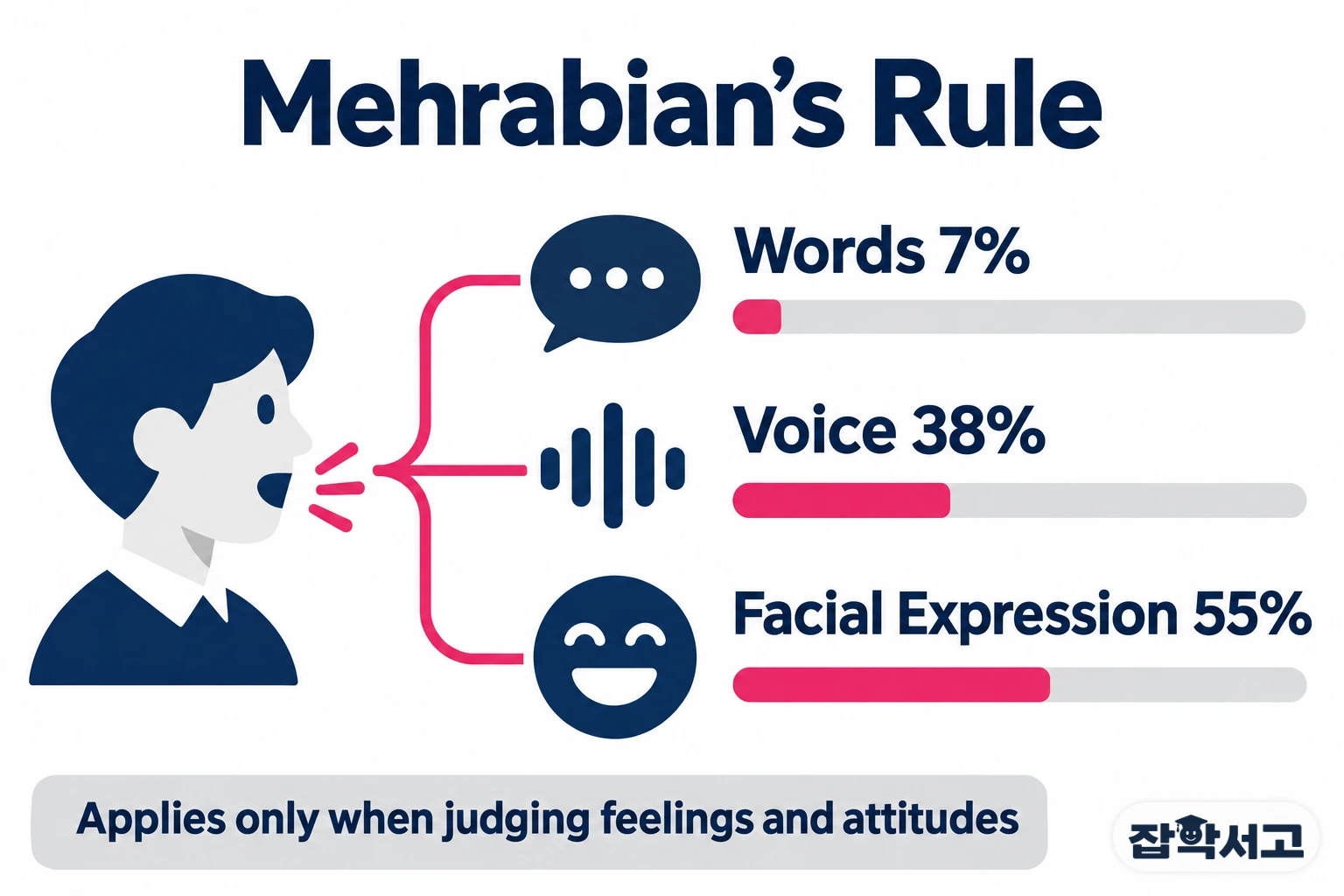
Presentation coaches and interview workshops love to quote one set of numbers. The impression you make, they say, comes 7% from your words, 38% from your voice and 55% from your facial expression.
Many people take this to mean that words hardly matter, but the research behind it covers a far narrower range. Let’s correct this formula, known as Mehrabian’s Rule after the American psychologist Albert Mehrabian, one point at a time.

Mehrabian’s Rule, Properly Understood
Mehrabian’s Rule puts numbers on what listeners rely on to judge someone’s liking for them when words, voice and facial expression contradict one another. Mehrabian wrote it as “Total liking = 7% verbal + 38% vocal + 55% facial.”
It rests on two experiments published in 1967. One played single words recorded in different tones of voice; the other combined a recorded voice saying the word “maybe” with photographs of faces. In his 1971 book Silent Messages, Mehrabian merged the two results into this ratio. He ran the first experiment with Wiener and the second with Ferris.
Mehrabian was born in 1939 to an Armenian family in Iran and first studied engineering before spending many years researching psychology at the University of California, Los Angeles (UCLA). The formula he left behind still turns up in self-help books and talks.
Myth 1: 93% of a Conversation Is Conveyed Without Words
In fact, these numbers never measured a whole conversation. What participants judged was a single thing: whether the speaker liked or disliked them, in other words a feeling or attitude. It was a very brief judgment made in a lab from recordings and photos alone.
Mehrabian himself has made clear that unless someone is talking about their feelings or attitudes, the formula does not apply. There is no basis for applying 93% to speech that exchanges information, such as giving directions or explaining a task.
Myth 2: What You Say Barely Matters
In fact, the finding is that nonverbal signals carry more weight when words, voice and expression don’t match. Hear a kind word like “thanks” in a curt tone, and people trust the tone over the word.
When all three signals point to the same feeling, there is nothing to split into percentages. Just think how you could never understand 93% of a language you don’t know by watching faces, and it is clear that content is still central. The fact that we get so much done every day through emails and texts, with no faces or voices at all, shows the same thing.
Myth 3: It Applies Directly to Presentations and Interviews
In fact, the experimental conditions were very narrow. Participants heard a single recorded word rather than a sentence, and the feelings they judged were as simple as positive, neutral or negative. Only women took part.
The first experiment used nine words: “honey,” “dear” and “thanks” for liking; “maybe,” “really” and “oh” as neutral; and “don’t,” “brute” and “terrible” for disliking. None of them came with the surrounding context of a real conversation.
Change the conditions and the numbers change too. In a 1970 study by Michael Argyle, nonverbal cues had about 4.3 times the impact of words when people judged superior or submissive attitudes. The 7-38-55 split is not a golden ratio for every situation. The same words can be read very differently depending on the relationship, the setting and the culture.
Myth 4: The 55% Belongs to Body Language
In fact, the 55% came from facial expressions in black-and-white photographs of faces. Posture, gestures and other body movements were not part of the experiment, and the images were still photos rather than moving video.
In the experiment that showed face photos together with the voice, facial expression and voice influenced judgments at a ratio of roughly 3 to 2. That ratio is where the 38% and 55% come from, so the claim that “body language decides more than half” stretches the original experiment a long way.
In Short
- Mehrabian’s Rule describes how people judge liking when words, voice and facial expression don’t match.
- The 7-38-55 figures apply only to situations where feelings and attitudes are being conveyed.
- In conversations that convey information, the content of the words is still what matters most.
- If you want to come across as sincere, the surest way is to make your words, voice and expression point in the same direction.
In the end, the rule says less about the power of nonverbal signals than about the power of consistency. A message comes through most fully when kind words are matched by a fitting voice and expression. Remembering the conditions behind the numbers, not just the numbers themselves, is the way to use this rule correctly.
Recommended reading