A bullet stops dead in midair, and only the camera moves, slowly circling the figure to show the moment from every angle. Once you have seen this strange image, in which time has stopped but the point of view keeps moving, it is hard to forget.
This technique is called bullet time. It is a visual effect that makes time appear to slow down drastically or stop, while creating the illusion that the camera is moving through the scene at normal speed. It is also known as frozen moment or time slice, and the name became widely known through the 1999 film The Matrix.
This article looks in turn at what bullet time is and how it differs from slow motion, how it is filmed, what attempts came before The Matrix, and how it is used outside the movies.
A Camera Walking Through Frozen Time: All About Bullet Time
What Is Bullet Time?
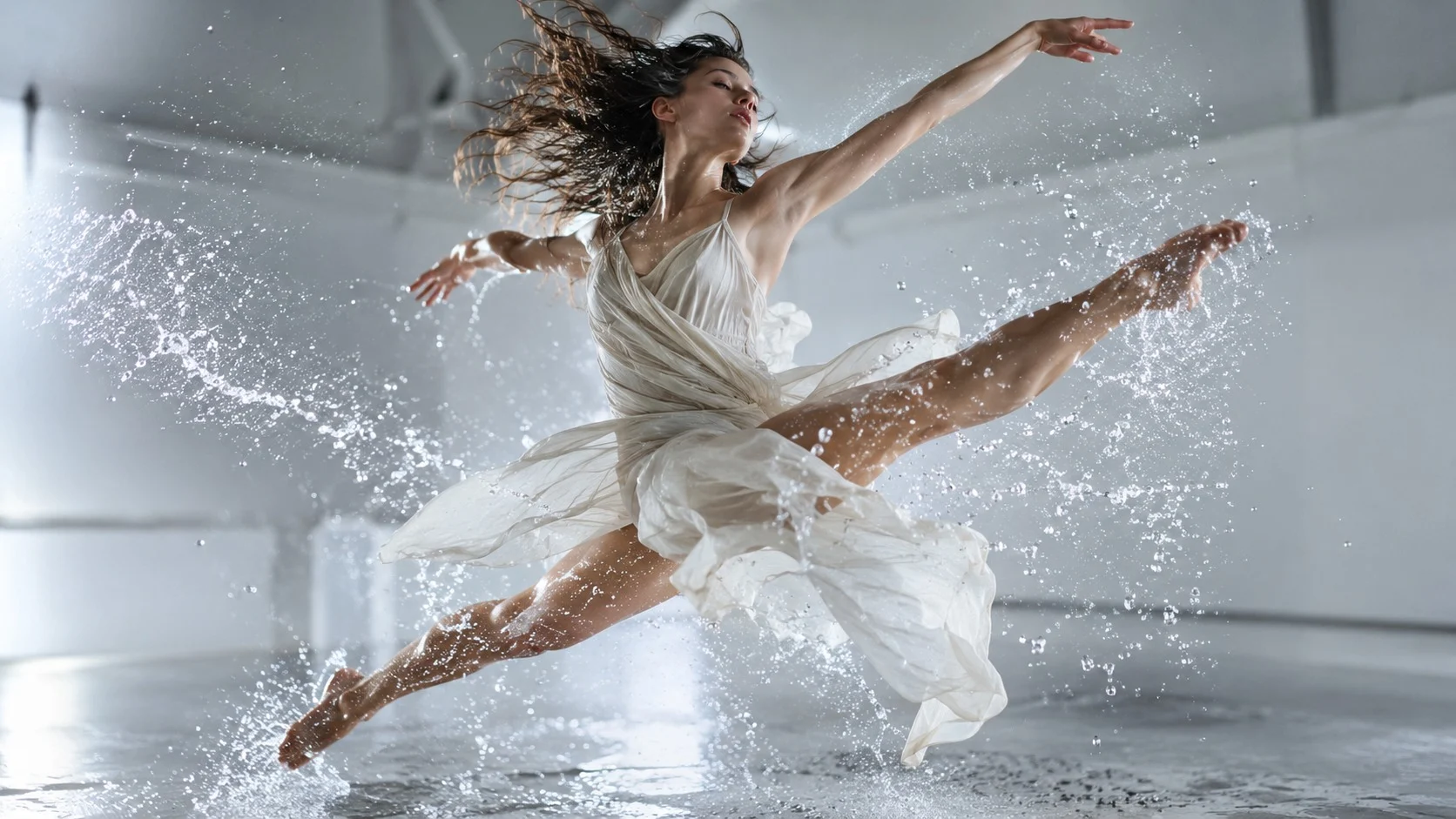
To understand bullet time, it helps to set it side by side with the slow motion we already know well.
(1) How It Differs from Slow Motion
In ordinary slow motion, everything on screen slows down together. When the characters slow down, the camera's movement slows down in exactly the same way. Bullet time separates the two. Time within the scene is almost stopped, yet the camera's viewpoint alone circles around or glides past at its usual speed.
(2) What the Viewer Gains
As a result, the audience can examine a bullet hanging in the air, an explosion frozen mid-burst, or water droplets caught as they splash upward, from one angle after another. It is like turning a single instant around as if it were a three-dimensional sculpture, so the depth of the space also feels far more vivid.
(3) A Shot No Real Camera Could Take
To film such a scene with a single camera, the camera would have to whip around the subject in an instant. Because that is impossible in reality, bullet time is often described as footage from a virtual camera in motion.
How Many Cameras Create the Effect
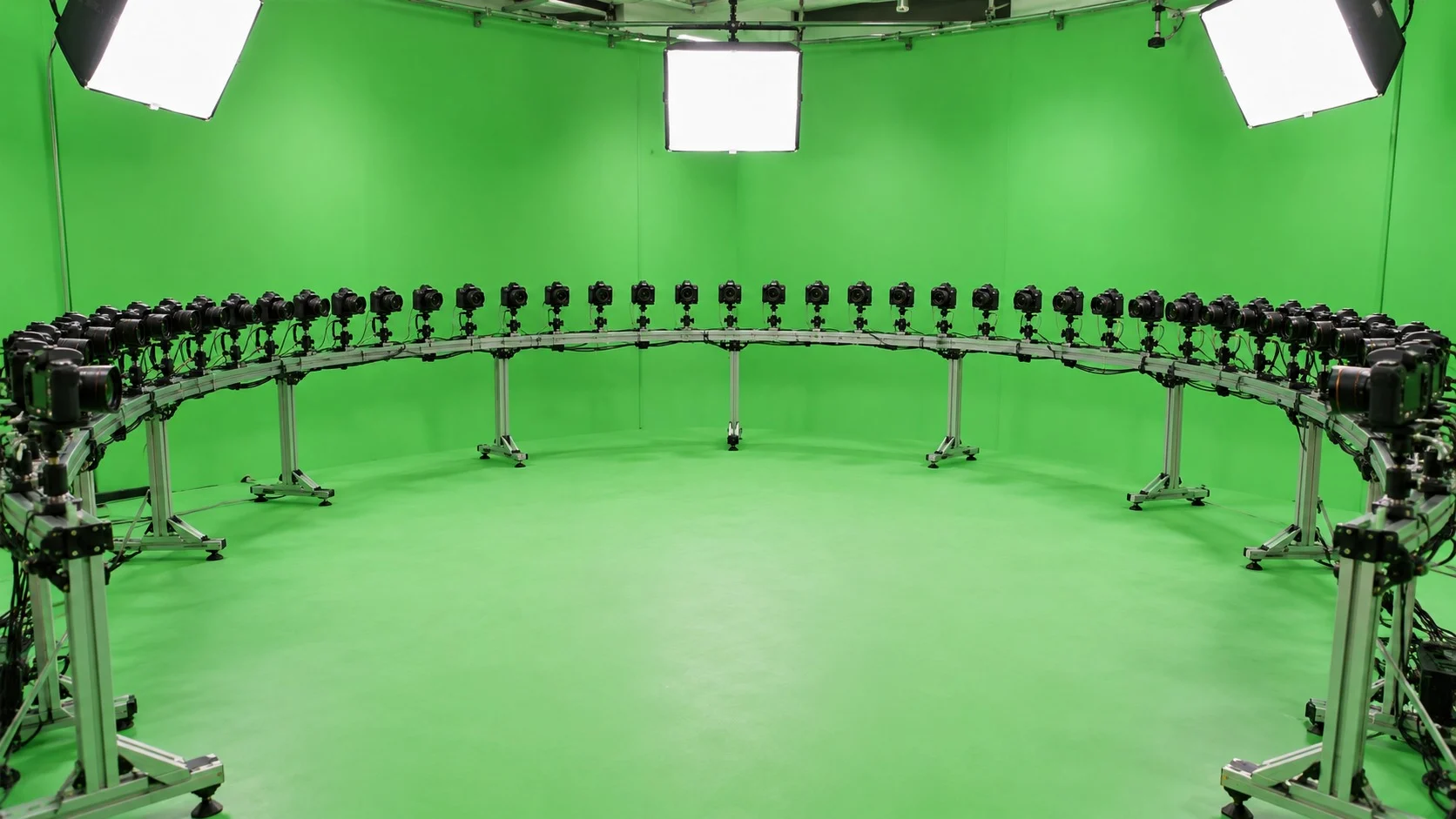
Bullet time was originally created with photographic techniques rather than computer graphics.
(1) Lining Up the Cameras
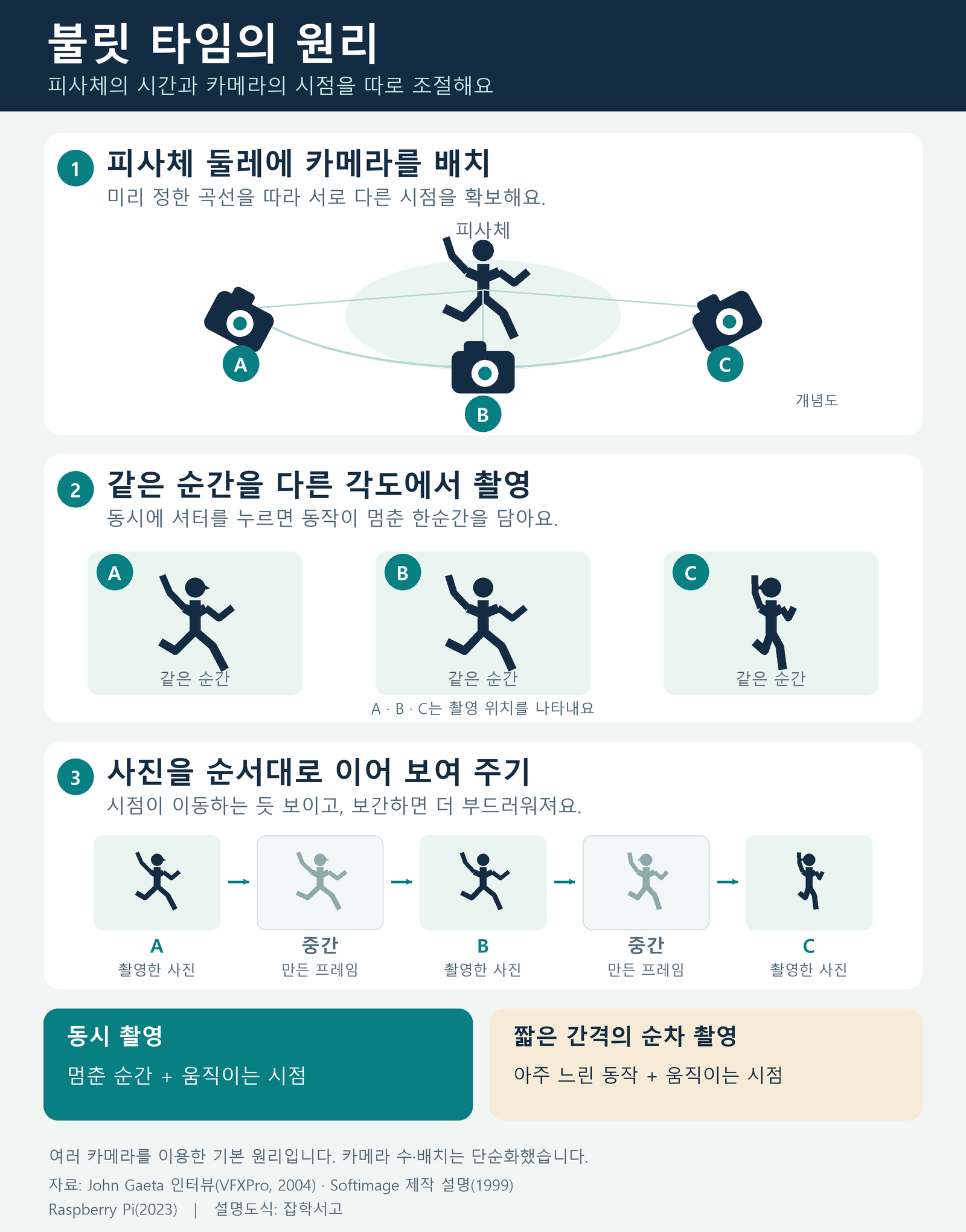
Many still cameras are placed close together along a circle or curve surrounding the subject. Each camera captures the same moment from a slightly different angle.
(2) The Order of the Shutters
If all the cameras fire at once, the result is a view that circles around a completely frozen instant. If they fire one after another at very short intervals, the result is a moving viewpoint while the action continues in extreme slow motion.
(3) Stitching the Photos Together
When the photos from each camera are shown one by one in the order the cameras were arranged, the result is footage that looks as if a single camera were circling the subject. Inserting computer-generated in-between frames makes the motion smoother, while dropping a few frames makes the action faster.
Before and After The Matrix
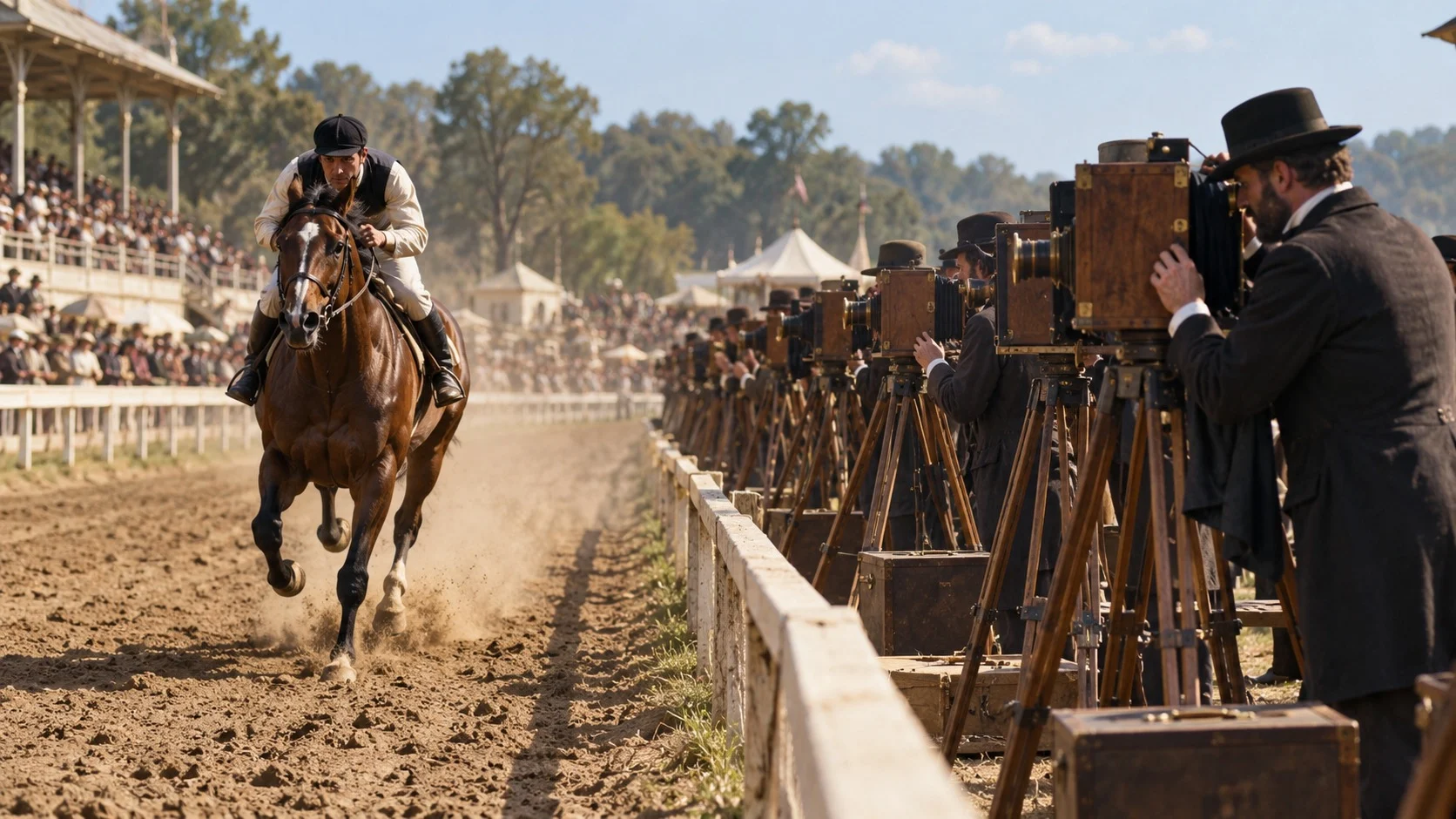
Bullet time was not invented by The Matrix; it is a technique that earned its name after years of accumulated experiments.
- Muybridge's experiment (The Horse in Motion): In 1878, photographer Eadweard Muybridge set up a row of cameras along a racetrack to photograph a running horse in sequence, and he also left studies that captured the same moment from several directions.
- Time-slice camera: From 1980, Britain's Tim Macmillan continued working on arranging cameras in a circle to look around a single instant.
- Music videos and commercials: In the 1990s, similar effects appeared in music videos directed by Michel Gondry and in a vodka commercial featuring a scene of dodging bullets.
In 1999, The Matrix brought together gunfight action, superhuman bullet-dodging movement, and the time-slice effect in a single scene. Visual effects supervisor John Gaeta's team designed the camera's path in advance with computer simulations, set up the cameras in a curve in front of a green screen, and aligned their positions with lasers. By adding computer-generated backgrounds and in-between frames, they produced seamless footage, and the scene, together with the name bullet time, became a technique imitated in countless works.
Bullet Time Beyond the Movies
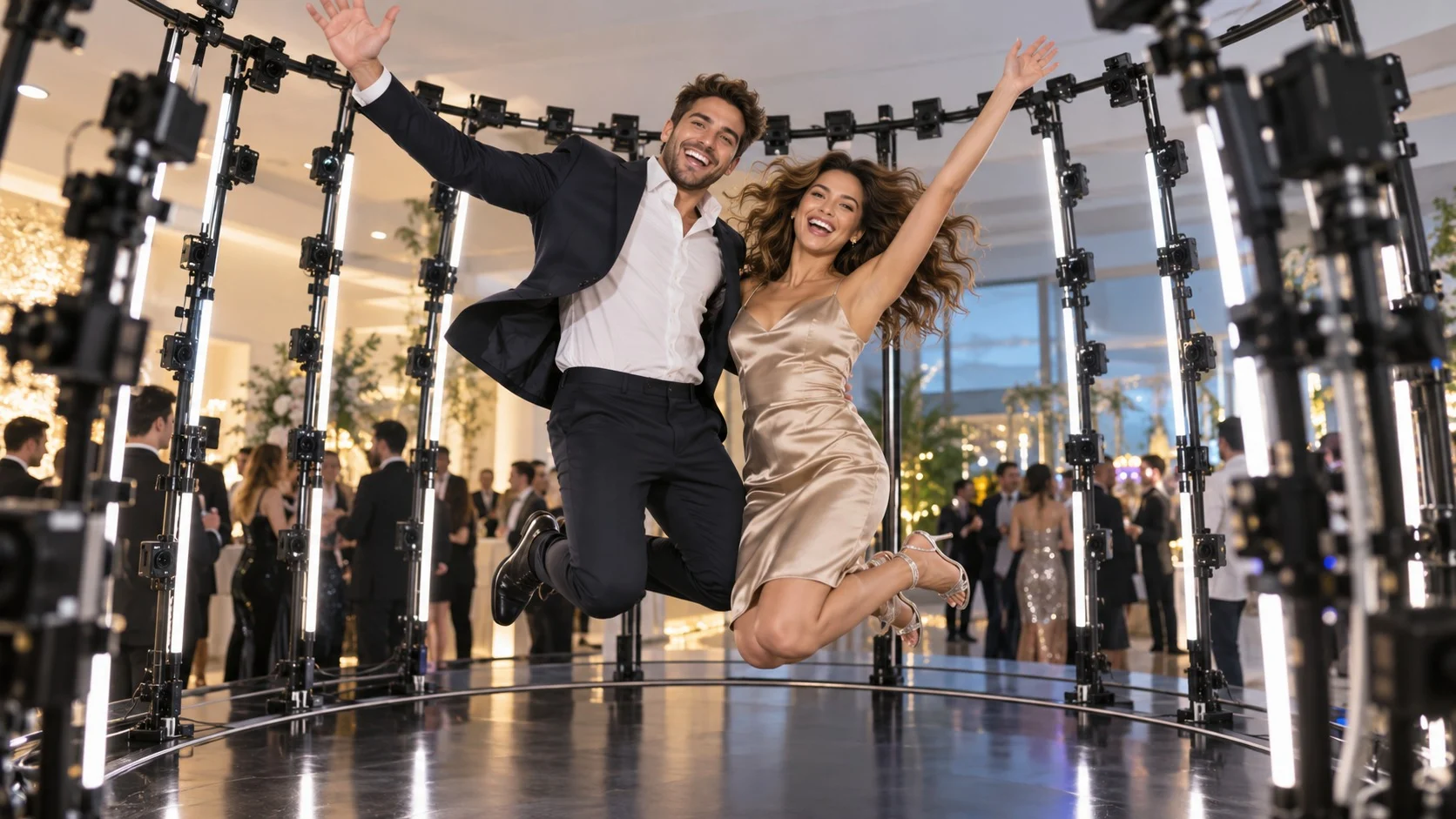
After The Matrix, bullet time spread beyond a screen effect into many fields.
(1) It Became an In-Game Ability
The 2001 game Max Payne gave the name bullet time to a feature that lets players aim and shoot while time around them slows down. Since then, slowing down time has become a staple feature of action games.
(2) From the Stage to Weddings and Sports
It is reported to have been used in concert footage for the first time in 2009, and today photo booths with multiple cameras arranged in a circle appear at events and weddings. Sports broadcasts also often combine footage from cameras around the stadium to replay decisive moments from many directions.
(3) Toward Free-Viewpoint Video
Recently, free viewpoint video technology has been advancing, which uses computers to analyze footage from multiple cameras and generate new views from any desired position. Leave out the slow motion, and it is essentially bullet time brought into real video.
Bullet time started from the simple idea of lining up cameras and has become a new visual language that lets time and point of view move separately.
Recognizing that even a single frozen moment hides stories from many directions is the first step to appreciating bullet time.