If you set your grandparents’ dinner table next to today’s, what would look most different? Tables once centered on mixed-grain rice, seasoned greens and soybean-paste soup now routinely hold meat, fried food, sweet drinks and packaged snacks. In nutrition science, this shift—in which what people eat and how they use their bodies change together as a society grows richer and more urban—is called the nutrition transition.
Simply put, the nutrition transition means ‘the process by which a society’s diet and nutrition problems move from hunger toward obesity and chronic disease as incomes rise and ways of life change.’ The idea became widely known after Barry Popkin, a nutrition scientist at the University of North Carolina at Chapel Hill, organized human diets into five patterns in a 1993 paper in the journal Population and Development Review.
In this article, we will look in turn at the theories behind the nutrition transition, the five dietary patterns Popkin proposed, the forces that speed up changes on the plate, and the double burden of undernutrition and obesity along with the responses to it.
A Map for Reading the History of the Table: The Nutrition Transition at a Glance
1. A Concept Born from Changes in Population and Disease

The nutrition transition did not appear out of nowhere; it was built on two ‘transition’ theories that explained changes in population and disease. Popkin argued that what people eat moves in step with these two trends.
(1) Link to the demographic transition
The demographic transition is the shift from a society with high birth and death rates to one where both are low. When people have fewer children and live longer, the population ages, and the effects of diet on health build up over a longer time.
(2) Link to the epidemiological transition
The epidemiological transition, proposed by Abdel Omran in 1971, describes the shift from a society where infectious disease and malnutrition are the main causes of death to one dominated by chronic diseases such as heart disease and diabetes. The nutrition transition can be seen as a framework that explains the dietary side of this change.
(3) Looking at diet and activity together
Popkin looked not only at food but also at how much people move. When farming and manual labor decline and machines and office work increase, more energy is left over even if people eat the same amount. That is why the nutrition transition treats changes in diet and changes in physical activity as a single package.
2. Popkin’s Five Dietary Patterns

Popkin divided human diets into five patterns. These patterns appeared one after another in history, but even today different patterns can coexist within a single country depending on region and income.
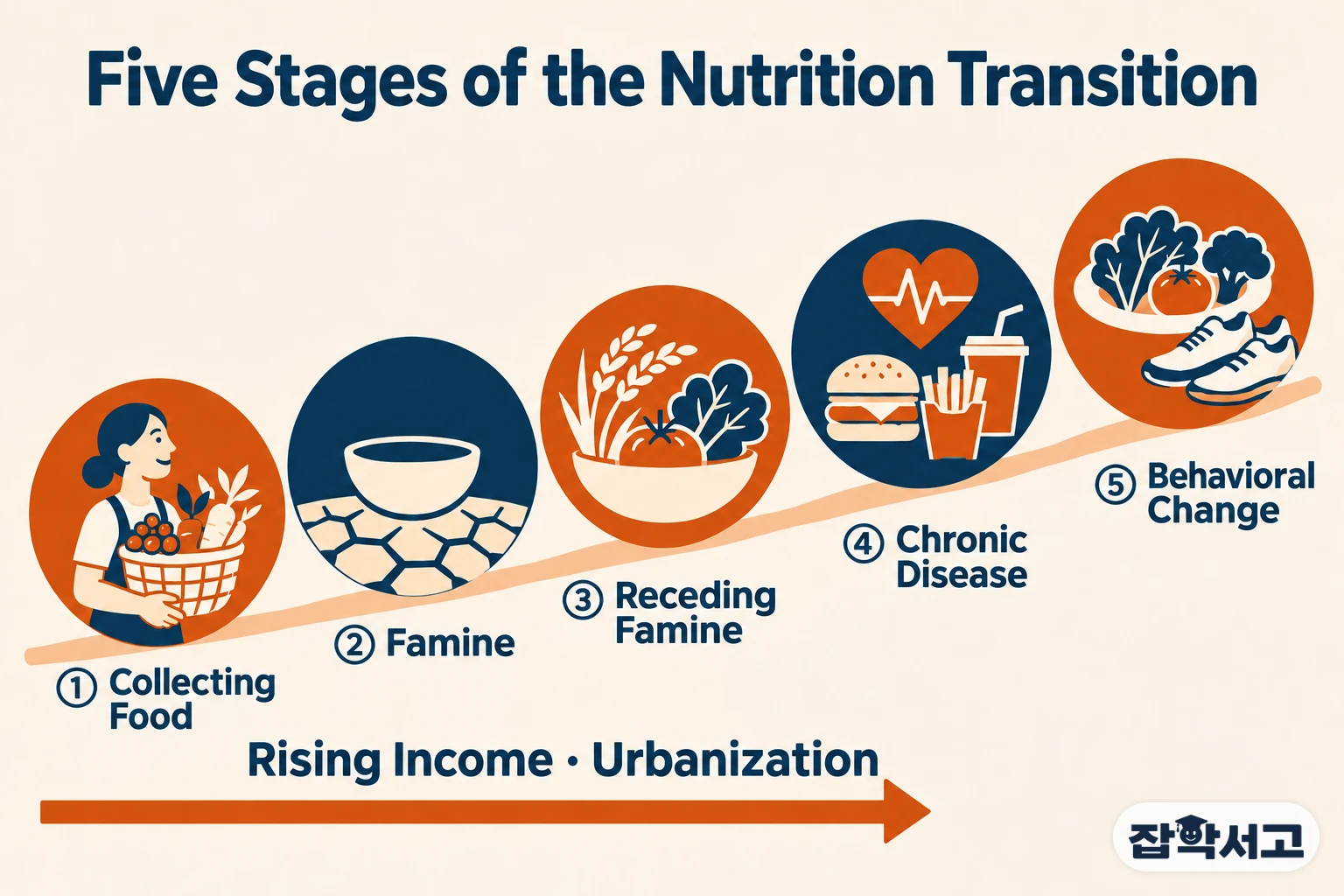
- Collecting Food: The era of obtaining food by hunting and gathering, with diets high in carbohydrates and fiber, low in fat, and high activity levels, so obesity was rare.
- Famine: The period after agriculture took hold, when diets became monotonous and severe food shortages struck with every bad harvest.
- Receding Famine: The stage when food supplies stabilize, starchy staples decline, and intake of fruit, vegetables and animal protein increases.
- Nutrition-related Noncommunicable Diseases: The stage when diets rich in fat, sugar and refined foods combine with sedentary lifestyles, increasing obesity and chronic disease.
- Behavioral Change: The stage when governments, health systems and individuals change diets and exercise to prevent or delay chronic disease; it is the most recently emerging pattern.
Popkin paid particular attention to the passage from the third pattern to the fourth. Many low- and middle-income countries are going through this stage now, and a key concern is that they are experiencing, at a much faster pace, changes that earlier high-income countries went through over a long period.
3. What Speeds Up Changes on the Plate?

No single force drives the nutrition transition. Income and urbanization, the food industry and technology interlock to change both people’s shopping baskets and their daily activity.
(1) Rising income and the shopping basket
As incomes rise, people generally spend more on energy-dense, rich-tasting foods such as meat, dairy products, cooking oil and sugar instead of grains and beans. As cooking oils and sweeteners came to be mass-produced cheaply, these changes appeared quickly even in countries where incomes had not risen much.
(2) Urbanization and supermarkets
When people move from the countryside to cities, food they buy replaces food they once grew. As large supermarkets, chain restaurants and advertising spread, processed foods, sugary drinks and fast food became easy to get, and critics point out that this advertising often targets children and adolescents.
(3) Technology and declining activity
Labor-saving technologies such as washing machines, cars and office automation made life more convenient but reduced the energy people use each day. Leisure time is also increasingly spent in front of television and computer screens, so more energy builds up in the body even if people eat the same amount.
4. The Double Burden and the Era of Behavioral Change

In countries where the nutrition transition is moving fast, obesity and chronic disease rise even before hunger has been fully solved. That is why many efforts are under way to move into the fifth pattern, behavioral change.
(1) The double burden of malnutrition
The double burden of malnutrition refers to undernutrition and overweight or obesity occurring together within one society, one household or even one person. A typical example is a household where a child with stunted growth lives with an adult who has obesity, and the problem became widely known through research by Popkin, Colleen Doak and others.
(2) Policies such as sugary drink taxes
From January 1, 2014, Mexico levied a tax of 1 peso per liter on sugar-sweetened beverages. According to an analysis published in 2016 in The BMJ by a research team that included Popkin, purchases of taxed beverages fell by an average of 6% over 2014 and by as much as 12% in December. Other policies in use include food labeling, school meal standards and restrictions on advertising aimed at children.
(3) South Korea, a case of keeping a traditional diet
South Korea has been studied as a case in which a diet high in vegetables and low in fat was maintained for a relatively long time despite rapid economic growth. A 2002 paper by Popkin and Korean researchers pointed to efforts by the government and nutrition experts to promote the benefits of the traditional diet and revive it in a form suited to today’s tastes.
In the end, the nutrition transition shows that what we eat is not just a matter of personal taste but the result of income, cities, industry and policy working together. The simple idea that today’s meal on my table is also one scene in a vast social change—that is the first step to understanding the nutrition transition.