Have you ever stood in front of a lunch menu, going back and forth between kimchi stew and soybean-paste stew, only to end up deciding nothing at all? The more equally appealing two options are, the harder it becomes to choose. Philosophy has an old thought experiment that pushes this kind of hesitation to the extreme: ‘Buridan's Ass.’
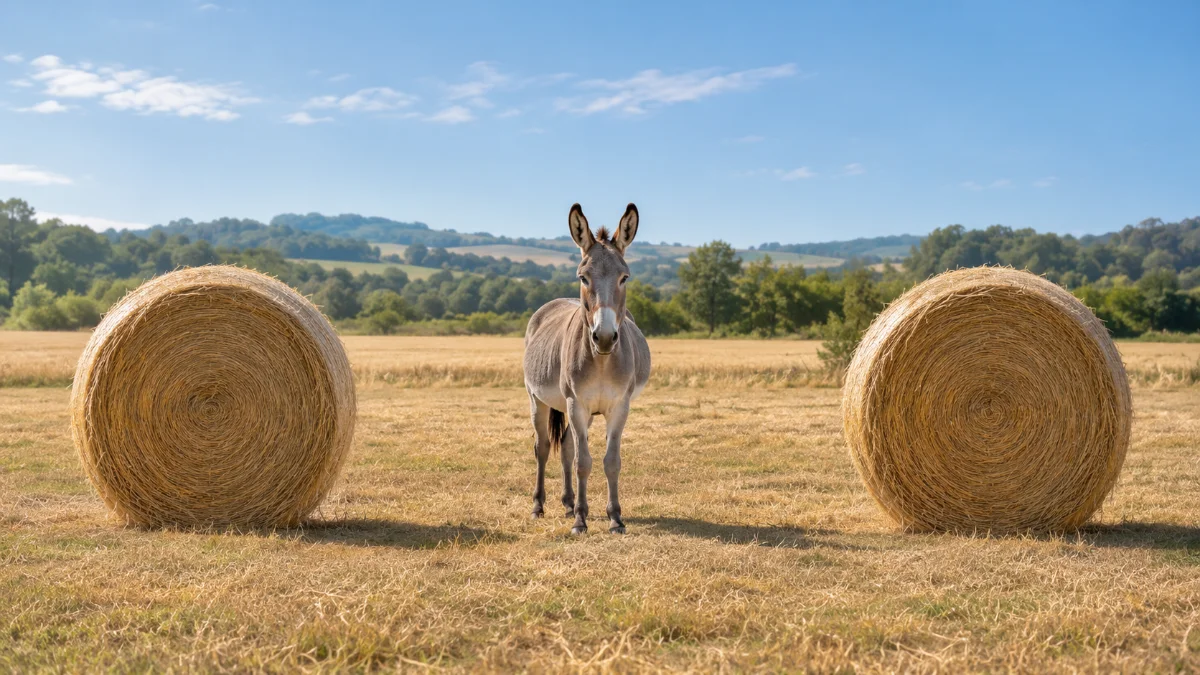
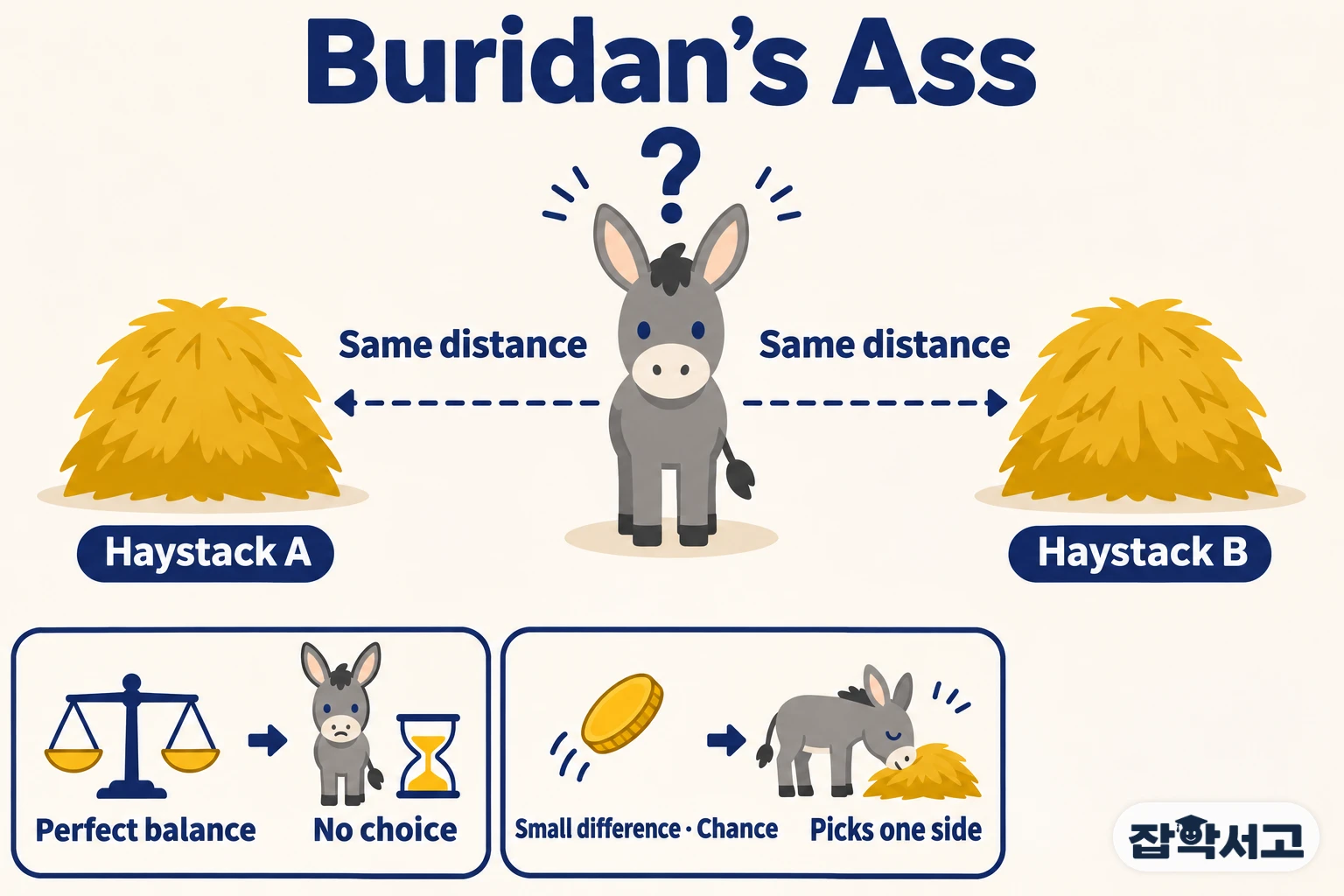
Put simply, Buridan's Ass refers to ‘a situation in which, faced with two equally good options, one finds no reason to prefer either and ends up choosing neither.’ It is the paradox of a donkey, exactly as hungry as it is thirsty, standing precisely midway between a stack of hay and a pail of water—or between two identical haystacks—that cannot move toward either and starves to death. It is named after the 14th-century French philosopher Jean Buridan.
In this article, we will look in turn at how the paradox came about, why perfect balance leads to standstill, Buridan's principle as it reappeared in computer circuits, and finally how to avoid this donkey in everyday life.
If both are equally good, can we not choose?
1. How the donkey paradox came about
Like the Ship of Theseus, this paradox passed through the hands of many thinkers over the centuries. Interestingly, the story is far older than Buridan, and the donkey does not actually appear anywhere in Buridan's own writings.
(1) Aristotle's starving man
Around 350 BC, Aristotle used an analogy in On the Heavens: a man who is just as hungry as he is thirsty, placed between food and drink, would have to stay where he is and starve. The analogy was meant to mock Anaximander's claim that the Earth stays still at the center of the universe because it is round.
(2) Al-Ghazali's two dates
The medieval Islamic scholar al-Ghazali held that a person facing two equally good dates will still pick one up in the end. His argument was that the power to single out one thing among similar things—in other words, free will—breaks the deadlock.
(3) The donkey that mocked Buridan
Buridan held that, unless something gets in the way, people always choose the greater good, and that when two courses seem equal, the will can only suspend judgment until circumstances change. Later critics of this view scoffed, ‘Then a donkey would starve,’ and so the donkey came to bear his name.
2. Why perfect balance leads to standstill

At the heart of this paradox lies the premise that ‘nothing is chosen without a reason.’ If two options are identical in every respect, the reason to choose one disappears, and a being that moves only by reasons has no choice but to stand still.
- Moral Determinism: Buridan's position that, without ignorance or obstruction, a person always chooses what they judge to be better.
- Principle of Sufficient Reason: the principle that everything happens for a reason; following it, Gottfried Wilhelm Leibniz argued that perfect balance can never actually occur.
- Petites Perceptions: Leibniz's term for perceptions and preferences too small to notice, which he said tip the mind one way even between seemingly identical options.
- Approach-Approach Conflict: in psychologist Kurt Lewin's field theory, the initial hesitation felt between two equally attractive goals.
In his Ethics, Baruch Spinoza admitted that a person placed in such a balance really would die of hunger, yet when asked whether such a person should be considered an ass rather than a man, he answered that he did not know. In the end, the paradox is not about the donkey's fate but about whether our choices are driven by reasons alone.
3. The donkey in the computer: Buridan's Principle

This paradox, which looked like a philosophical joke, resurfaced in 20th-century computer science, thanks to a 1984 essay, ‘Buridan's Principle,’ by Leslie Lamport, known for his research on distributed systems.
(1) A continuous input, an either-or decision
Lamport summed it up as follows: ‘a discrete decision based upon an input having a continuous range of values cannot be made within a bounded length of time.’ If the donkey's starting position changes little by little and continuously, then somewhere among those positions there is one from which it never reaches either haystack. The essay was published in 2012 in the journal Foundations of Physics.
(2) The driver at the railroad crossing
One of Lamport's examples is a driver in front of a crossing as a train approaches. However safe we make the rule for deciding whether to cross or stop, depending on when the train arrives there theoretically remain cases where the decision comes too late and leads to an accident.
(3) A circuit caught between 0 and 1
A computer must read a continuous voltage as either 0 or 1. If a signal arrives at an ambiguous moment, the circuit's output can linger for a while in a metastable state (Metastability) that is neither 0 nor 1. Because the probability of such a state lasting long drops sharply over time, engineers give the decision extra time to make the risk small enough to ignore.
4. Avoiding Buridan's Ass in everyday life

No real donkey has ever starved between two haystacks. Yet wasting time in front of similar options is quite common for us.
(1) The more options, the harder to choose
In Sheena Iyengar and Mark Lepper's 2000 jam-tasting experiment, the share of people who actually bought jam was much higher when only 6 kinds were displayed than when 24 kinds were (about 30% versus 3%). Later studies found that the effect varies greatly by situation, but the idea that many similar options can make deciding burdensome has become widely known.
(2) The wisdom of leaving it to chance
The simplest solution philosophers have offered is to pick either one if the options are equally good. Leaving it to chance, like flipping a coin, at least keeps you from starving. The limitation of this solution, however, is that judging ‘the two options are similar enough’ is itself another decision.
(3) The man who would eat both
This donkey was also used in political satire. Abraham Lincoln said of the 1848 presidential candidate Lewis Cass that, far from starving between two haystacks, he would eat them both. It is a jab suggesting that on the other side of hesitation lies another trap: greed.
If two options really are identical, you lose nothing whichever you pick. The lesson of Buridan's Ass is that it is better to decide at a reasonable moment than to wait forever for a perfect reason. The simple idea that ‘if both are equally good, choosing anything beats choosing nothing’ is the first step toward understanding Buridan's Ass.