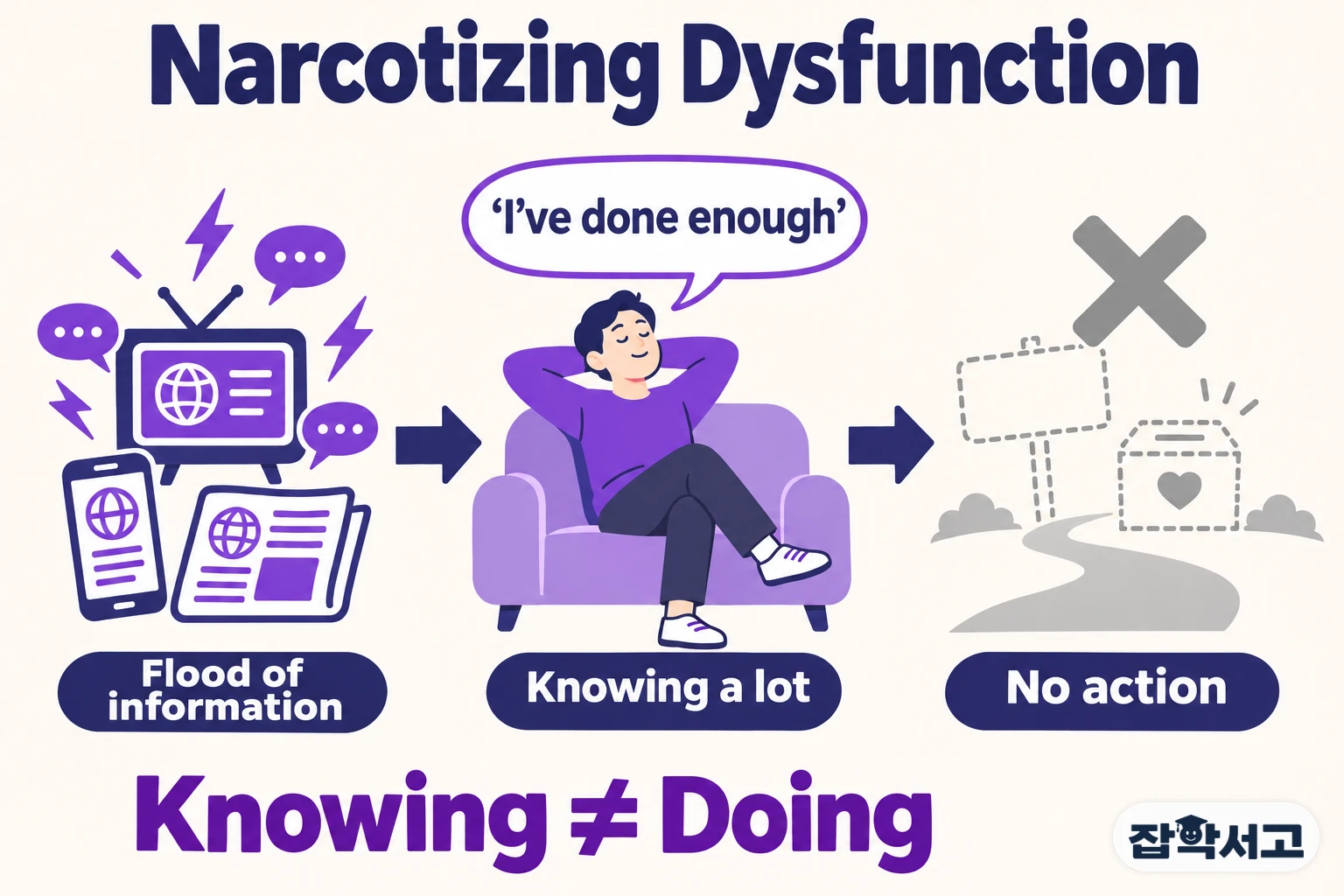
Have you ever watched the news for more than an hour and come away feeling as if you had done your part for the world? Following the news closely makes us feel engaged with what is going on, yet very often nothing in our behavior actually changes. Communication research calls this paradox, in which the flood of information from the media ends up keeping people from acting, the ‘narcotizing dysfunction.’
Put simply, the narcotizing dysfunction means ‘a phenomenon in which the abundance of information from the mass media makes people numb and passive rather than moving them to act.’ The term was coined in 1948 by Columbia University sociologists Paul F. Lazarsfeld and Robert K. Merton in their paper “Mass Communication, Popular Taste and Organized Social Action.”
In this article, we will look in turn at the background in which the narcotizing dysfunction was first proposed, the three social functions of the mass media and how the ‘narcosis’ works, the new forms it takes in the social media era, and ways to turn information into action.
Media That Make Us Mistake Knowing for Doing
1. The Warning from Lazarsfeld and Merton

In the late 1940s, after the Second World War, radio, newspapers and magazines had become deeply rooted in American homes. Many people expected the mass media to enlighten citizens and strengthen democracy. Lazarsfeld and Merton questioned exactly this optimism.
(1) More information does not mean more participation
The two argued that although people were spending far more time reading articles and listening to broadcasts about social issues, this did not translate into organized action. The more time spent taking in information, the less time was left for actually attending meetings and getting things done.
(2) Soothing the conscience with knowledge
An interested and well-informed citizen can feel satisfied with how much he or she knows, without noticing that no decision or action has actually been taken. The two pointed out that people come to mistake knowing about problems for doing something about them.
(3) Why they called it a ‘dysfunction’
In functionalist sociology, a dysfunction is an effect that harms the social system. Because the two believed that large numbers of politically apathetic and inert citizens are not in the interest of a complex modern society, they called this effect a ‘dysfunction’ rather than a ‘function.’ And because it spreads on its own without anyone intending it, they likened the mass media to one of the most respectable and efficient ‘social narcotics.’
2. Three Social Functions of the Mass Media

Lazarsfeld and Merton summarized what the mass media do in society as three functions. If the first two are forces that move society, the third, the narcotizing dysfunction, was a shadow that had received little attention.
- Status Conferral: People, organizations and issues featured in the mass media are recognized as important and authoritative simply by being featured.
- Enforcement of Social Norms: By publicly exposing deviations from norms, the media create pressure for society to reaffirm and uphold those norms.
- Narcotizing Dysfunction: An excess of information keeps people’s attention on passive knowing rather than action, dulling social participation.
- Political Apathy: The result of accumulated narcotizing dysfunction, a state in which citizens know about public issues yet do not take part.
The three functions are not separate from one another. When the press gives an issue heavy coverage, the issue gains important status; but when the same issue pours in every day, people easily feel that simply consuming the news is enough. The narcotizing dysfunction is less a fault of the press than a side effect of information that is too abundant and too easily available.
3. The Narcotizing Dysfunction in the Social Media Era

What worried Lazarsfeld and Merton were radio and newspapers, but the concept is cited even more often today, when smartphones and social media deliver news all day long. A simple scroll brings the world’s problems in an endless stream.
(1) Participation with a single click: slacktivism
Low-effort gestures of support such as pressing ‘like’ or sharing a post are called ‘slacktivism,’ a blend of slacker and activism. In experiments by Kirk Kristofferson’s team published in the Journal of Consumer Research in 2014, people who showed a small token of support in front of others were less likely to go on to give more meaningful help such as donating or volunteering, whereas those who showed support privately tended to follow through with greater help.
(2) Mounting fatigue: compassion fatigue
When we encounter tragic news too often, our initial shock and sympathy gradually wear off. In her 1999 book “Compassion Fatigue,” American journalism scholar Susan D. Moeller argued that when the media cover disease, famine and war repeatedly in the same way, audiences grow weary and indifferent.
(3) The endless stream created by algorithms
Recommendation algorithms keep adding news that will hold users’ attention longer. Watching infuriating and worrying stories one after another strengthens the feeling of taking part in something, but often all we have actually done is scroll. Combined with a filter bubble that gathers only the news we want to see, the illusion of knowing the world well can grow even stronger.
4. Turning Information into Action

The narcotizing dysfunction does not mean we should stop watching the news. Knowing is the starting point for action; the problem is stopping at knowing.
(1) Narrow your focus to one issue
If you try to follow every problem, it is hard to act on any of them. Choose one or two issues to follow steadily and decide on one concrete action for them, such as signing a petition, donating, volunteering or voting, so that knowledge leads more easily to action.
(2) Reporting that also covers solutions
Within journalism, too, there has been reflection that reporting that only lists problems deepens a sense of helplessness. ‘Solutions journalism,’ which also reports on responses to problems along with their effects and limits, is an attempt to restore readers’ sense that there is something they can do.
(3) Start small and close to home
Big problems far away easily make us feel powerless, but nearby matters such as tending a neighborhood park, joining a local group or voting in local elections let us see the results of our actions with our own eyes. The sense of efficacy gained from small actions becomes the power that drives the next one.
After switching off the news, it helps to make a habit of asking once more, ‘So what did I actually do today?’ The simple idea that ‘knowing is only the beginning of doing and can never replace it’—that is the first step toward understanding the narcotizing dysfunction.