Have you ever signed a petition on the street just to be helpful, only to find it hard to say no when the same group asked a few days later for a regular donation? People who first agree to a small request become more likely to agree to a larger one later. A persuasion method built on this tendency is called the ‘Foot-in-the-Door Technique.’
Simply put, the foot-in-the-door technique means that ‘if you first win agreement to a request so small that it is hard to refuse, a larger request made some time later—the one you really wanted—becomes more likely to be accepted.’ The name comes from door-to-door salespeople who would wedge a foot into a closing door to keep the conversation going, and in 1966 Jonathan Freedman and Scott Fraser of Stanford University in the United States were the first to demonstrate it systematically in experiments.
In this article, we will look in turn at the famous first experiment with front-yard signs, the psychological reasons why a small yes leads to a big yes, the conditions that strengthen or weaken the effect, and finally its everyday uses and the opposite technique.
The Psychology of Persuasion: How a Small Yes Invites a Big Yes
1. The Big Sign That Arrived Two Weeks Later

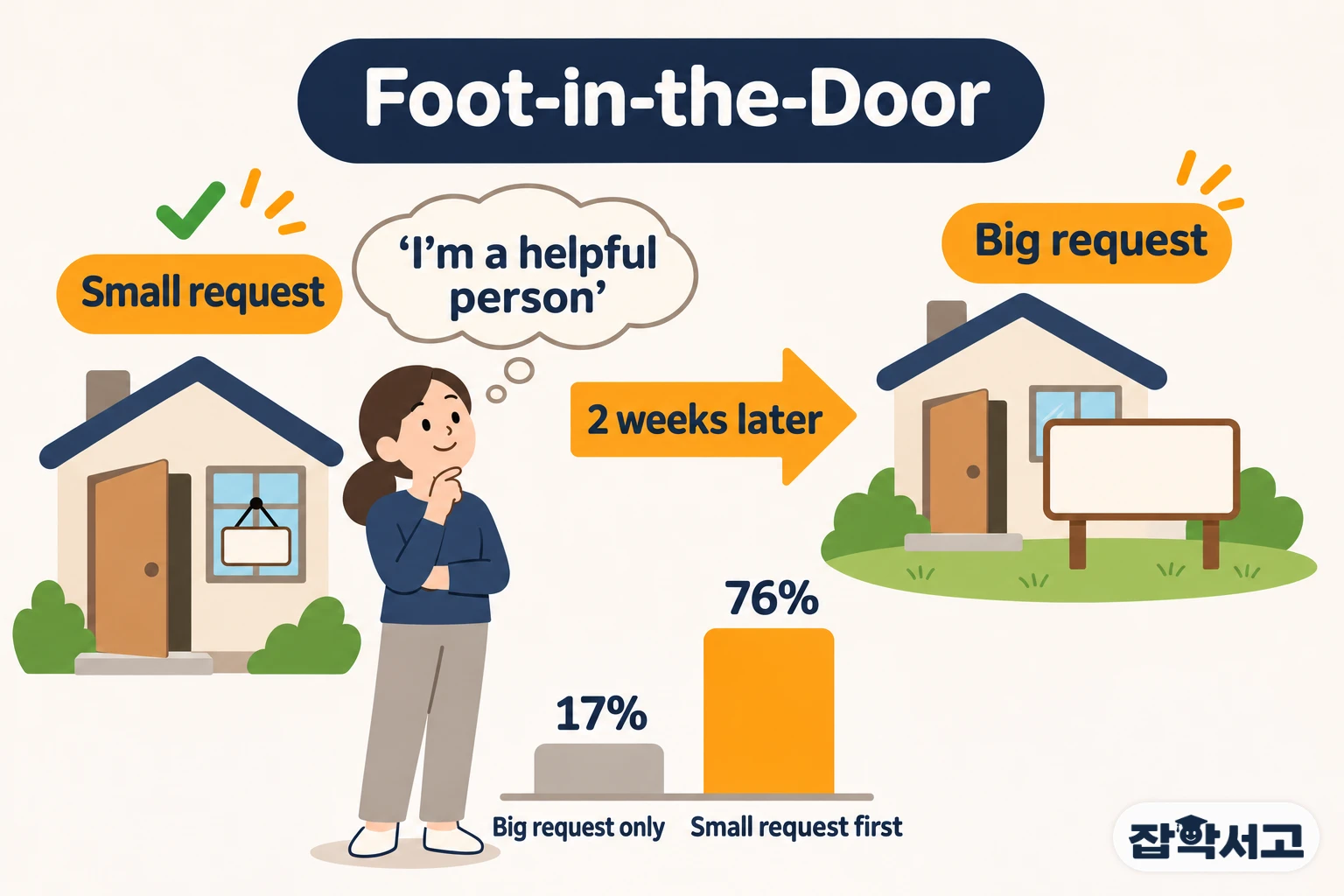
Freedman and Fraser ran their experiment by going door to door in residential neighborhoods of Palo Alto, California. The researchers asked homeowners to put up a large sign urging ‘safe driving’ in their front yard for 7 to 10 days; the sign was poorly lettered and unattractive, so it was not an easy request to accept. In another experiment in the same paper, housewives who had answered a few questions about household products were more than twice as likely as housewives hearing the request for the first time to agree, three days later, to let five or six men come into their home and spend two hours examining their household goods.
(1) The small request that came first
Two weeks earlier, the researchers visited some households and made a light request: to put up a small sign about 3 inches (about 7.6 cm) square reading ‘Be a safe driver,’ or to sign a petition supporting safe-driving legislation.
(2) Households that got only the big request
Of the households asked for the large front-yard sign right away, with no small request beforehand, only about 17% agreed. For most people, planting an unsightly sign in their yard was a burdensome demand.
(3) A striking 76%
By contrast, 76% of the households that had earlier accepted a small sign on the same topic allowed the large sign. Even households that had received a small request on a completely different topic, such as ‘Keep California Beautiful,’ agreed at an average rate of 47%, showing that the effect appeared even when the first request was about something else.
2. Why One Yes Changes Who You Are

Why does a single small request change a decision made two weeks later? The researchers explained that in the course of granting the first request, people change the way they see themselves.
- Self-Perception Theory: The theory, proposed by psychologist Daryl Bem, that people observe their own behavior and infer their attitudes from it.
- Consistency Principle: The tendency to act in ways that do not contradict what one has already said or done, which makes it harder for someone who has said yes once to refuse a similar follow-up request.
- Self-Image: The ideas people hold about themselves, such as ‘I am someone who cooperates with this kind of thing,’ which can shift with even one small action.
- Sequential Request Technique: An umbrella term for persuasion methods that make requests in a planned order rather than all at once.
In short, a person who put up the small sign comes to see themselves anew: ‘I put this up without getting anything in return, so I must be someone who cares about public causes like safe driving.’ Refusing the big request two weeks later would clash with this new self-image, so they find it easier to agree than someone who received the big request from the start. This explanation also connects with cognitive dissonance, the urge to reduce the discomfort that arises when thoughts and actions conflict.
3. When the Effect Grows and When It Weakens

The foot-in-the-door technique has been confirmed again in many later studies, but it is not magic that always works. Analyses that pool many studies show that the size of the effect is generally modest and that it grows or weakens depending on several conditions.
(1) A yes given freely, without reward
If people receive a reward such as money or a gift for the first request, they tend to think ‘I did it for the reward,’ so their self-image changes little and the effect weakens accordingly.
(2) Time gap and actual action
The two requests are often separated by a few days to a few weeks. Many results also show that the effect is stronger when people actually do something for the first request, such as putting up a sign or signing a petition, rather than simply agreeing in words.
(3) Strongest for requests that help others
Many studies find that it works especially well for prosocial requests such as safe driving, blood donation, and recycling. For donation requests that cost money, however, the evidence is mixed, with some studies showing a clear effect and others not.
4. From Free Samples to the Opposite Technique

The foot-in-the-door technique is hidden throughout the marketing and campaigns around us. There is also a technique that does the reverse and opens with a big request, and setting the two side by side makes the principles of persuasion easier to see.
(1) Foot-in-the-door strategies in daily life
Free samples at the supermarket, one-month free trials, and requests like ‘just one survey question’ are all devices for winning a small yes first. A 1983 study also found that when households that had signed a petition two weeks earlier were asked for a donation, both the share of households that gave and the amount raised were higher.
(2) The opposite technique: door-in-the-face
In 1975, Robert Cialdini’s research team reported that when college students were asked outright to ‘take a group of juvenile delinquents to the zoo for two hours,’ only about 17% agreed, but when they were first asked a big favor—‘volunteer as a counselor two hours a week for two years’—and refused, 50% agreed to the same zoo request. This is called the ‘Door-in-the-Face’ technique.
(3) The power of noticing
Knowing this technique helps you avoid letting a small yes make your next decision for you. When you receive a big request, asking yourself ‘Would I have agreed if this had been the only request from the start?’ helps you judge the request in front of you on its own, regardless of earlier agreements.
‘One small yes changes me, and the changed me accepts the next request’—this simple idea is the first step to understanding the foot-in-the-door technique.