A person who has come to believe, after several failures, that “I’m just someone who can’t do it” no longer reaches out, even when an opportunity comes along. If someone else steps in and solves the problem for them, the immediate difficulty may ease, but that does not give them the strength to stand on their own. The key concept that pushed social welfare beyond “giving help” toward “helping people regain their power” is “empowerment.”
Put simply, empowerment means “the process by which individuals and groups build the power to participate in and control the decisions that affect their own lives.” In Korean it is commonly translated as “capacity building,” and today it is one of the most widely used perspectives in social work practice.
This article lays out, in an easy-to-understand way, everything from the origins and concept of empowerment to the strengths perspective that supports it, the three dimensions in which power grows, and the three stages of practice used in the field.
The Concept and Practice Principles of Empowerment
What Is Empowerment?

The person who brought the term “empowerment” to wide attention in social welfare was the American social work scholar Barbara Solomon. In her 1976 book Black Empowerment, she pointed out that the “powerlessness” experienced by people in communities facing discrimination is not a personal defect but a result created by society.
This powerlessness also resembles what psychology calls “learned helplessness.” In 1967, Martin Seligman showed through experiments that animals that had repeatedly experienced inescapable shocks did not even try to escape later, even when a way out was opened. Since repeated frustration leaves people, too, with the belief that “there’s no point in trying,” empowerment begins precisely by breaking this belief.
This idea was also influenced by the Brazilian educator Paulo Freire. In Pedagogy of the Oppressed, he emphasized “conscientization,” in which oppressed people come to critically recognize their own situation. Empowerment can be seen as the process by which this awareness leads to real action and change.
- Paternalistic perspective (paternalism): An approach in which experts diagnose the problem and hand down solutions.
- Empowerment perspective: The person concerned takes ownership of solving the problem, and the expert becomes a collaborator who finds the way together with them.
The Strengths Perspective That Supports Empowerment

For empowerment to be possible, the way we look at people must change first. The “Strengths Perspective,” developed in the early 1990s by Dennis Saleebey and colleagues at the University of Kansas in the United States, proposed starting from the strengths people have rather than their deficits.
(1) Everyone has strengths
No matter how difficult their circumstances, individuals, families, and communities have resources such as talents, experiences, relationships, and hope. A diagnosis or a list of problems is not the whole of a person.
(2) Hardship can be both a wound and an opportunity for growth
Illness, loss, and hardship are undoubtedly painful, but the experience of enduring them can also become a source of new strength and wisdom.
(3) Limits on growth are not set in advance
The moment an expert concludes that “this is as good as it gets,” the possibility of change closes. Taking the person’s dreams and goals seriously is the starting point.
(4) The environment is full of resources
Beyond formal services, resources that sustain life are hidden everywhere—neighbors, religious groups, neighborhood shops, and self-help groups.
The Three Dimensions in Which Empowerment Grows
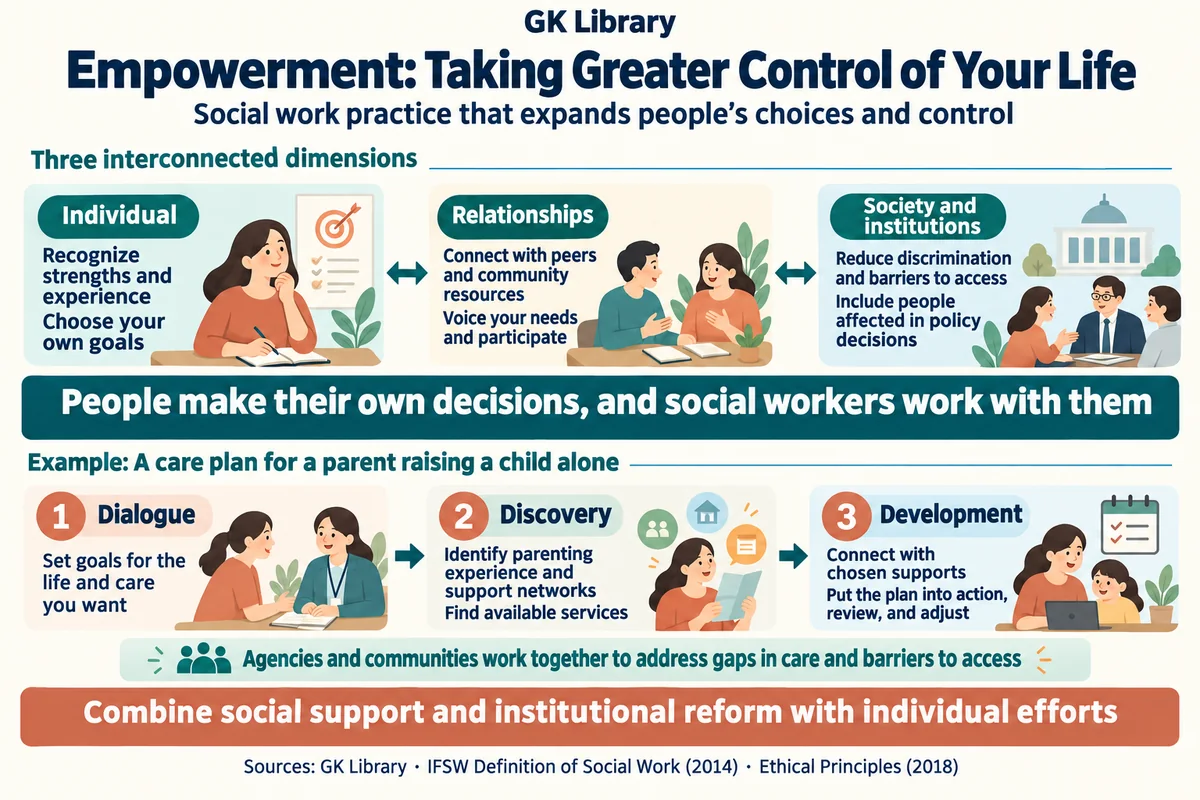
Empowerment is not just about changing one person’s mindset. Social work scholar Lorraine Gutiérrez and others explained that power begins within the individual and expands into relationships and society.
- Personal dimension: The stage of recovering self-efficacy and self-esteem—the sense that “I can do it too.”
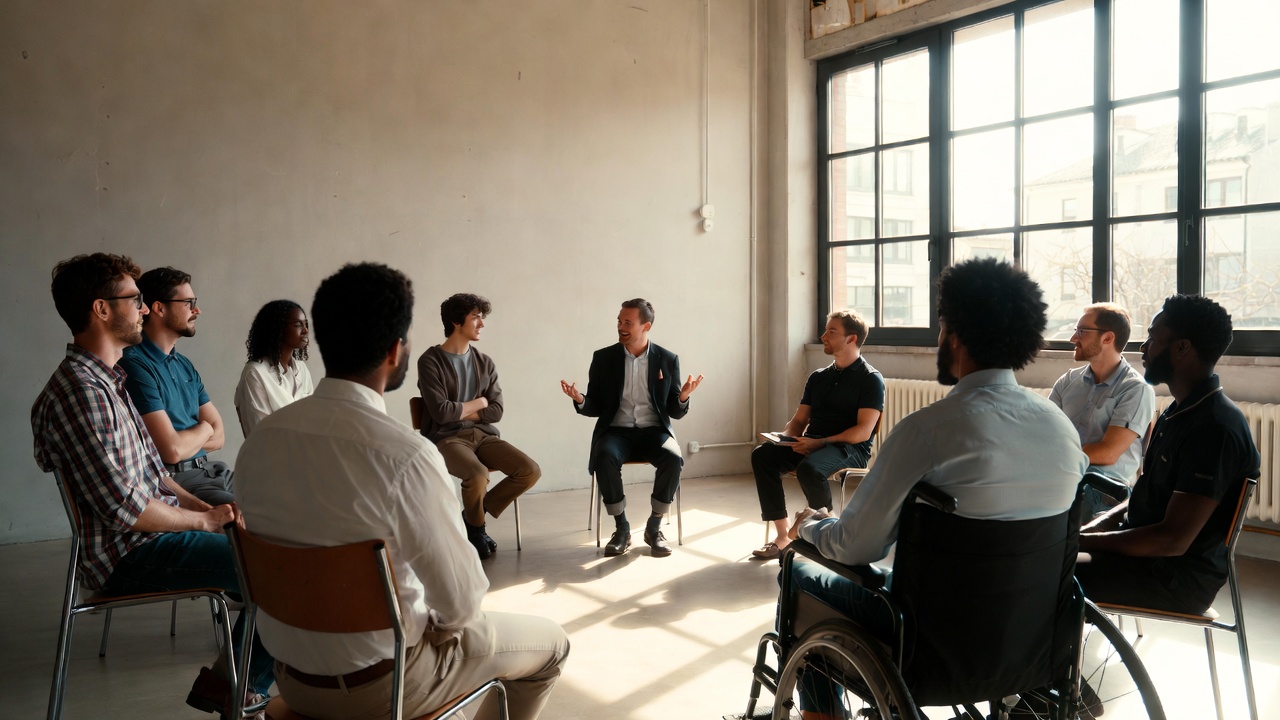
- Interpersonal dimension: Connecting with people who have had similar experiences to share knowledge and skills, and building the power to state one’s own needs clearly.
- Socio-political dimension: The stage of joining voices together to take part in changing institutions and policies.
The disability rights movement’s slogan, “Nothing About Us Without Us,” illustrates the third dimension well. It means that the people concerned should not remain mere objects of policy but should step forward as agents who shape it.
Dialogue, Discovery, Development: The Three Stages of Empowerment Practice

In the field, the three-stage model proposed by Miley, O’Melia, and DuBois is widely used. The key point is that at every stage, the person concerned and the social worker work as equal partners.
[Stage 1] Dialogue
The two build a relationship of mutual trust and together clarify what change the person wants. At this stage, they ask “What kind of life do you want?” before asking “What is the problem?”
[Stage 2] Discovery
They identify the strengths and resources hidden in the person and their surroundings. For example, for a parent raising a child alone, resources might include the resilience that has carried them through so far, relatives who can help, and local cooperative childcare groups.
[Stage 3] Development
They connect the resources they have found to carry out a concrete plan, recognize small successes together, and move toward the next goal. Through this process, the person gradually builds experience in solving problems on their own.
Empowerment signifies a shift from “welfare that does things for people” to “welfare that builds strength together.” However, this concept must not be used to shift responsibility by saying, “Now figure it out yourself.” Because there are structural barriers that individual effort alone cannot overcome, true empowerment is achieved only when social support and institutional improvement go hand in hand.
When you want to help someone, try asking “What can you do?” before asking “What can I do for you?” Believing in the strength that already lies within the other person—that is the first step toward someone becoming the master of their own life once again.