Unemployment benefits are an important social safety net that provides financial stability when workers unexpectedly lose their jobs. Provided as part of the employment insurance system, unemployment benefits go beyond financial assistance to offer various forms of support that help recipients prepare for reemployment and successfully return to work.
This article explains the definition and role of unemployment benefits, eligibility criteria and requirements, application procedures, precautions during the benefit period, and frequently asked questions in detail.
Defining Unemployment Benefits: Their Role as a Social Safety Net

The Definition and Social Role of Unemployment Benefits
Unemployment benefits are a system that provides financial assistance to unemployed workers for a certain period. Operated as part of employment insurance, the system provides workers with the financial foundation needed to maintain their livelihoods and prepare for reemployment even when they unexpectedly lose their jobs. Employment insurance premiums are shared by the government and businesses to create a funding pool, which enables unemployed workers to receive benefits.
This system goes beyond helping individuals maintain their livelihoods and functions as an important social safety net that strengthens the financial stability of society as a whole. By helping workers feel less financial pressure and continue spending, unemployment benefits can have a positive impact throughout the economy. In this respect, unemployment benefits are more than financial assistance; they are a system that helps maintain economic vitality.
Providing Time to Prepare for Reemployment and Opportunities to Choose a Career
Unemployment benefits give workers time to prepare for reemployment without rushing to find a job after becoming unemployed. While receiving benefits, workers can carefully explore occupations that suit them and, if necessary, acquire new skills or receive job training. This gives workers an opportunity to choose a job that offers long-term stability, rather than one that merely sustains their livelihood.
If workers develop their capabilities and choose occupations that allow them to use their talents during this process, the quality of the labor market also improves. This increases workers' job satisfaction while, over the long term, producing the positive effect of bringing better human resources into the economy as a whole.
Increasing Labor Market Flexibility and Supporting Economic Transition
Unemployment benefits play an important role in increasing labor market flexibility. When economic conditions change rapidly or particular industries shrink, workers often have no choice but to change occupations. Unemployment benefits help workers explore new opportunities without financial burdens during these career transitions.
When workers can find new jobs without being overwhelmed by financial insecurity, they can respond flexibly to changes in industrial structure and promote the creative restructuring and development of the economy. As a result, increased labor market flexibility also makes workforce movement smoother during industrial restructuring. This cycle has a positive impact on the stability of the national economy as a whole.
Reducing Social Inequality and Strengthening Economic Inclusion
Unemployment benefits provide a particularly important layer of protection for groups in vulnerable positions in the labor market. They help people who have lost their jobs minimize the financial shock of unemployment and prevent the risk of falling into poverty.
Unemployment benefits also make an important contribution to reducing social inequality. By guaranteeing a certain level of income, they protect low-income and vulnerable groups from financial decline and further contribute to creating a socially inclusive economic environment. This plays an important role in breaking the vicious cycle of poverty and achieving social integration.
Unemployment benefits are an important system that supports workers' livelihoods after job loss and promotes reemployment. Beyond providing financial stability, they make an important contribution to increasing labor market flexibility and reducing social inequality. This allows individuals to find new jobs without financial pressure while helping society as a whole maintain stable economic vitality. Effective use of unemployment benefits can bring positive changes to individual workers and society as a whole.
Eligibility for Unemployment Benefits: Conditions and Requirements

Eligibility for Unemployment Benefits: Basic Requirements for Support
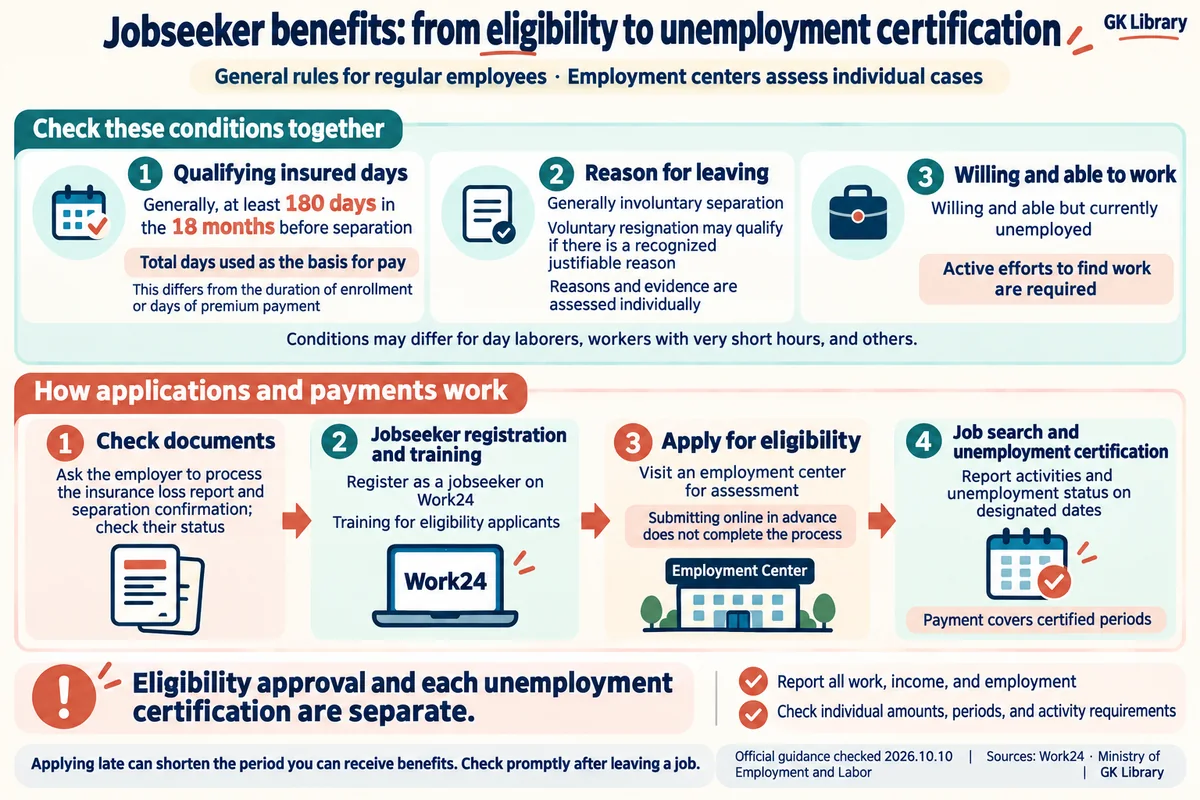
To receive unemployment benefits, workers must first meet several basic eligibility requirements. One of the most important conditions is enrollment in employment insurance. Workers must have been enrolled in employment insurance for a certain minimum period, and a record of premium payments covering at least 180 days is generally required. In this case, the premiums are based on the amounts jointly paid by the worker and employer.
Because employment insurance is a system designed to provide financial stability when workers lose their jobs, this basic requirement must be met to qualify for benefits.
Requirements Concerning Involuntary Job Loss
Unemployment benefits are paid to workers who lose their jobs involuntarily. In other words, workers who voluntarily resign are generally not eligible for unemployment benefits. However, departures due to unfair dismissal, a company's business circumstances, or unavoidable personal circumstances may be recognized as exceptions, allowing workers to receive benefits.
Involuntary job loss refers to unemployment that occurs in circumstances where a worker has not unilaterally chosen to resign, and unemployment benefits are paid only in these cases. The reason for a worker's job loss is therefore an important criterion in determining eligibility.
Proof of Job Search Activities and Willingness to Return to Work
To continue receiving unemployment benefits, recipients must consistently engage in job search activities. Beyond financial assistance, this is an important requirement that demonstrates recipients are actively working toward reemployment. Job search activities are managed through official channels such as employment support centers and Worknet, and recipients must submit documentation proving that they have engaged in these activities.
Unemployment benefits are a system established as part of the process of returning to work, going beyond simply helping unemployed people. Willingness and effort to search for work are therefore essential, and recipients must fulfill these responsibilities diligently to receive benefits.
Conditions Concerning the Ability to Work and the Intention to Return to Employment
Having the ability to work and the intention to return to employment is another important condition for eligibility. Unemployment benefits are paid on the premise that workers have both the ability and willingness to work. Therefore, people who are unable to work for health reasons or have no intention of finding employment cannot receive unemployment benefits.
This condition emphasizes that unemployment benefits are a system that helps workers participate in economic activity again, rather than merely a form of welfare. Clearly demonstrating the ability to work and the intention to return to employment is essential to receiving benefits.
Income Limits and Other Restrictions on Benefits
Unemployment benefits may be restricted or withheld if recipients have other sources of income or earn income above a certain level. This is a mechanism for preventing overlapping support and ensuring that unemployment benefits are concentrated on those who need them. When recipients have other income, earnings above a specified threshold may affect their receipt of unemployment benefits.
This helps ensure that appropriate support reaches those who need financial assistance and improves the operational efficiency of the unemployment benefit system.
Unemployment benefits are an important system that provides financial stability for a certain period to workers enrolled in employment insurance who have lost their jobs involuntarily. However, receiving benefits requires meeting various conditions, including a record of employment insurance enrollment, involuntary job loss, proof of job search activities, the ability to work and willingness to return to employment, and income limits. Thoroughly understanding and preparing for these requirements is the first step toward using unemployment benefits effectively.
Applying for Unemployment Benefits: A Step-by-Step Guide

Registering as a Job Seeker: The First Step
To receive unemployment benefits, workers must register as job seekers immediately after losing their jobs. The first step is to visit the employment center responsible for their area, formally report their unemployment, and register as a job seeker. This registration is a mandatory procedure for applying for unemployment benefits and an important step that begins the process of confirming job loss and reviewing eligibility.
Registering as a job seeker allows workers to receive support from the employment center and marks both the beginning of the application process and the first step toward reemployment.
Completing the Unemployment Benefit Application and Preparing Documents
Once job seeker registration is complete, workers fill out an unemployment benefit application at the employment center. Documents needed for the application include a certificate confirming job loss from the previous employer and proof of employment insurance premium payments. These documents are used to review the reasons for job loss and the history of employment insurance enrollment, and they are important materials for confirming eligibility.
Missing or insufficient documents may delay benefit payments, so it is important to prepare the required documents in advance.
The Interview and Development of a Job Search Plan
After the application and documents have been submitted, an interview takes place at the employment center. This interview provides an opportunity to discuss the reasons for job loss and the job search plan in depth, including the development of a specific reemployment plan tailored to the worker's circumstances. Through counseling, the center checks whether the recipient meets the benefit requirements and provides specific guidance on how to prepare for reemployment.
This process is more than a procedural step; it is an important opportunity to lay the groundwork for actually returning to work.
Application Review and the Decision on Benefit Payments
Once all application documents and counseling details have been finalized, the employment center reviews them comprehensively and decides whether to pay unemployment benefits. This process is usually completed within 14 days, and once eligibility is confirmed, benefits are paid into the designated account. The payment period and amount vary according to the individual's employment insurance premium payment history and the reasons for job loss.
Through this process, the employment center supports workers' preparation for reemployment, while recipients can maintain financial stability after job loss through unemployment benefits.
Regular Reports on Job Search Activities: Maintaining Eligibility
Recipients must regularly report their job search activities while receiving unemployment benefits. This is an important procedure for demonstrating continued efforts to find work during the benefit period. Regular reporting mainly takes place through an online system, and recipients must submit records of their job search activities at specified intervals according to the employment center's guidelines.
Neglecting these reports may result in benefit payments being suspended, so demonstrating active efforts to find work is essential.
Benefit Duration and Payment Amount
The duration of unemployment benefits is determined by the length of the worker's employment insurance premium payment history and the reasons for job loss. Benefits are generally paid for a minimum of 90 days and a maximum of 240 days, with the aim of giving recipients the time they need to find a new job. The longer workers have been enrolled in employment insurance, and the more their reasons for job loss involve circumstances that make reemployment difficult, the longer they can receive unemployment benefits.
The amount of unemployment benefits is calculated based on the wages workers received before losing their jobs. Generally, approximately 60% of the average wage before leaving employment is paid as unemployment benefits. For example, if a worker received an average monthly salary of 200 ten-thousand-won units before becoming unemployed, they could receive approximately 120 ten-thousand-won units in unemployment benefits.
However, unemployment benefits have upper and lower limits to prevent payments from being excessively high or low. The approximate upper limit is 76,000 won per day, and the lower limit is 63,336 won per day. Calculated monthly, recipients can receive a maximum of approximately 228 ten-thousand-won units and a minimum of approximately 190 ten-thousand-won units per month.
Unemployment benefits are an important system that goes beyond financial assistance to give recipients sufficient time to prepare for reemployment, and the duration and amount of benefits are adjusted flexibly according to recipients' circumstances.
The application process for unemployment benefits proceeds through a series of steps, beginning with job seeker registration and continuing through completing the application, attending an interview, and submitting regular reports. This entire process goes beyond financial assistance and forms part of a systematic support program for reemployment. Unemployment benefits are an important system that helps workers maintain a stable livelihood after job loss and find new employment.
Precautions While Receiving Unemployment Benefits and Frequently Asked Questions

Precautions While Receiving Unemployment Benefits
Several important points require attention while receiving unemployment benefits. First, any additional income must be reported immediately. Because unemployment benefits are a system for replacing income during unemployment, additional income may lead to adjustments in the benefit amount or a suspension of payments. In particular, failing to report additional income may be considered fraudulent receipt of benefits and result in legal penalties, so fully complying with reporting obligations is essential.
Regular reports on job search activities are also mandatory. Recipients must periodically submit records of their job search activities to demonstrate that they are continuing to look for work. Neglecting this obligation may result in benefit payments being suspended, and examples of job search activities include using recruitment websites and attending job fairs organized by employment centers. These activities must represent concrete efforts to return to work, rather than merely fulfilling a formality.
Eligibility After Voluntary Resignation
A frequently asked question is whether people who resign voluntarily can receive unemployment benefits. In principle, voluntary resignation does not qualify for benefits, but exceptions may be possible when there are unavoidable reasons. For example, people who leave their jobs for health reasons or to care for family members may qualify if they submit documents proving these circumstances. In such cases, the employment center comprehensively assesses each person's circumstances to decide whether benefits should be paid.
Recognition of Volunteer Work and Alternative Activities During the Benefit Period
For some older recipients or those in particular circumstances, volunteer work or educational activities may substitute for job search activities. Older workers or recipients facing difficulties in returning to work can consult the employment center about meeting job search requirements through volunteer work or activities that contribute to society. However, volunteer work must receive prior approval from the employment center to be recognized as a job search activity, and the activities must demonstrate that recipients are maintaining abilities suitable for reemployment and contributing to social activities. These alternative activities offer an appropriate approach for people who face relatively greater difficulty returning to work, such as older people and people with disabilities, giving them an opportunity to receive unemployment benefits while maintaining social participation.
Reporting Overseas Travel and Extended Stays Abroad During the Benefit Period
Because unemployment benefits are premised on job search activities within the country, recipients must notify the employment center in advance if they plan to travel overseas or leave the country for an extended period. An extended stay abroad may be grounds for suspending benefit payments and serves as a criterion for determining whether job search activities are actually taking place. Therefore, any travel or departure plans must be reported to the employment center, and whether benefits continue to be paid is determined according to the reason.
Whether an Extension of Unemployment Benefits Can Be Requested
There are also many inquiries about whether an extension can be requested when recipients still have difficulty finding work after their benefit period ends. Unemployment benefits are generally paid for a specified period, but an extension may be possible in exceptional economic circumstances or when reemployment is extremely difficult. An extension application must undergo review by the employment center, and an additional job search plan must be submitted. Older people, people with disabilities, and people living in areas facing a severe economic crisis are more likely to have their applications for extended benefits approved.
Other Cases: Self-Employed People, Non-Regular Workers, and Workers in Special Employment Arrangements
Self-employed people and non-regular workers may also be eligible for unemployment benefits. Employment insurance coverage has recently expanded, opening a path for self-employed people and workers in special employment arrangements to enroll, which allows them to receive unemployment benefits when they become unemployed. People who worked in special employment arrangements can apply for unemployment benefits if they lose work because their contracts expire or there is insufficient work available, and self-employed people can also qualify when their businesses close if they meet certain conditions.
While receiving unemployment benefits, recipients must carefully comply with various requirements, including reporting income, regularly reporting job search activities, and reporting overseas travel. They can also consult the employment center to address various circumstances, such as eligibility after voluntary resignation, recognition of volunteer work as a substitute activity for older people or people with disabilities, and the possibility of extending the benefit period. Unemployment benefits are an important system that goes beyond financial assistance to help recipients prepare for reemployment, and using them effectively requires an accurate understanding of the various requirements and procedures and diligent compliance with them.
Unemployment benefits play an important role in helping workers overcome financial difficulties after job loss and find new employment. They enable individuals to maintain financial stability while contributing to the continuation of economic activity in society.
Clearly understanding the eligibility conditions and procedures for unemployment benefits is essential to using the system efficiently. It is therefore hoped that unemployment benefits will be accurately understood and appropriately used.