Welfare administration is a system that plays an important role in improving citizens' quality of life and strengthening the social safety net. It serves as an essential foundation for addressing various social problems and ensuring that all citizens receive the services and resources they need.
This material examines the fundamental importance and role of welfare administration and analyzes policy approaches and strategies for its effective development. It also aims to explore ways to achieve sustainable development and present the direction that welfare administration should take in the future.
The Importance of Welfare Administration: The Foundation for Building a Social Safety Net

The Role of Welfare Administration: The Basis for Building a Social Safety Net
Welfare administration plays an essential role in building a social safety net. A social safety net is a system that helps citizens secure a minimum standard of living when they face unforeseen accidents or economic crises, allowing them to maintain a basic quality of life. Welfare administration serves as a key mechanism for putting this safety net into practice by providing citizens with various forms of support.
This safety net is established through the various programs and policies of welfare administration. As a basic mechanism for addressing problems throughout society, including poverty, unemployment, illness, and population aging, welfare administration helps all citizens enjoy equitable opportunities. In doing so, it plays an important role in achieving social integration and reducing economic inequality and discrimination.
Welfare administration also contributes to alleviating social insecurity and increasing community stability. When welfare systems operate effectively, citizens' livelihoods become more secure, promoting the well-being and development of society as a whole. This minimizes the risks faced by individuals and families and strengthens social solidarity and interdependence at the national level.
Reducing Economic Inequality and Promoting Social Integration
Welfare administration is an important means of reducing economic inequality. As income disparities and the gap between rich and poor widen, social insecurity and conflict increase, making welfare administration at the national level necessary to address these problems. Welfare administration provides direct financial support to low-income and vulnerable groups, thereby contributing to economic equality.
Welfare administration also promotes social integration by providing equal opportunities to all citizens. By supporting individuals' economic independence and providing opportunities for upward social mobility, it increases trust among members of society. Beyond economic support, welfare administration seeks to improve citizens' quality of life in various areas, including education, health, and housing.
Alleviating Social Insecurity and Increasing Community Stability
Welfare administration plays an important role in alleviating social insecurity. Social insecurity arises from various risk factors, including poverty, unemployment, and illness, and these problems affect not only individuals but also the community as a whole. Welfare administration increases community stability by establishing systems to prevent and respond to these problems.
In particular, welfare administration makes citizens' lives more secure by providing psychological security alongside financial support. This helps reduce the disruption that can arise from social inequality or conflict and strengthens overall social stability. Community members cooperate with one another through welfare systems, building trust and solidarity in the process.
Community Development and the Role of Welfare Administration
Welfare administration also makes an important contribution to community development. Welfare programs implemented in each locality build the community's economic and social capital through residents' direct participation and cooperation. This process drives community development by stimulating the local economy and strengthening relationships among local residents.
Welfare administration in local communities reduces regional imbalances, particularly through support for marginalized or vulnerable groups, and ensures that all residents can enjoy welfare benefits fairly. This enables sustainable development at the local level and, in the long term, contributes to balanced development across the entire country.
The State's Social Responsibility and Welfare Administration
Welfare administration is a major means of fulfilling the state's social responsibility. The welfare services that the state provides to citizens go beyond simple assistance, and their importance is increasingly emphasized in the international community as well. In developed countries in particular, the development of welfare systems is recognized as playing an important role in enhancing national standing and improving citizens' quality of life.
The development of welfare administration is also directly linked to the development of the country as a whole. When welfare policies guarantee citizens' basic living conditions, productivity throughout society also improves. This is closely related to the country's long-term economic growth, and when welfare administration is properly implemented, both citizens' quality of life and the country's international standing improve.
Core Functions of Welfare Administration

The Main Roles and Functions of Welfare Administration
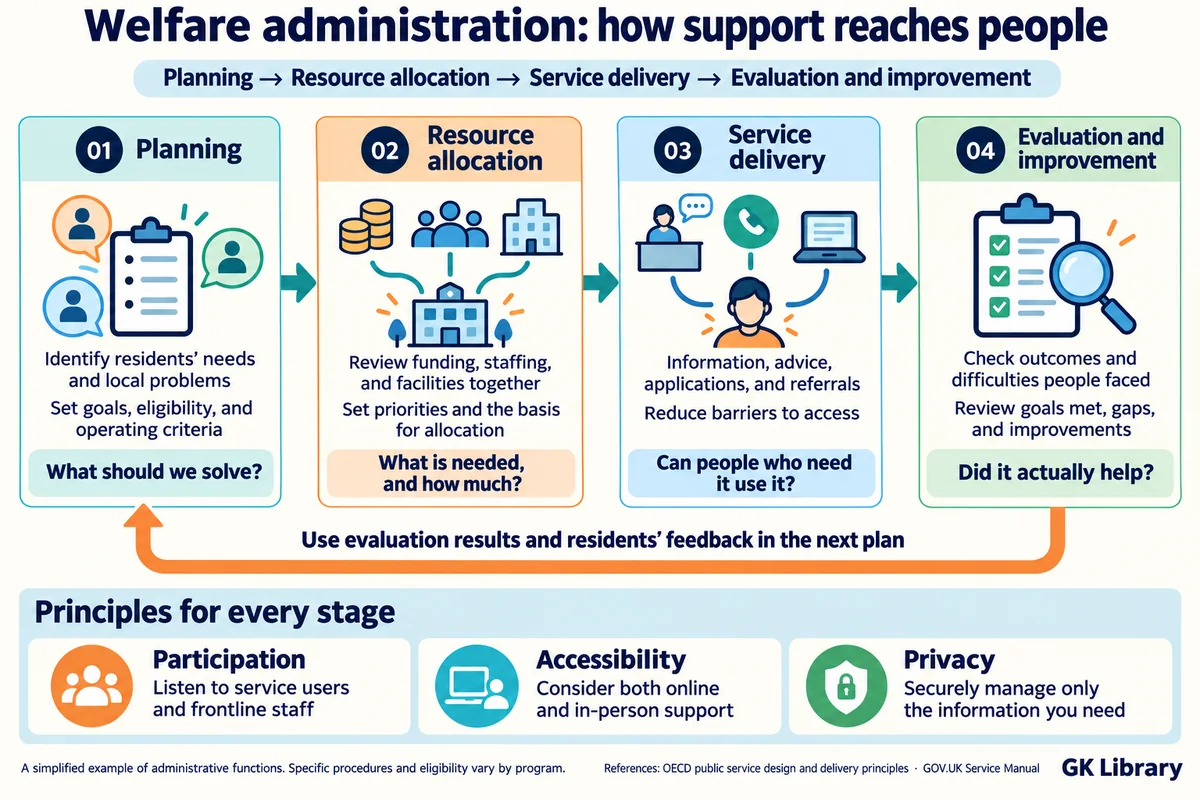
Welfare administration plays a central role in promoting citizens' welfare through a multidimensional approach. Important functions in this process include policy planning and formulation, resource allocation, service delivery, monitoring and evaluation, and social advocacy and participation. These functions help welfare administration operate effectively and respond promptly to social needs.
The core functions of welfare administration aim to meet citizens' basic needs and strengthen the social safety net. Policy planning and resource allocation establish the basic framework for welfare services, while service delivery and evaluation provide important procedures for determining whether citizens actually receive welfare benefits. Through these functions, welfare administration lays the foundation for continued development.
Policy Planning and Formulation: Responding to Changing Social Needs
Policy planning and formulation are the starting point of welfare administration and among its most important functions. Through these functions, welfare administration develops policies based on an accurate analysis and understanding of social problems and gains the ability to respond to social needs. In particular, policies must be continually adjusted and developed in line with changing social conditions so that welfare services can be provided to citizens more effectively.
The policy planning process must reflect various social factors and changes, making field research, the collection of expert opinions, and data analysis essential. Systematically analyzing social problems and developing strategies to address them are at the heart of policy planning. When this planning is carried out properly, welfare administration gains the flexibility and responsiveness needed to meet citizens' diverse needs.
Resource Allocation: The Foundation for Efficient Welfare Service Provision
Resource allocation performs an important management function in welfare administration. How limited resources are allocated determines the quality and scope of welfare services, directly affecting the performance of welfare administration. Equitable resource allocation ensures that all citizens have equal access to welfare services, bringing about tangible improvements in their welfare.
Resource allocation goes beyond simply dividing financial resources and includes the efficient use of various resources, such as human and material resources. Allocating resources appropriately to suit each locality and situation is an important factor in determining the success of welfare administration. This can maximize the accessibility and effectiveness of welfare services and prevent resources from being wasted.
Service Delivery: Putting Welfare into Practice on the Ground
Service delivery is the practical implementation stage of welfare administration, referring to the process through which policies are applied directly to citizens on the ground. Welfare administration provides welfare services through various delivery systems, and establishing systems that citizens can easily access is important. Improving service quality and providing individually tailored services are important considerations in this process.
Welfare services must be adjusted to each citizen's circumstances and needs, making prompt and flexible responses on the ground essential. The core of service delivery is to ensure that citizens effectively receive the support they need by providing tailored services that take diverse regional characteristics and population structures into account.
Monitoring and Evaluation: Strengthening Transparency and Accountability
Monitoring and evaluation are essential processes for the continued development of welfare administration. Monitoring provides a feedback process for checking whether welfare administration is operating effectively and improving areas where it falls short. This enables welfare administration to maintain transparency and accountability and establish itself as a system trusted by citizens.
Evaluation is the process of determining whether policy objectives have actually been achieved and is an important stage in measuring how efficiently services are being delivered. It can prevent unnecessary waste of resources and identify improvements needed to provide better welfare services. Monitoring and evaluation are processes that welfare policies must undergo to achieve sustainable development.
Social Advocacy and Participation: Building an Inclusive Welfare System
Social advocacy and participation are important elements in ensuring that welfare administration operates democratically and inclusively. Advocacy for socially disadvantaged and marginalized groups is needed so that all citizens can fairly enjoy the benefits of welfare services, and it is also important to provide opportunities for all members of society to participate in welfare administration.
Social participation means providing opportunities to take part in the formulation and evaluation of welfare policies, in addition to receiving welfare benefits as a beneficiary. This enables citizens to develop into active agents capable of protecting and improving their own welfare, while welfare administration can operate more effectively through their participation and cooperation.
Policy Approaches and Strategies for Developing Welfare Administration

An Integrated Approach to Developing Welfare Administration
An integrated policy approach is essential for the development of welfare administration. Welfare administration can function more effectively when various policy areas are connected and operated in an integrated manner. An integrated approach helps prevent duplication of welfare services and use resources efficiently. This allows welfare services to be delivered more quickly and accurately to where they are needed and enables the systematic operation of the social safety net.
An integrated approach can also maximize the effects of welfare policies by enabling interaction among various sectors throughout society. For example, when education, health, and housing policies are closely connected with welfare administration, the objectives of each area can be achieved more effectively. This enables citizens to enjoy multiple benefits simultaneously and receive comprehensive solutions to various social problems.
Welfare Policies Tailored to Regional Characteristics
Welfare policies tailored to regional characteristics are an essential element in the development of welfare administration. Policies that consider each region's social, economic, and cultural characteristics can reflect residents' actual needs. This means that welfare administration goes beyond unilaterally implementing centrally planned policies to provide more effective services through interaction with local residents.
Policies specific to local areas strengthen the role of local governments and provide opportunities for local residents to participate voluntarily. For example, because social needs differ between rural and urban areas, differentiated welfare policies that account for these differences are necessary. This approach also contributes to stimulating local economies and is an important strategy for promoting balanced community development.
Innovating Welfare Administration Through Technology
The use of information and communications technology (ICT) is an important strategy for significantly improving the accessibility and efficiency of welfare administration. Introducing technology into welfare services speeds up administrative processing and makes it easier for citizens to access welfare services. For example, systems that allow citizens to apply for welfare services through online platforms and check the progress of their applications in real time maximize convenience.
Introducing technology also helps increase the transparency of administrative work and reduce errors caused by inaccurate information. Analysis using big data and artificial intelligence (AI) plays an important role in formulating welfare policies, enabling accurate demand forecasting and resource allocation. Such technological innovation serves as a key element in modernizing welfare administration.
The Importance of Developing and Managing Skilled Personnel
Personnel with professional expertise are essential for the successful operation of welfare administration. Staff capabilities play an important role in improving the quality of welfare services, requiring ongoing education and training. In particular, civil servants and frontline practitioners responsible for welfare administration must develop the ability to respond appropriately to various situations.
To improve the efficiency of personnel management, appropriate training programs suited to each role must be provided, and staff deployment must be optimized. This can make a substantial contribution to improving the quality of welfare services and also plays an important role in increasing the overall operational efficiency of welfare administration. Proper personnel management is a fundamental basis for further raising the standard of welfare services provided to citizens.
Building Cooperation and Partnerships Among Stakeholders
Cooperation among various stakeholders, including the government, the private sector, and nonprofit organizations, is essential for the development of welfare administration. Because welfare administration is difficult to operate through national policies alone, a structure in which multiple stakeholders cooperate in its operation is needed. This cooperation lays the foundation for providing more comprehensive and multifaceted welfare services.
In particular, cooperation with private companies provides opportunities to introduce new resources and technologies into welfare administration. For example, improving the efficiency and accessibility of welfare services through partnerships with the private sector can play an important role in developing welfare administration. This cooperative structure is built on mutual trust and can create a more effective and sustainable welfare system.
Strategies for Ensuring Transparency and Accountability
Ensuring transparency and accountability throughout all processes of welfare administration is essential for earning citizens' trust. Because welfare services are funded by citizens' taxes, their processes must be disclosed transparently, and their operation must be accountable. To achieve this, the transparent provision of information and citizen participation must be guaranteed during policy implementation.
Accountability in policy implementation plays an important role in strengthening the credibility of welfare administration and also serves as a preventive measure against policy failure. When citizens trust welfare administration, greater participation and cooperation can follow, maximizing policy effectiveness.
Future-Oriented Welfare Administration: Directions for Sustainable Development

Environmental Sustainability in Future Welfare Administration
Considering environmental sustainability is essential in future-oriented welfare administration. It is important to minimize the negative environmental impacts of providing welfare services and develop ways to use sustainable resources. For example, welfare administration can contribute to environmental protection by improving the energy efficiency of welfare facilities and introducing environmentally friendly operating methods. This can establish sustainable welfare administration that achieves both a social safety net and environmental responsibility.
To ensure environmental sustainability, an environmentally friendly approach is needed at every stage of public welfare services. This must apply not only to facility operations but also to the overall processes involved in providing welfare services. For example, reducing paper-based administration through digital transformation and introducing energy-saving infrastructure can reduce the environmental impact of welfare administration. In the long term, these changes provide a foundation for welfare administration to contribute to addressing global problems such as climate change.
Economic Sustainability: Efficient Use of Limited Resources
Economic sustainability is a very important element in future welfare administration. Innovative financial management approaches are needed to use limited budgets and resources efficiently. Because welfare services become less efficient and sustainable as resources become scarcer, allocating resources appropriately and identifying new sources of funding are essential. For example, approaches are needed to secure funding for welfare services through public-private cooperation or develop new financial models.
To ensure economic sustainability, the operational system of welfare administration must also be managed transparently and efficiently. Transparent financial management prevents resources from being wasted and increases trust in welfare services. To achieve this, strategies for optimizing resource allocation using big data or financial forecasting models based on artificial intelligence can be introduced to maximize the economic efficiency of welfare administration over the long term.
Strengthening Social Sustainability and Inclusion
The core of social sustainability is ensuring that all members of society can enjoy welfare benefits equitably. Welfare administration must develop policies that consider equity so that benefits are not concentrated among particular groups. This can achieve social integration and, over the long term, increase social harmony and stability. Social sustainability can be strengthened by providing tailored welfare services that reflect the characteristics of diverse groups and regions.
For social sustainability, welfare systems must be accessible and fair to everyone. Support for vulnerable and marginalized groups is particularly important and can reduce social inequality. Citizen participation and the incorporation of citizens' opinions into welfare policies also play an important role, enabling welfare administration to develop in a direction that responds to their needs. Inclusive welfare systems increase solidarity throughout society and ensure that all citizens can fairly enjoy their benefits.
Increasing the Efficiency of Welfare Administration Through Technological Innovation
Technological innovation is an important element in strengthening the competitiveness of future welfare administration. Advanced technologies such as artificial intelligence (AI), big data, and blockchain can significantly improve the efficiency of welfare administration. For example, approaches can be introduced to conduct predictive analysis of welfare service beneficiaries using AI or evaluate the effects of welfare policies in real time using big data. Introducing such technologies strengthens both the transparency and speed of welfare administration.
Technological innovation can also improve access to welfare services. Online platforms allow citizens to access welfare services anytime and anywhere, increasing the efficiency of those services. In particular, simplifying administrative procedures through digital transformation is an important strategy for shortening the time needed to provide welfare services and improving convenience for citizens. Such technological innovation is becoming an essential direction for the development of future welfare administration.
The Need for Global Cooperation and Solidarity
Global cooperation is an important element in developing future welfare administration. Cooperation with the international community can improve the quality of welfare administration by sharing best practices and formulating policies that align with international standards. Drawing on successful welfare administration models from other countries to improve our country's welfare system can also be an effective strategy. Global cooperation goes beyond simple policy exchanges and contributes to establishing global standards for welfare administration.
International cooperation networks can promote the development of welfare administration by sharing experiences with various countries and setting common welfare goals. This enables countries' welfare policies to complement one another and can raise the standard of welfare administration globally. Such cooperation is an important strategy that can contribute both to improving the quality of welfare administration and to strengthening international standing.
Welfare Administration That Strengthens Human Rights and Inclusion
Strengthening human rights and inclusion is a central direction for future welfare administration. Welfare administration that respects every individual's rights and diversity promotes social solidarity and helps expand inclusion. In particular, policies for marginalized and disadvantaged groups must be strengthened to ensure that all citizens receive welfare benefits fairly. Welfare administration centered on human rights plays a role in achieving social integration and increasing society's sustainability over the long term.
Respect for human rights and inclusion means that welfare administration must move beyond simply providing material support toward ensuring each citizen's dignity. To achieve this, various welfare systems and policies must provide equal benefits regardless of gender, age, or disability status. This direction enables welfare administration to function as an important tool for achieving social justice and equality.
Welfare administration plays a central role in ensuring citizens' basic quality of life and strengthening the social safety net. Developing this system requires the integrated implementation of various functions, including policy planning, resource allocation, and service delivery, and these processes must be accompanied by policy approaches and strategies.
With sustainable development as its goal, future welfare administration must consider comprehensive growth across environmental, economic, social, and technological dimensions. These directions for development will help expand inclusion and strengthen solidarity in society, ultimately serving as an important foundation for building a better society.