Many people believe trans fat is found only in margarine and that a "0 g" on the package means there is nothing to worry about. Both ideas are only half true.
Trans fat is a fat that the World Health Organization (WHO) says has "no known health benefits." In this article, we look at what trans fat is and how it is labeled, then correct four common myths one by one.

Trans Fat, Properly Understood
Trans fat is an unsaturated fat that has at least one "trans"-shaped double bond in its molecule. Most of it forms during partial hydrogenation, when hydrogen is added to liquid vegetable oil to make it solid, and according to the WHO, partially hydrogenated oil contains 25–45% trans fat on average.
The difference from saturated fat lies in the shape of the chain. Saturated fat has no double bonds, so its chain stays straight, which is why it is solid at room temperature, like butter. Ordinary unsaturated fat is the cis type, whose chain bends at the double bond, so it stays liquid. Trans fat is unsaturated, yet its chain is straight, so it hardens like saturated fat, and in the body it is known to raise LDL cholesterol and lower HDL cholesterol.
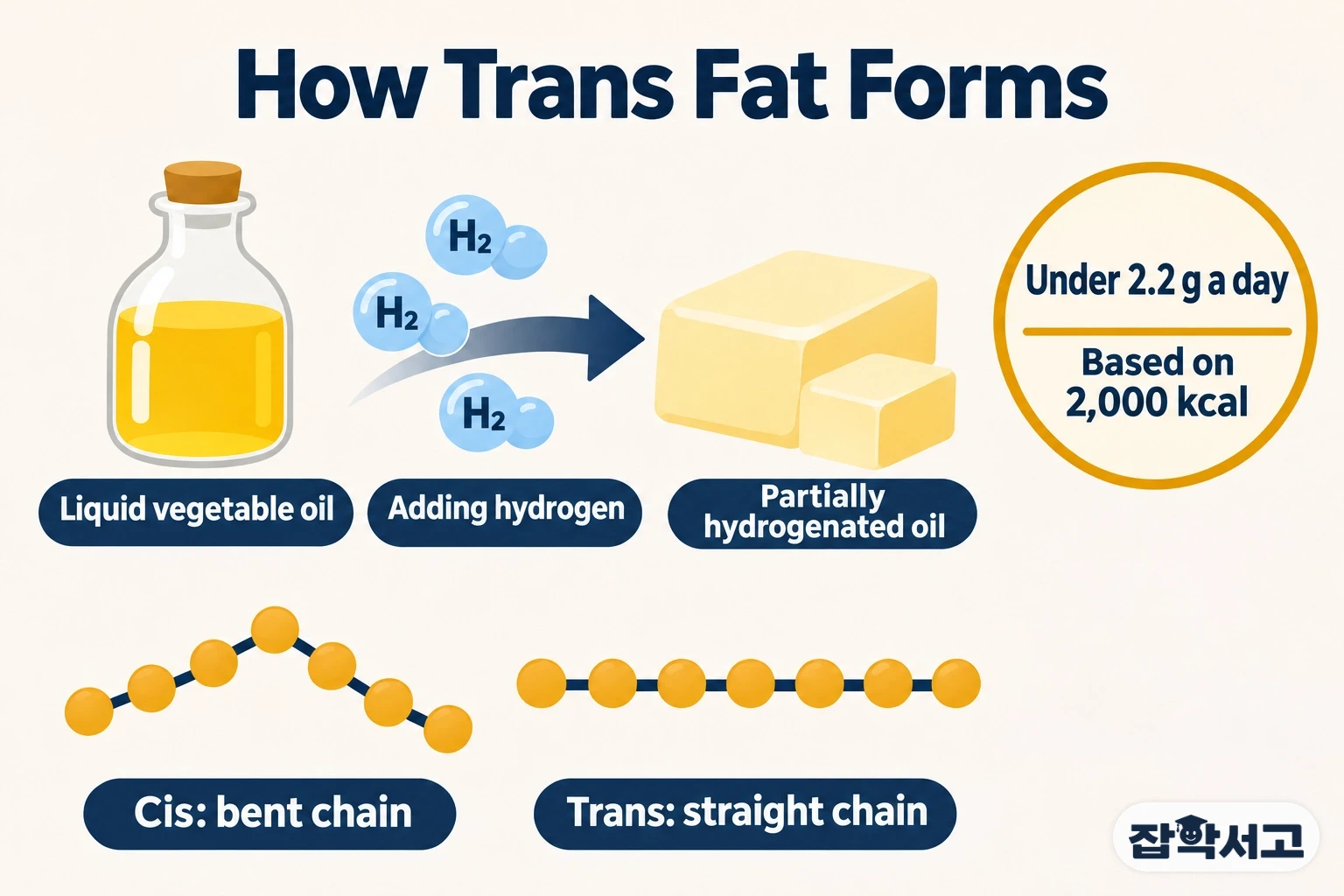
According to the WHO, high trans fat intake increases the risk of death from any cause by 34%, coronary heart disease deaths by 28%, and coronary heart disease by 21%. The WHO also estimates that more than 278,000 deaths worldwide each year can be attributed to industrially produced trans fat. That is why the recommended limit is less than 1% of total energy intake, or under 2.2 g a day for an adult eating 2,000 kcal.
Myth 1: Plant-Based Margarine Is Always Better Than Butter
Because margarine is made from vegetable oil, it was once considered healthier than butter, an animal fat. In fact, how a fat was hardened matters more than what it was made from. Margarine and shortening hardened by partial hydrogenation can be high in trans fat, and they have long been used to give cookies and bread a crisp, long-lasting texture.
Today, many products have changed their manufacturing methods and cut trans fat sharply. Still, whether you choose butter or margarine, the surest habit is to read the saturated fat and trans fat lines on the nutrition label together and check the ingredient list for shortening or hydrogenated oil.
Myth 2: "0 g" on the Label Means There Is None
South Korea has required trans fat labeling on processed foods such as snacks since 2007. Under the rules of the Ministry of Food and Drug Safety, however, trans fat may be labeled "0" if a serving contains less than 0.2 g, and it is written as "less than 0.5 g" if a serving contains 0.2 g or more but less than 0.5 g. Edible oils and fats may be labeled "0" if they contain less than 2 g per 100 g.
In other words, "0 g" means "very little," not "none at all." If one bag is divided into several servings, it is also worth remembering that eating the whole bag at once adds those amounts together. If you see shortening or hydrogenated oil in the ingredient list, it is safer to assume the product may contain a little trans fat even when it says "0 g."
Myth 3: All Trans Fat Is Made in Factories
Trans fat also occurs in nature. It forms when microbes in the stomachs of ruminants such as cows, sheep, and goats transform fat, so the meat, milk, and dairy products of these animals contain small amounts.
The WHO considers industrial and natural trans fat equally harmful. However, national regulations target industrial trans fat made from partially hydrogenated oil. The WHO's best-practice policies are either a limit of 2 g of industrial trans fat per 100 g of total fat in all foods or an outright ban on producing and using partially hydrogenated oil.
Myth 4: Frying Always Turns Food into a Lump of Trans Fat
It is true that heating oil to high temperatures creates a little trans fat. According to the WHO, however, high-temperature frying adds only up to about 2–3%, which is small compared with the 25–45% average in partially hydrogenated oil.

What determines the trans fat in fried food is not the frying itself but the kind of oil used. Of course, oil that has been used for a long time undergoes rancidity, and fried food is high in calories, so a low trans fat content does not mean you can eat as much as you like.
In Short
- Trans fat is an unsaturated fat with a straight chain, and it comes mainly from partially hydrogenated oil.
- The recommended limit is less than 1% of total energy, or under 2.2 g a day based on 2,000 kcal.
- A "0 g" label means less than 0.2 g per serving.
- Natural trans fat exists too, but the main target to cut is industrial trans fat.
In 2018, the WHO launched its REPLACE action package and called for eliminating industrial trans fat by the end of 2023, but the goal was not fully met. As of 2023, 53 countries, covering 46% of the world's population, had best-practice policies in place. The remaining gap can be closed at the grocery store. Take one more look at the trans fat line and the ingredient list on the label.
Recommended reading