
If something you ordered online arrived three days later, the box was not moving that whole time. Most of those days passed while it waited its turn on a warehouse shelf, in front of a sorting line, or in the back of a truck.
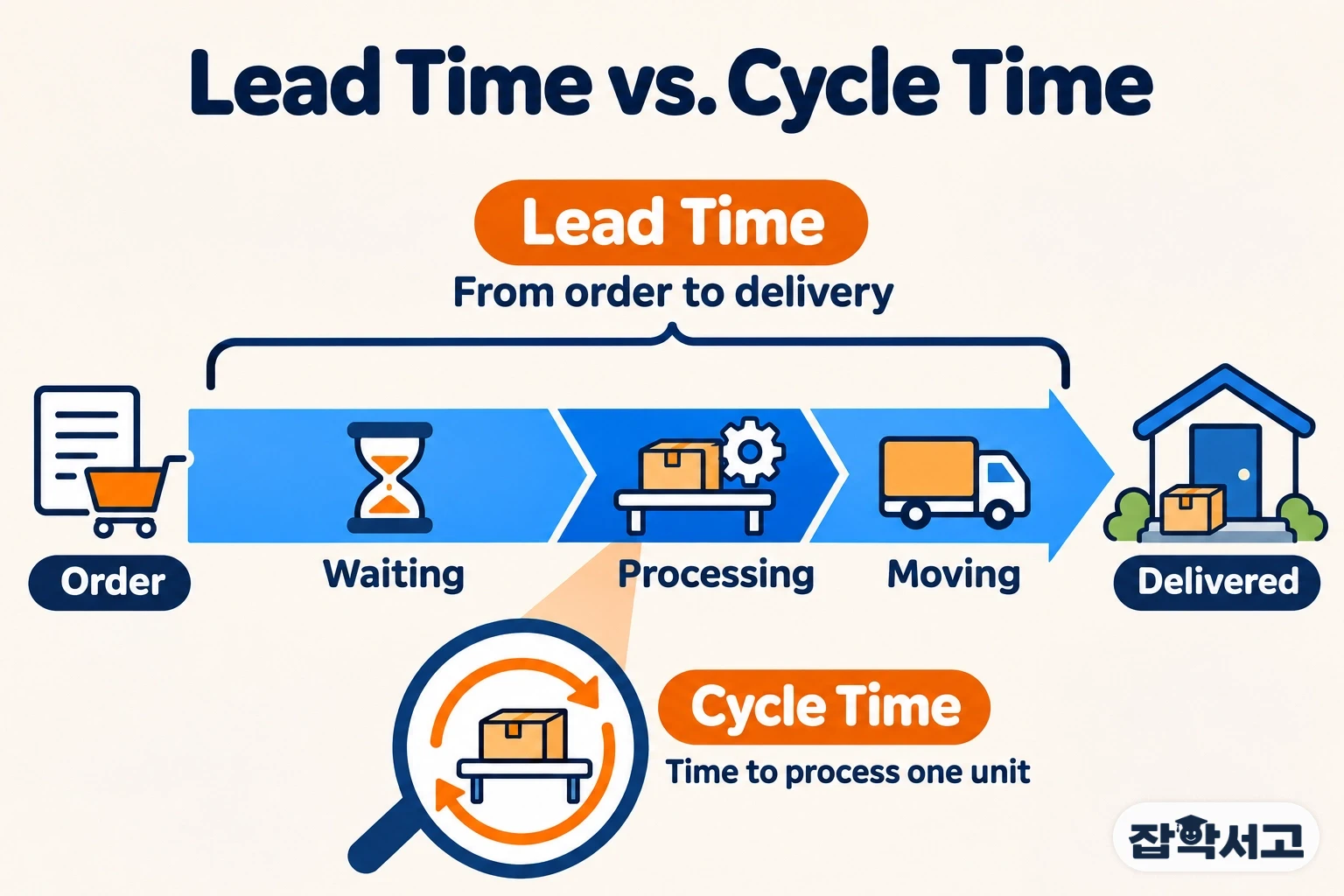
The total time from when a piece of work starts until it is finished is called lead time. On the shop floor it is often mixed up with cycle time, the time it takes to process a single unit, but the two clocks measure different things from the start.

Lead Time vs. Cycle Time: What Is the Difference?
Both terms end in “time,” but lead time measures the length of the whole flow, while cycle time measures the length of one step within it. Once you know the difference, you can read exactly what the same “three days” means.
What Is Lead Time?

Lead time is the time that passes from the moment something starts until the moment it ends. Its name changes slightly depending on where you start and stop the clock.
- Procurement lead time: from the day you place an order with a supplier until the materials arrive at your warehouse
- Production lead time: from when raw materials enter the process until they come out as finished goods
- Order lead time: from the moment a customer orders until they receive the item, the time the customer actually waits
Lead time includes not only processing time but also waiting, moving, and inspection time. The glossary of the Lean Enterprise Institute in the United States also explains that the time that actually adds value is usually shorter than cycle time, and cycle time is usually shorter than production lead time.
A classic formula for estimating lead time is Little’s Law. Proved by John D. C. Little in the journal Operations Research in 1961, it becomes “average lead time = work in process ÷ throughput” when applied to a factory. For example, if 120 half-finished products are piled up in the process and 40 are completed each day, a newly started product can be expected to come out about three days later on average.
Lead time is also used in inventory calculations. Because you need enough stock to cover sales until the ordered goods arrive, the reorder point is commonly set as “average daily demand × procurement lead time + safety stock.”
What Is Cycle Time?
Cycle time is the time it takes for one process to handle one unit of product. The Lean Enterprise Institute defines it as the time required to produce a part or complete a process, as obtained by actual measurement. Its defining feature is that it is measured directly on the floor rather than calculated.
For example, if it takes 40 seconds at a packing station to fold a box, put the item in, and tape it shut, the cycle time of that packing process is 40 seconds. For a machine, you add the time to load and unload the item to the processing time.
A term that pairs with cycle time is takt time. Takt time is the “target pace,” found by dividing the available working time by customer demand. If there are 480 minutes of working time in a day and 240 orders, the takt time is 2 minutes, and if any process has a cycle time longer than 2 minutes, that day’s orders cannot be met on time.
Side-by-Side Comparison
Putting the two side by side makes the difference clear. Think of lead time as measured on the customer’s calendar and cycle time as measured on the worker’s stopwatch.
| Item | Lead time | Cycle time |
|---|---|---|
| What it measures | The whole flow (from start to finish) | One process step, one unit |
| Time included | Processing, waiting, moving, and inspection | Time to process one unit in that process |
| Main uses | Customer delivery dates, ordering and inventory planning | Work design, judging production capacity |
| How it is obtained | Recording start and end times, estimating with Little’s Law | Measured directly on the floor |
| Main reason it grows | Piled-up work in process and waiting | Slow work methods or equipment |
Even a process with a cycle time of one minute can have a lead time of several days if half-finished goods are piled up in front of it. That is why most of lead time is filled with “waiting.”
Telling Them Apart with Confusing Cases
(1) A cup of coffee at a café
If it takes a barista 3 minutes to pull an espresso, steam the milk, and finish one cup, that is the cycle time. If five people are lined up ahead of you, it takes more than 15 minutes from ordering to getting your coffee, and that is the lead time the customer feels. Even if the barista’s hands do not get faster, a shorter line alone reduces lead time.
(2) A single parcel
The 40 seconds it takes to pack one box at a fulfillment center’s packing station is cycle time, while the day or two from clicking the order button until the box lands at your door is order lead time. A late delivery does not mean the packing was slow. It is more likely that the box waited a long time at a sorting center or in front of a line-haul truck.
(3) A task card in software development
Development teams that work with Kanban use the same two words a little differently. They often call the time from when a request is received until it is deployed the lead time, and the time from when a developer actually starts working until finishing the cycle time. Since the starting point differs by field, always check “from where to where” first when you look at a number.
How to Shorten Lead Time
Taiichi Ohno, who built the Toyota Production System, said that all they were doing was looking at the timeline from the moment a customer gives an order to the point when they collect the cash, and reducing that time by removing non-value-adding waste. In other words, shortening lead time was the very goal of the production system.
- Reduce piled-up work in process: as Little’s Law shows, if throughput stays the same, less material in the process means shorter lead time.
- Eliminate waiting and moving: placing processes close together and not passing work along in large batches cuts waiting time.
- Fix the bottleneck first: the process with the longest cycle time sets the speed of the whole flow, so improve it first.
When lead times are long and erratic, companies inflate their order quantities, and as this grows along the supply chain it spreads into the bullwhip effect. Whenever you look at a number, getting into the habit of first asking whether it is the time of one step or of the whole flow is the starting point for cutting time.
Recommended reading