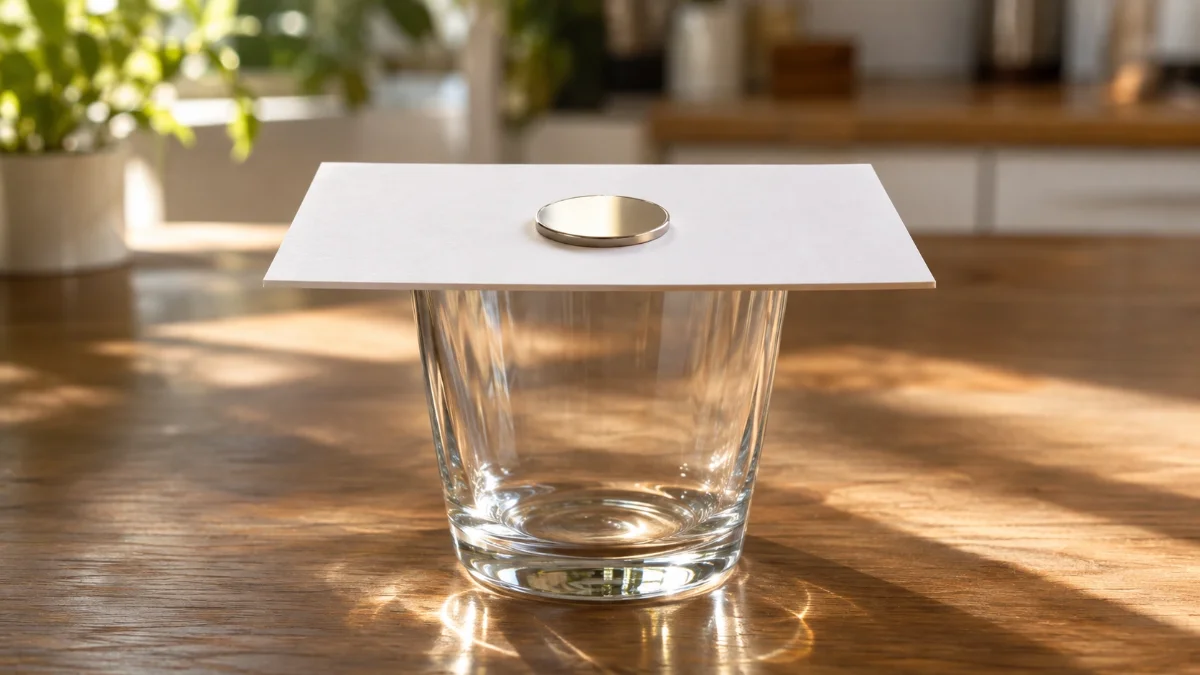
Place a card on top of a cup, set a coin on the card, then flick only the card hard with your finger: the coin does not follow the card but drops straight into the cup. It looks like a magic trick, but it happens because objects tend to keep their current state.
This tendency is described by the law of inertia. Isaac Newton set it out as the first of his laws of motion in the Principia in 1687, so it is also called Newton's first law of motion. The materials are simple, so let's check it ourselves.
A Law of Inertia Experiment You Can Do at Home
There are two experiments. One shows a resting object trying to stay at rest, and the other shows a spinning object trying to keep spinning. Each takes only a few minutes, and you can see the result right away.
What You Need
- 1 cup (an unbreakable plastic cup is even better)
- 1 stiff paper card about the size of a postcard
- 1 coin
- 1 raw egg, 1 hard-boiled egg and 1 wide plate
Steps
- Place the cup on a flat table and lay the card across the middle of its rim.
- Put the coin on the card, directly above the mouth of the cup.
- Hook your index finger behind your thumb, then release it to flick the edge of the card quickly and horizontally.
- Watch where the coin falls.
- This time, pull the card slowly by hand and compare the results.
When you hit the card, don't knock it upward; the trick is to strike its edge with your fingertip in a short, sharp, horizontal motion. Even if you fail at first, you will get the feel after a few tries.
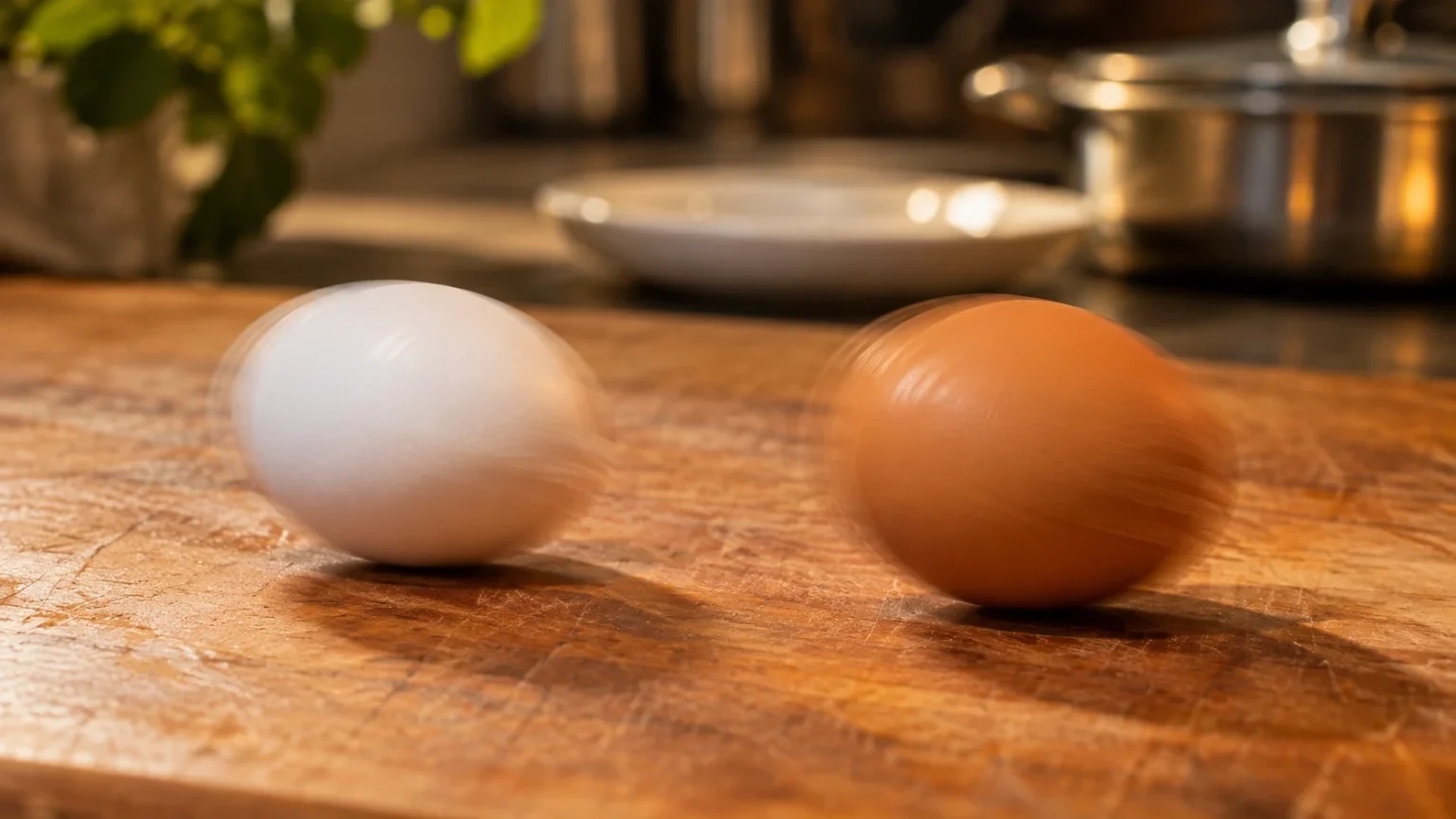
The second experiment uses eggs. Spin the raw egg and the boiled egg on the plate like tops, press each one lightly with a finger to stop it, and let go immediately.

What Will You See?
When you flick the card quickly, only the card flies off to the side, and the coin drops almost straight down into the cup. If you pull the card slowly instead, the coin tends to ride along with the card and fall outside the cup.
The eggs give an even clearer result. The boiled egg stops as soon as you press it, but the raw egg slowly starts spinning again the moment you let go. Even at the start, the boiled egg spins fast and upright, while the raw egg spins slowly and wobbles.
Why Does This Happen?
The law of inertia can be stated like this: if the sum of the forces acting on an object (the net force) is zero, an object at rest stays at rest, and a moving object keeps moving in a straight line at the same speed. The greater an object's mass, the greater this tendency, called inertia. A fully loaded cart is harder both to start and to stop than an empty one.
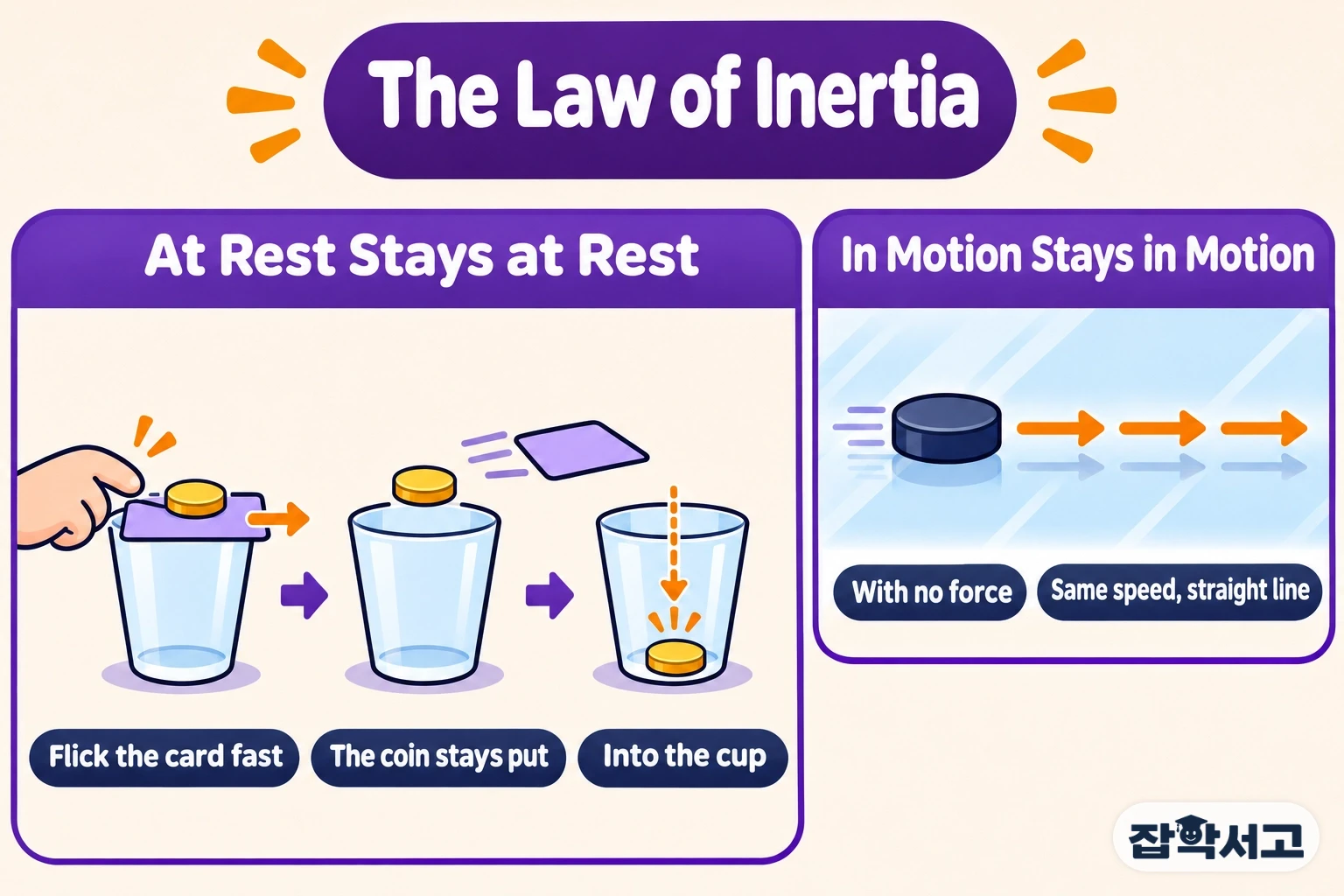
In equation form, it means that when the net force ΣF = 0, the velocity v is constant. If you put a net force of zero into Newton's second law, F = ma, the acceleration a also becomes zero, so the first law is sometimes seen as a special case of the second. Still, the first law has its own meaning because it defines the frame in which the laws of motion hold as they are: the inertial frame of reference.
In the coin experiment, friction acts between the card and the coin, but when you flick the card quickly, that force acts on the coin for only a very short time. So the coin is barely pushed sideways and keeps its state of rest, then falls under gravity the moment its support disappears. If you pull slowly, friction acts for longer and drags the coin along.
The egg experiment tells the same story. In a boiled egg, the inside is solid and moves together with the shell as one piece, but in a raw egg the liquid inside moves separately from the shell. Your finger stopped only the shell; the liquid inside tries to keep spinning and drags the shell around again.
Aristotle believed that an object needs a continuous force to keep moving. Galileo Galilei thought that without friction, a rolling ball would never stop. In a thought experiment with two facing slopes, he reasoned that the gentler the opposite slope, the farther the ball would roll, and that on a level surface it would roll forever. Newton then summed this up as his first law. The objects around us eventually stop not because their inertia disappears, but because forces such as friction and air resistance act on them.
Inertia in Everyday Life
When a moving bus suddenly stops, your body lurches forward, and when a stopped bus starts, your body is pushed back. A seat belt is the device that holds back your body as it keeps moving forward. When a car takes a sharp turn, your body leans outward because it tries to keep going in its original direction. Shaking a blanket hard, so that only the blanket moves while the dust stays put and falls away, works on the same principle.
When a hammer head comes loose, striking the end of the handle on the floor stops the handle, but the head keeps moving down and fits more tightly onto the handle. A space probe keeps traveling for a long time after its engine shuts off for the same reason: with almost no friction or air resistance, it moves by inertia.

When you try the experiments, use a plastic cup rather than a glass one, and always spin the eggs on a plate. If the coin drops into the cup on the first try, you have seen Newton's first law with your own eyes in that brief moment. Next time you hold a bus strap, try to picture in advance which way your body will lean.
Recommended reading