10,244,550 people. That was the number of registered residents aged 65 or older in South Korea as of December 23, 2024, a figure equal to 20% of the total population. Korea had become a country where one in five people is 65 or older.
A society like this is called a super-aged society. This article reads five numbers in turn to explain what defines a super-aged society, when Korea entered that stage, how the share differs by region, and how fast the change came compared with other countries.
The Super-Aged Society in Numbers
A super-aged society is one in which people aged 65 and over make up 20% or more of the total population, a share known as the elderly population ratio. Because the measure is a share rather than a headcount, the ratio rises when the young population shrinks, even if the number of older people stays the same. The figures below are based on resident registration statistics from Korea's Ministry of the Interior and Safety.
7·14·20 — The Three Thresholds That Divide a Society
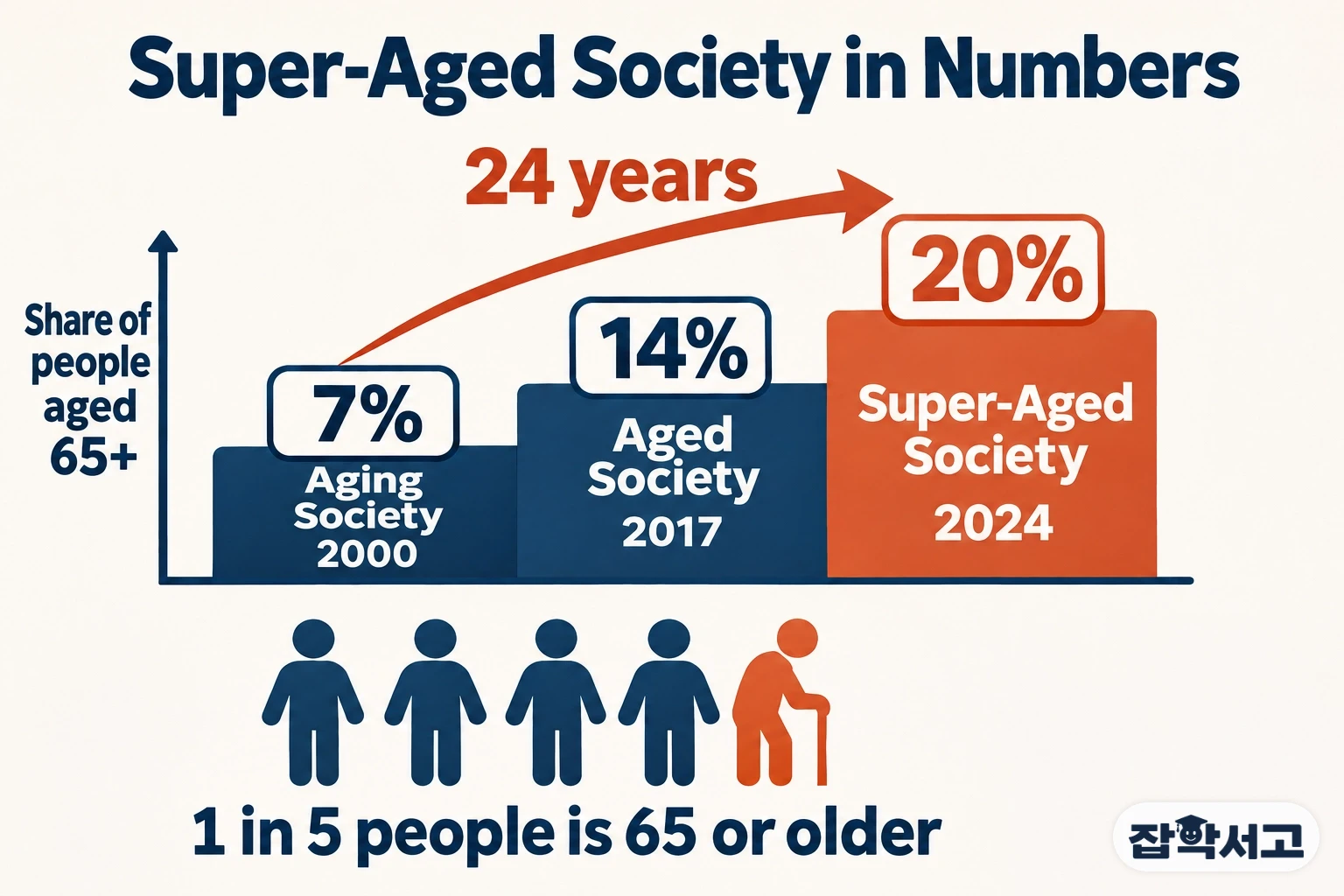
To classify societies by their elderly population ratio, the United Nations' categories are widely used. When people aged 65 and over make up 7% or more of the population, it is an aging society; at 14% or more, an aged society; and at 20% or more, a super-aged society. Because 65 has long served as the age that marks old age in many countries' population statistics and pension systems, the elderly population ratio is usually calculated with 65 as the cutoff.
The names are similar and easy to confuse, but the order is clear. Think of an aging society as one that is growing older, an aged society as one that has already grown old, and a super-aged society as one that has gone beyond that stage. It also matters that the yardstick is a ratio, not a number of people. Even with the same 10 million older residents, the stage depends on how large the total population is.
20% — One in Five People Is 65 or Older
According to the Ministry of the Interior and Safety, as of December 23, 2024, there were 10,244,550 registered residents aged 65 or older, accounting for 20% of the 51,221,286 registered residents in total. With that, Korea entered the super-aged stage for the first time. These figures are based on resident registration, so they may differ slightly from other population statistics that also count foreign nationals.
If five people are in one subway car or a neighborhood restaurant, one of them is 65 or older. Compared with 2008, when the population aged 65 and over was 4,940,573, the number more than doubled in 16 years.
24 Years — From Aging Society to Super-Aged Society
Korea became an aging society in 2000 and an aged society in 2017, and it became a super-aged society in 2024. In other words, it took 24 years for the elderly population ratio to climb from 7% to 20%.
The figures in between show the rise even more clearly. The elderly population ratio first reached the 10% range at 10.02% in 2008, then climbed steadily to 11.01% in 2011, 12.03% in 2013, 13.02% in 2015 and 14.02% in 2017. It entered the 15% range in 2019 and the 19% range in early 2024, before reaching the 20% threshold at the end of that year.
7 Years — From Aged Society to Super-Aged Society
Korea took about seven years to go from 14% to 20%. Japan became an aged society 24 years after it became an aging society in 1970, and 12 years after that, in 2006, it became a super-aged society. From aging society to aged society, Korea took 17 years, from 2000 to 2017, shorter than Japan's 24. The gap becomes even clearer when the time each country took to go from an aged society to a super-aged society is placed side by side.
- South Korea: about 7 years (aged society in 2017 → super-aged society in 2024)
- Japan: 12 years (became super-aged in 2006)
- Germany: 37 years
- France: 39 years
About 20 countries have become super-aged societies, and in Asia, Korea is the second after Japan. What stands out here is not the ratio itself but the speed. Other countries had decades to adjust their pension, health care and care systems, while Korea had far less time.
27.18% — Different Speeds Within One Country
The clock of a super-aged society runs differently by region. As of the same date, the region with the highest share of people aged 65 and over was South Jeolla Province at 27.18%, followed by North Gyeongsang at 26%, Gangwon at 25.33% and North Jeolla at 25.23%. Sejong had the lowest share at 11.57%, less than half that of South Jeolla.
The share was 17.70% in the Seoul metropolitan area and 22.38% outside it. When young people move to cities for jobs and schooling, the elderly ratio in the regions they leave behind rises faster. Within the single label of a super-aged society, there are cities still at the aged-society stage and regions where more than one in four residents is already elderly.
The Principle Behind the Numbers
The elderly population ratio is a number whose numerator and denominator move together. The numerator, the older population, grows as people live longer, and the denominator, the total population, grows more slowly or shrinks as fewer children are born. Korea's life expectancy was 82.7 years in 2022, and its total fertility rate was 0.72 in 2023. Living longer is a welcome change, but when births fall at the same time, the ratio is pushed up from both directions at once. On top of that, the so-called baby boomers born between 1955 and 1963 began turning 65 in 2020, which made the ratio rise especially fast in recent years.
According to Statistics Korea's population projections, Korea's elderly population ratio is expected to reach 34.4% in 2040, close to Japan's 34.8%. That is why a super-aged society is not an issue for older people alone; it is a number that asks society to rethink its whole design, from the finances of pensions and health insurance to who will provide care and the burden on the working generation. This is also why programs such as the Basic Pension and long-term care insurance for older people so often make the news. It is likewise why policies that help people keep living where they have always lived as they age, such as jobs for older people, care close to home and walkable neighborhoods, are discussed alongside them.
When you see the number 20%, try picturing the daily lives of the 10 million people behind it and the systems that will support those days.
Recommended reading