Chemical bonds play a very important role in the process by which atoms combine to form molecules. This process is determined by how the electrons of atoms interact with one another, and there are various types of bonds. Let's take a closer look at the basic principles of chemical bonding, along with the specific principles and characteristics of ionic, covalent, and metallic bonds.
Basic Principles of Chemical Bonding: The Interaction of Atoms and Electrons
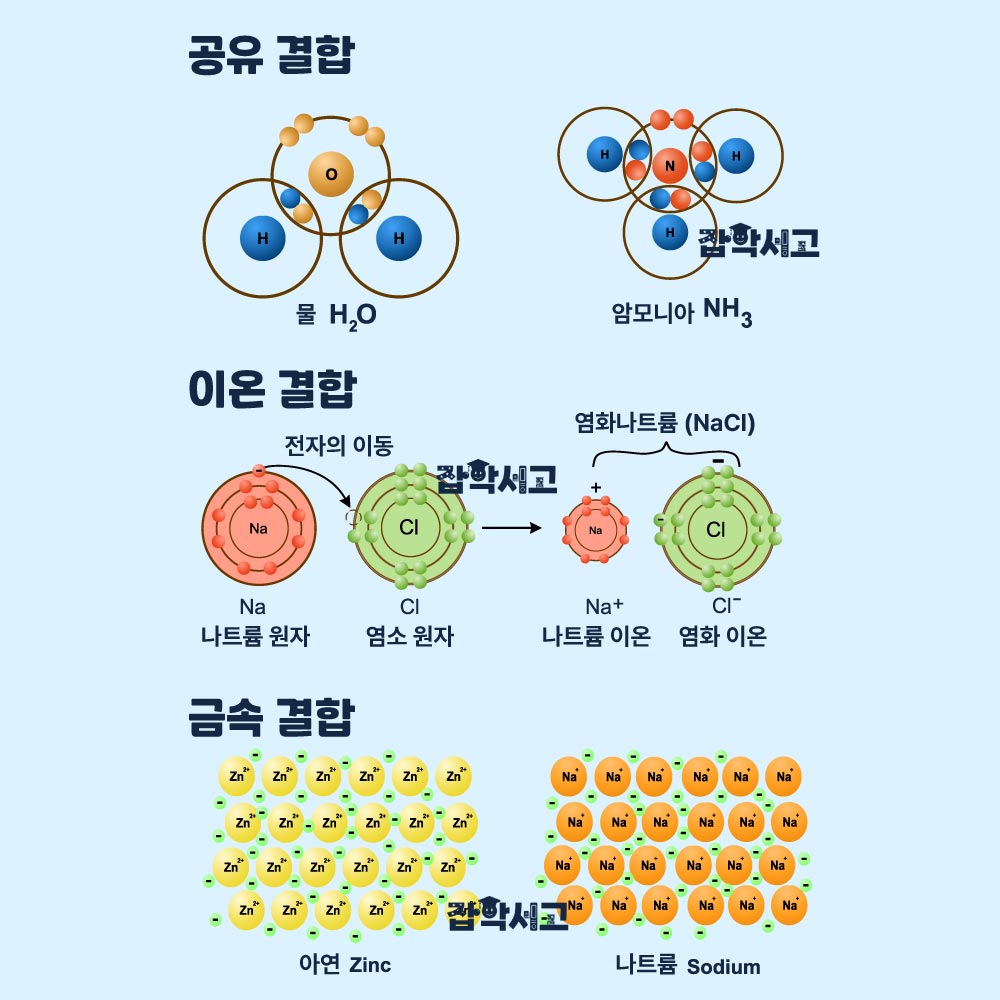
Chemical bonds are formed through interactions between atoms and electrons, and this is an important process that determines the properties of matter. An atom consists of a nucleus made up of protons and neutrons, surrounded by electrons. Electrons carry a negative charge and interact electrically with the positively charged nucleus to form bonds.
Atoms form bonds to achieve a stable electron configuration, and in this process they tend to remain in the lowest-energy state. Most atoms follow the octet rule, which describes their tendency to have eight electrons in their outer electron shell, and when this rule is satisfied, the atom stays in a more stable state.
The Relationship Between Electron Configuration and Chemical Bonding
The arrangement of electrons is an important factor that determines the nature of a chemical bond. Electrons in the outer shell of an atom interact with the electrons of other atoms to form bonds. In this process, electrons balance the attractive and repulsive forces between atoms and create various types of bonds.
Energy is released when a chemical bond forms, and energy is required to break a bond. These energy changes are an important factor in explaining the strength and stability of bonds. The electrical interactions between atoms determine the type of bond: the electrical attraction between a positively charged atom and a negatively charged atom forms an ionic bond, while sharing a pair of electrons forms a covalent bond.
Types of Chemical Bonds: Ionic, Covalent, and Metallic Bonds
After understanding the basic principles of chemical bonding, it is worth looking at the specific principles and characteristics of ionic, covalent, and metallic bonds. Ionic bonds are formed by the strong electrical attraction between cations and anions, which produces substances that are hard in the solid state and have high melting points. For example, sodium chloride (NaCl) is a typical example of an ionic bond.
A covalent bond is a type of bond in which two atoms share a pair of electrons, and it forms mainly between nonmetal atoms. Covalent bonds determine the structure of a molecule through bond length and bond angle, which greatly affects the molecule's physical properties. For example, water (H₂O) is a molecule formed by two hydrogen atoms and one oxygen atom through covalent bonds.
A metallic bond is a bond formed as electrons move freely among metal atoms, and it plays an important role in explaining the conductivity and ductility of metals. Substances formed through metallic bonds conduct electricity and heat well and are resistant to physical impact.
The Importance of Chemical Bonds
Chemical bonds are a key factor in determining the physical and chemical properties of matter. Ionic, covalent, and metallic bonds each form according to a unique way in which atoms and electrons interact, and as a result, substances come to have different properties. By understanding the principles and types of chemical bonds, we can gain a deeper understanding of the world of molecules, which plays an important role not only in chemistry but also in various fields such as physics and materials science.
Ionic Bonds: Electron Exchange and the Interaction of Charges
Definition and Formation of Ionic Bonds
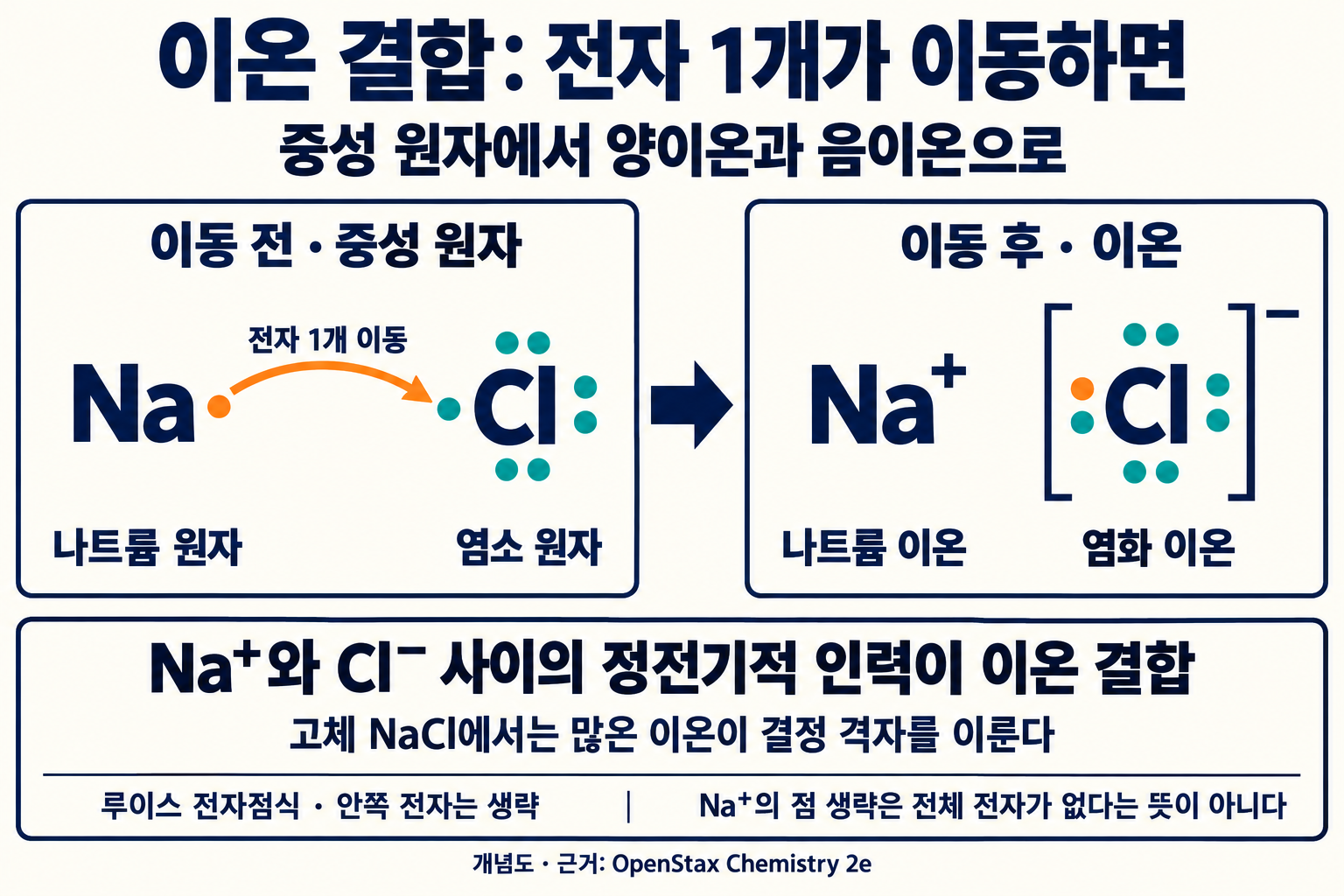
An ionic bond is a chemical bond formed when electrons are exchanged between atoms; through the transfer of electrons, one atom becomes a cation and the other becomes an anion. The key to an ionic bond is the strong electrical attraction that forms between these cations and anions. An atom that loses electrons takes on a positive charge and is called a cation, while an atom that gains electrons takes on a negative charge and is called an anion. The strong electrical attraction between these two ions forms the ionic bond.
An Example of Ionic Bonding: How NaCl Forms
The bonding of sodium (Na) and chlorine (Cl) atoms is a representative example of an ionic bond. A sodium atom loses one electron to become an Na⁺ ion, and a chlorine atom accepts that electron to become a Cl⁻ ion. At this point, a strong electrical attraction acts between Na⁺ and Cl⁻, forming the ionic compound sodium chloride (NaCl). The energy released in this process is an important factor that increases the stability and strength of the bond.
Ionic Bonds and Energy Changes
The formation of an ionic bond is accompanied by changes in energy. Energy is required when an atom loses or gains electrons, and energy is released when ions bond together. This released energy, that is, the bond energy, is an important factor in explaining the strength and stability of an ionic bond. In general, the higher the bond energy, the stronger and more stable the bond.
Conditions for Forming Ionic Bonds
Ionic bonds form mainly between metal atoms and nonmetal atoms. Metal atoms have a strong tendency to lose electrons and become cations, while nonmetal atoms have a strong tendency to gain electrons and become anions. These tendencies vary depending on the positions of metallic and nonmetallic elements in the periodic table. Metallic elements on the left side of the periodic table lose electrons easily, while nonmetallic elements on the right side gain electrons easily.
Properties of Ionic Compounds
Compounds formed by ionic bonds generally have high melting and boiling points and form electrically neutral crystal structures. In these crystal structures, the ions are arranged in a regular pattern so that each ion is surrounded by as many oppositely charged ions as possible. This maximizes the electrical attraction and increases the strength and stability of the bonds. In addition, ionic compounds act as electrolytes and conduct electric current well when dissolved in solution or in a molten state.
The Importance of Ionic Bonds
In conclusion, ionic bonds are formed through the exchange of electrons and the interaction of charges, producing very stable and strong compounds. Understanding ionic bonds is a very important concept in chemistry and is essential for explaining the properties and reactions of various substances. By understanding the characteristics of these bonds, we can gain a deeper understanding of the structure and properties of matter.
Covalent Bonds: Sharing Electron Pairs and Forming Molecular Structures

Definition and Formation of Covalent Bonds
A covalent bond is a chemical bond formed when two atoms share a pair of electrons, and it occurs mainly between nonmetal atoms. Through this bond, each atom achieves a stable electron configuration in its outer electron shell and satisfies the octet rule. Covalent bonds provide strong bonding forces between the participating atoms and stabilize the molecule.
Examples of Covalent Bonds: Hydrogen and Oxygen Molecules
The hydrogen molecule (H₂) is a representative example in which two hydrogen atoms each share one electron to form a single bond. This shared electron pair creates a strong attraction between the two hydrogen atoms, producing a stable molecule. Similarly, the oxygen molecule (O₂) shares two electron pairs to form a double bond, and the nitrogen molecule (N₂) shares three electron pairs to form a triple bond. In this way, covalent bonds are classified as single, double, or triple bonds depending on the number of shared electron pairs, and the strength and characteristics of the bond differ accordingly.
Covalent Bonds and Molecular Geometry
Covalent bonds have a major influence on the geometric structure of molecules. Bond angles and bond lengths are determined by the spatial arrangement of shared electron pairs, which is an important factor in explaining a molecule's physical and chemical properties. For example, in a water molecule (H₂O), the oxygen atom forms covalent bonds with two hydrogen atoms, giving a bond angle of about 104.5 degrees. This bond angle plays an important role in explaining water's distinctive properties, such as its high boiling point and surface tension.
Strength and Energy of Covalent Bonds
The strength of a covalent bond is determined by how much the electron clouds overlap when the bond forms. The greater the overlap of the electron clouds, the stronger the bond. The strength of a bond is also expressed as bond energy, which means the amount of energy required to break the bond. The greater the bond energy, the stronger the bond and the more stable the molecule. For example, the nitrogen molecule, which has a triple bond, has a very high bond energy, which means that the nitrogen molecule is stable.
The Importance of Covalent Bonds
In conclusion, covalent bonds are formed through the sharing of electron pairs and are a key factor in determining the structure and properties of molecules. The type and strength of covalent bonds greatly affect a molecule's geometric structure and the resulting physical and chemical properties. Therefore, understanding covalent bonds is essential for predicting and explaining the behavior and properties of molecules in chemistry.
Metallic Bonds: Understanding Free Electrons and the Properties of Metal Atoms

Definition and Formation of Metallic Bonds
A metallic bond is a special bond that forms between metal atoms: the metal atoms form a lattice structure, and free electrons moving through it maintain the bond. Free electrons are not fixed to any particular atom and can move throughout the entire metal, which is the fundamental cause of many of the distinctive physical properties of metals.
Free Electrons and the Electrical Conductivity of Metals
One of the most notable features of metallic bonding is the excellent electrical conductivity of metals. Because free electrons can move freely within the metal lattice, electrons are transferred smoothly when an electric current passes through a metal. As a result, metals perform exceptionally well as electrical conductors and are used as essential materials in electrical applications such as wires, circuits, and batteries.
Thermal Conductivity and Efficient Heat Transfer in Metals
Metals conduct not only electricity but also heat well. This is because the free electrons in a metallic bond can transfer thermal energy quickly. When heat is applied, the free electrons absorb the energy and spread it rapidly throughout the metal, so metals also perform excellently as thermal conductors. Because of this property, metals are widely used in tools and machine components where heat transfer is important, such as pots, heat sinks, and heat exchangers.
Ductility and Malleability of Metals
Metallic bonding is an important principle that explains the ductility and malleability of metals. Ductility is the ability of a metal to bend or deform under force, and malleability is the ability of a metal to be spread into thin sheets. Because free electrons maintain the bond while moving freely within the metal lattice, metals do not easily break under external impact or pressure and are flexible. Thanks to these properties, metals can be processed into various shapes for use.
Luster and Reflectivity of Metals
The luster of metals arises from metallic bonding. Light striking the surface of a metal is absorbed by the free electrons and then re-emitted, producing the characteristic shiny luster of metals. This luster allows metals to be used as decorative elements and also in mirrors and light-reflecting devices that require reflectivity.
Density and Strength of Metals
Metallic bonding also plays an important role in explaining the high density and strength of metals. Because metal atoms are densely arranged in a lattice structure and free electrons stabilize this structure, metals have high density and high strength. Thanks to these physical properties, metals are widely used as structural materials in various industries such as construction, machinery, and transportation.
The Importance of Metallic Bonds
In conclusion, a metallic bond is a bond formed as free electrons move freely among metal atoms, and it is the key principle that explains the unique physical properties of metals. Electrical conductivity, thermal conductivity, ductility, malleability, luster, density, and strength are all properties that result from metallic bonding, and because of them, metals are used as essential materials in various industries and in everyday life. An understanding of metallic bonding provides important foundational knowledge for the application and analysis of the properties of metals.
Chemical bonds are an important factor through which atoms interact and determine the various properties of matter. In ionic, covalent, and metallic bonds, atoms and electrons each interact in a unique way, and the substances formed through them have their own distinctive physical and chemical properties. By understanding the principles and types of these bonds, we can gain a deep understanding of the world of molecules.