Most of us have had this happen: you slice an apple for a packed lunch, and by noon it has turned a dull yellowish brown. The same goes for cut potatoes, a halved avocado, or a peeled banana. Nothing has spoiled, yet the color changes. This phenomenon is called Enzymatic Browning.
Put simply, enzymatic browning means “a reaction in which enzymes in fruits and vegetables use oxygen from the air to oxidize phenolic compounds, producing brown pigments as a result.” If the brown on grilled meat comes from the Maillard reaction driven by heat, the brown on an apple is a different kind, produced by enzymes even at room temperature. It may make food look less fresh, but the very same reaction also gives black tea its reddish color and rich flavor.
In this piece we will look in turn at what enzymatic browning is and how the reaction works, ways to slow browning in everyday life, and the foods and new technologies that put browning to deliberate use.

The Enzyme Science Hidden in an Apple’s Brown
What Is Enzymatic Browning?
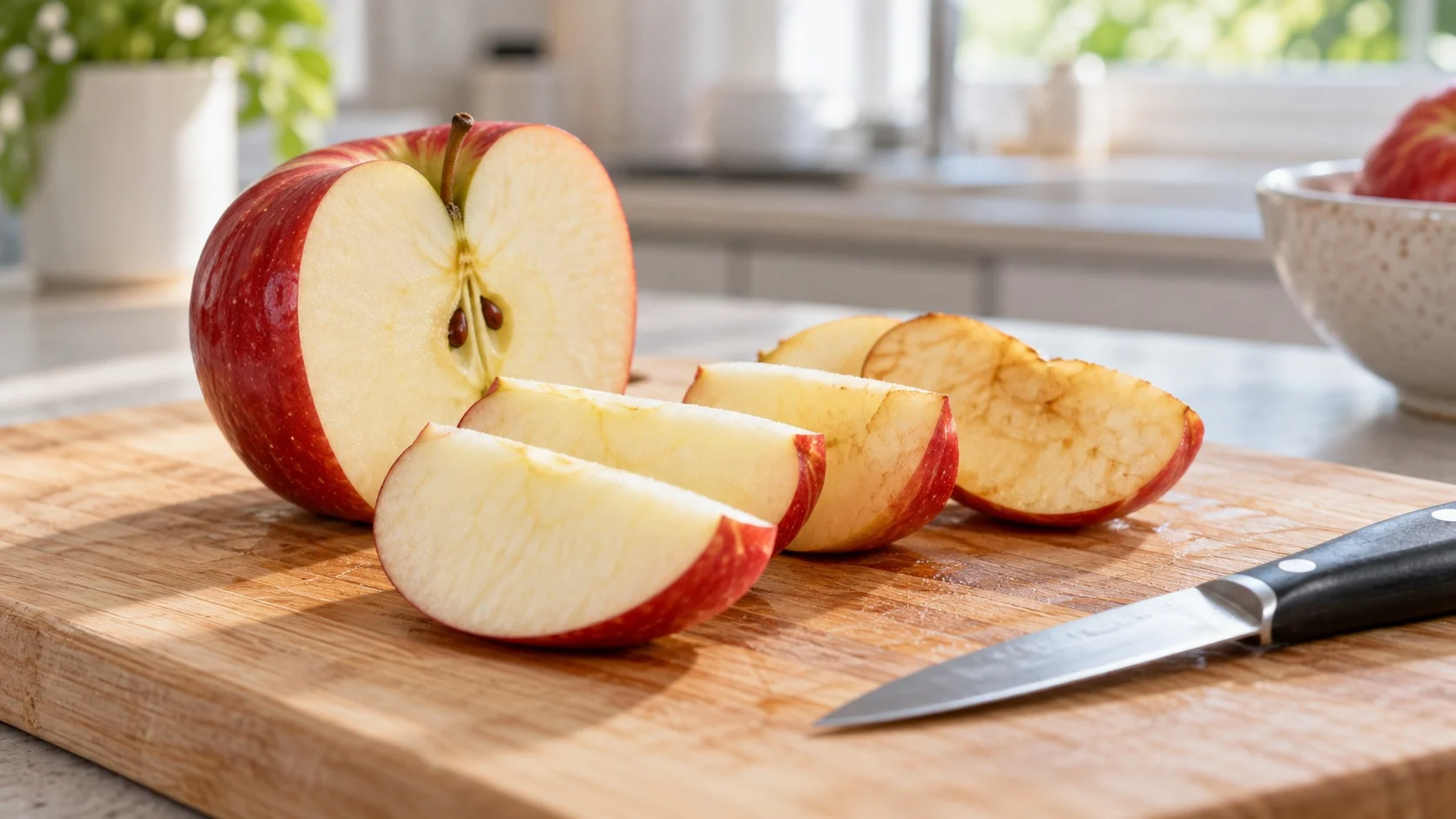
Enzymatic browning begins when plant tissue is cut or bruised. In intact cells, the reaction’s ingredients and the enzyme are kept in separate compartments, so they rarely meet. When a knife or a bruise ruptures cell walls and membranes, the two mix, and once oxygen from the air joins in, the reaction starts right away.
- Polyphenol Oxidase: a copper-containing enzyme, often abbreviated PPO, and the main driver of the browning reaction.
- Phenolic Compounds: substances that give fruits and vegetables their astringency and aroma, and the raw material for browning.
- Melanin: the brown or black pigment produced at the end of the reaction, from the same family of pigments that gives human skin its color.
Different apple varieties brown at different speeds because the amount of enzyme and the types of phenolic compounds vary from variety to variety. Vegetables that change color the moment they are cut, such as potatoes, eggplant, burdock root, and lotus root, tend to be especially rich in both.
The Three Stages That Make Brown
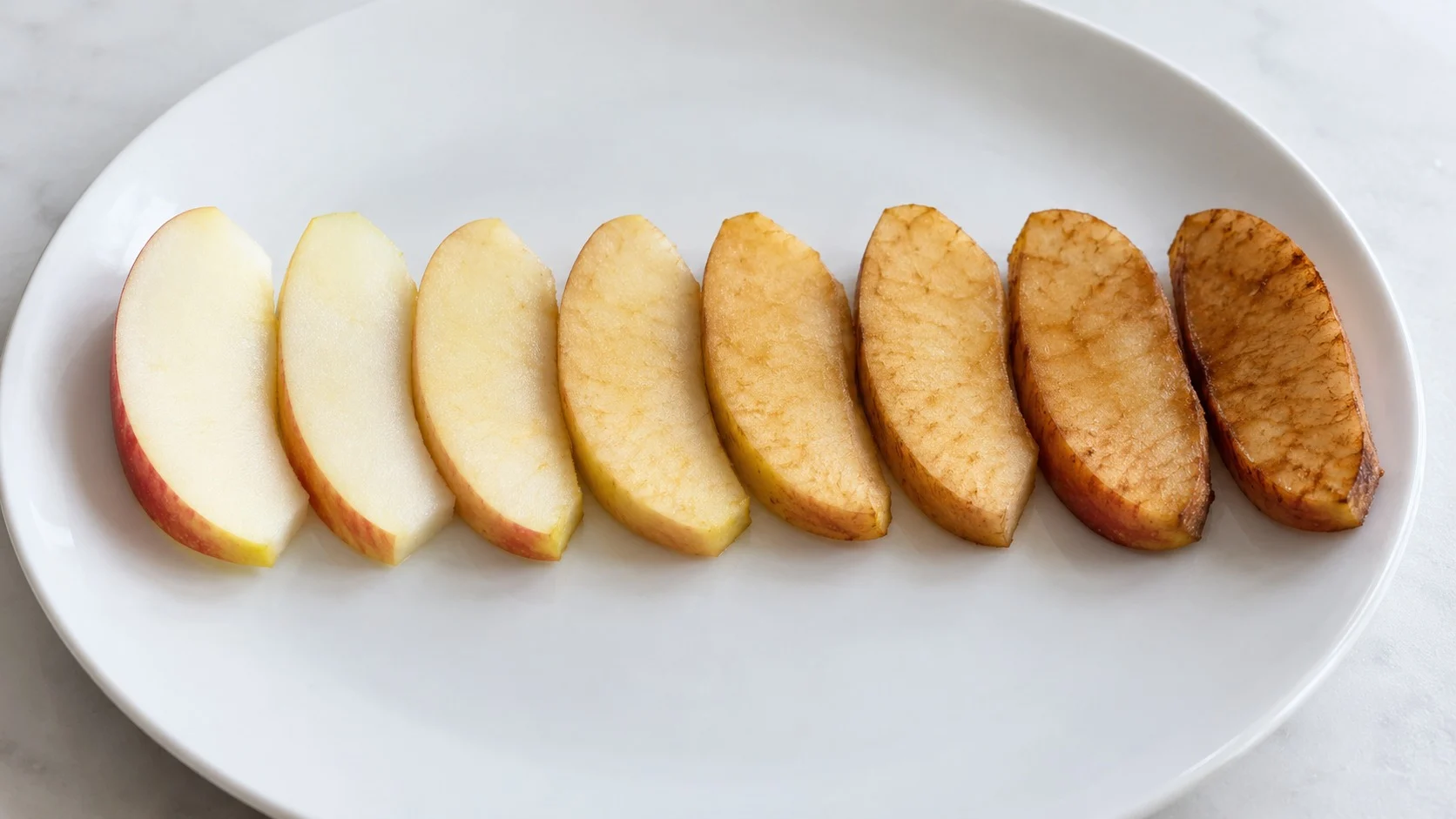
Enzymatic browning proceeds through a chain of chemical reactions. The enzyme handles the early stage, and the later stages carry on by themselves without it.
(1) Oxidation: phenols become quinones
Polyphenol oxidase uses oxygen to turn phenolic compounds into highly reactive substances called “quinones.” Up to this point, there is still hardly any visible brown.
(2) Polymerization: quinones clump together
Quinones are unstable, so they stick to one another or bind with proteins and amino acids. As the molecules grow larger, they absorb more and more light.
(3) Coloring: melanin appears
The enlarged molecules eventually become melanin, a brown pigment. From this point on, the apple’s cut surface turns yellowish and then gradually deep brown.
This reaction needs the enzyme, phenolic compounds, oxygen, and conditions in which the enzyme can work well. Polyphenol oxidase is generally most active around pH 5 to 7 and loses almost all its power below pH 3. Cut off just one of the four, and browning slows down dramatically.
Slowing Browning Through Easy Examples
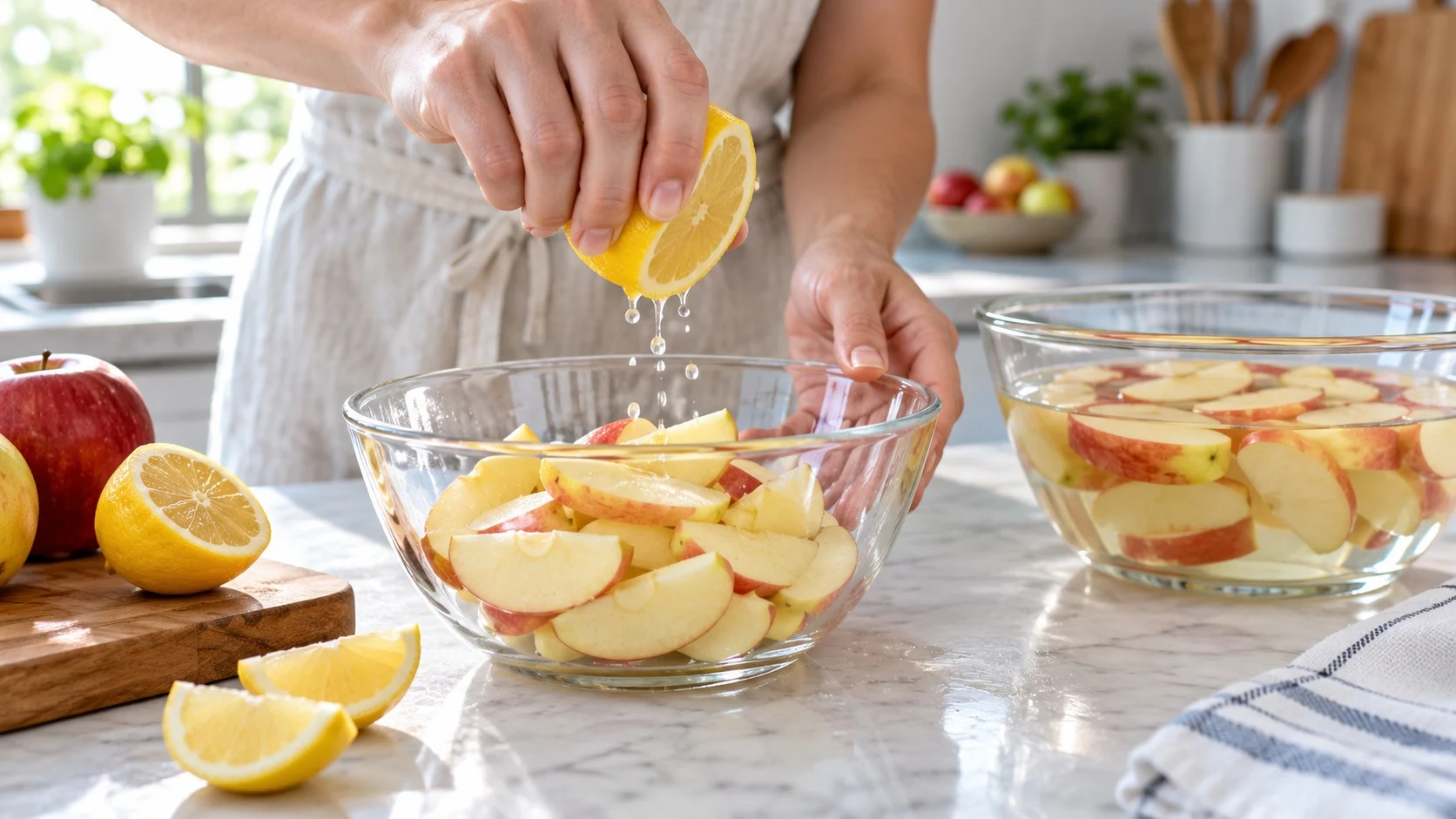
Preventing browning ultimately comes down to removing one of the conditions the reaction needs. The tricks commonly used in the kitchen each have a scientific reason behind them.
[Example 1] Apples sprinkled with lemon juice and soaked in sugar water
Sprinkling lemon juice lowers the pH with acid and weakens the enzyme, while the vitamin C (ascorbic acid) in lemon turns quinones back into colorless phenols. However, vitamin C is used up as it works, so once it runs out over time, browning starts again. Soaking slices in lightly salted water or sugar water also helps by keeping the surface away from the air.
[Example 2] Blanching and vacuum packing
When frozen vegetables are made, they are briefly dipped in boiling water or steam in order to destroy the enzyme itself with heat. Vacuum packing or nitrogen flushing removes oxygen, and refrigeration slows the reaction down.
- Acidification: a method that lowers the pH with citric acid or vinegar to suppress enzyme activity.
- Reducing Agent: a substance, like vitamin C, that turns quinones back into their original form so that color does not develop.
- Blanching: a processing step that applies heat for a short time to inactivate enzymes.
At one time, restaurant salad bars sprayed sulfites on vegetables to keep them looking fresh. But after a string of serious hypersensitivity reactions, especially among people with asthma, the U.S. Food and Drug Administration (FDA) banned the use of sulfites on fruits and vegetables meant to be eaten raw in 1986.
Foods and New Technologies That Use Browning
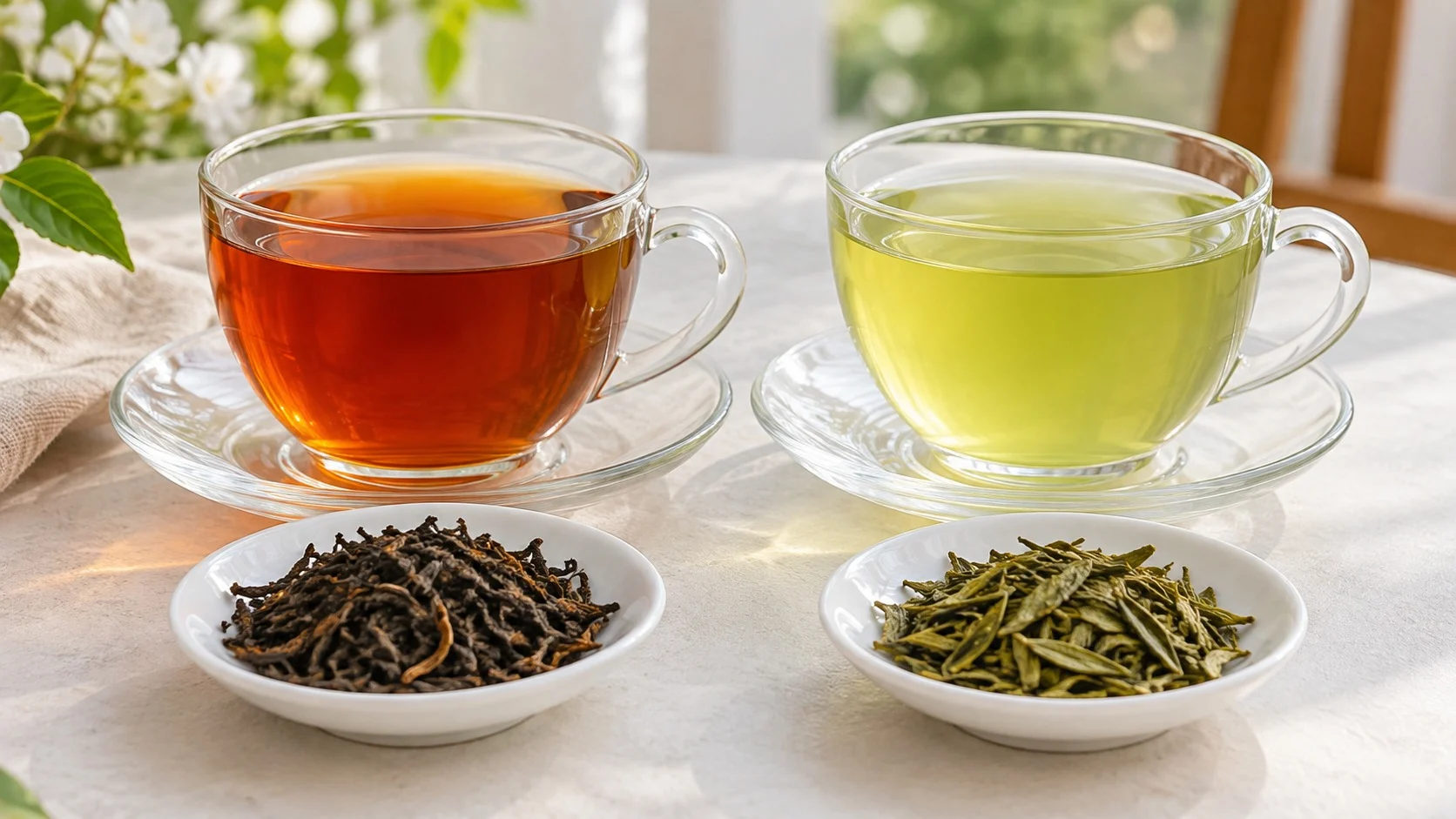
Browning is not always something to avoid. Some foods deliberately trigger this reaction to gain their distinctive color and flavor.
(1) Where black tea and green tea part ways
Leaves from the same tea plant become black tea when they are rolled and crushed and left so the enzyme can thoroughly oxidize their catechins. The theaflavins and thearubigins formed in this process give the tea its red liquor and deep flavor. Conversely, if the leaves are pan-fired or steamed right after picking to stop the enzyme, they become green tea.
(2) The deep color of dried fruit
Enzymatic browning also plays a part in the dark brown color of dried fruits such as raisins and dried persimmons. Together with other browning reactions that occur during drying, it creates their characteristic color and flavor.
(3) The apple that doesn’t brown
Canada’s Okanagan Specialty Fruits developed the “Arctic Apple,” which uses fragments of the apple’s own genes to suppress the polyphenol oxidase genes, and the U.S. Department of Agriculture approved it in 2015. Its cut surface stays white for a long time, though debate over its status as a genetically modified crop continues.
Enzymatic browning is a natural reaction in which enzymes, phenolic compounds, and oxygen meet in damaged plant tissue to create brown pigments. That is why cutting off just one condition, with acid, heat, blocking oxygen, or low temperatures, can slow it down, and why, handled well as in black tea, it can become a new flavor and color.
Picturing the enzymes at work on the browned face of a cut apple: that is the first step of food science, turning your kitchen into a small laboratory.