Paper and wood release a great deal of heat when they burn in oxygen. Yet the books on a shelf never burst into flames on their own. Only when you strike a match and bring a flame close do they begin to burn, and once lit, the fire spreads by itself. That means a reaction has a threshold it must first cross, and the name for the height of that threshold is “activation energy.”
Put simply, activation energy is “the minimum energy hill that reactants must climb over to turn into products.” When the hill is high, the reaction is slow; when it is low, the reaction runs quickly even at the same temperature. That is why this idea is the starting point for explaining how fast reactions go, from cooking and food storage to factories and the metabolism inside our bodies.
In this article, we will look in turn at what activation energy means and the Arrhenius equation, why higher temperatures speed reactions up, how catalysts and enzymes lower the hill, and easy examples from everyday life.
Activation Energy Sets the Speed of a Reaction
What Activation Energy Means and the Arrhenius Equation

For reactant molecules to become products, they must pass through an intermediate stage of highest energy, where old bonds loosen and new bonds begin to form. The top of this pass is called the transition state, and the energy difference between the reactants and the transition state is the activation energy. It is usually expressed in kilojoules per mole (kJ/mol).
The person who put this idea into an equation was the Swedish chemist Svante Arrhenius. In 1889, building on van ’t Hoff’s work from 1884, he proposed that the rate constant k follows “k = A × exp(−Ea/RT).” Here Ea is the activation energy, T is the absolute temperature, and R is the gas constant.
The equation is easy to grasp if you picture rolling a ball toward a village on the far side of a hill. Even if the destination lies lower down, a high hill in between means the ball rarely makes it over. Because Ea sits inside the exponent, raising the hill even slightly cuts the number of balls that get over by several times, or even tens of times.
- Transition State: the unstable arrangement of atoms at the moment of highest energy along the reaction path.
- Pre-exponential Factor: the A in the equation, reflecting how often molecules collide in a suitable orientation.
- Rate Constant: a value showing how fast a reaction is at a given concentration; the larger it is, the faster the reaction.
Why Higher Temperatures Speed Reactions Up

According to collision theory, molecules must bump into each other to react, but not every collision leads to a reaction. Only collisions that have enough energy and the right orientation together make it over the hill.
(1) More Molecules Carry High Energy
Raising the temperature increases the molecules’ average kinetic energy, and the fraction of molecules with more energy than the activation energy grows sharply. Because this fraction changes exponentially, even a small rise in temperature can change the reaction rate a great deal.
(2) The “Double Every 10 Degrees” Rule of Thumb
Near room temperature, a reaction with an activation energy of about 50 kJ/mol roughly doubles in speed when the temperature rises by 10 degrees. This is only a rule of thumb, though; the higher the hill, the more sensitive a reaction is to temperature.
(3) Orientation Matters Too
Even with enough energy, molecules simply bounce off if the reactive parts do not meet. This orientation condition is built into the pre-exponential factor A.
How Catalysts and Enzymes Lower the Hill
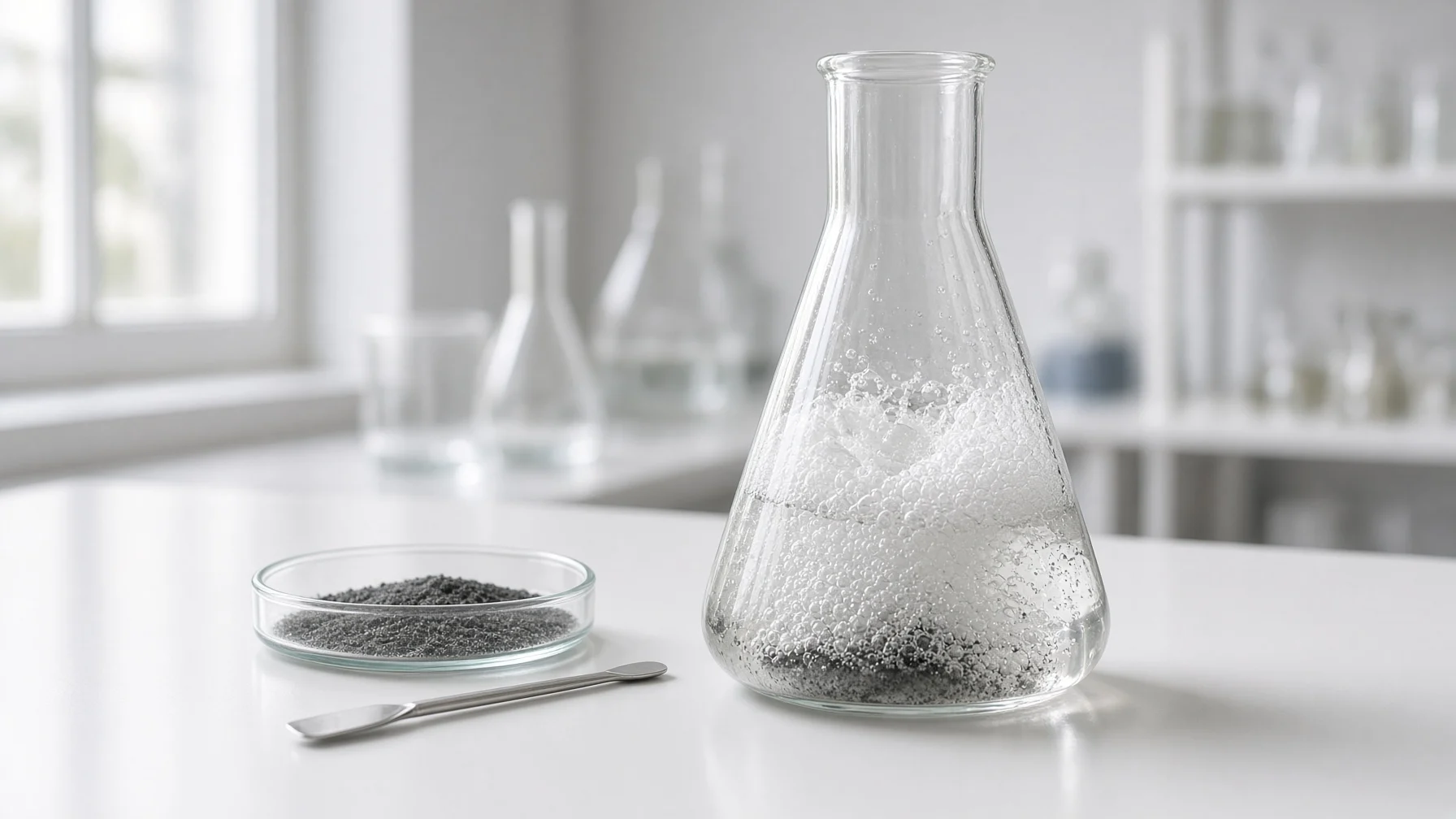
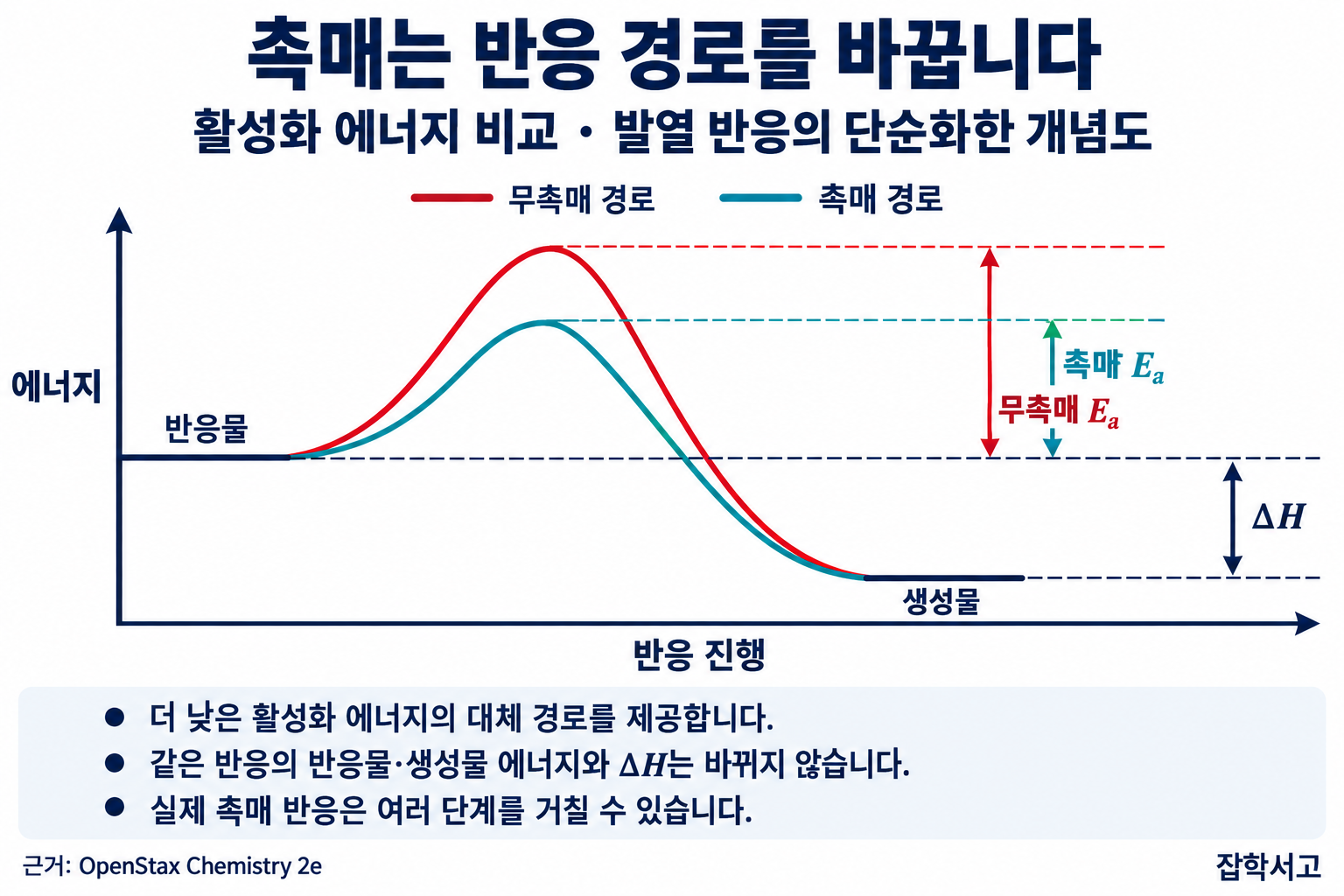
A catalyst is a substance that takes part in a reaction but is left unchanged at the end; it opens a new reaction path with a lower activation energy. At the same temperature, far more molecules can get over the hill, so the reaction speeds up.
What a Catalyst Changes and What It Cannot
- Reaction Pathway: a catalyst swaps the mountain pass that the reactants travel for a lower route.
- Enthalpy of Reaction: the heights of the starting and ending points stay the same, so the heat released or absorbed by the reaction does not change.
- Chemical Equilibrium: because it speeds up the forward and reverse reactions alike, equilibrium is reached sooner, but its position does not shift.
- Enzyme: a protein catalyst made by living things, which lets reactions in the body happen on time even at temperatures as low as body temperature.
Understanding It Through Everyday Examples
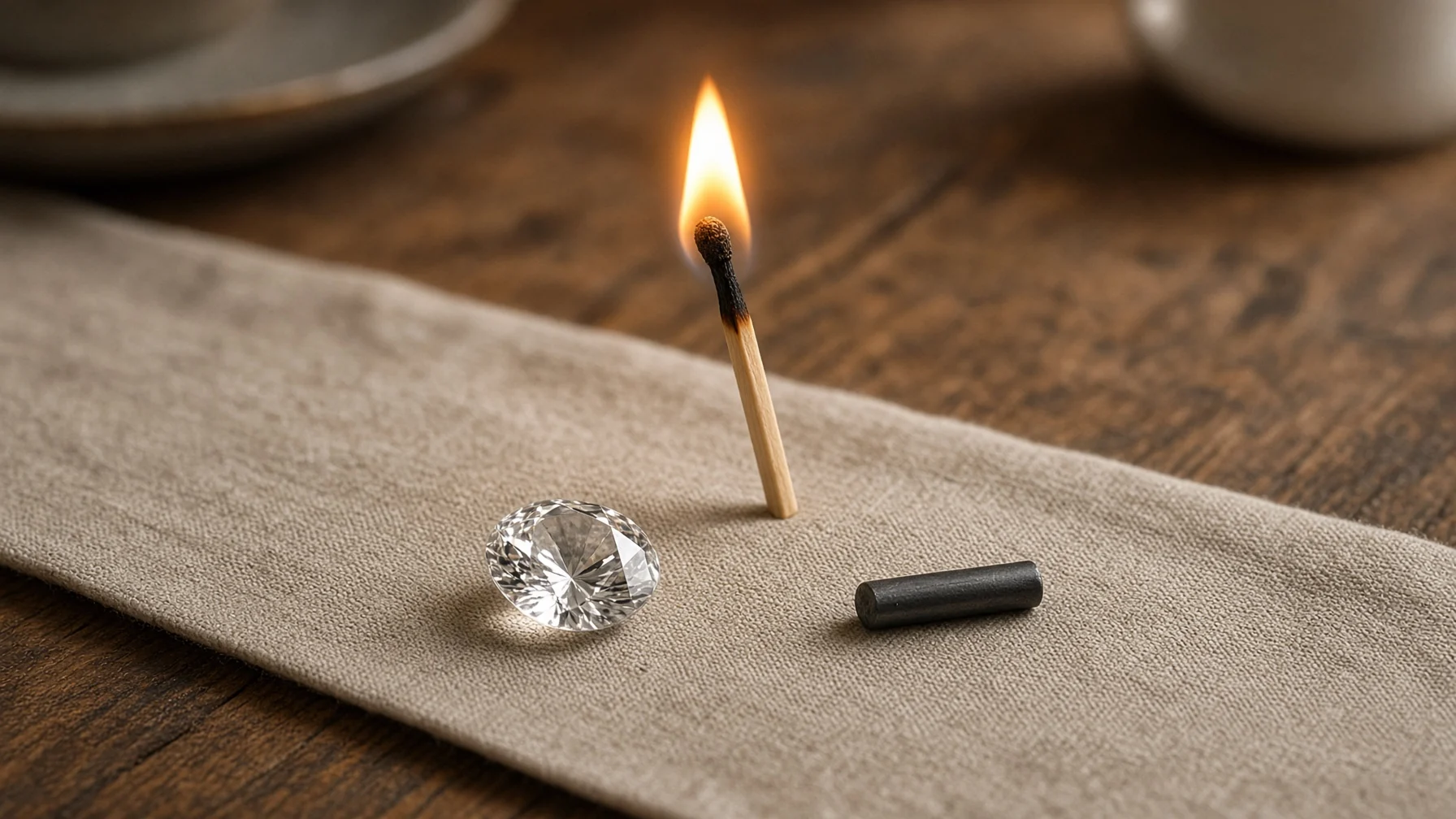
Activation energy is at work every day outside the lab, too. Sometimes we deliberately push reactions over the hill, and sometimes we keep them from getting over it.
(1) The Spark of a Match or a Gas Stove
Fuel and oxygen do not burn just because they meet. Once friction heat or an ignition spark pushes them over the first hill, the heat released by the reaction lifts the next molecules over, and the fire keeps going.
(2) Refrigerators and Food Storage
The reactions that spoil food, along with the enzyme reactions of microbes, slow down as the temperature drops. Refrigeration buys time by cutting the number of molecules that make it over the hill.
(3) Car Exhaust Converters
Metal catalysts such as platinum, palladium, and rhodium quickly turn carbon monoxide and nitrogen oxides into less harmful substances. Without a catalyst, these reactions would struggle to happen in the brief moment the gas spends passing through the exhaust pipe.
(4) Why Diamond Does Not Turn into Graphite
Under ordinary conditions graphite is the more stable form, yet diamond stays as it is. The path for the change has such a high activation energy that, in practice, it does not proceed. Whether a reaction can happen and how fast it happens are two different questions.
Activation energy is the minimum energy hill that reactants must climb to become products, and its height together with temperature sets how fast a reaction runs. The Arrhenius equation and collision theory explain, in a single thread, how we light fires, keep food fresh, and use catalysts to manage reactions in factories and in our bodies.
When some change is slow or fast, look first at the height of the hill it must climb rather than at its outcome—that is the first step toward applying activation energy wisely in everyday life.