Pour milk into a glass, and the white liquid looks evenly mixed, as if something had completely dissolved in it. But the fat and protein in milk are not scattered molecule by molecule the way salt dissolves in water; instead, they float in the water as extremely tiny clumps. These clumps are small enough that they do not easily settle even after standing for a long time.
A mixture in this in-between state, neither dissolved nor settling, is called a “colloid.” Put simply, a colloid refers to a state in which particles too small to see are evenly dispersed and suspended in another substance. Many common substances around us, such as milk, mayonnaise, jelly, and fog, belong to this category.
In this article, we will look in turn at what a colloid is and how it differs from a solution, what colloids exist in our daily lives, what the Tyndall effect that appears when light shines through them is, and even how colloidal particles can be deliberately made to clump together.
The World of Mixtures That Seem Dissolved but Are Not
What Is a Colloid?

A colloid is a mixture classified by the size of its particles.
(1) Between Solutions and Suspensions
A mixture in which a substance is dissolved as ions or molecules, like salt water, is called a solution, while one in which large grains float for a while and then settle, like muddy water, is called a suspension. Colloids sit in between: their particles are much larger than those in a solution, yet small enough that they do not settle on their own.

(2) From 1 Nanometer to 1 Micrometer
The International Union of Pure and Applied Chemistry (IUPAC) regards a system as being in the colloidal state when the dispersed particles measure roughly between 1 nanometer and 1 micrometer in at least one direction. However, this boundary is not a strict standard but an approximate range that can shift slightly depending on the properties involved.
(3) A Name Derived from Glue
The name colloid was coined in 1861 by the British chemist Thomas Graham. When he grouped together substances such as glue and gelatin that do not pass easily through membranes and diffuse slowly, he took the name from kolla, the Greek word for glue.
- Dispersed Phase: The tiny particles scattered and suspended within a colloid.
- Dispersion Medium: The base substance that holds the particles, such as water or air.
Colloids Around Us
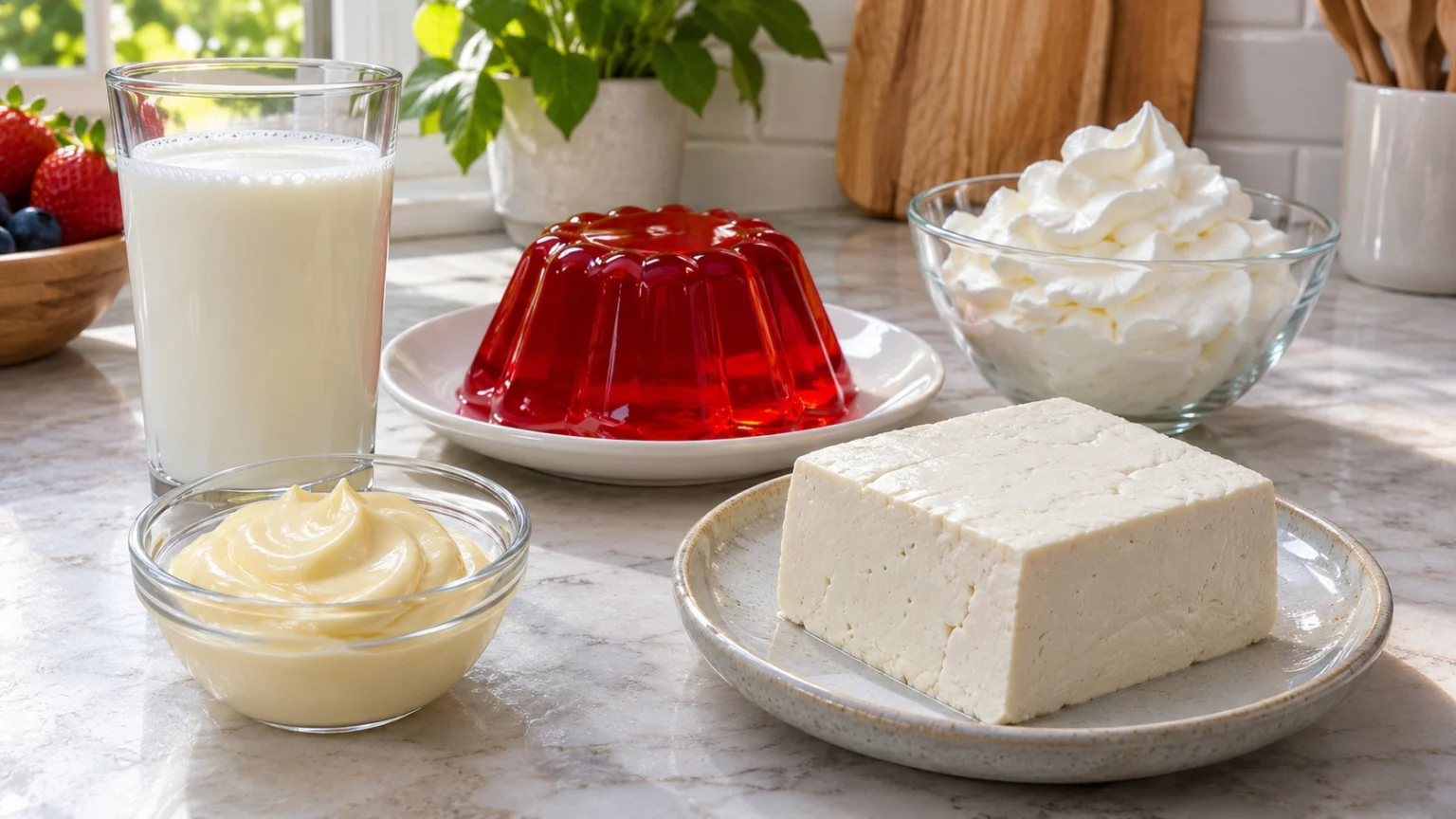
Depending on what the dispersed phase and the dispersion medium are, colloids appear in many different forms.
- Sol: A state in which solid particles are dispersed in a liquid and flow, as in ink or paint.
- Gel: A state in which particles link up like a net, trapping liquid and setting firm; jelly, muk (Korean starch jelly), and tofu are typical examples.
- Emulsion: A state in which droplets of one liquid are dispersed in another liquid; milk and mayonnaise fall into this category.
- Foam: A state in which gas is trapped within a liquid or solid; whipped cream and sponges are examples.
- Aerosol: A state in which tiny liquid droplets or solid particles float in a gas; fog and smoke are typical examples.
Because colloids vary so widely in their properties, knowledge of colloids is widely used to control the texture of food and to mix cosmetics and medicines evenly.
The Tyndall Effect: Revealing the Path of Light
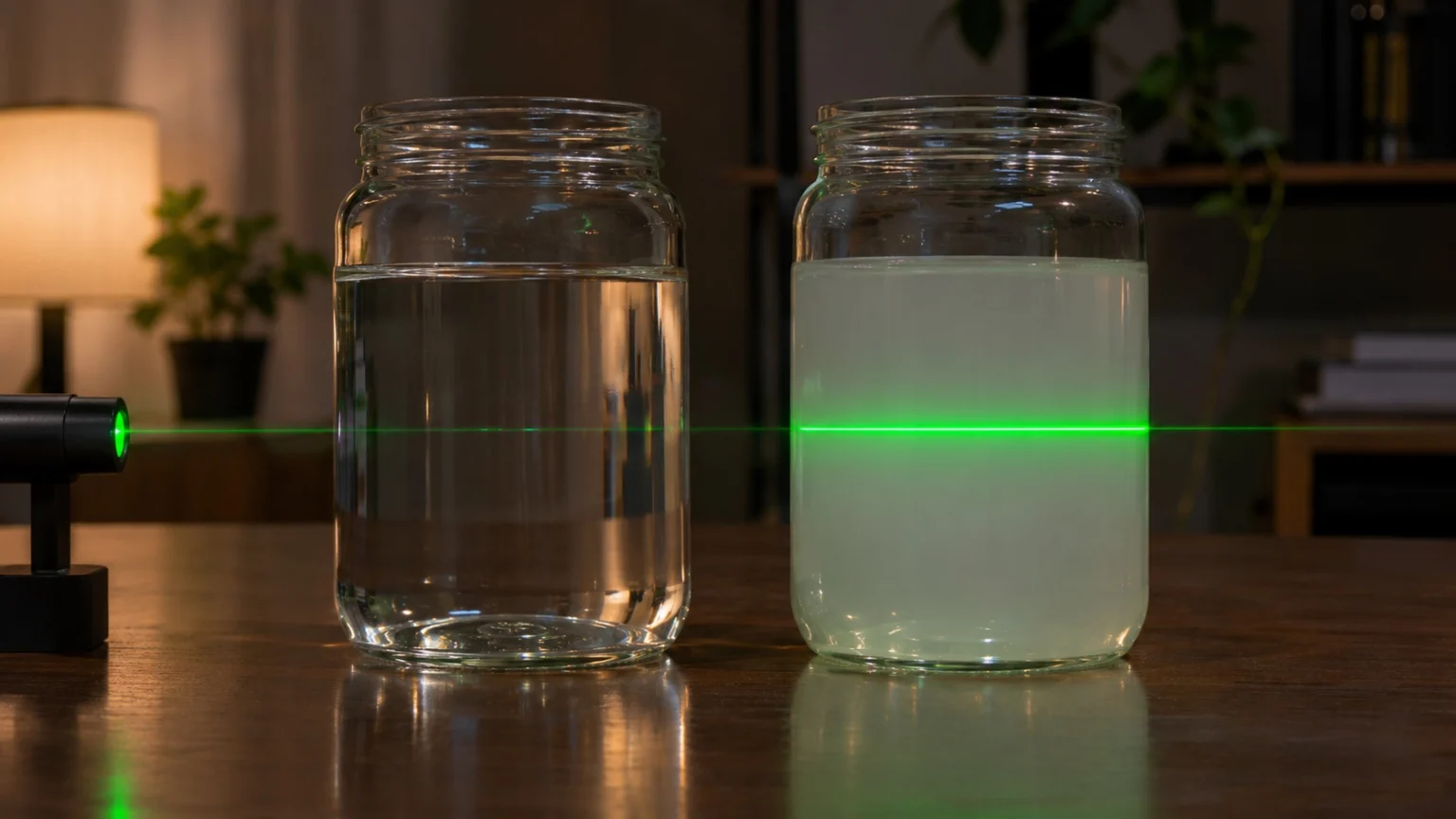
Although the particles in a colloid cannot be seen with the naked eye, their presence is revealed when light shines through.
(1) Why the Path of Light Becomes Visible
If you shine a laser pointer through salt water and through diluted milk in a dark room, the path of the light is barely visible in the salt water, but a beam of light shows up clearly in the diluted milk. This is because the colloidal particles scatter the light in all directions, a phenomenon known as the Tyndall effect.
(2) Tyndall's Smoke Experiment
The name comes from the 19th-century British physicist John Tyndall. In the 1860s, he experimented by passing light through a tube filled with smoke and observed that the light looked blue when the tube was viewed from the side and red when viewed from the opposite end.
(3) A Microscope for Seeing Invisible Particles
In 1902, Richard Zsigmondy and Henry Siedentopf used this principle to build the ultramicroscope. Because it works by viewing from the side the light scattered by the particles rather than the particles themselves, it made it possible to observe colloidal particles that could not be seen with an ordinary microscope, and Zsigmondy received the 1925 Nobel Prize in Chemistry.
How to Make Colloids Clump Together

There is a reason colloids stay dispersed for so long, and by removing that reason, the particles can be deliberately made to clump together.
(1) Particles That Repel Each Other
Colloidal particles often carry the same type of electric charge on their surfaces, so they repel each other when they come close. On top of this, Brownian motion, in which water molecules constantly collide with the particles and jostle them about, keeps the particles from easily clumping or settling.
(2) Coagulation Caused by Salt
When a substance rich in ions is added to a colloid, the electric charge on the particle surfaces is masked and the particles stick together; this is called coagulation. Making tofu by adding nigari (brine) to soy milk, and mud carried by a river settling at the estuary when it meets seawater, are also related phenomena.
(3) Coagulants That Make Water Clear
At water treatment plants, coagulants such as alum are added because the extremely tiny soil particles in the water do not settle easily. The small particles then clump together into large flocs, and once these flocs settle and are filtered out, the water becomes clear.
A colloid is a unique state created by tiny particles that neither dissolve nor sink, and it is hidden in a glass of milk, a foggy morning, and a block of tofu alike. By understanding particle size and electrical properties, people can choose for themselves whether to keep things mixed or make them clump.
Knowing that invisible particles may be floating even in a substance that looks transparent is the first step in the chemical thinking that uncovers the hidden structure of mixtures.