From the smartphone we check as soon as we open our eyes each morning to electric cars quietly passing along the street, laptops, and power banks, the daily lives of people today would be difficult to sustain for even a moment without batteries. We pay close attention to the remaining battery percentage (%) displayed in the upper-right corner of our smartphone screens, but often give little thought to what is happening inside that tiny rectangular box.
A battery is more than just a 'space for storing electricity.' More precisely, it is a 'chemical reaction device that converts chemical energy into electrical energy.' Rather than accumulating electricity directly, it works by using changes in the chemical states of materials to move electrons when needed.
Focusing on lithium-ion batteries, a leading type of modern rechargeable battery, this article will examine in depth, from a chemical perspective, the 4 key components inside a battery, the chemical mechanisms of charging and discharging, degradation, and next-generation battery technologies.
The 4 Key Components of a Battery and Their Roles
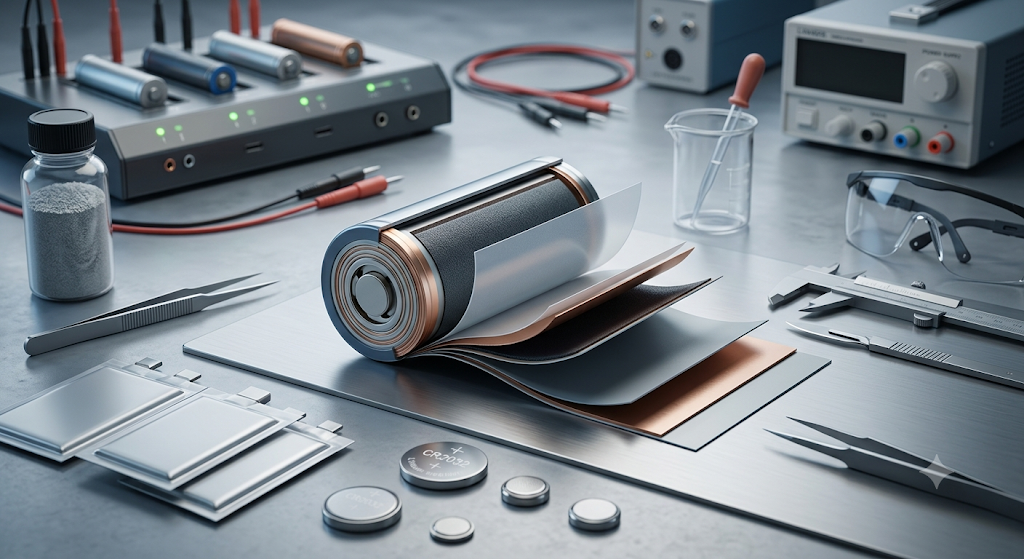
To understand how a battery works internally, we first need to understand its 4 key components: cathode material, anode material, electrolyte, and separator. These 4 components serve as the 'buildings' and 'roads' where guests called lithium ions stay and travel.
(1) Cathode Material (Positive Electrode / Cathode)
The cathode material is the most important component in determining a battery's 'capacity' and 'power output.' It usually takes the form of lithium combined with oxides (nickel, cobalt, manganese, iron, etc.), such as LCO, NCM, or LFP. To use a simple analogy, it can be seen as the 'family home (apartment)' where lithium ions stay peacefully when the battery is fully charged.
(2) Anode Material (Negative Electrode / Anode)
The anode material receives and stores lithium ions from the cathode during charging. Graphite or silicon-based materials are commonly used. Graphite has a layered structure, with multiple sheets stacked together, making it particularly suitable for safely trapping lithium ions in the empty spaces between its layers. The anode material serves as the 'temporary lodging' where lithium ions stay during charging.
(3) Electrolyte
The electrolyte is a medium that helps lithium ions move smoothly between the cathode and anode. It usually exists as a liquid made by dissolving a lithium salt in an organic solvent. It is designed to allow ions to pass through while preventing electrons from doing so. It serves as a 'highway and river' that carries ions.
(4) Separator
The separator is a membrane with tiny holes (a porous membrane) that physically prevents the cathode and anode from coming into direct contact. If the cathode and anode touch directly, a short circuit occurs, causing rapid heat generation and an explosion. The separator acts as a 'safety doorman,' blocking electrons and allowing only tiny lithium ions to pass through its holes.
The Chemical Mechanisms of Charging and Discharging (The Journey of Lithium Ions)
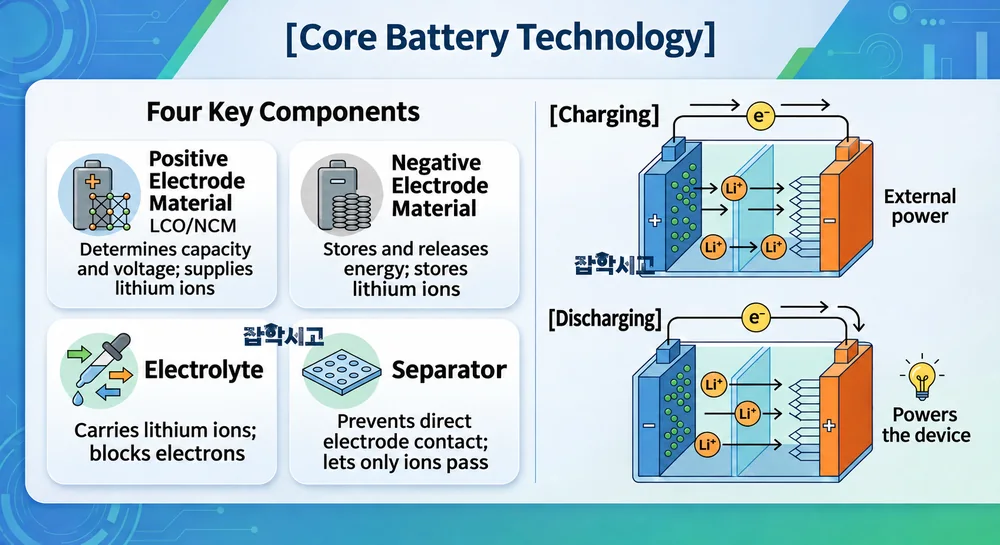
When a battery operates, oxidation-reduction reactions (redox reactions) occur inside it. A reaction that loses electrons is oxidation, and a reaction that gains electrons is reduction. The key to a lithium-ion battery is that, because electrons cannot be sent directly, ions travel internally through the electrolyte while electrons take a detour through an external circuit.
[Charging Process (External Power Supply)]
Cathode (family home) ---> (Lithium ion movement: electrolyte) ---> Anode (temporary lodging) ---> (Electron movement: external wires) --->
[Discharging Process (Using an Electronic Device)]
Anode (temporary lodging) ---> (Lithium ion movement: electrolyte) ---> Cathode (family home) ---> (Electron movement: external wires: device operation) --->
(1) Discharge: The Process of Using Electricity
This is the reaction that occurs when we use a smartphone.
- Anode reaction: Lithium (Li) stored in the anode (graphite) loses an electron (e⁻) and is oxidized into a lithium ion (Li⁺).
- Movement: The lithium ions (Li⁺) produced travel through the electrolyte and separator to the cathode. Because the electrons (e⁻) released in this process cannot pass through the electrolyte, they flow to the cathode through a conductor connected outside the battery (the smartphone's circuit).
- Operation: This flow of electrons through the external conductor is the 'electric current (electricity)' that we use.
- Cathode reaction: The lithium ions and electrons that return to the cathode recombine with the cathode material (reduction), returning to a stable state.
(2) Charge: The Process of Putting Energy Back In
The reverse reaction of discharging occurs. When a charger is plugged in, voltage is forcibly applied from outside.
- The lithium ions bound to the cathode lose electrons again, leave the cathode, and travel through the electrolyte to the anode.
- The electrons move to the anode through the external charger circuit.
- Lithium ions and electrons are neatly stored again between the graphite layers of the anode.
Why Do Batteries Reach the End of Their Lifespan? (Chemical Causes of Degradation)
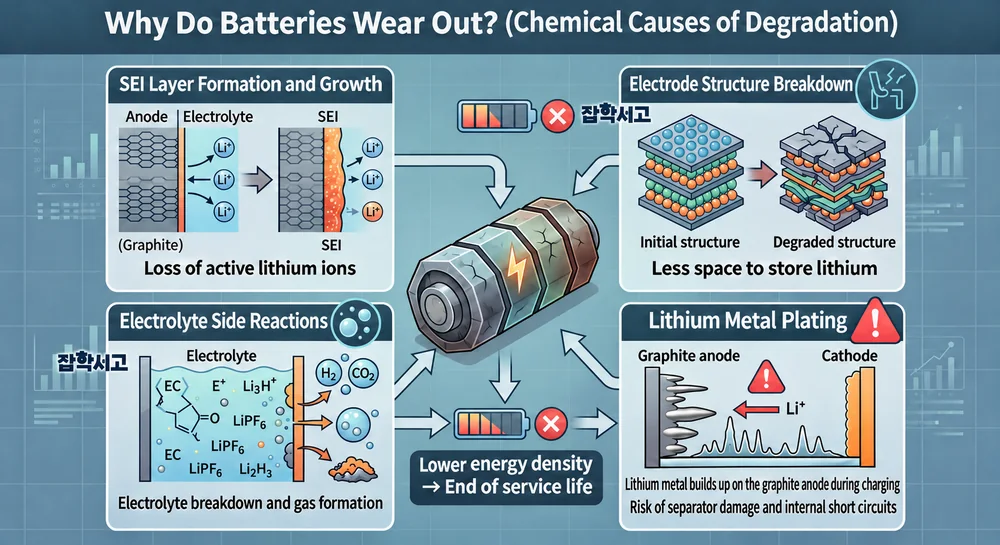
After using a battery for a long time, you may notice that its runtime is significantly shorter than when it was first purchased. This is called 'battery degradation,' and its main causes lie in the following chemical alterations.
(1) Growth of the SEI (Solid Electrolyte Interphase) Layer
When a battery is charged for the first time, the electrolyte decomposes at the anode surface, forming a thin protective layer (the SEI layer). At a suitable thickness, this layer protects the battery, but it gradually thickens as charging and discharging are repeated. During this process, lithium ions become trapped and immobilized in the layer, reducing the 'amount of available lithium ions' that can participate in reactions.
(2) Damage to the Crystal Structures of the Cathode and Anode
As lithium ions continually move in and out between layers of graphite or cathode material (the phenomenon of intercalation), small physical stresses are applied to the materials. Over time, the material structure breaks down on a microscopic scale or develops micro-cracks, reducing the space available for lithium ions to enter.
(3) Effects of Temperature and Voltage
In high-temperature environments, side reactions in the electrolyte increase sharply, accelerating layer formation. Under conditions of overdischarging (keeping the battery at 0%) or overcharging (remaining at 100%), structural imbalances in the electrode materials become more severe, rapidly shortening the battery's lifespan.
Next-Generation Battery Technologies and Challenges for the Chemistry Community
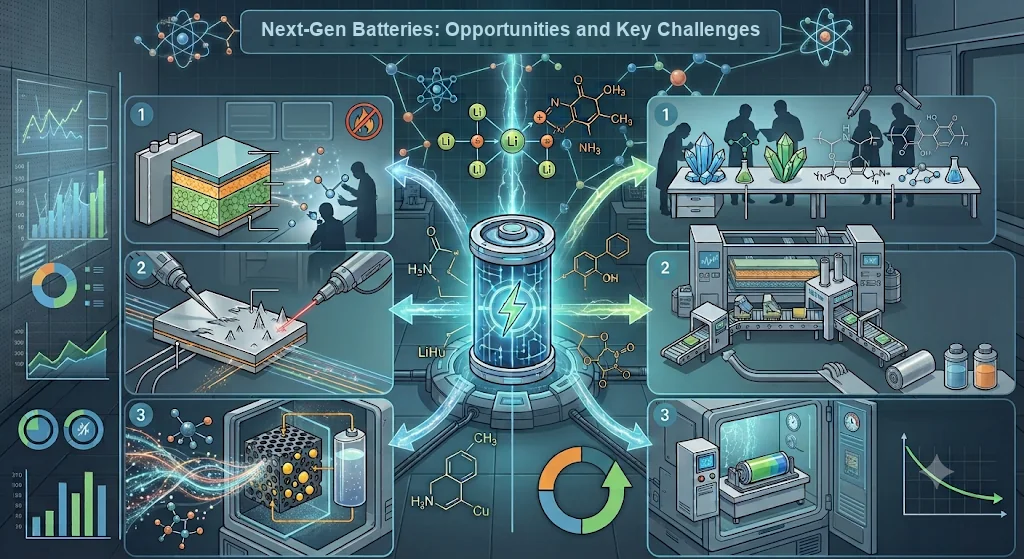
Lithium-ion batteries offer excellent energy density, but face the challenges of fire risks associated with liquid electrolytes and physical limits on energy density. To overcome these challenges, the chemistry community is actively researching next-generation batteries.
(1) All-Solid-State Battery
This technology replaces the liquid electrolyte with a solid electrolyte.
- Advantages: The risk of fires and explosions caused by the gas generation and leakage characteristic of liquid electrolytes is significantly reduced. A solid electrolyte can also serve as a separator, reducing battery volume and maximizing energy density.
(2) Sodium-ion Battery
This battery uses sodium, the main component of salt, which is abundant and inexpensive, instead of the rare metal lithium.
- Advantages: It offers excellent cost savings and suffers less performance loss in low-temperature environments. Because its energy density is somewhat lower than that of lithium, it is attracting considerable attention for energy storage systems (ESS) or low-cost electric vehicles.
The Power of Chemistry in Leading a Sustainable Future
A battery is more than just an engineering product; it is a perfect chemical system that transforms chemical reactions in the microscopic world into energy in the macroscopic world. The small movements of lithium ions traveling tirelessly between the cathode and anode combine to power electric vehicles and make humanity's digital life possible.
Chemists are currently continuing innovations to improve the safety, cost-effectiveness, and environmental friendliness of batteries, including commercializing all-solid-state batteries, developing high-density cathode materials, and researching environmentally friendly processes for recycling spent batteries.
Now that we have entered an era of energy transition, understanding battery chemistry will go beyond simple knowledge to become an important key to reading future trends in industry and technology.