Browse the shelves of a neighborhood library and you may find yellowed covers, computer guides more than 20 years old and several copies of the same book packed so tightly that the one you actually want is hard to find. If collecting books is a library’s job, does removing them ruin the library? In fact, libraries keep their shelves healthy by regularly picking books out, and this work is called ‘weeding’.
Weeding, simply put, means ‘a collection management activity that removes worn-out, inaccurate or no-longer-used materials from the shelves according to set criteria.’ The name comes from pulling weeds in a garden, and the CREW method, first introduced in 1976, has become the most widely used weeding standard today through the manual published by the Texas State Library in the United States.
In this article, we will look in turn at the meaning and necessity of weeding, the CREW method and MUSTIE criteria in a picture, the benefits weeding brings to libraries, and finally the points to weigh and the debates before discarding.
Shelves That Grow by Letting Go: Weeding
1. What weeding is and why it is needed

A library collection is not property that is finished once purchased, but a living body that needs constant care. As Indian library scientist S. R. Ranganathan said in the last of his Five Laws of Library Science, ‘a library is a growing organism,’ and a collection grows healthily only when materials that have served their purpose are removed as new ones come in.
(1) Not the same as discarding
Weeding refers to the whole decision to remove material from the shelves. Removed items may be repaired or rebound and returned, replaced with a new edition, or sent out through donation, sale or recycling, among other routes.
(2) As important as collecting
Selecting materials and weeding them are two sides of collection development. That is why many libraries write weeding criteria into their collection development policies and make clear on what grounds materials are removed.
(3) The limits of space and time
Shelf space and budgets are limited, while new publications pour out every year. When materials nobody looks for take up room, there is less space for new books and less time for users to find the books they want.
2. The CREW method and MUSTIE criteria in a picture

CREW stands for ‘Continuous Review, Evaluation, and Weeding,’ meaning weeding should be done steadily as routine work rather than as a one-time big cleanup. Starting from Joseph P. Segal’s work in 1976, revised editions were produced by Belinda Boon in 1995 and Jeanette Larson in 2012.
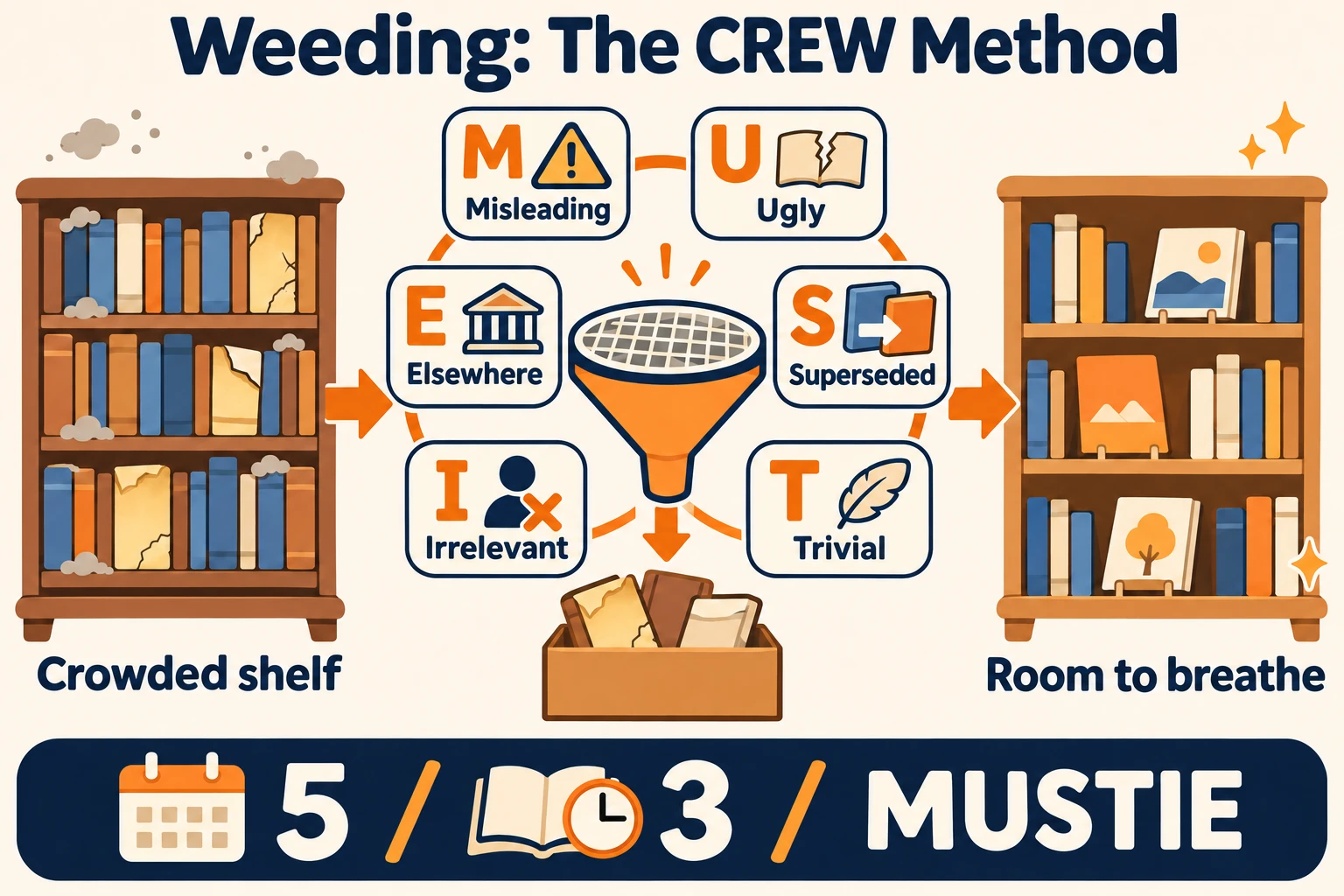
- Misleading: Material whose content is wrong or outdated and may mislead users.
- Ugly: Material so worn and torn that even mending or rebinding cannot save it.
- Superseded: Material that has given way to a new edition or a better book on the same subject.
- Trivial: Material that was only a passing interest and has little discernible literary or scholarly merit.
- Irrelevant: Material that does not match the needs and interests of the community the library serves.
- Elsewhere: Material that can easily be obtained from another library or through interlibrary loan.
(1) The first number: years since publication
CREW attaches a formula such as ‘5/3/MUSTIE’ to each subject. The first number is the years since the latest copyright date, so natural sciences (500) become candidates for careful review after five years.
(2) The second number: time without use
The second number is the maximum time an item can go without being used. With 5/3/MUSTIE, the library checks whether the item has gone unborrowed for three years and also weighs whether it has any MUSTIE flaws.
(3) X and differences by subject
If a condition does not apply to a subject, its place is filled with an X. Computers (004) use 3/X/MUSTIE and fiction uses X/2/MUSTIE, so fields where information ages quickly and fields where usage records matter follow different standards.
3. The benefits weeding brings to libraries

The CREW manual sums up several benefits of weeding. The idea that a library improves after reducing its books may sound strange at first, but it is easy to understand when you look at the shelves through users’ eyes.
(1) It saves space and time
Freed-up space can hold new books or make room for seating and displays, and both users and librarians find what they need faster.
(2) The shelves become more appealing
When old books leave and there is room to display covers face-out, the shelves look much fresher. The manual explains that this change can increase circulation, and Stanley J. Slote, known for his research on weeding, also held that regular weeding increases use.
(3) Reliable information and a collection checkup
Filtering out old medical and health information raises trust in the library’s materials. The process of deciding what to remove also naturally reveals which subjects are weak and what should be bought next.
4. Points to weigh and debates before discarding
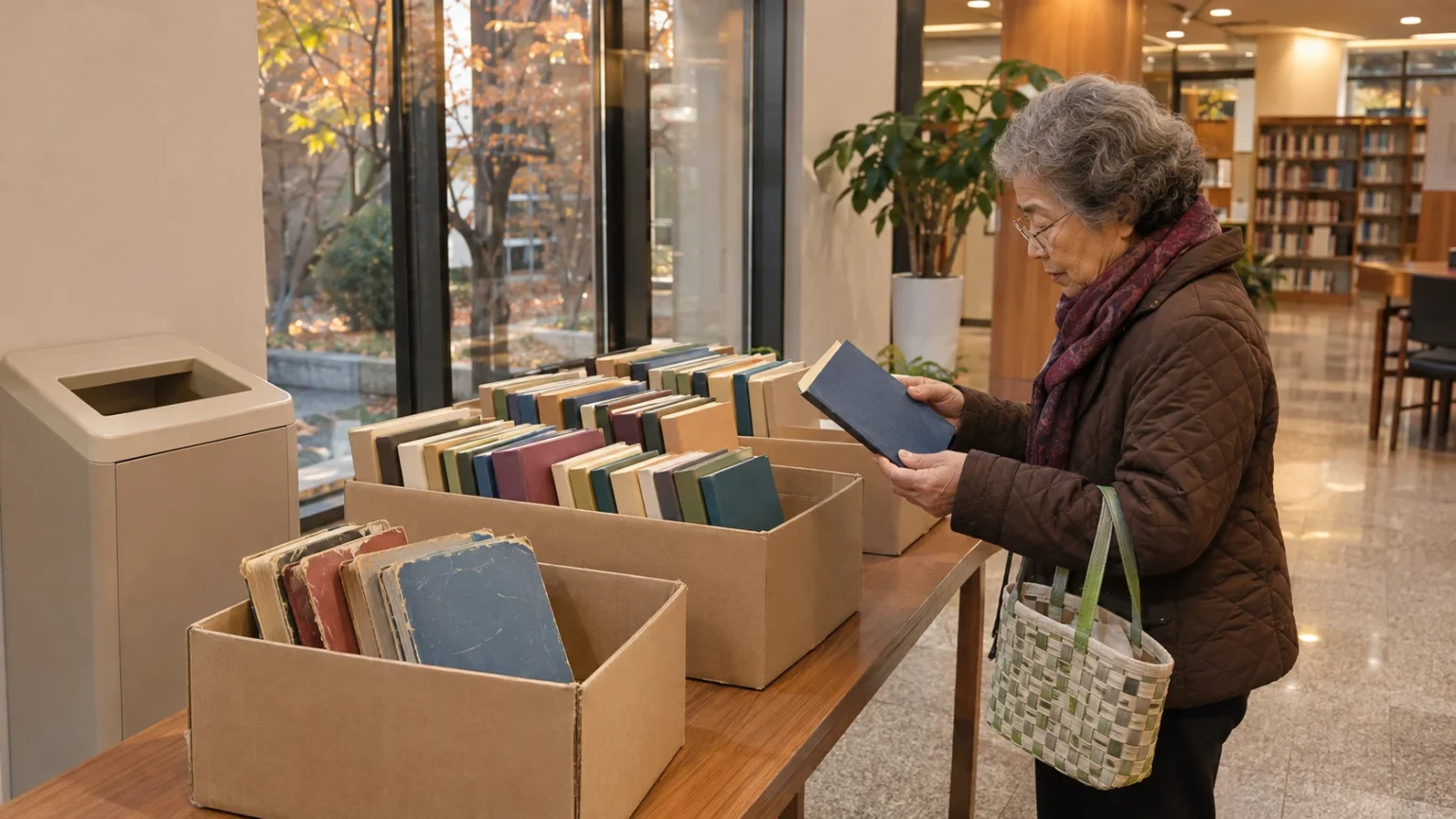
Weeding is not something to do mechanically just because the numbers fit. Scenes of books being thrown away can provoke strong backlash from users, so it is important to have transparent criteria and procedures.
(1) Cases that sparked strong backlash
In 2013, the Urbana Free Library in Illinois, United States, removed many books at once based on publication date and faced fierce protests from residents. Novelist Nicholson Baker criticized libraries for discarding original newspapers after microfilming them in his 2001 book Double Fold.
(2) Materials unique to a region
The judgment that material ‘can be obtained elsewhere’ holds only while another library keeps it. That is why local history materials or last remaining copies are often kept or moved to storage even when they meet the criteria.
(3) Where removed books go
Weeded books have their library markings and barcodes removed and are then sold at book sales or donated, and only those that can no longer be used are recycled. Many books that leave the shelves find new readers.
In the end, weeding is not about carelessly throwing books away but about building the most useful shelves for the people who visit the library now. The simple idea that ‘new knowledge comes in only when the shelves have gaps’ is the first step to understanding weeding.