This time, I would like to prepare material on the concept and characteristics of metadata. Alongside this, I will also briefly examine the characteristics of HTML and XML, languages used to describe metadata.
The phrase most commonly used to define metadata is 'data about data.' Here, data refers to electronic resources, and it is written directly by the creator of the material.
The Concept of Metadata
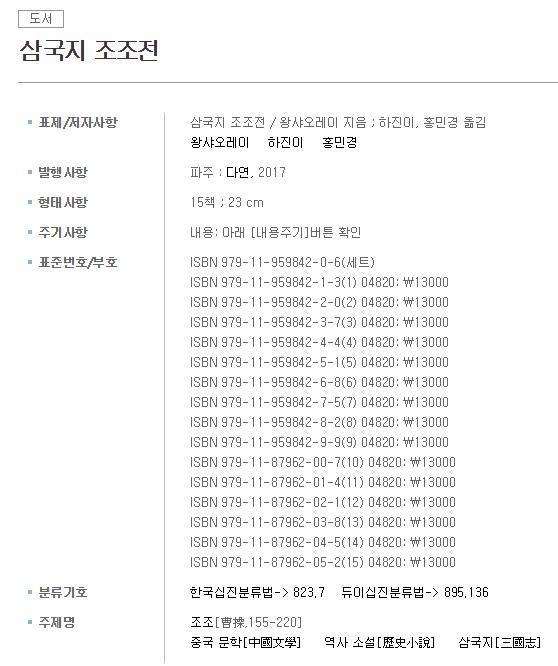 Metadata Example
Metadata is created by embedding data in the information resource itself for provision to search engines and similar services, and this information includes identifying information, access points, and location information.
 SEO = Search Engine Optimization
The need for metadata emerged as the Internet became widespread, information grew abundant, and file formats for that information diversified, and metadata allows users to quickly and easily find the information they want within vast amounts of information.
Metadata is also invisible to users, making it difficult to perceive directly, but because machines read, understand, and use its contents, it can be considered highly important data on the web.
Uses and Structure of Metadata
 Where Metadata Is Actively Used
Karen Coyle defined metadata as 'data created for a particular purpose,' and libraries are a representative setting where such metadata is used to describe bibliographic information.
Libraries traditionally used MARC (Machine Readable Cataloging), but in 1995, OCLC and NCSA created a new metadata format called Dublin Core (DC). It was simplified to make it easier to understand than existing formats and designed for international use, and above all, it stands out for having been designed to be extensible.
The 15 Dublin Core Elements
- Title (Title)
- Creator (Creator)
- Type (Type)
- Other Creators (Contributor)
- Publisher (Publisher)
- Date (Date)
- Language (Language)
- Format (Format)
- Description (Description)
- Subject (Subject)
- Relation (Relation)
- Identifier (Identifier)
- Permissions (Rights)
- Source (Source)
- Scope (Coverage)
To write metadata in XML, the descriptive elements and attributes must first be designed, and this design is carried out using a DTD or XML Schema.
And to display it, it must be defined using CSS (Cascading Style Sheets) and XSL (eXtensible Style Language) that include the metadata elements.
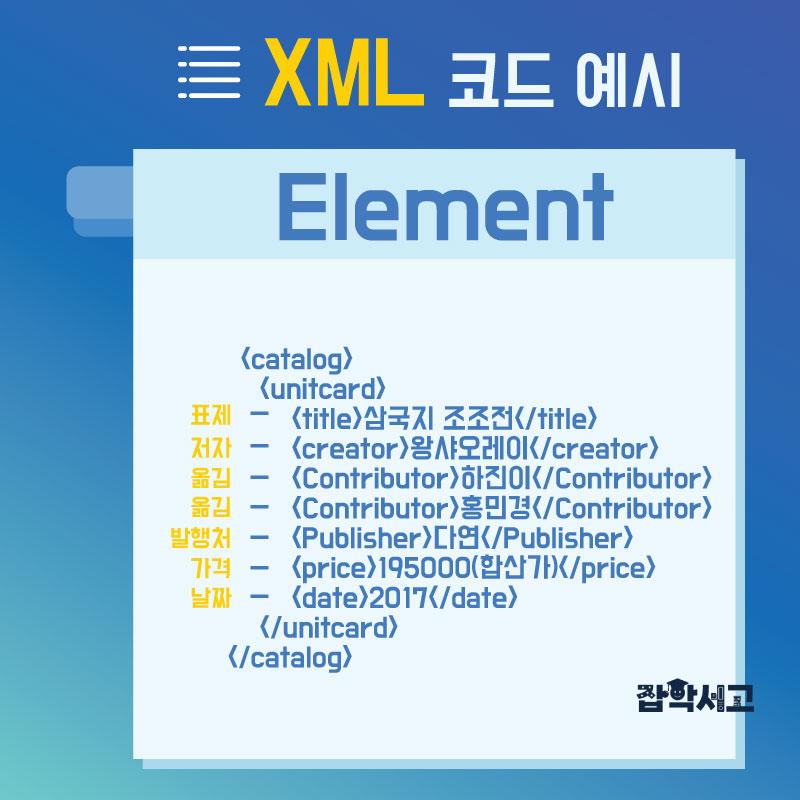 Example of the Element Section of XML Code (Using the 15 Dublin Core Elements)
A summary of the structure and characteristics of metadata in relation to the above is as follows.
Structure of XML
※ Descriptive Elements (Element)
- The descriptive rules are oversimplified, and access points are not distinguished from identifying information, resulting in a lack of consistency.
- There are no rules specifying the format of information to be used as access points.
- The types and nature of descriptive elements vary by field.
- A method of grouping information is needed, as in a catalog, where information is divided into 8 categories.
※ Descriptive Attributes (Attribute)
- An attribute consists of an attribute name and an attribute value, and an encoding scheme (Encoding Scheme) is required. Examples: date notation formats, place name notation formats, DDC, KDC, etc.
- Controlled vocabularies such as thesauri and ontologies are needed.
※ Description Language (Encoding Language)
- HTML - An international standard language that specifies the format of documents on the web and defines TAGs and attributes (Attribute).
- XML - A simplified form of SGML in which TAGs can be defined and used for a particular purpose.
- XML-RDF
- RDF-OWL (W3C standard) - Available in three types: Lite, DL, and FULL
- Topic M APS (ISO standard)
※ Format Definition
- DTD - An XML DTD (document type definition: Document Type Definition) includes element type definitions, attribute list definitions, entity (object) declarations, notation declarations, processing instructions, and comments.
- XML Schema - W3C (World Wide Web Consortium) proposed XML Schema as a standard to address the shortcomings of DTD.
- RDF Schema - Based on XML Schema, it enables data to be merged even across different schemas and supports common rules for semantics, syntax, and structure.
- OWL (Lite, DL, FULL) RDF Schema
Comparison of HTML and XML
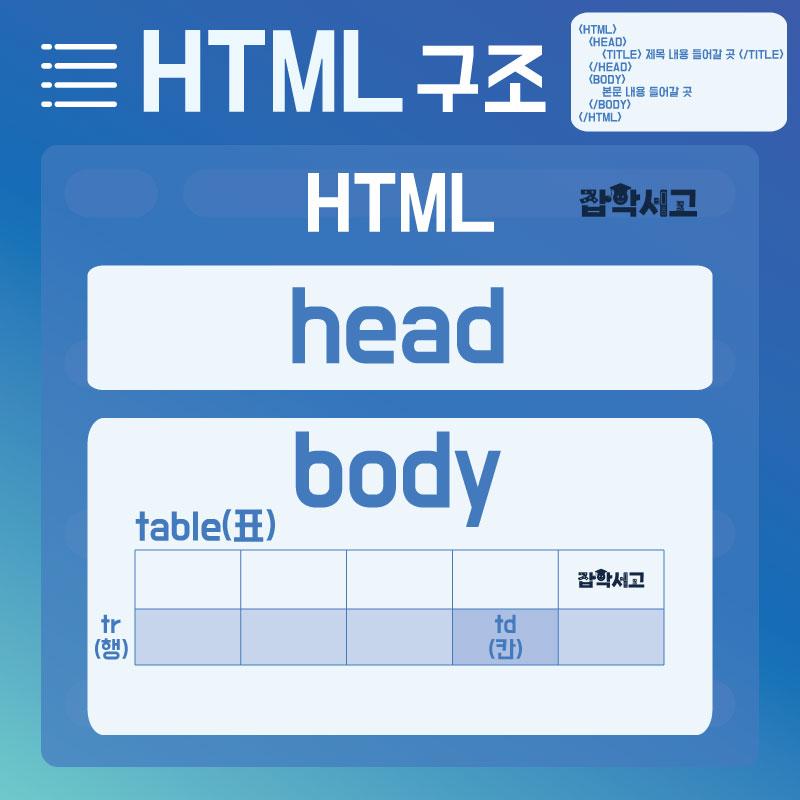 Understanding the Structure of HTML
The most representative example for expressing metadata can be said to be HTML tags. HTML tags include <head> and <body>, with <table> inside <body>, <tr> inside <table=table>, and <td=box (cell)> inside <tr=line (row)>, forming a hierarchical tree structure from higher to lower levels.
To understand HTML's hierarchical structure, looking at the image above will probably be a little easier than reading an explanation.
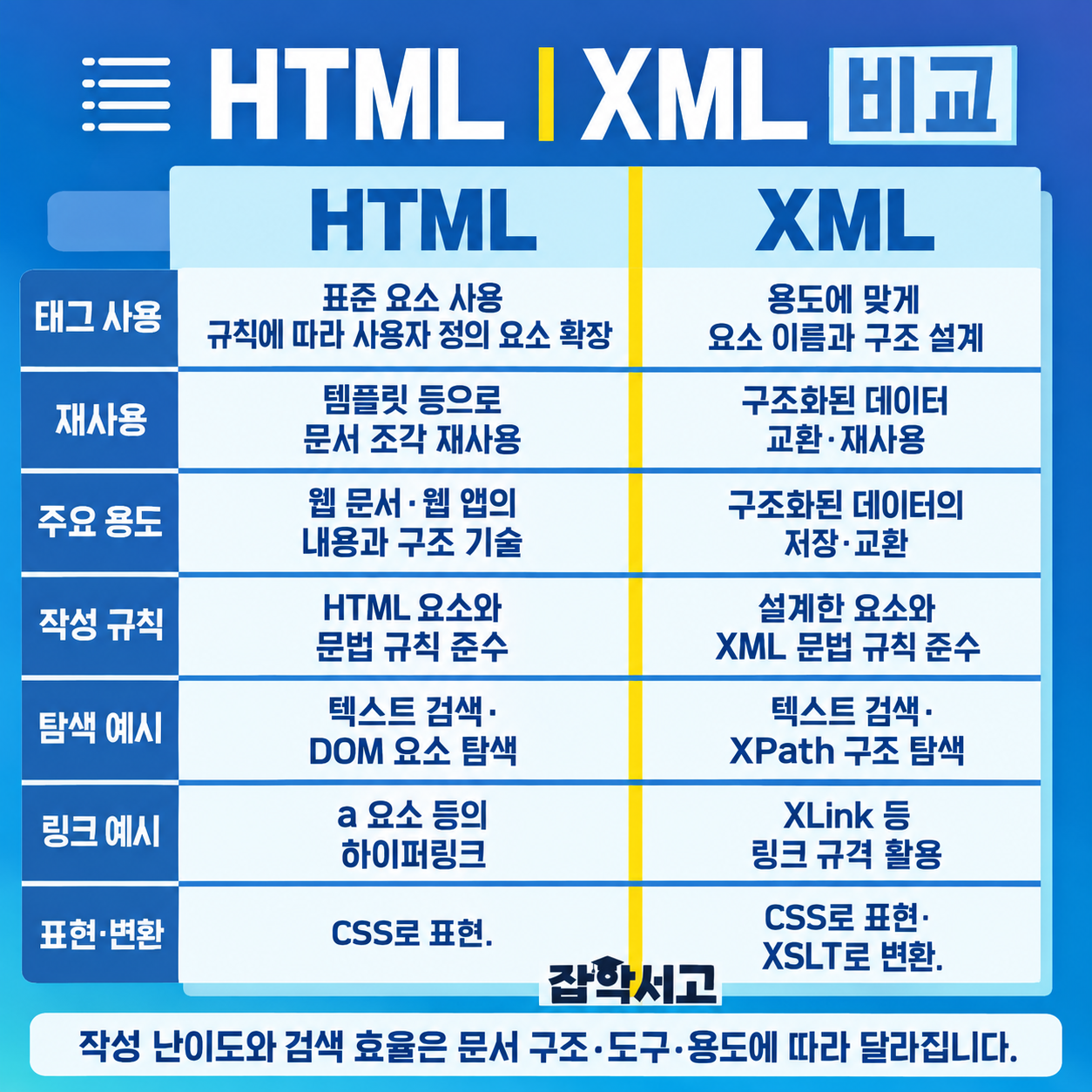 Comparison of HTML and XML
However, HTML has 2 main limitations.
One is a problem arising from the use of attributes (text, colors, etc.) to express document formatting, and the other is that HTML’s built-in TAG vocabulary is defined by the standard. However, current HTML allows author-defined elements that follow the Custom Elements rules. XML (eXtensible Mark-up Language) is a simplified form of SGML that can describe document structure and data using purpose-specific TAGs.
To resolve these issues, the former is handled by using Cascading Style Sheet (CSS) or eXtensible Stylesheet Language (XSL language) for presentation, while the latter is resolved by defining TAGs using DTD (Document Type Definition) or XML Schema.
We have briefly explored the concept and characteristics of metadata, along with HTML and XML, the languages used in connection with it. Although the subject is complex, the key point about metadata is that it is data entered into content according to certain rules to efficiently find the desired information amid a vast flood of information.
I hope these concepts have helped you understand metadata, and with that, I conclude this article on metadata, HTML, and XML.