Search on your smartphone, and tens of thousands of results pour out in an instant. But the search box won’t pick out the trustworthy information for you, check where it came from, or apply it to your situation. The ability that becomes more important the more information overflows is ‘Information Literacy.’
Put simply, information literacy means ‘the ability to recognize what information you need, find it, evaluate it, and use it ethically.’ It is a concept long refined in library science and library and information science, and today it has become a core competency across school, work, and everyday life.
This article explains, in an easy-to-understand way, everything from the definition and origins of information literacy to the core framework proposed by the ACRL, checking habits for everyday life, and the ways libraries help build this ability.
The Concept of Information Literacy and a Framework for Practice
What Is Information Literacy?
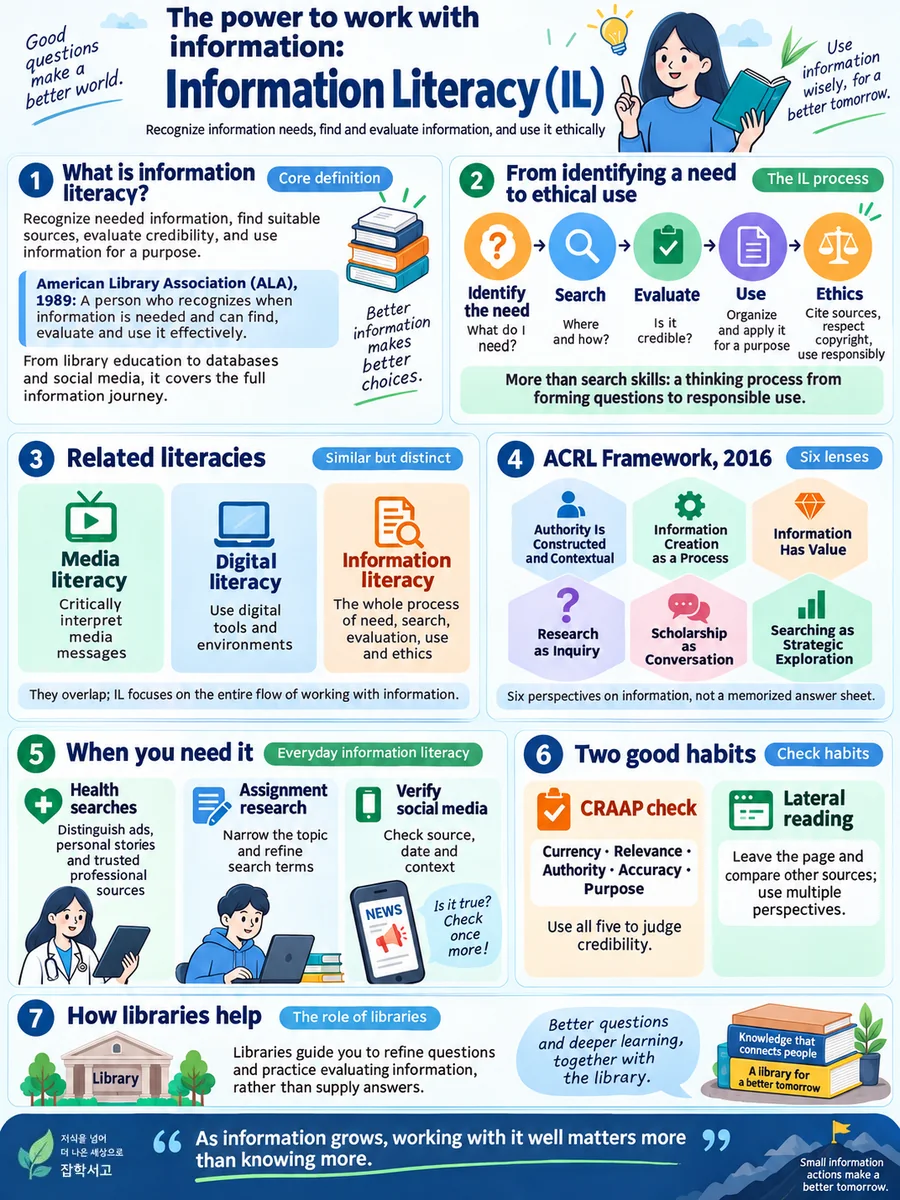
In 1989, the American Library Association (ALA) defined an information-literate person as someone who ‘recognizes when information is needed and has the ability to locate, evaluate, and use effectively the needed information.’ The term doesn’t refer simply to the ability to read a lot of books or to search skills alone.
The concept began with ‘Bibliographic Instruction’ in libraries, and its scope widened as computers and the internet became widespread. It grew from knowing how to read lists printed on paper into ‘the ability to handle the entire information environment,’ spanning databases, the web, and social media.
If media literacy focuses on critically reading media messages such as news, videos, and advertisements, information literacy views the information needed for assignments, research, and decision-making as an entire process of ‘recognizing the problem → searching → evaluating → using → ethics.’ The two overlap, but their starting points and goals differ.
- Information Literacy: The entire process of recognizing a need, then finding, evaluating, and using information.
- Media Literacy: The ability to critically interpret messages created by the media.
- Digital Literacy: The skills and attitudes for handling digital tools and environments.
The ACRL Framework: Six Lenses on How Information Works

In 2016, the Association of College and Research Libraries (ACRL) presented six ‘frames’ in its “Framework for Information Literacy for Higher Education.” They are less a checklist and more like lenses for looking at information.
(1) Authority Is Constructed and Contextual
Who counts as an ‘expert’ depends on the field and the purpose. The authority of an academic paper and the authority of a patient’s personal account come from different contexts.
(2) Information Creation as a Process
Blogs, news articles, and peer-reviewed papers are created through different processes. Knowing the format makes it easier to gauge reliability.
(3) Information Has Value
Copyright, personal data, and paid databases show that information has economic and legal value.
(4) Research as Inquiry
Good research starts not with an answer but with a better question. Refining the question itself is literacy.
(5) Scholarship as Conversation
A paper is not a monologue spoken alone but a conversation that continues from earlier research. Citation is the way to take part in that conversation.
(6) Searching as Strategic Exploration
Changing keywords, switching databases, and failing again and again are a normal part of searching.
Information Literacy in Everyday Life Through Easy Examples

Information literacy doesn’t exist only inside the library. Here is how it is used in everyday life.
[Case 1] Searching for Health Information
When you search for headache medicine, you don’t give advertising blogs the same weight as materials from health authorities or hospitals. You first check the author, the date, the evidence (research or guidelines), and any conflicts of interest (such as a sales motive).
[Case 2] Finding Sources for Assignments and Reports
If you start with a broad topic such as ‘the effects of climate change,’ you get far too many results. Narrow the scope, as in ‘urban heat waves and vulnerable groups’ or ‘domestic studies since 2015,’ and reduce the noise with search operators such as AND, OR, and quotation marks.
[Case 3] Breaking News on Social Media
Don’t share something based only on a sensational headline and a screenshot. Treat it as ‘fact’ only after checking the original link, the name of the news outlet or institution, and whether a correction has been published.
- CRAAP test (Currency, Relevance, Authority, Accuracy, Purpose): A quick way to check how current, relevant, authoritative, accurate, and purposeful a source is.
- Lateral Reading: The habit of first researching the author and the outlet in a new tab, rather than digging deep into that one page.
How Libraries Build Information Literacy

Public and university libraries are hands-on classrooms for information literacy. Librarians’ reference services, database training, research skills classes, and fake news workshops are all activities that build this ability.
Users are invited to move from being ‘people who receive answers’ to ‘people who search together.’ Rather than writing down the right answer for them, librarians help users refine their questions, choose suitable tools, and practice evaluation criteria. This is the heart of information literacy education as library and information science describes it.
Inquiry-based lessons in school libraries, database orientations at universities, and life-stage information education at public libraries all aim at the same goal: not to ‘possess’ information, but to leave people with ‘the confidence to handle it’ whenever they need to.
As information grows, ‘handling it well’ changes lives more than ‘knowing more.’ The habit of noticing when you need information, looking it up, weighing it, and using it properly is the first step of information literacy.