The theory and practice of information organization play a central role in maximizing information discovery and use through the systematic classification and arrangement of materials. By managing information and knowledge efficiently, they help people locate the materials they need quickly and accurately.
This article covers the development of information organization theory, its core concepts, the role of information classification and arrangement in library and information science, and various examples of applying the theory in practice. A thorough understanding of the theory enables more efficient solutions to problems that may arise in the collection, preservation, retrieval, and use of information.
The Development of Information Organization Theory and an Introduction to Its Key Concepts

The Historical Development of Information Organization Theory
Information organization theory has developed to support the systematic management of information. Initially, the main focus was on classifying and arranging books in libraries. Notably, Melvil Dewey's Decimal Classification and Charles Cutter's dictionary cataloging method had a major influence. They established the foundations of information organization and provided a basis for the subsequent development of information management methods.
Over time, information organization theory evolved with the emergence of electronic information resources. As awareness grew that traditional library classification systems were unsuitable for digital environments, new models of information organization were proposed. Alongside advances in information technology, the rapid spread of the internet and databases led to an explosive increase in the volume of information, creating a need for systematic methods to manage it effectively.
Information Technology and Changes in Information Organization
Advances in information technology brought information organization theory into a new phase. In particular, the emergence of the internet and large databases greatly increased the volume of information, making existing classification methods insufficient. In response, new approaches to information organization were studied, and various tools and theories suited to digital environments emerged.
Metadata, ontologies, and tagging are representative examples of these changes. Metadata is data that describes other data, making information easier to manage and share. Ontologies organize information semantically, clarifying relationships between pieces of information and enabling more efficient retrieval and discovery. Tagging also made it possible to classify and access digital information resources more intuitively.
User-Centered Information Organization
Information organization has evolved beyond simply classifying information to enabling users to discover and access information efficiently. User experience is now an important consideration in information organization, and systems are being designed to analyze and reflect users' discovery behavior. These changes lead to improvements in information system interface design and accessibility based on user feedback.
The arrangement of information is shifting from fixed systems toward more user-friendly approaches. For example, it is evolving toward analyzing users' search patterns and discovery needs to suggest better discovery paths. Improving information accessibility is also an important factor, and system design is being improved so that anyone can easily access information.
Innovation in Information Organization Through Integration with Diverse Fields
Information organization theory has developed through integration with various fields, including computer science, cognitive science, and sociology. This integration is making information organization methodologies more innovative, and the introduction of artificial intelligence and machine learning, in particular, enables the automation and advancement of information organization.
Artificial intelligence plays a major role in automatically classifying and managing vast amounts of information. In addition, personalized information systems that analyze information patterns through machine learning to predict and provide the information users need are gradually being implemented. This maximizes the efficiency of information discovery and contributes to the creation of personalized information environments.
An Analysis of the Role of Information Organization Theory

The Core Role of Information Organization Theory
Information organization theory plays an essential role in systematically collecting and managing information. It enables vast amounts of information to be organized in an orderly way so that users can find the information they need quickly and accurately. These functions of information organization make information discovery and use more efficient and are particularly important today, when the volume of information is increasing exponentially.
Supporting Efficient Information Retrieval
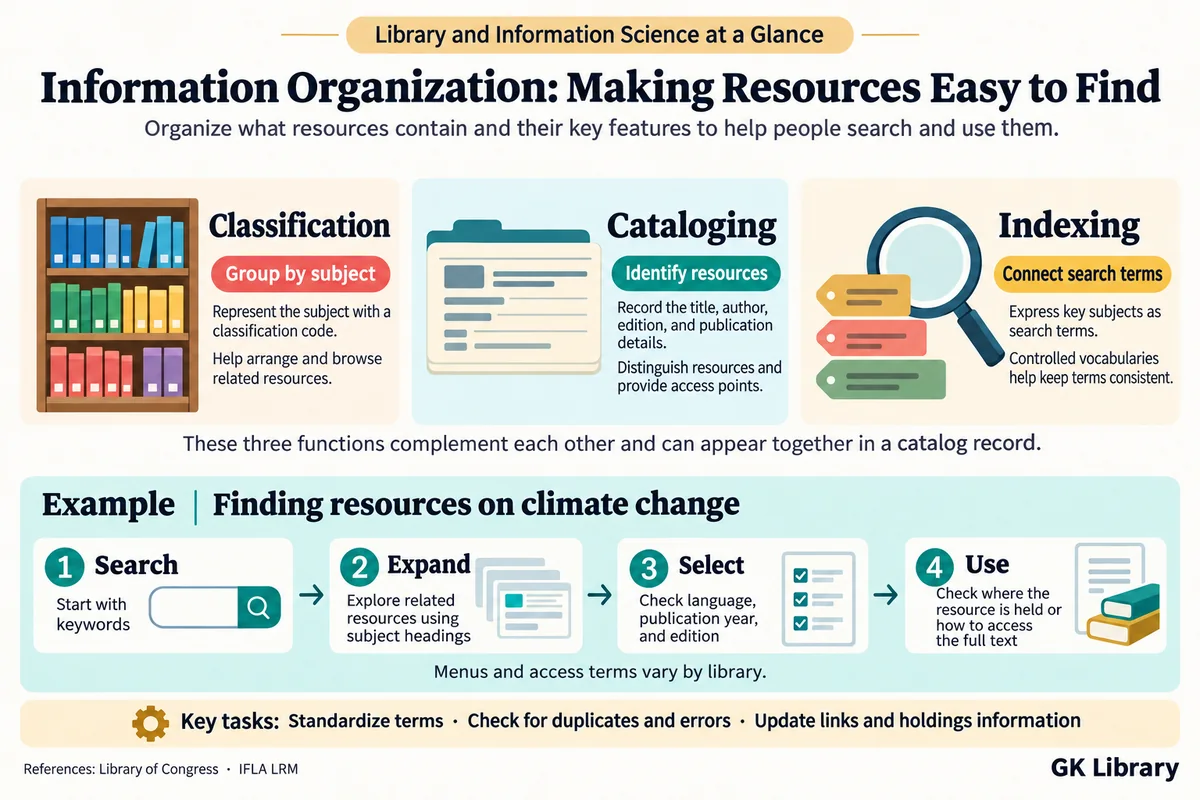
Information organization theory makes a particularly important contribution to improving the efficiency of information retrieval. For users to find the information they need quickly within vast databases, information must be systematically organized, and the classification systems and indexing methods that provide its theoretical foundation must be used appropriately. Information organization theory plays a central role in developing these classification systems, indexing methods, and search algorithms. This improves information retrieval efficiency and enables a better user experience.
Information Quality Management
Maintaining information quality, as well as managing its volume, is an important task. Information organization theory contributes to ensuring the accuracy and reliability of information and guarantees its integrity through measures such as removing duplicate information, clarifying information sources, and keeping information up to date. These quality management processes ensure that information is always provided in a reliable state and establish a foundation that allows users to trust and use the information provided.
Promoting the Dissemination and Sharing of Knowledge
Systematically organized information also helps promote the dissemination and sharing of knowledge. By managing information systematically, information organization theory helps researchers and users in various fields easily access the knowledge they need. This enables the use of information not only in research and academic advancement but also in various industries, including business, education, and healthcare, and plays an important role in promoting the overall sharing and dissemination of knowledge.
Improving the User Experience
Information organization theory makes an important contribution to improving the user experience, extending beyond simply arranging information. User-centered information organization helps users find the information they need more easily and plays an important role in improving the quality of information services. This increases user satisfaction and reduces difficulties during the information discovery process. As information becomes easier to discover and use, the efficiency of information services also improves significantly.
Challenges and Opportunities in a Changing Information Environment
Information organization theory needs to redefine its role in a constantly changing information environment. Alongside advances in information technology, user needs continue to change, and the volume and diversity of information are also increasing rapidly. These changes mean that information organization theory must be applied in new ways, presenting new challenges and opportunities in information management. Information organization theory will continue to develop in response to the changing environment.
The Importance of Applying Theory Through Information Organization Practices

The Importance of Applying Information Organization Theory in Practice
Information organization theory demonstrates its importance and efficiency through various practical examples. When the theory is applied systematically, information management and use become much smoother, and this application is a key process in demonstrating the theory's effectiveness. By putting information organization theory into practice, information professionals gain clearer and more specific guidance, enabling them to improve the quality of information management.
Applying Information Organization Theory in Libraries
Libraries are the setting in which information organization theory has most traditionally been applied, and the systematic classification and arrangement of information are essential. In Korea, the Korean Decimal Classification (KDC) is particularly widely used and plays an important role in managing library materials. By systematically classifying books into detailed subject categories, the Korean Decimal Classification helps users quickly find the materials they need.
Various other classification systems tailored to specific fields are also used, and these approaches to information organization contribute to improving the efficiency of library information services. Systematically organizing information increases the accessibility of library materials and reduces the time needed to discover information. In this way, information organization theory facilitates information management and preservation in libraries and plays a central role in ensuring continued access to information.
Information Organization in Digital Archives
Digital archives are a good example of how information organization theory is applied in modern environments. Vast amounts of digital material can cause confusion if they are not managed systematically. When materials are classified and managed using metadata and ontologies, users can efficiently retrieve and access the information they need. Digital archives offer significant value to both researchers and general users, demonstrating that systematic information management is essential in the digital age.
Information Organization in Businesses
Information organization theory also plays an important role in business environments. Businesses maintain their competitiveness and support rapid decision-making by systematically managing various forms of information. For example, systematically classifying and arranging customer information, product data, and market analysis materials enables this information to be used effectively. Greater management efficiency through information organization contributes to improvements in business productivity and management efficiency.
Information Organization Theory in Education
Information organization theory also plays an important role in education. When online learning platforms systematically classify and provide various learning materials and educational content, learners can easily find and use the information they need. This contributes to improving the learning experience and the quality of education. Information organization theory is also essential in the material management systems of schools and educational institutions. It enables both teachers and students to access materials easily and increases educational efficiency.
Practical Feedback and the Development of Information Organization Theory
Information organization theory develops continuously through practice. Feedback obtained from various practical applications provides an important foundation for developing new information organization methodologies. The theory does not remain confined to the laboratory; it is validated, improved, and developed through application in real environments. This process is essential for continually improving the quality of information management and developing new information organization models.
Future Prospects and Challenges for the Theory and Practice of Information Organization

The Evolution of Information Organization in a Changing Information Environment
With the arrival of the digital age, the volume and complexity of information are increasing exponentially. Accordingly, the theory and practice of information organization must continue to develop in step with the changing environment. Advances in new information technologies present both challenges and opportunities for existing information organization methods, and information organization theory requires continuous evolution and innovation to support systematic information management and efficient use.
Integrating Artificial Intelligence with Information Organization
Future information organization will integrate artificial intelligence (AI) and machine learning technologies to provide more automated information classification and personalized information. Artificial intelligence technologies are usefully employed to classify vast amounts of information quickly and accurately and to provide information tailored to users. In particular, applying AI to metadata generation and information classification can maximize the efficiency and accuracy of information organization. This will change the paradigm of information management and enable the creation of more automated and intelligent information organization systems.
Strengthening User-Centered Information Accessibility
Future information organization theory must develop around the user experience. Providing a user-friendly environment for information access and discovery is very important. Information organization theory will comprehensively consider user interface design, information visualization, and accessibility improvements to provide a more intuitive information discovery environment tailored to users. This will reduce the difficulties users encounter when accessing information and create an environment in which they can quickly find the information they want.
Expanding Information Through Collaboration Across Diverse Fields
Information organization theory can be further enriched through collaboration with other fields. Integration with social information networks and data interoperability are factors that can further strengthen the integrated management and use of information. Such collaboration effectively combines information generated in different fields, providing a foundation for increasing its added value and maximizing its use. Future information organization systems will develop into systems that provide interconnected information from diverse fields, extending beyond a single institution or field.
Considering Ethical and Social Issues
Ethical issues will be an important challenge in the future development of information organization theory. Protecting information privacy, ensuring equitable access to information, and maintaining information transparency are core elements that information organization theory must consider. Information organization systems must be able to protect data, provide an environment users can trust, and fulfill their social responsibilities. These ethical issues will need to receive greater attention as information organization theory develops.
The Continued Development and Role of Information Organization Theory
Ultimately, the theory and practice of information organization will continue to change and develop in response to technological advances and social needs. Amid rapid changes in information technology, information organization theory will play an important role in meeting the information needs of individuals and organizations through efficient information management and use, and in expanding society's knowledge base.
The theory and practice of information organization are important as essential tools for the systematic management and efficient use of information. As its development, practical applications, and future prospects demonstrate, information organization theory is constantly changing and will play an increasingly central role in the information society.
The continued development of the theory will effectively provide the information individuals and organizations require, ultimately contributing to a higher level of informatization across society and to building a better society.