We live in an age of 'information overload,' with an enormous amount of information and books pouring out every day. Everyone has probably experienced feeling overwhelmed about which book to read when entering a large bookstore or library and facing tens of thousands of books. The key concept that emerged amid this decision fatigue is 'Book Curation.'
Book curation goes beyond simply organizing or laying out books. It is a major area of practice in library and information science that meaningfully recommends the books information users need and connects users with them.
In the past, the roles of libraries and bookstores focused on 'preservation' and 'classification.' Books were arranged on designated shelves according to decimal classification systems (DDC, KDC), and users searched for and located them themselves.
However, in modern society, where tens of thousands of new books are published each year, quantitative classification systems alone struggle to meet readers' needs. This is because readers have contextual and situational information needs, such as 'books that will comfort me right now' or 'books to read when considering a new life after leaving my job,' rather than simply wanting categories such as 'history' or 'fiction.'
Book curation is the act of reaching readers by giving books themes and context, just as a museum curator gives artworks new meaning through exhibition planning.
The Core Concepts and Practical Structure of Book Curation
The Difference Between Traditional Classification and Book Curation
To help clarify the distinction, let us compare traditional classification and book curation using examples.
- Category: Traditional Classification Method (Based on Taxonomy)
- Criteria: Subject, academic discipline, author's name, publication year, and so on
- Example: Shelving books under 813.7 (Modern Korean Fiction)
- Role: Helps users find books at the desired location
- Category: Book Curation Method (Based on Context)
- Criteria: Readers' circumstances, moods, social issues, and specific themes
- Example: "A Selection of 5 Short Stories to Soothe Your Mind on a Weary Commute Home"
- Role: Helps users discover new books they had not considered (Serendipity)
If traditional classification is a system that tells readers a book's 'address,' book curation is storytelling that gives books 'stories and reasons.'
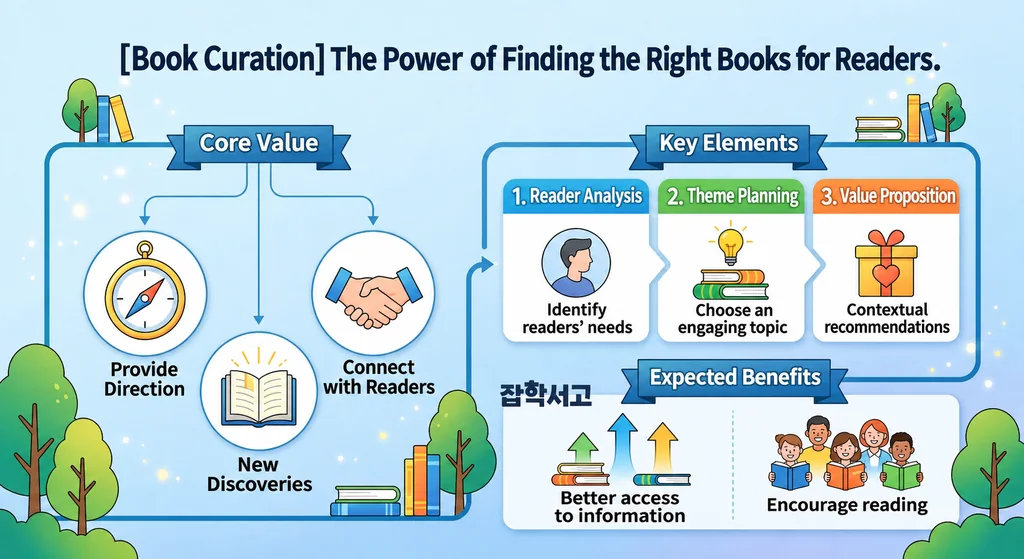
The 3 Core Elements of Book Curation

For successful book curation, the following three elements must be organically connected.
First, Target Audience Analysis (Audience Analysis)
The approach varies depending on whether the audience consists of children, job seekers, retirees, or researchers interested in a particular subject.
Second, Theme Planning (Theme Conceptualization)
Clear and engaging themes are established around seasons, seasonal divisions, social issues, human emotional states, and other topics.
Examples: 'For Environment Day: How to Coexist with the Earth,' 'Overcoming Burnout Syndrome: The Art of Pausing for a Moment'
Third, Display and Contextualization (Contextual Display)
Book reviews, brief recommendation blurbs, related three-dimensional objects, and other materials are used to create visual and emotional appeal beyond simply arranging books on shelves.
Value from the Perspective of Library and Information Science
In library and information science, book curation is a tool for achieving both 'improved access to information' and 'increased engagement in reading.'
- Providing Unexpected Discoveries (Serendipity): In addition to the books users originally intended to find, curation provides opportunities to unexpectedly discover good books that are just what they need.
- Strengthening Librarians' Professional Expertise: It establishes librarians' roles as information intermediaries and cultural planners, extending beyond simply collecting and organizing materials.
The Future Direction of Book Curation in the Digital Age
Today, book curation is expanding beyond physical libraries and bookstores into online platforms and digital environments. Although personalized recommendation services based on AI algorithms are advancing, planned curation that reflects human sensibilities, context, and original perspectives still holds unique value.
Good book curation has the power to breathe new life into classics that are slipping from memory and books tucked away in corners of the shelves. It restores readers' enjoyment of reading and is establishing itself in society as a knowledge infrastructure that builds a healthy reading culture.
Future research and practical applications in library and information science will also need to continue developing advanced book curation models that combine data-driven reader analysis with emotionally engaging theme planning.