Have you ever noticed that a camera move that looked smooth in the cinema seems to stutter slightly when you watch the same film on an old TV or a DVD? Behind that stutter lies an old calculation used to fit film shot at 24 pictures per second onto a television screen that changes about 30 times per second. This method is called ‘3:2 pulldown’.
Put simply, 3:2 pulldown means ‘a rule for stretching four film frames into five television frames’. It is used in telecine, the process of transferring motion picture film to video, and it gets its name from placing each film frame alternately into two and then three half-pictures of video. It is also called 2:3 pulldown.
In this article, we will look in turn at why film and television ended up running at different speeds, how 3:2 pulldown divides the frames, the judder and side effects it creates, and how 3:2 pulldown is reversed and handled today.
The rule that turns 24 frames per second into 30: 3:2 pulldown
1. Why film and television run at different speeds

3:2 pulldown is needed because film and television change pictures at different speeds. Each medium set its standard for its own reasons, and bridging that gap became the trickiest part of transferring film to video.
(1) Film shot at 24 frames per second
Motion picture film is normally shot and shown at 24 pictures, or 24 frames, per second. The name ‘pulldown’ comes from the mechanical action of a projector or telecine pulling the film down one frame at a time to advance to the next frame.
(2) NTSC television at about 30 frames per second
Televisions in countries that used the NTSC system, such as the United States, Japan and South Korea, sent about 29.97 pictures per second. Each picture is made of two half-pictures, called fields, one drawing the odd lines and one the even lines, so about 59.94 fields go by every second.
(3) The PAL system at 25 frames
Televisions in countries using PAL or SECAM, such as those in Europe, show 25 pictures per second. There, 24-frame films were simply played about 4% faster at 25 frames, so 3:2 pulldown was not needed, but running times became slightly shorter and the sound rose by about 0.7 of a semitone.
2. How 3:2 pulldown divides the frames
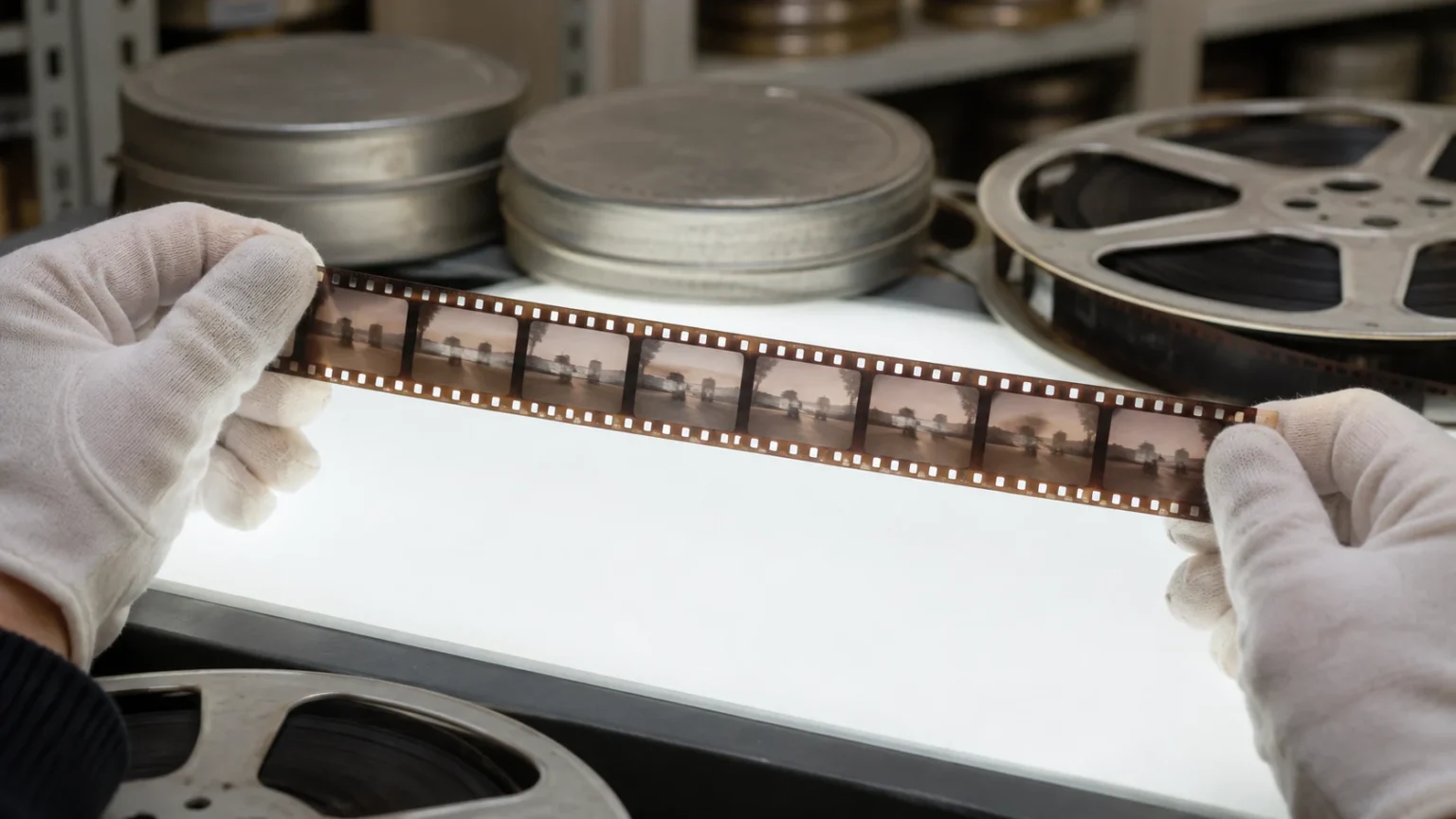
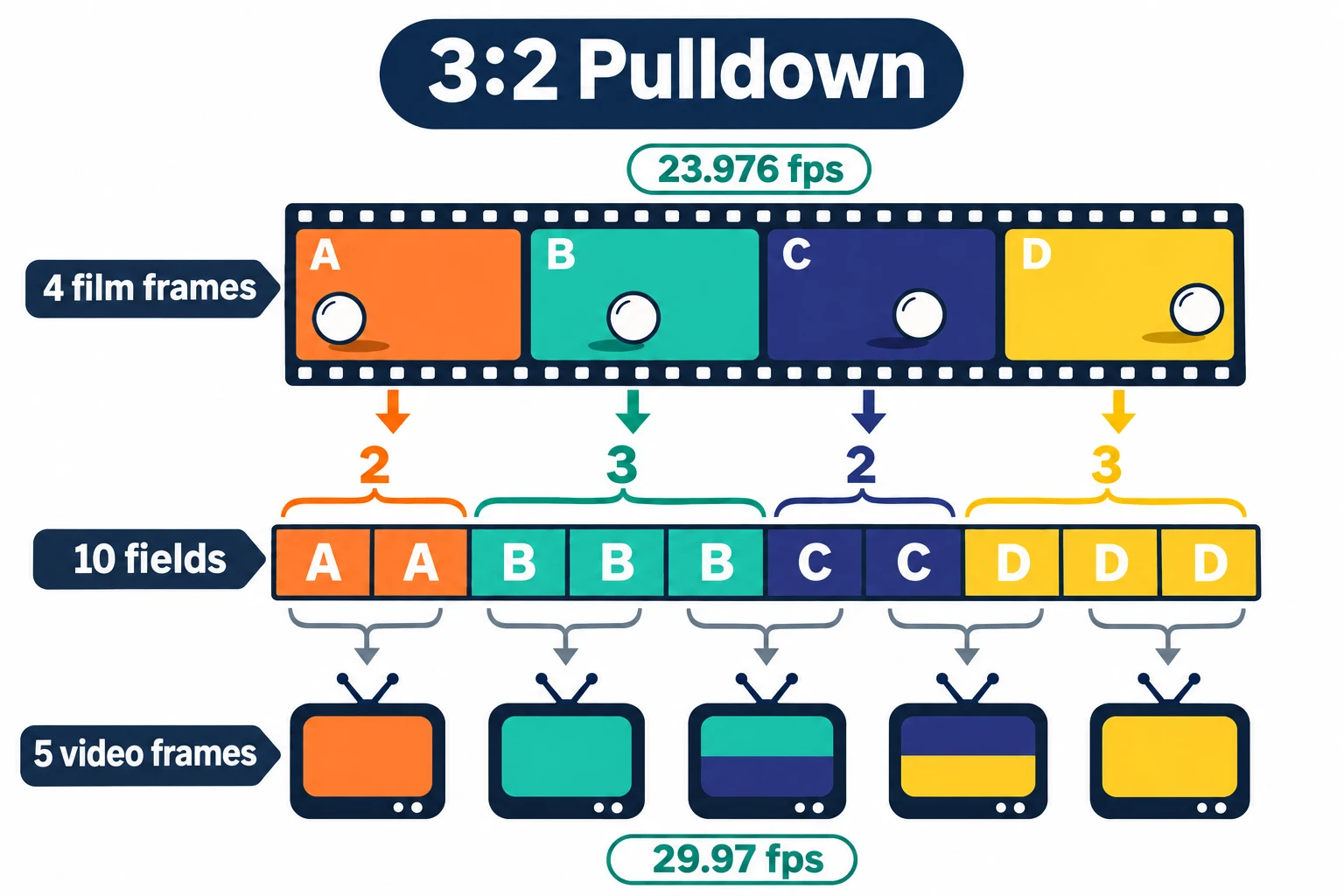
3:2 pulldown works in two steps. First the film speed is slowed down very slightly, and then the film frames are distributed into video fields, alternating between two and three fields.
- Telecine: The process, or the equipment, used to transfer motion picture film to a video signal; in the industry it is also abbreviated as TK.
- Frame: A single complete picture in film or video.
- Field: A half-picture in interlaced scanning that contains only the odd or the even lines; two of them make up one video frame.
- 23.976fps: The speed obtained by slowing 24 frames by a ratio of 1000/1001, exactly 24,000/1001 frames per second.
(1) Slowing down by one part in a thousand
In the first step, the film is run at about 23.976 frames per second, slowed from 24 by a ratio of 1000/1001. The difference cannot be noticed by eye, but a two-hour film gets about 7.2 seconds longer.
(2) Two, three, two, three
Next, the four film frames A, B, C and D are divided among ten fields. A goes into two fields, B into three, C into two and D into three, giving the order A-A-B-B-B-C-C-D-D-D, and the ten fields become five video frames.
(3) Why 2:3 and 3:2 are the same
The 2-3 order and the 3-2 order are the same repeating cycle, differing only in which frame you start counting from. Under the standards of the Society of Motion Picture and Television Engineers (SMPTE), the first frame of each four-frame group is scanned twice, so strictly speaking 2:3 pulldown is the more accurate name.
3. The judder and side effects of 3:2 pulldown

3:2 pulldown adapts film to television, but it leaves a trace: film frames do not all stay on screen for the same amount of time. This trace shows up in certain kinds of shots.
(1) Telecine judder
A frame held for three fields stays on screen for about 50 milliseconds, while a frame held for two fields stays for about 33 milliseconds. As a result, scenes with slow, steady camera movement look slightly jerky, which is called telecine judder.
(2) Pictures that mix different frames
When A-A-B-B-B-C-C-D-D-D is grouped two fields at a time, two of the five frames mix halves of B and C, and of C and D. On a CRT the fields are drawn one at a time, so this is hard to see, but when the picture is paused or shown on a progressive display, comb-like stripes can appear.
(3) PAL’s alternative: Euro pulldown
In PAL regions, Euro pulldown was also developed to avoid the 4% speed-up, inserting one extra field every 12 frames. It keeps the pitch of the sound, but every 12th frame stays on screen for three fields, causing a similar hitch.
4. How 3:2 pulldown is reversed and handled

3:2 pulldown did not disappear in the digital age. It remains in old video material and broadcast equipment, so techniques for detecting and reversing it are used alongside it.
(1) Inverse telecine
Some DVD players and video editing programs find and remove the repeated fields in video that contains 3:2 pulldown, restoring the original 24 frames per second. This is called inverse telecine, or IVTC for short; it cuts redundant data and looks cleaner on progressive displays.
(2) Matching frames in the edit suite
Non-linear editing systems that build edit lists based on the original film need to know exactly which film frame each video frame came from. For this reason, a record of the correspondence between film and video is sometimes handed over with the telecine work.
(3) Today’s screens and multiples of 24
Today video is often stored at about 24 frames per second as it is, and when a screen refreshes at a multiple of 24, such as 120 times per second, it can show every frame exactly five times, avoiding the judder of 3:2 pulldown.
Why old video stutters slightly, and what the pulldown removal feature in editing software does, both come from the same principle. The simple idea of showing each film frame two times, then three times, to connect two worlds running at different speeds — that is the first step to understanding 3:2 pulldown.