If a questionnaire asked, “Have you ever underpaid your taxes in the past year?”, how many people would honestly write “yes”? Faced with sensitive questions, people tend to lie or avoid answering altogether, so survey figures usually come out lower than reality. Statistics found a way to solve this problem with a single coin, and it is called the “Randomized Response Technique.”
Simply put, the randomized response technique means “a survey method that has respondents answer according to the outcome of a chance device, hiding each person’s true answer while still calculating the proportion for the group as a whole.” It was first proposed in 1965 by American statistician Stanley L. Warner in the paper “Randomized Response: A Survey Technique for Eliminating Evasive Answer Bias,” published in the Journal of the American Statistical Association.
In this article, we will look in turn at why sensitive questions distort surveys, how a single coin hides an answer, how to calculate the true proportion from scattered answers, and how the idea led to today’s privacy-protection technologies.
A Survey That Finds the Truth in Hidden Answers: Randomized Response Technique
1. Why Sensitive Questions Distort Surveys

Surveys rest on the belief that people answer truthfully. But on topics people would rather keep to themselves, such as illegal behavior, health problems or income, this belief easily breaks down.
(1) Social desirability bias
Social desirability bias is the tendency of respondents to answer in ways others would view favorably rather than as they really are. They understate undesirable behavior and exaggerate praiseworthy behavior.
(2) Refusal to answer
Nonresponse, where people simply do not answer, is also a problem. Those who have engaged in sensitive behavior are more likely to avoid answering, so calculations based only on the remaining responses are skewed to one side.
(3) Why anonymity alone is not enough
Even in an anonymous survey without names, respondents may feel that the surveyor could recognize their answers. Warner believed that honest answers could be obtained only if the answer itself proved nothing about any individual.
2. How a Single Coin Hides the Answer

The heart of the randomized response technique is inserting a chance outcome known only to the respondent between the question and the answer. The best-known version is the forced response design, in which a coin is tossed once or twice.
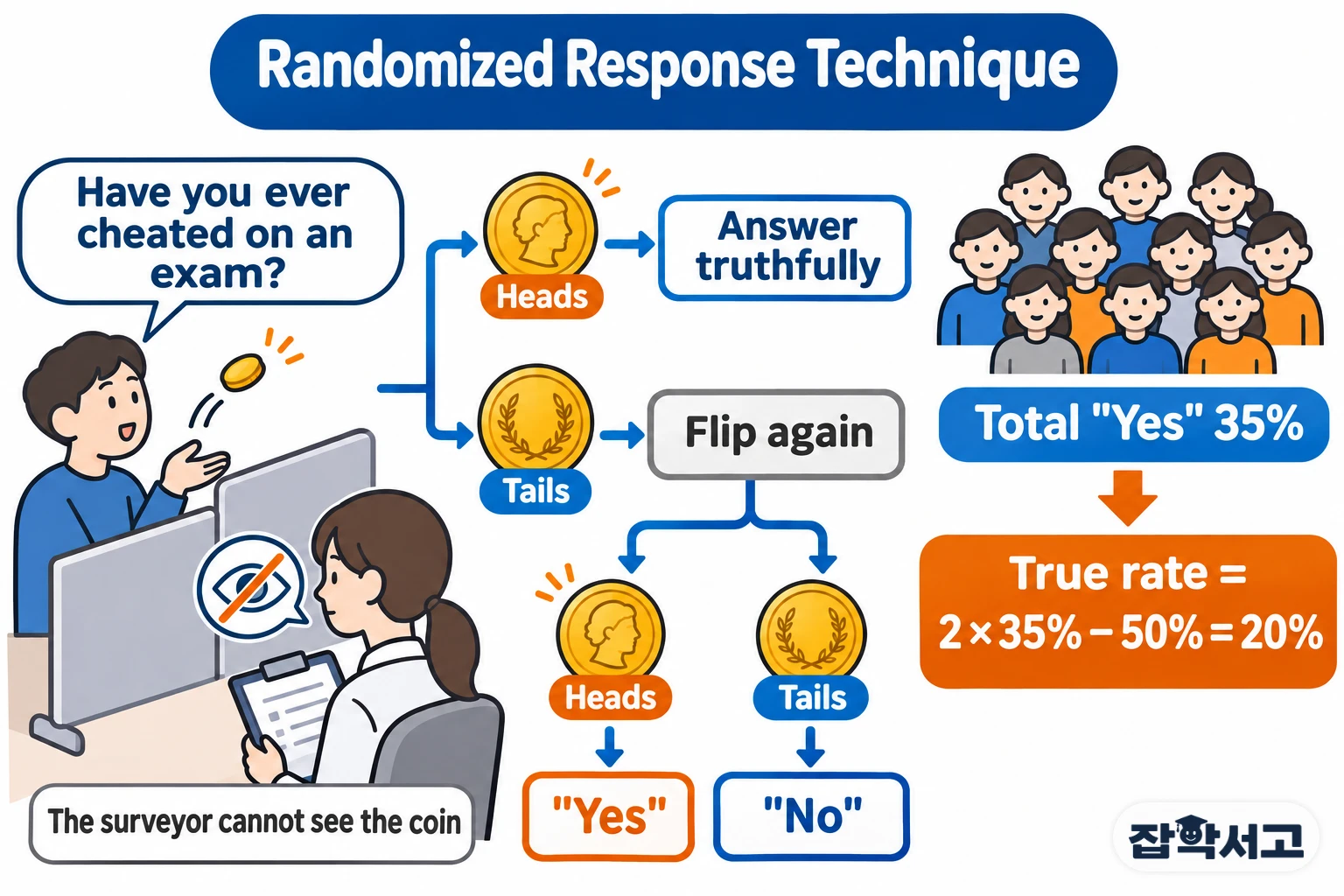
- Forced Response Design: depending on the outcome of a chance device, the respondent either answers truthfully or gives a predetermined answer
- Warner’s Model: the original method, in which a chance device decides whether the respondent answers “Do you belong to group A?” or “Do you not belong to group A?”
- Unrelated Question Design: depending on a chance device, the respondent answers an unrelated question such as “Is your birthday in an even-numbered month?” instead of the sensitive one
(1) Only the respondent sees the coin
The respondent tosses the coin behind a screen and shows the result to no one. If the first coin lands heads, they answer the question truthfully.
(2) Tails means a set answer
If the first coin lands tails, they toss it again and answer “yes” for heads and “no” for tails. This answer has nothing to do with the content of the question.
(3) A “yes” is not evidence
The surveyor cannot tell whether a particular person’s “yes” is a real confession or an answer dictated by the coin. Because respondents also know this, they feel less pressure and can answer truthfully.
3. Calculating the True Proportion from Scattered Answers

Each individual answer has been blurred, but the probabilities of the coin landing heads or tails are known exactly. Using these probabilities, the true proportion for the whole group can be calculated backward.
(1) Building the equation from probabilities
If π is the proportion of people who actually engaged in the behavior, the probability of a “yes” is 1/2 × π from truthful answers plus 1/4 from “yes” answers dictated by the coin. So the overall “yes” rate is π/2 + 1/4.
(2) Solving backward
Rearranging the equation gives π = 2 × (overall “yes” rate) − 1/2. If 350 out of 1,000 people, or 35%, answered “yes,” the true proportion is estimated at 2 × 35% − 50% = 20%.
(3) The price to pay
Because noise is deliberately mixed into the answers, the error of the estimate grows. Achieving the same accuracy as a direct survey requires asking far more people, and if respondents misunderstand or ignore the rules, the results become unstable again.
4. Randomized Response and Privacy-Protection Technology

The idea of hiding each person’s answer while accurately learning about the group went beyond surveys and led to privacy-protection technologies in the digital age.
(1) Research on sensitive topics
The randomized response technique has been used to study topics that are hard to ask about directly, such as drug use, exam cheating and tax evasion. Researchers also compare its results with direct questions on the same topic to gauge how large the response bias is.
(2) Differential privacy
Differential privacy is a privacy-protection concept that adds calibrated noise so that whether a particular individual’s data is included has almost no effect on the result. Having users mix noise into their own data before sending it follows the same principle as the randomized response technique.
(3) Google’s RAPPOR
In 2014, Google released RAPPOR, a technology for collecting usage statistics from the Chrome browser. Each user’s device randomly alters its report before sending it, so no individual’s settings can be known, yet the overall trend can be identified by gathering many reports.
The randomized response technique shows that protecting individual secrets and knowing the truth about society as a whole need not conflict. The simple idea that even without knowing one person’s answer, the truth emerges when many answers come together—that is the first step to understanding the randomized response technique.