When we pick up our smartphones, we often say it's “just a habit.” Yet even on the same device, one person reads the news, another laughs at short videos, and someone else checks in on a friend. Overturning the old notion that media simply fire their messages at people in one direction, this perspective asks, “What am I choosing, and what am I trying to get out of it?” This is Uses and Gratifications Theory.
Put simply, Uses and Gratifications Theory holds that “people are not merely passive receivers of messages; they actively choose and use media according to their own needs and motives, and through that use they satisfy psychological and social needs.” Systematized in the 1970s by Elihu Katz, Jay Blumler, and others, the theory remains just as useful today for understanding short-form video, subscriptions, and algorithmic recommendations.
This article offers an accessible overview of Uses and Gratifications Theory, from its core premises to its main types of gratification, the choice patterns that appear in everyday life, and the points to keep in mind when reading the theory in the context of today's digital environment.
The Concept and Reality of Uses and Gratifications Theory
What Is Uses and Gratifications Theory?
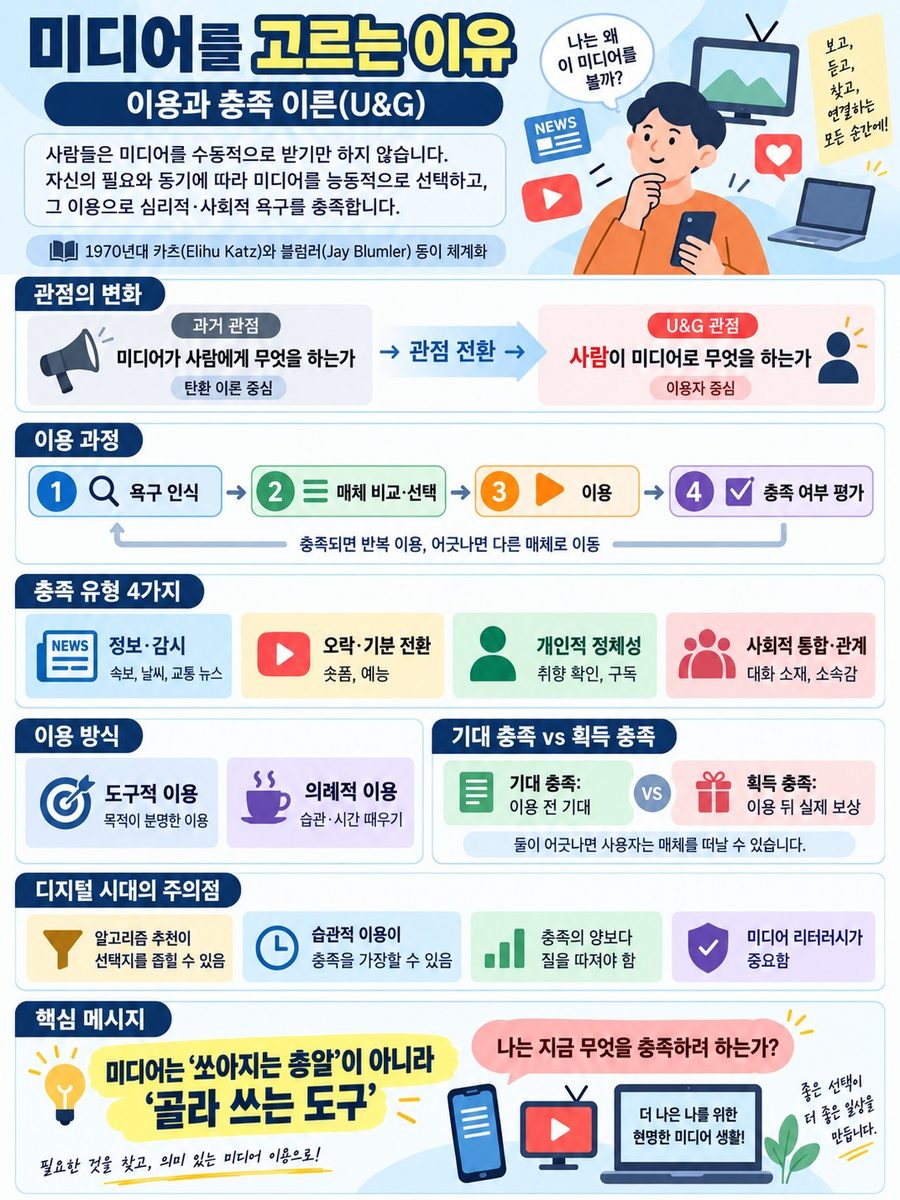

The classic “magic bullet theory” and other strong-effects models assumed that media could persuade audiences who were all but defenseless. Uses and gratifications reverses that direction. Its starting point is not “What do media do to people?” but “What do people do with media?”
Katz and his colleagues argued that audiences recognize their needs, compare and choose among media that could meet those needs, and then evaluate after use whether those needs were satisfied. The same news program may be a source of information for one person, background sound for an evening routine for another, and a storehouse of conversation topics for yet another. The theory's strength lies in explaining, through “motives for use,” the differences that the “effects” of media and content alone cannot account for.
- Active Audience: The image of users who do not consume media indiscriminately, but select and interpret it to suit their purposes.
- Gratification: The psychological and social satisfaction gained through use, including information, entertainment, relationships, and identity.
- Use: The actual behavior of engaging with a given medium: when, how much, and in what way.
What Do We Choose Media to Satisfy?

Lists vary somewhat from study to study, but they are commonly organized into four broad groups. A single instance of use does not satisfy just one kind of gratification; several motives often overlap.
(1) Information / Surveillance
The need for knowledge in order to keep up with changes in the world, avoid risks, and make decisions. The habit of keeping breaking-news alerts turned on, or the pattern of checking weather, traffic, and policy news first, comes close to this.
(2) Entertainment / Diversion
Relieving tension, killing time, and taking a brief escape from daily life. Short-form videos on the commute and binge-watching variety shows after a stressful day are typical examples.
(3) Personal Identity
The need to confirm and reinforce one's own values, tastes, and roles. Subscribing to a particular columnist or repeatedly lingering on content from a hobby community falls into this category.
(4) Social Integration / Relationships
The need to find topics for conversation, feel a sense of belonging, and connect with others. Skimming the news just to be able to say, “Did you see that story?” is also one facet of relational gratification.
- Instrumental Use: Selective use with a clear purpose (information, a task).
- Ritualized Use: Repetitive use that is closer to habit, mood, or killing time.
Uses and Gratifications in Everyday Life

The theory may sound like laboratory jargon, but it shows up plainly in our daily media routines.
[Case 1] Same App, Different Motives
You might open a messaging app to check on work, to have a short chat that eases loneliness, or to keep an eye on group announcements. More than the name of the app, it is “What am I trying to fill right now?” that determines the meaning of the use.
[Case 2] How News and Short-Form Video Divide the Roles
In the morning we scan the world through headlines (information), at lunch we catch our breath with short comedy clips (entertainment), and at night we affirm the tastes that feel “truly me” through channels on our interests (identity). Even across different platforms, the maps of gratification overlap.
[Case 3] When “Sharing” Becomes Gratification
Reading doesn't have to be the end of it: the moment we send a link or leave our opinion in a comment, relational and identity gratifications are reinforced. Spread is not mere transmission; it is also the result of users' social needs turning into action.
- Gratifications Sought: The rewards one expects before use.
- Gratifications Obtained: The rewards actually experienced after use; when the two diverge, people drift away from the medium.
Expansion and Cautions in the Digital Age

Algorithmic recommendations, infinite scrolling, and personalized feeds have widened the stage for uses and gratifications. They seem to help us find the gratifications we want more quickly, but at the same time they blur the line between “me, the one who chooses” and “the system that pushes content.”
(1) Our activeness is not always complete
When recommendations narrow the options in advance, users may appear to be choosing actively, but in reality they are choosing from a limited menu. We should not overestimate the “choice” in the theory.
(2) Habitual use can masquerade as gratification
If you open an app without thinking and can't remember what you got out of it, that is closer to stimulus-seeking or avoidance than to gratification. It is worth examining your usage time separately from your needs.
(3) The quality of gratification is worth weighing
Even if brief entertainment soothes your mood for the moment, if it harms your sleep, focus, or relationships, in the long run it is closer to “non-gratification.” The practical lesson of this theory is to ask not how much, but “What did I actually fill?”
(4) It goes hand in hand with media literacy
If you put into words whether what you want right now is information, reassurance about your relationships, or simply an escape, it becomes easier to design your media use rather than being dragged along by the feed.
Uses and Gratifications Theory leads us to see media not as “bullets fired at us” but as “tools we choose and use.” The same screen can take on an entirely different meaning depending on a person's motives and circumstances. What matters is not consuming more content, but noticing what you opened that content to fill.
This evening, just before you open your smartphone, ask yourself just one question: “What am I trying to satisfy right now?” Choosing your media as you answer that question is the first step toward using media wisely.