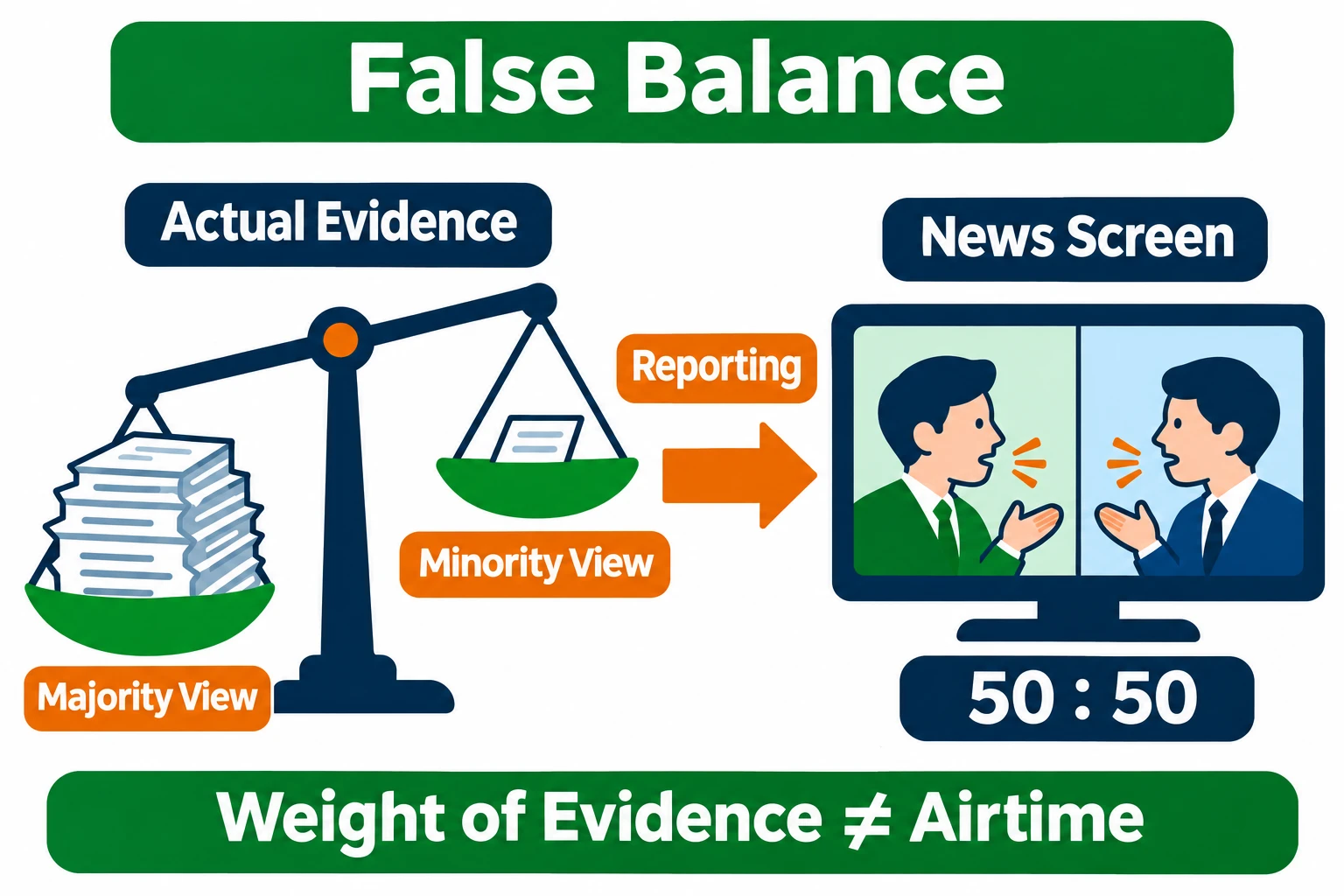
On a news debate show, one seat is taken by a scientist who represents a large body of research, and the other by a commentator who champions a minority view, and both speak for exactly the same amount of time. What if this scene, which looks perfectly fair, actually leads viewers to the wrong conclusion? In journalism studies, this phenomenon is called ‘false balance.’
False balance simply means ‘reporting two claims backed by very different weights of evidence as if they were equal, giving them the same prominence.’ In English it is also called bothsidesism, meaning ‘always telling both sides,’ and it has been criticized especially often in science and health reporting.
In this article, we will look in turn at the meaning and origins of false balance, how it arises, notable cases in climate change and vaccine coverage, and finally ways of reporting that avoid it.
Reporting that looks fair but clouds judgment
The meaning and origins of false balance

Balanced reporting is originally an important principle that the press should uphold. It is a safeguard against carrying only one voice on issues where opinions differ. The problem arises when this principle is applied mechanically even to questions of fact.
(1) Where the balance norm began
As objective reporting became a professional norm in the 20th century, journalists came to treat presenting both sides side by side, without revealing their own judgment, as proof of fairness.
(2) The difference between opinion and fact
Whether to raise taxes is a matter of value judgment, so it is right to hear a range of opinions. But whether a phenomenon is actually happening is a question settled by evidence, and giving a minority claim the same space leads readers to think the matter is still unresolved.
(3) Why it is called false
The coverage may be split 50 to 50, but the actual evidence is not. Because the appearance of balance hides an imbalance in reality, it is called ‘false’ balance.
How false balance arises

False balance usually stems from newsroom habits and production conditions rather than from journalists’ ill will. When the habit of adding a counterargument before deadline, the judgment that conflict makes a more interesting story, and the wish to avoid accusations of taking sides all overlap, both sides end up being given the same space regardless of the weight of evidence.
- Balance norm: A reporting principle that calls for presenting opposing positions on contentious issues with similar prominence.
- Bothsidesism: A critical term for the attitude of always including both sides to stay neutral, regardless of the evidence.
- Due impartiality: A concept used in British broadcasting rules, meaning that instead of giving every view equal time, each should be given weight appropriate to the nature of the issue.
- Weight-of-evidence reporting: A reporting approach that also tells audiences where, and how heavily, the evidence among experts has accumulated.
In the end, the problem is not carrying a counterargument itself, but failing to tell audiences how much support that counterargument actually has.
Cases in climate change and vaccine coverage

False balance became widely known through research on, and reflection about, science reporting. Even after the scientific community’s conclusions became clear, the press kept framing issues as debates, and public perception repeatedly failed to keep pace with the actual direction of research.
(1) Climate change coverage in US newspapers
In their 2004 study ‘Balance as Bias,’ Maxwell Boykoff and Jules Boykoff analyzed global warming articles in major US daily newspapers from 1988 to 2002. They found that more than half gave roughly equal weight to the view that human activity is the cause and to skepticism.
(2) The MMR vaccine controversy
After Andrew Wakefield claimed a link between the MMR vaccine and autism in 1998, the British press for a long time reported both claims side by side. The paper was retracted by the journal The Lancet in 2010, but in the meantime anxiety about the vaccine had spread widely.
(3) Broadcasters reflect
In 2011, a review of science coverage that the BBC had commissioned from geneticist Steve Jones criticized the broadcaster for giving undue weight to fringe views. Later, in 2018, the BBC issued internal guidance stating that there was no need to bring in a climate change denier to balance its climate coverage.
Ways of reporting that avoid false balance

Avoiding false balance does not mean erasing opposing views. It means providing the context audiences need to judge the weight of each claim for themselves.
(1) Tell audiences how much evidence there is
Weight-of-evidence reporting, proposed by American communication scholar Sharon Dunwoody and others, recommends that even when a minority view is presented, reporters make clear what conclusion most experts have reached.
(2) Check expertise and interests
Checking whether the person raising the objection is a researcher in the relevant field, whether the claim rests on peer-reviewed research, and whether it is entangled with particular interests helps avoid putting claims of very different weight on the same footing.
(3) Readers’ habits
Readers, too, need the habit of asking once more how much evidence each claim has, rather than concluding that ‘since both sides were presented, the question must still be open.’
The simple idea that giving equal time does not create equal weight is the first step toward understanding false balance.