Every morning, when we turn on our smartphones, we encounter a flood of news articles, real-time search rankings, and social media trending tabs. On some days, a particular political issue fills the entire internet; on others, a celebrity's personal life or news about a new virus makes the headlines.
At such times, there is a question worth asking ourselves.
"Why am I thinking deeply about and discussing this topic today?"
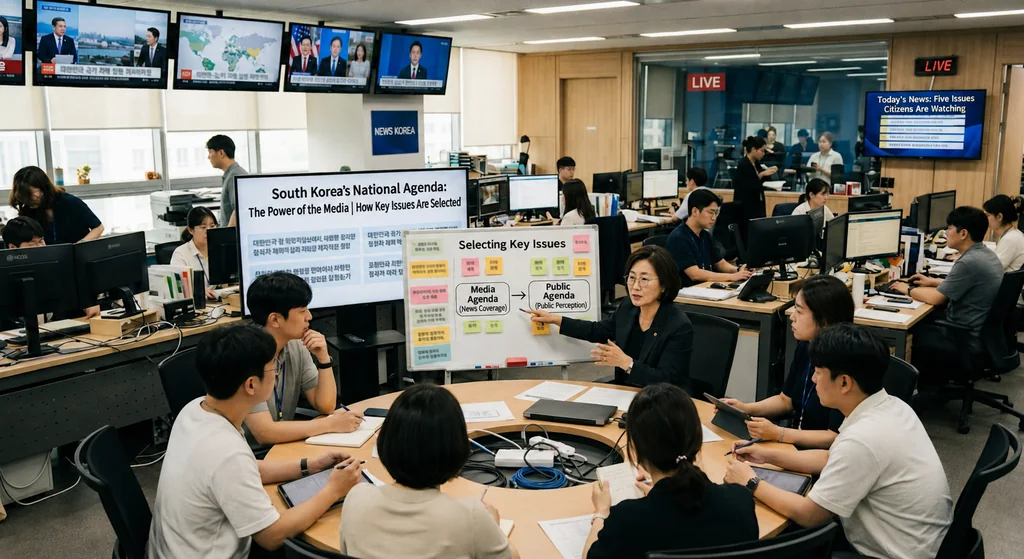
We often believe that we independently choose to think about topics we find interesting or consider important. Media studies, however, offers a somewhat different perspective. The more consistently mass media (Media) highlights a topic as important news, the more naturally people come to perceive it as a 'socially important matter.'
The theory that the media shapes the public's interests and priorities in this way is 'Agenda-Setting Theory,' one of the central concepts in media studies. This article will explore the concept and mechanisms of agenda-setting theory, specific examples, and how the theory is evolving in the age of new media.
The Structure of Agenda-Setting Theory and Its Real-World Applications
What Is Agenda-Setting Theory?
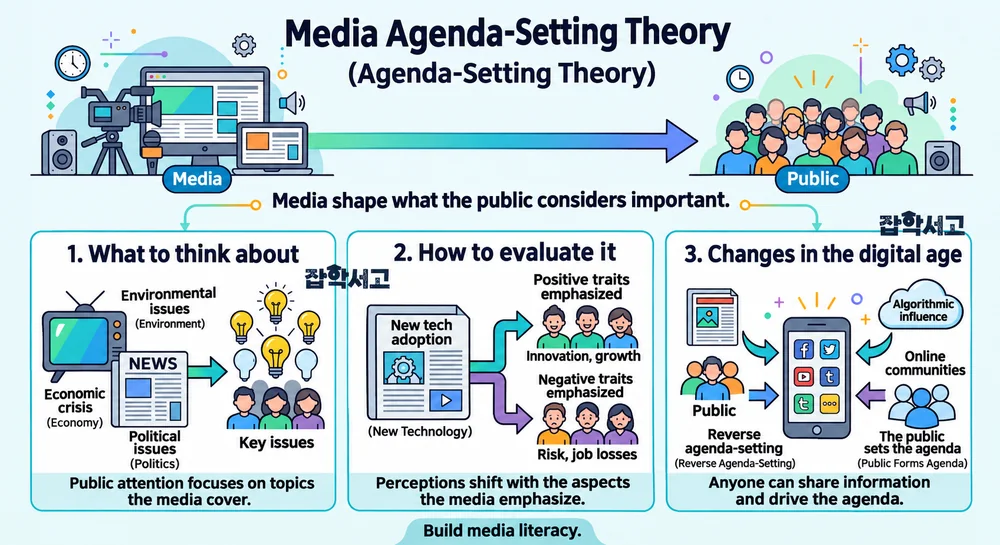
Agenda-setting theory was established in a study published in 1972 by American media scholars Maxwell McCombs and Donald Shaw. They surveyed voters in Chapel Hill, North Carolina, during the 1968 U.S. presidential election to examine the correlation between media coverage and the issues voters considered important.
The results were striking. The issues that the media covered prominently, such as the economy, foreign affairs, and welfare, matched almost perfectly with voters' responses about 'the most important problems in our society right now.'
There is a famous statement that best captures the central point of this study. Media scholar Bernard Cohen said the following.
"The media may fail to tell people 'how to think (What to think),' but it is remarkably effective at telling them 'what to think about (What to think about).'"
In other words, even without insisting that a particular matter is 'right' or 'wrong,' the media can establish a topic as an 'important issue' in the public's mind simply by reporting on it 'frequently' and 'prominently.'
Everyday Examples to Help Explain the Concept
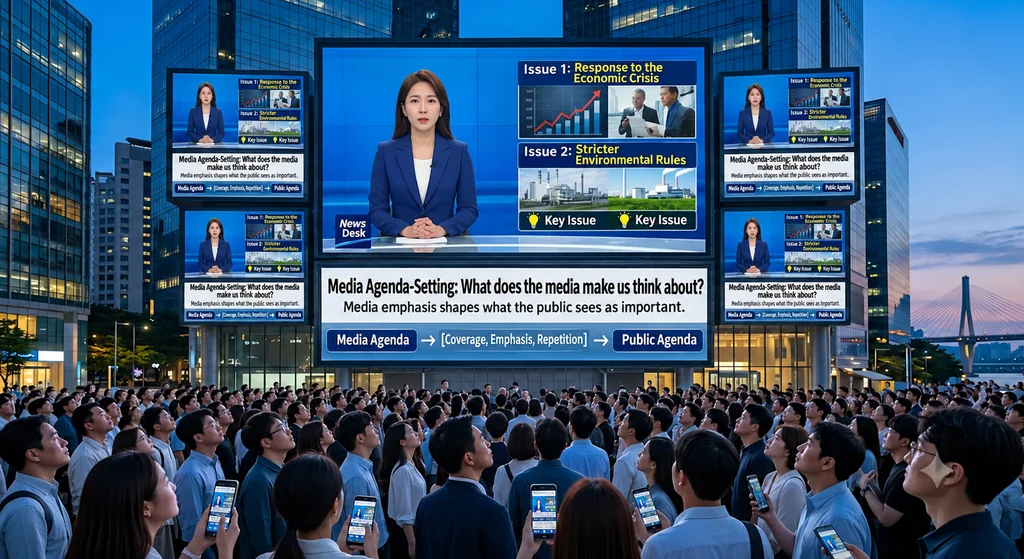
Let us look at some everyday examples to make this concept a little easier to understand.
Example 1: Environmental Pollution Coverage and Our Attention
Suppose a media outlet conducts an in-depth investigation into the 'plastic waste problem' and reports on it as the lead story of its main news program throughout the week. Before encountering this coverage, people may not have felt much guilt about using disposable cups. But when articles about plastic problems appear every day, people begin saying things to their friends such as, 'Plastic waste is a really serious problem these days,' and 'We should carry reusable tumblers.' The media has brought the agenda of 'plastic pollution' to the forefront of the public's thoughts.
Example 2: Restaurant Reviews and Featured Dishes
If a food blog or broadcast program repeatedly emphasizes a particular restaurant's 'spicy braised ribs,' customers will naturally say, 'I hear their spicy braised ribs are famous,' and consider that dish first when visiting the restaurant. Regardless of which dish is actually the most delicious there, the media has effectively determined what people consider—their agenda.
Extending Agenda Setting: Level 2 Agenda Setting (Attribute Agenda Setting)
While early agenda-setting theory focused on 'what the media makes people think about,' later researchers took it a step further. This is called level 2 agenda setting (Second-level Agenda Setting), or attribute agenda setting (Attribute Agenda Setting).
This concept holds that the media does more than select a topic or issue: it also influences the public's evaluations and attitudes depending on 'which attributes or characteristics' of that topic it emphasizes.
- Example: Coverage of the Introduction of a New Technology (AI)
- Even when covering the same topic, 'the development of artificial intelligence (AI),' the public's response varies depending on how the media reports on it.
- Media Outlet A (Emphasizing Positive Attributes): Focuses its coverage on 'the productivity breakthroughs and improvements in medical diagnostic accuracy that AI will bring' → The public perceives AI as a 'promising and useful technology.'
- Media Outlet B (Emphasizing Negative Attributes): Focuses its coverage on 'job losses caused by AI and risks of privacy violations' → The public perceives AI as 'something dangerous that needs to be regulated.'
- Even when covering the same topic, 'the development of artificial intelligence (AI),' the public's response varies depending on how the media reports on it.
In other words, by applying a frame (Frame) to particular attributes, the media even shapes the 'perspective' through which the public views an issue.
Agenda Setting in the Digital Media Age: An Era in Which the Public Creates the Agenda
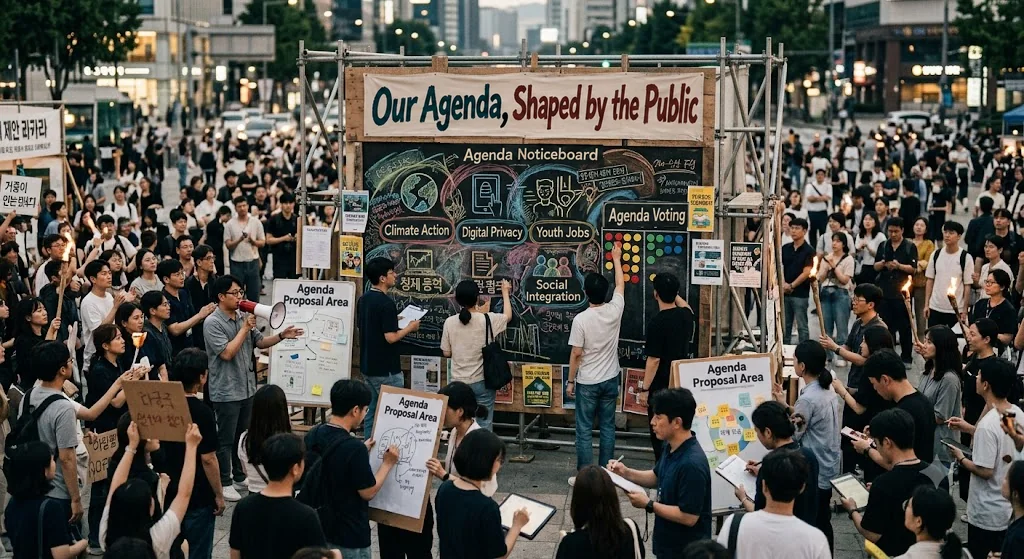
In the past, when newspapers and TV broadcasts dominated the media landscape, media organizations alone served as gatekeepers (Gatekeeper, or doorkeepers), setting the agenda unilaterally. Now that the internet, social media (SNS), and YouTube have become widespread, however, this structure has changed considerably.
- Reverse Agenda-Setting
This is a phenomenon in which events that first attract attention among internet users in online communities or on social media, such as a company's unfair practices or heartwarming stories, are subsequently reported to legacy media—newspapers and broadcasters—and become major news stories. A process has emerged in which the public directly sets the media's agenda.
- Algorithms and Fragmented Agendas
In the past, everyone in the country watched the 9 o'clock news and shared similar agendas. In modern society, however, the information each person encounters varies because of YouTube or algorithmic recommendation systems. As a result, the 'common agenda' shared by the public as a whole shrinks, and an 'Echo Chamber' phenomenon can emerge in which different groups become absorbed in different issues.
The Need for Media Literacy
Agenda-setting theory clearly shows that the media we encounter every day does more than simply convey information. The media is not a transparent window that shows everything in the world exactly as it is. Instead, it serves as a frame that magnifies and emphasizes only certain parts according to its own criteria and perspectives.
What approach, then, should we take as we live amid this flood of information?
What matters most is 'independent critical thinking.' When encountering news, we need to develop the habit of going beyond simply consuming the reported content and asking questions such as the following.
"Why are so many media outlets giving this incident prominent coverage today?"
"Are there other important problems being buried behind this issue or left unmentioned?"
"Which aspects of this matter is the media emphasizing to the exclusion of others?"
Understanding agenda-setting theory goes beyond simply acquiring academic knowledge of media studies. It means equipping ourselves with a powerful 'Media Literacy' weapon that enables us to step back and examine the currents of public opinion shaped by the media while maintaining our own balanced perspective.