In one country a newspaper cannot print a single line without the government’s permission, while in another, articles sharply criticizing the government run every day. Both carry the same name, “the press,” yet what they do and the promises they must keep differ this much by country and era. So for whom should the press exist, and by what principles should it operate?
The book that first offered a systematic framework for this question is Four Theories of the Press, published in 1956. Written jointly by Fred Siebert, Theodore Peterson, and Wilbur Schramm, it divided the world’s press into four theories (authoritarian, libertarian, social responsibility, and Soviet communist) and was long read as a basic text of comparative press studies.
In this article, we will look in turn at what each of the four theories believed, where the social responsibility theory came from, and the criticism the framework received and how it lives on today.
Four Ideas About What the Press Is For
Authoritarian Theory and Libertarian Theory

First, the two theories part ways over the question “who finds the truth?”
(1) Authoritarian Theory
An idea that took hold in late-Renaissance Europe, it holds that truth is something a few wise people work out and that the press is a tool to help the government they lead. So printing comes with licensing and censorship, and criticizing the ruler is punishable.
(2) Libertarian Theory
This idea grew out of the writings of thinkers such as Milton, Locke, Mill, and Jefferson. It holds that seeking truth is a natural human right, and believes truth will eventually be sorted out in a “free marketplace of ideas” where diverse opinions compete freely. The press takes on the role of the “Fourth Estate,” watching over the government.
(3) The Difference Between the Two
Under authoritarianism, the government stands above the press; under libertarianism, the press takes a position from which it looks at the government. Most press systems in modern democracies started from the libertarian side.
Why the Social Responsibility Theory Emerged

The libertarian theory ran into a new problem as the 20th century began. As newspapers and broadcasters grew into huge corporations, the market where anyone could easily start a paper disappeared, and a small number of owners came to decide, in effect, which people and which facts would reach the public.
- Hutchins Commission: In 1947, the “Commission on Freedom of the Press,” led by Robert Hutchins, issued a report titled A Free and Responsible Press. It warned that blocking government interference is not enough, and that the press must itself embrace citizens’ rights and the public interest.
- Five Requirements: These were a trustworthy account of the day’s news, a forum for public expression, comprehensive coverage free of stereotypes, stories that dig deep into democratic life, and an environment in which everyone can reach the news.
- Social Responsibility Theory: The idea that, because the press holds enormous power, it has a duty to carry all opinions fairly and to give citizens enough information to judge for themselves. It held that if the press does not take on that duty by itself, other public institutions may demand it.
Siebert and his co-authors explained that this theory was not an abstraction conjured only in the heads of the commission’s scholars, but a current of thought that responsible editors and publishers had been voicing even before.
The Soviet Communist Theory and Comparing the Four Theories

The fourth is the view of the press represented by the Soviet Union at the time. The book saw it as an older authoritarianism grown broader and more active.
(1) Soviet Communist Theory
Rooted in Marxism, it holds that the press is a tool for achieving the goals of the party that represents the working class. The press is owned by the state and directed by the party, and its biggest mission is propaganda and education that help build socialism.
(2) Ownership and Control
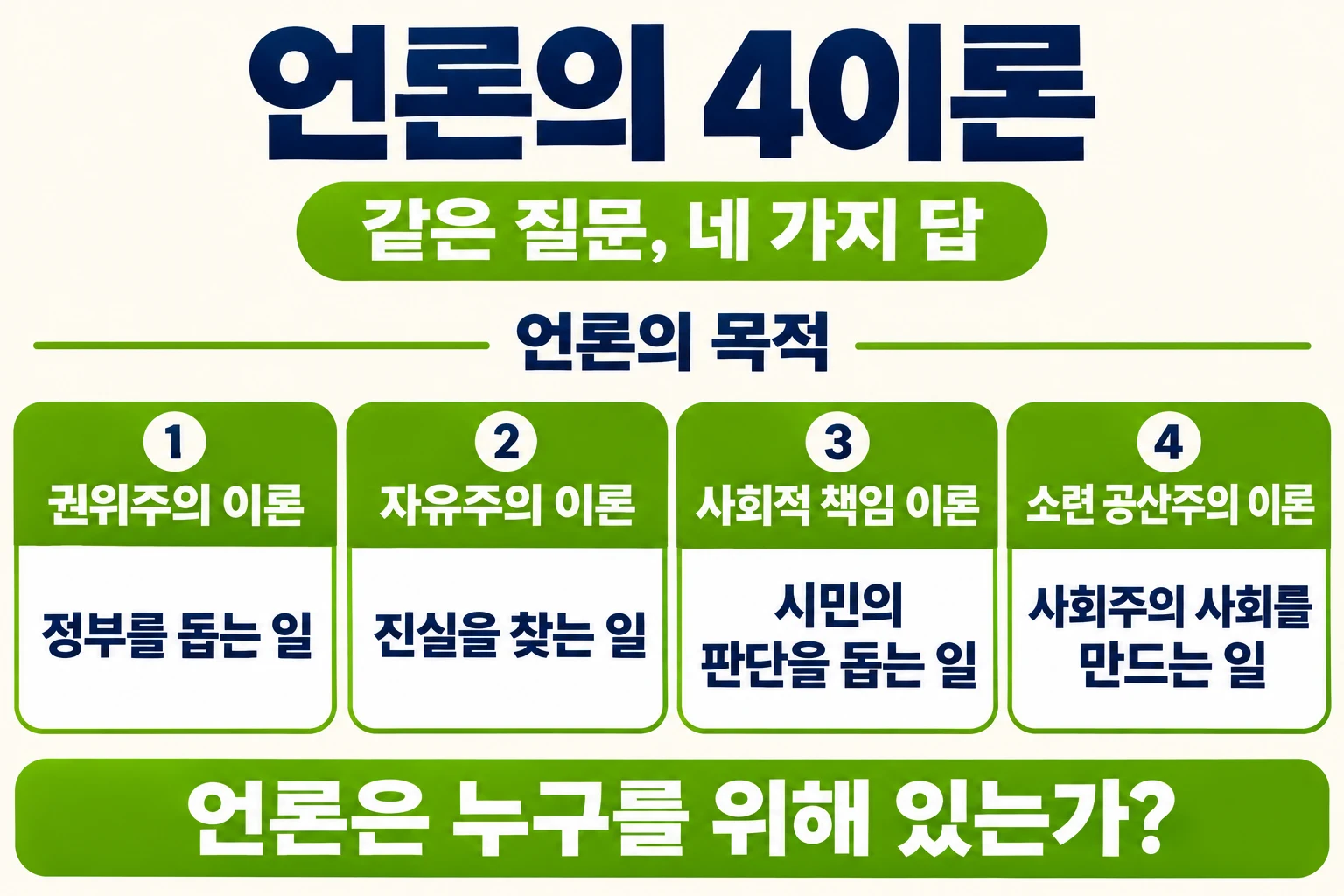
Authoritarianism handles the press through licensing and censorship, libertarianism through the market and individual ownership, social responsibility by layering professional ethics and public expectations on top of the market, and the Soviet model through state ownership and party direction.
(3) The Purpose of the Press
The purposes are set differently: helping the government, finding truth, helping citizens judge, and building a socialist society.
Criticism and Use Today

The book was so influential that it was once called “the bible of comparative press studies,” but its limits are also clear.
(1) A Cold War Lens
It is heavily colored by the 1950s US–Soviet confrontation in which it was written, and it was criticized for taking Western liberalism as the standard and looking down on other systems.
(2) Simplicity That Cannot Capture Reality
If you sort the press into just four boxes, it is hard to explain forms that fit none of them, such as the press of developing countries, public broadcasting, or today’s digital platforms.
(3) Later Alternatives
In 2004, Daniel Hallin and Paolo Mancini, in Comparing Media Systems, divided Western media into three models (polarized pluralist, democratic corporatist, and liberal), offering a more realistic framework.
(4) The Question That Remains
Even so, the credit for organizing the question “whom does the press exist for?” into four answers remains. When weighing responsibility in the age of fake news and platforms, this question is called up again.
The shape of the press is like a mirror reflecting how a society understands truth, power, and freedom. The four theories show that the same question had different answers, and invite us to look back at which answer the press beside us today stands on.
Asking once whom the news we encounter was made for: that is the first step to understanding the Four Theories of the Press.