When we scroll through the news on our phones in the morning, we often read only the headline and the first paragraph before moving on to the next story. Even so, we get a rough idea of what happened, when, and where. The style of writing that gathers the most important content at the very front of an article and pushes less important content to the back is the ‘Inverted Pyramid.’
Put simply, the inverted pyramid means ‘a way of writing news articles that puts the conclusion and key facts first and places information further back the less important it is.’ It got its name because, like a triangle turned upside down so that its wide base is on top, the heaviest information sits at the head of the piece and the content grows thinner toward the bottom.
In this piece, we will look in turn at how the inverted pyramid is structured, the background in which it was born, how to actually write an article with it, and the changes that suit the digital age.
The Basics of News Writing That Delivers the Core First
How Is the Inverted Pyramid Structured?

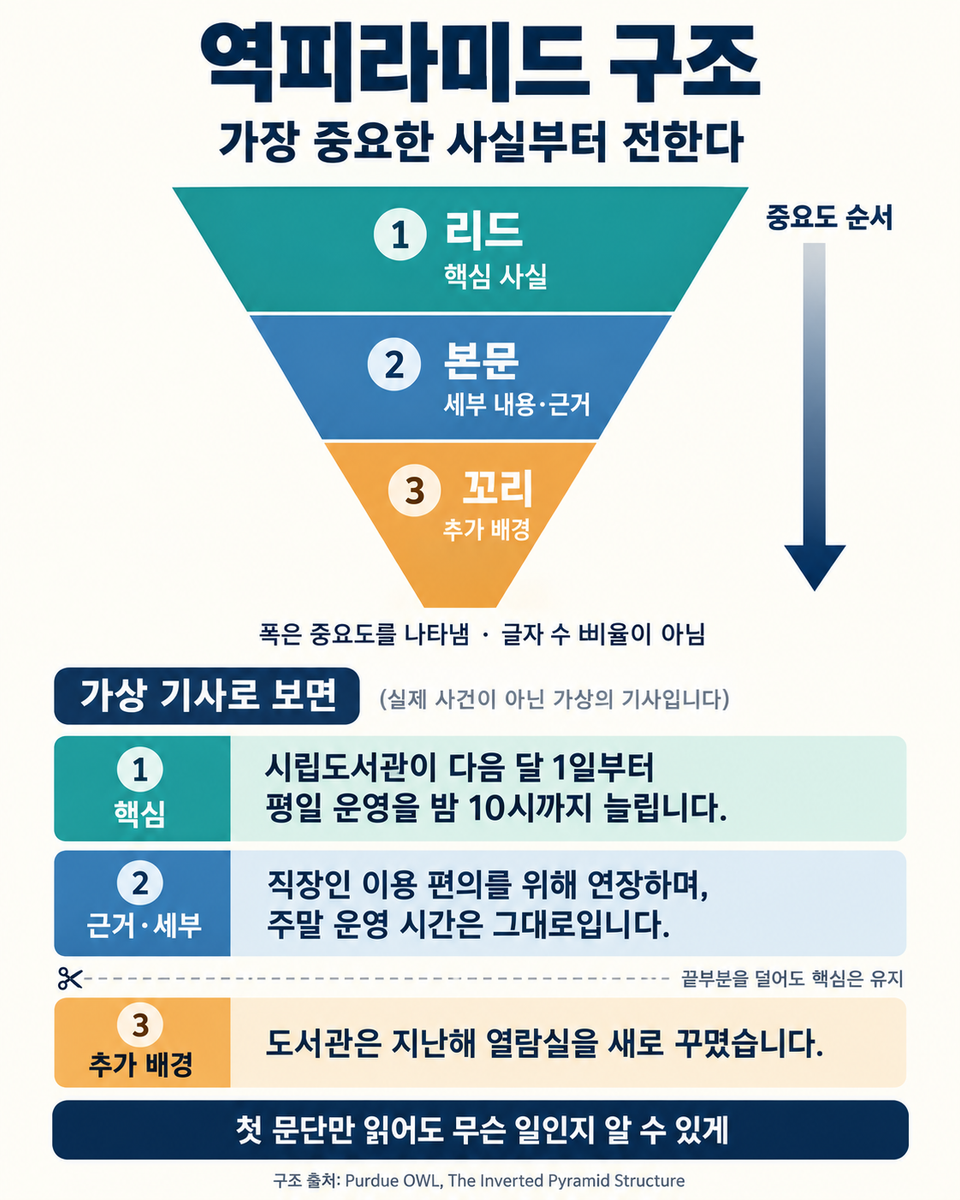
An inverted pyramid article is broadly divided into three parts. Each part has a clear role, so wherever readers stop reading, the core has already been delivered.
(1) Lead
The first paragraph of the article, which captures the heart of the event in one or two sentences. As many answers as possible to the five Ws and one H (who, when, where, what, how, and why) go here.
(2) Body
Details that support the facts stated in the lead, along with evidence such as quotes from people involved and figures, are added in order of importance.
(3) Tail
Content whose absence would not change the meaning of the article, such as background explanations or reference information, goes at the very end.
Written this way, the story does not fall apart even when an editor cuts paragraphs from the end of the article for lack of space. This is called ‘Cutting from the Bottom.’ It also has big advantages for readers. They can grasp the outline of the event wherever they stop reading, and those who want to know more can read to the end to fill in the details.
A Style of Writing That Took Hold with the Telegraph
Even scholars disagree about when the inverted pyramid came about.
(1) The Telegraph Origin Theory
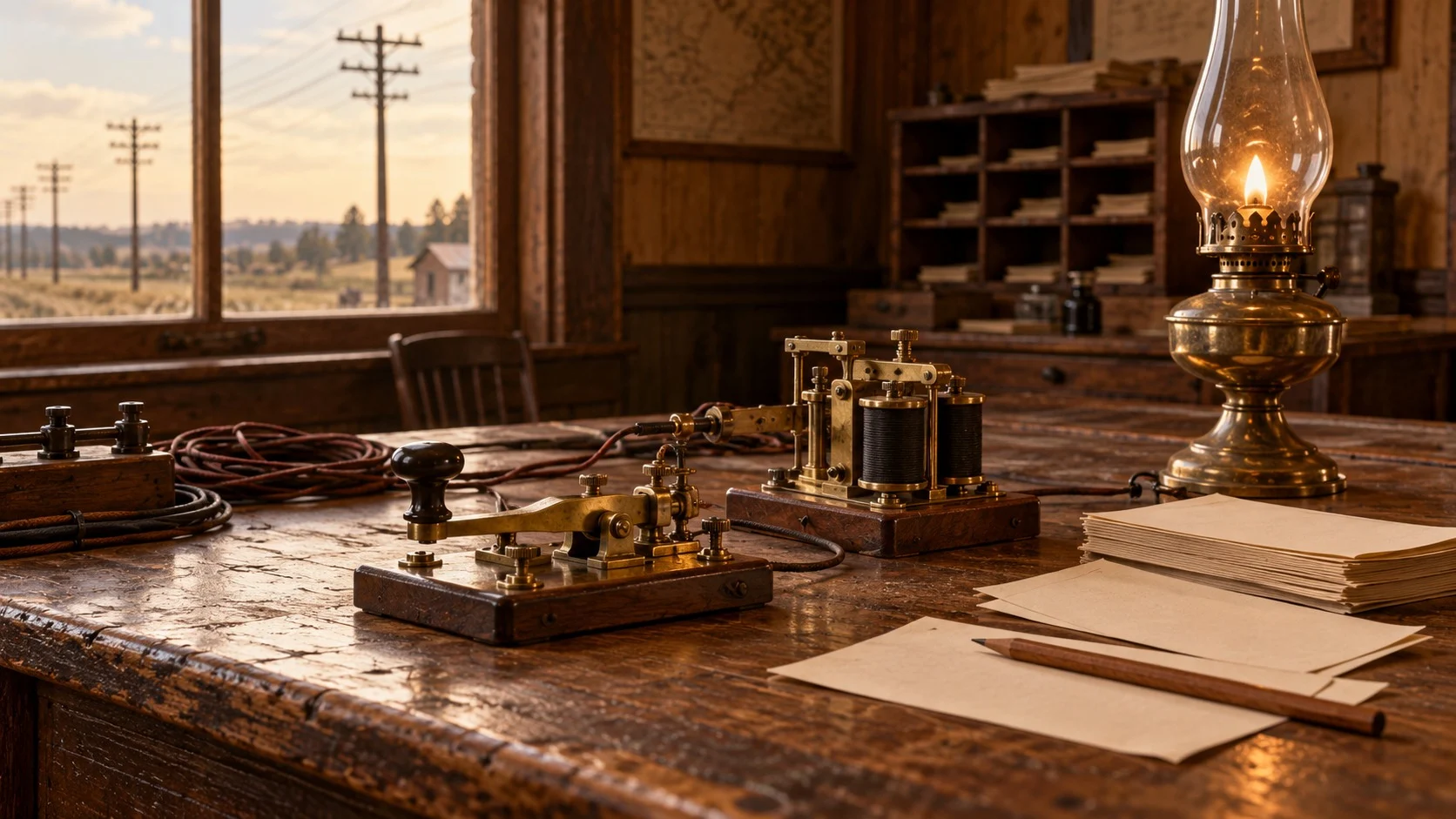
The commonly known explanation traces it to the telegraph around the time of the American Civil War in the 19th century. Because telegraph rates were expensive and the lines were often cut, reporters supposedly got into the habit of sending the most important facts first.
(2) The News of Lincoln’s Assassination
A frequently cited example is the official telegram from Secretary of War Edwin Stanton that ran in newspapers dated April 15, 1865. The telegram first delivered the key point, that “this evening at about 9:30 p.m. at Ford’s Theatre the President was shot,” and then added, in turn, the assassin’s escape, the extent of the wounds, and the attack on Secretary of State Seward. Interestingly, the Associated Press (AP), covering the same event, sent out a chronological story written in the order things happened instead of using this approach.
(3) The Counterargument That It Came Later
On the other hand, the German journalism scholar Horst Pöttker analyzed articles from the New York Herald and the New York Times in a 2003 study and found that this approach became common only around the 1880s, about 20 years later. He held that the form was shaped less by the limits of technology than by journalists’ efforts to help readers understand the news more easily.
How to Write an Inverted Pyramid Article

The inverted pyramid can be used as-is not only for news but also for reports and work emails. In the military and in business, the same principle is sometimes called ‘Bottom Line Up Front (BLUF).’
- Writing the Lead (Summary Lead): Pick the one fact readers need to know first and put it in the first sentence. (Example: “A water main burst on the road in front of City Hall this afternoon, blocking evening rush-hour traffic for two hours.”)
- Setting the Order (Ranking): Line up the remaining information by importance, and check that the story is complete even if only the opening paragraphs are read.
- Short Paragraphs: Put only one piece of information in each paragraph. That way, the flow does not become awkward even if paragraphs are cut or reordered during editing.
- Not Burying the Key Point (Burying the Lead): Avoid the mistake of hiding the most important content in the middle or at the end. English-speaking reporters call this ‘burying the lead’ and guard against it.
- The Closing Line (Kicker): When needed, a memorable quote or an outlook may be added after the pyramid ends to leave a lingering impression. It is mainly used in feature stories.
The Inverted Pyramid in the Digital Age

In an age when we read on screens, the inverted pyramid has become even more important. In a 1996 article, usability expert Jakob Nielsen advised that because web users skim rather than read carefully, writing for the web should also follow the inverted pyramid and start with the conclusion.
(1) A Format Suited to Search and Previews
Search results and social media previews show only the beginning of an article. The core has to be in the first sentence for readers to decide right away whether to click. A smartphone screen shows only a few sentences at a time, so if the core is not delivered on the first screen, readers can easily leave for another piece with a single swipe.
(2) Coexisting with Narrative Stories
Meanwhile, narrative stories that open with an anecdote continue to be written as well. The Portuguese researcher João Canavilhas has even suggested that on the web, a ‘Tumbled Pyramid’ structure, in which readers follow links and choose how deep to read, is a better fit.
The inverted pyramid is an old promise that helps busy readers get the most important facts in the least amount of time. From articles of the telegraph era to today’s mobile news and work reports, choosing what to say first is still the starting point of good writing. The more information overflows, the shorter readers’ time becomes, and the greater the weight of the first sentence.
Putting what readers most want to know in the first sentence: that is the first step in journalism toward writing that gets read.