Mass media play a central role in conveying information and shaping public opinion in modern society. Beyond simply serving as a means of conveying information, they have become an important intermediary that brings together the opinions of society's members and helps build social consensus. Information provided through various media directly influences people's perceptions and behavior, shaping public opinion and bringing about social change.
This material explains the definition of mass media and their social importance, and analyzes the characteristics and differences of the ways each medium conveys information. It also examines the influence of mass media on the formation of public opinion and the various social phenomena that arise in that process. Finally, it explores in depth the long-term effects of changing media consumption patterns on the media industry.
The Definition of Mass Media and Their Importance in Modern Society

The Definition and Role of Mass Media
Mass media are means of conveying information to large numbers of people and exist in various forms, including newspapers, radio, television, and the internet. Beyond simply conveying information, these media exert enormous influence across various areas of society and are deeply involved in individuals' decision-making processes. Mass media help spread knowledge and play an important role in enabling citizens to obtain information, exercise their rights, and fulfill their responsibilities. In modern society, mass media have become a central tool for communication.
A Pivotal Role in Providing Information and Shaping Public Opinion
Mass media convey information quickly and widely, enabling members of society to understand events taking place around the world and in their surroundings. News coverage provides people with the latest information, while current affairs programs analyze social issues and make an important contribution to shaping public opinion. Through this, individuals' opinions and behavior take shape and are also reflected in social decision-making processes. When mass media provide accurate and fair information, public opinion develops in a more rational and balanced direction.
Social Functions and the Spread of Culture
In addition to providing information, mass media play an important role in social integration and the spread of culture. Dramas, variety shows, documentaries, and other content provided through various media entertain people while promoting cultural exchange. Through this, people can understand and empathize with different cultures, which contributes to strengthening social integration. Mass media function as a tool for breaking down cultural barriers between countries and building shared understanding around the world.
Economic Functions and the Role of Advertising
Mass media also play an important economic role. Through advertising, businesses widely publicize their products and services, while consumers gain opportunities to choose from a variety of options. The advertising industry serves as the main source of revenue for mass media, making it an essential element in the growth and maintenance of the media industry. In particular, as the digital age has emerged, internet-based advertising has grown rapidly, further emphasizing the economic role of mass media.
The Need to Provide Information Responsibly
The importance of mass media comes with a corresponding requirement to provide information responsibly. If false information or biased perspectives are conveyed, they can cause social conflict or unnecessary confusion. Mass media must therefore strictly apply their own censorship and ethical standards to maintain objective and fair reporting. Preventing the distortion of information and fairly reflecting diverse perspectives are important duties of mass media.
Freedom of the Press and the Independence of Mass Media
The social responsibility of mass media is closely connected to freedom of the press. Freedom of the press provides the foundation for mass media to operate independently, without external pressure or interference. This allows media to fairly convey the diverse voices of society and create an environment in which democracy can function smoothly. If freedom of the press is not guaranteed, mass media can lose public trust, which can ultimately negatively affect the functioning of a democratic society.
Changes in Mass Media in the Digital Age and Future Challenges
Mass media are continually changing alongside advances in digital technology. As new forms of media emerge with the widespread adoption of the internet and smartphones, traditional mass media face the challenge of redefining their roles. Amid these changes, mass media must adapt to new ways of conveying information and new content consumption patterns without being bound by existing methods. This requires ongoing analysis and research into structural changes in mass media and new business models.
An Analysis of Differences in Information Delivery by Media Type
The Diversity of Information Delivery Methods Across Media Types
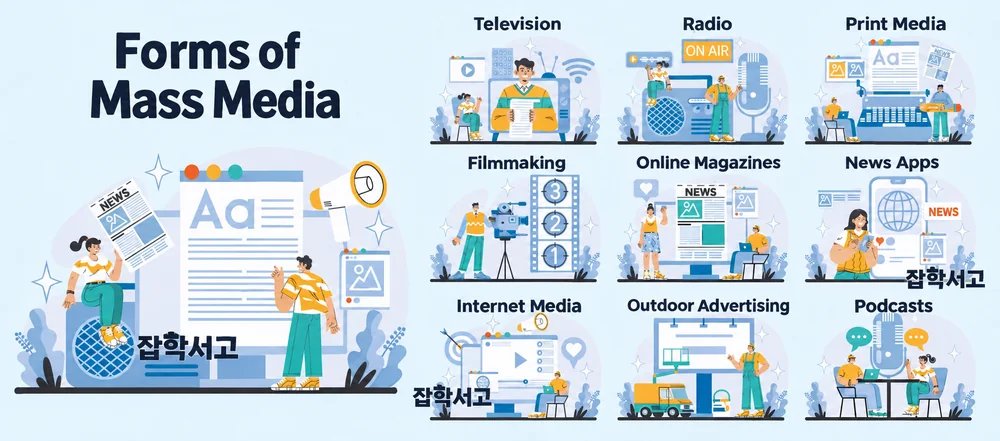
The ways mass media convey information differ greatly depending on their type. Each medium, including newspapers, radio, television, and the internet, has its own characteristics, and the ways information is conveyed through them also differ. These differences greatly influence how audiences receive and interpret information. Understanding the characteristics of each medium's information delivery methods is an important factor in conveying information effectively and considering audience responses.
Newspapers: In-Depth and Analytical Information Delivery
Newspapers are a traditional medium that uses text and photographs to convey information, with a particular strength in providing readers with detailed information through in-depth, analytical articles. Readers can read articles at their own pace and revisit or reflect on important sections as needed. In this respect, newspapers are regarded as a medium that analyzes information in depth and stimulates readers' thinking. In addition, the placement and editing of articles can visually express the importance of information, allowing readers to easily find and focus on the information they need.
Radio: A Leader in Real-Time Information Delivery
Radio is an excellent medium for conveying information in real time through sound. Because it conveys information through hearing, it is easily accessible even while on the move and is particularly effective for providing immediate information, such as traffic updates or news briefings. Radio primarily offers live news, music, and discussion programs, and audiences have the advantage of being able to concentrate without visual distractions. However, because it relies solely on sound without visual materials, it has limitations when information needs to be visualized or explained in complex detail.
Television: The Power of Audiovisual Information Delivery
Television combines sight and sound to convey information, allowing for an intuitive and emotional approach. By providing vivid images on screen while simultaneously conveying information through sound, it richly stimulates viewers' senses. This is particularly effective for providing information with a sense of realism and is especially advantageous for conveying a sense of being on the scene in news coverage and documentaries. Television can leave a strong impression in a short time, but information may also be simplified or presented in fragments to attract viewers' attention. This can sometimes reduce the depth of the information.
The Internet: The Advantages of Multimedia and Two-Way Communication
The internet offers great flexibility in conveying information by integrating various formats, including text, images, video, and sound. These multimedia elements convey information more vividly, and the possibility of two-way communication encourages interaction with audiences. Internet media can provide personalized information through various platforms, such as blogs, social media, and online news. Audiences can easily find the information they want and participate actively by leaving opinions or sharing content as needed. These characteristics are transforming the way information is consumed and enabling rapid exchanges of information.
Differences in Information Reception Across Media Types
Differences in information delivery methods across media types also bring significant changes in their impact on audiences. Newspapers encourage readers to analyze information and understand it in depth, while radio focuses on conveying information quickly and concisely. Television stimulates audiences' emotions through powerful audiovisual elements, while the internet expands the participation of information recipients through two-way communication. Understanding these differences well and using media appropriately are important tasks for both information providers and the audiences who receive information.
The Importance of Understanding Media Characteristics
Understanding the differences in information delivery methods across media types is essential for conveying information effectively. The unique characteristics of each medium greatly influence both the delivery of information and the ways audiences receive it. By understanding these characteristics, information providers can choose delivery methods suited to the medium and convey information effectively, while audiences can choose media that suit them and consume information efficiently.
The Influence of Mass Media on the Formation of Public Opinion and Examples

The Relationship Between Mass Media and the Formation of Public Opinion
Mass media play a very important role in shaping public opinion, and information conveyed through media is directly linked to audiences' ways of thinking and the formation of their opinions. Mass media can spark discussion of specific issues or focus public attention, thereby shaping social perceptions of particular events or problems. This has an important influence on social trends and decision-making.
The Power of Agenda Setting Through Media
By repeatedly covering a particular issue, mass media can bring it to prominence on the social agenda. This process is called the agenda-setting function, and when mass media focus on a particular matter, public discussion of it naturally expands. For example, if the news extensively covers a particular political problem or social event, that issue comes to be perceived as an important social problem. This leads audiences to consider certain issues more important and becomes a key factor in determining the direction in which public opinion develops.
Framing Effects and the Formation of Public Opinion
Framing is the way mass media report events or issues from a particular perspective, and it greatly influences audiences' perceptions and interpretations. Even for the same event, people's interpretations and reactions can differ depending on the frame used. For example, when an economic problem is reported as a 'crisis' versus a 'change,' audiences view that problem from entirely different perspectives, and the resulting direction of public opinion also differs greatly. Framing effects have an important influence on the formation of public opinion depending on how mass media handle social issues.
Election Coverage and Its Influence on Public Opinion
During election periods, mass media provide information about candidates and discussions of policies, playing an important role in shaping voters' opinions. In particular, opinion poll results and coverage of candidates' images leave strong impressions on voters and can influence election results. Opinion polls trigger people's tendency to follow mainstream opinion while also serving as an important factor that can influence the course of an election through changes in each candidate's level of support.
The Role of Media in Social Movements and Campaigns
Mass media also greatly influence the success of social movements and campaigns. As various issues, such as environmental protection, human rights movements, and social inequality, spread through mass media, they help change social perceptions and trigger policy changes. For example, when an environmental protection movement receives extensive media attention, it attracts many people's interest, ultimately contributing to policy changes or legal reforms. In this way, mass media serve as an important driving force that promotes social change.
The Negative Influence of Mass Media and Their Responsibility
Although mass media have a substantial positive influence on the formation of public opinion, negative effects can also arise. False information or biased reporting risks encouraging social conflict or deepening negative perceptions of particular groups. Mass media must therefore fulfill their responsibility to maintain fairness and objectivity, while audiences must consume media with critical thinking. Responsible reporting by mass media and sound interpretation of information by audiences are essential to prevent false information from distorting public opinion or causing social division.
The Responsibility of Mass Media in Shaping Public Opinion and Future Challenges
Mass media exert a powerful influence on the formation of public opinion, playing an important role in promoting discussion of social issues and leading to policy changes or social consensus. However, if mass media fail to maintain fair and objective reporting, there is also a risk of causing social confusion. Mass media must therefore shape public opinion through responsible reporting, and audiences must also receive information with critical thinking. The future of mass media depends on this sense of responsibility and ethical awareness, and they will need to continue fulfilling their social roles through ongoing change and innovation.
The Long-Term Effects of Changes in Media Consumption on the Media Industry

Digital Technology and Changes in Media Consumption
Advances in digital technology have brought major changes to the way media are consumed, and these changes are having long-term effects on the media industry. Established, traditional ways of consuming media are rapidly declining, with digital content and social media platforms taking their place. These changes are bringing major transformations not only to the ways media are consumed but also to the structure and revenue models of the media industry.
The Spread of Personalized Media Consumption
Media consumption today is becoming increasingly personalized. Online platforms use algorithms to provide personalized content based on users' behavioral data. These systems make it easier for users to find the information they want, producing positive effects by increasing access to information and widening the range of choices. Conversely, however, users may consume only the information they prefer, reinforcing selective information consumption and potentially causing confirmation bias. Because this situation risks creating social conflict or division, ensuring diversity in the information provided by media is emerging as an important task.
Changes in Traditional Advertising Models and New Revenue Structures
With the spread of digital media, traditional advertising models are no longer as effective as they once were. As advertising avoidance technologies develop, consumers are reducing the time they spend encountering advertisements, significantly affecting the media industry's revenue structure. In response, subscription-based revenue models and new forms of advertising, such as native advertising, are emerging. These changes point to new directions for the sustainable development of the media industry, and media companies face a situation in which they must generate revenue in various ways rather than relying solely on advertising revenue.
The Rise of User-Generated Content and the Challenges Facing Traditional Media
Another characteristic of the digital age is the emergence of an environment in which anyone can easily create and distribute content. User-generated content is exerting an increasingly powerful influence, creating a need for traditional media companies to adapt to these changes. Traditional media face the challenge of providing distinctive content based on credibility and expertise. This requires improvements in media quality as well as continuous innovation to survive competition with user-generated content.
Competition and Cultural Diversity in the Global Media Environment
Changes in media consumption are also bringing major changes internationally. Digital media transcend borders to spread information instantly around the world, breaking down the media industry's geographical boundaries. As global platforms spread, there is a growing need for content that encompasses diverse cultures and languages, while multinational media companies gain influence day by day. As a result, local media need strategic responses to avoid falling behind in competition with global companies, and must develop global competitiveness while preserving their local characteristics.
Legal and Ethical Issues Arising from Changes in Media Consumption
Changes in media consumption in the digital age are accompanied by various legal and ethical issues. Privacy protection, copyright infringement, and the spread of fake news are more prominent in the digital media environment, requiring legal regulation and the establishment of voluntary ethical standards within the media industry to address them. In particular, the indiscriminate spread of digital content can amplify the negative effects of fake news or distorted information on society, placing greater emphasis on media companies' ethical responsibility to prevent this.
Challenges Facing the Media Industry as Media Consumption Changes
Changes in the ways media are consumed are making structural changes in the media industry inevitable, and this will have long-term effects. The media industry must reorganize its revenue models to suit the digital age, provide distinctive value in competition with user-generated content, and make efforts to build competitiveness in a global environment. It must also strengthen its responses to legal and ethical issues and, through these efforts, build a sustainable future for the media industry.
Mass media fulfill essential roles in modern society and exert a significant influence on information delivery and the formation of public opinion. A deep understanding of the diversity of media types and their characteristics is essential in a rapidly changing media environment.
In addition, changes in the forms of media consumption serve as an important factor determining the future of the media industry. Amid these changes, continually analyzing the roles and influence of mass media will remain an important task in the years ahead.