How do the everyday items we use and the countless products imported from overseas reach our hands? Most arrive aboard enormous container ships at major ports such as Busan Port or Incheon Port. But a port on the coast is not the end of every logistics journey. Tens of thousands of containers unloaded at ports are then loaded onto countless trucks and trains and distributed throughout the country.
The most serious bottleneck in this process occurs at the port itself. Containers cannot be stacked indefinitely on limited port grounds, and if tens of thousands of trucks enter simultaneously, the surrounding roads become gridlocked. ICDs (Inland Container Depots) are innovative logistics facilities developed to solve this problem. Here, we will take a closer look at the definition and roles of ICDs, known as 'inland ports,' and why they are essential to our logistics system.
What Is an ICD?: Concept and Definition
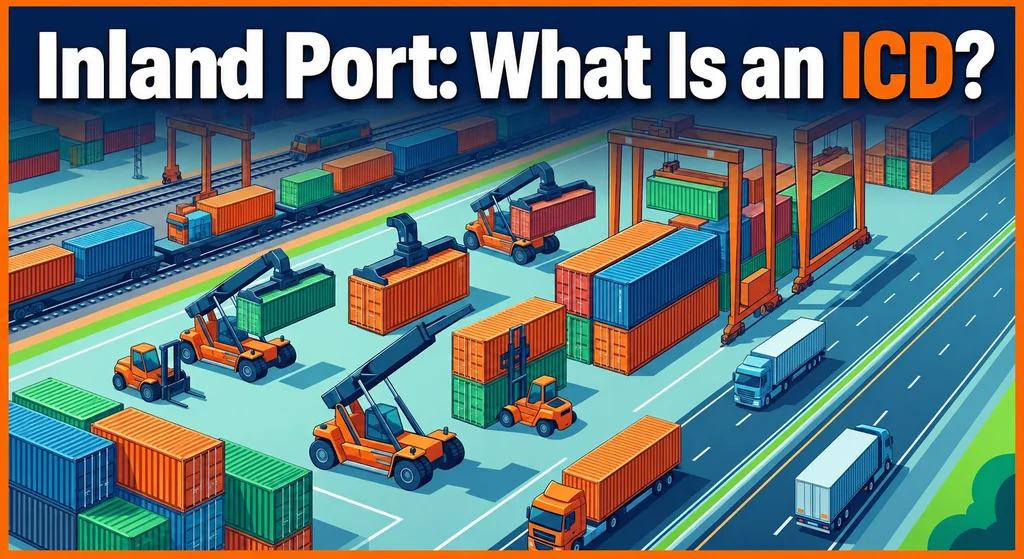
ICD stands for Inland Container Depot and literally means a container storage facility located inland. It is a logistics hub built in an inland area away from the sea to perform the same functions as a port.
To understand it easily, imagine an ICD as a 'port without the sea.' At a port, ships dock and unload containers, while at an ICD, trains or large trucks bring in containers instead of ships.
An ICD is more than a warehouse where containers are temporarily stored. It is a comprehensive logistics terminal that handles customs clearance by the Korea Customs Service, the collection and sorting of import and export cargo, the storage and movement of empty containers in and out, and the connection between rail and road transport. A representative ICD in South Korea is Uiwang ICD, located in Uiwang, Gyeonggi Province, which plays a central role in the distribution of import and export cargo in the Seoul metropolitan area.
Moving Port Functions Inland: The Core Roles of ICDs

The most important roles that ICDs perform in the logistics system can be broadly summarized into three categories.
1. Relieving Port Congestion (Port Congestion Relief)
Ports have limited land available. When a massive container ship unloads thousands of containers at once, the port's container yard (CY, Container Yard) quickly fills up. If these containers cannot be moved inland in time, the efficiency of port operations drops sharply.
In these situations, ICDs serve as a 'buffer zone.' Containers that arrive at a port are immediately transported in bulk to an inland ICD by rail or large trucks. This quickly frees up space at the port, allowing the next ship to enter and unload its cargo without disruption.
2. Moving Customs Clearance Inland (Inland Customs Clearance)
In principle, cargo arriving from overseas must complete customs clearance at the port's customs office before it can move inland. However, if all cargo waited for customs clearance at the port, congestion would become even worse.
ICDs are 'bonded areas' designated by the Korea Customs Service, allowing cargo that has not completed customs clearance at the port to be brought to an ICD under 'bonded transport.' Shippers (the owners of the cargo) can conveniently carry out customs procedures and collect their goods at an ICD near their home. This not only makes things more convenient for shippers but also greatly reduces the administrative burden on customs offices at ports.
3. A Hub for Integrated Intermodal Transport (Intermodal Transport Hub)
An ICD is a 'hub' where different modes of transport meet. It has a system in which containers are brought from a port to the ICD by rail and large trucks (coastal transport), which are suitable for bulk transportation, and then sorted at the ICD for delivery to their final destinations by smaller trucks.
This combination of rail and road transport makes it possible to build an economical logistics network while reducing social costs such as road damage, traffic congestion, and environmental pollution. In particular, a system that stores empty containers at an ICD and makes them immediately available to export shippers is central to logistics efficiency.
An Easy-to-Understand Example: From Busan Port to Seoul
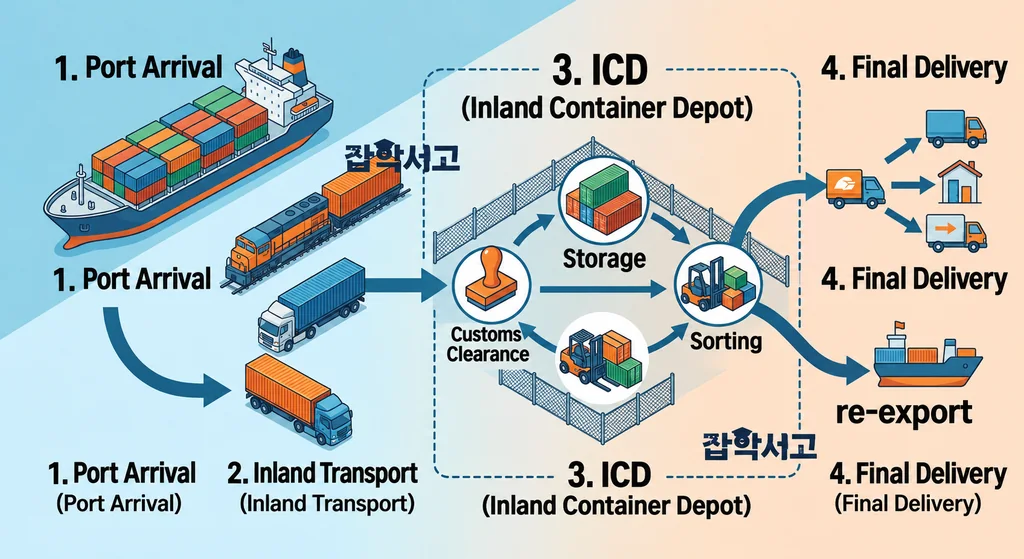
Let us look at an example to understand the general flow of how an ICD works.
Situation: Company A, based in Seoul, imports 10 containers' worth of materials from the United States. These materials arrive at Busan Port.
Without an ICD: The containers are unloaded at Busan Port. Company A must wait until customs clearance is completed at the port's customs office. Once clearance is complete, it must arrange 10 container trucks to transport the containers individually from Busan to Seoul. During this process, available space in Busan Port's container yard shrinks, and truck traffic on the expressway between Busan and Seoul increases.
With an ICD: Once the containers are unloaded at Busan Port, they are immediately loaded onto a train without customs clearance. A massive freight train carries all 10 containers at once to Uiwang ICD inland. Company A completes customs clearance at the Uiwang ICD customs office instead of in Busan. Once clearance is complete, the containers only need to travel the short distance from Uiwang ICD to Seoul by truck.
As a result, using an ICD allows Busan Port to quickly free up space, makes customs clearance more convenient for Company A, and reduces expressway congestion nationwide.
ICDs: The Unsung Heroes of National Logistics Competitiveness
An ICD (Inland Container Depot) is an essential facility that performs the functions of a port even without the sea and keeps the lifeblood of the national logistics network flowing smoothly. Its roles span many areas, including reducing the burden on ports by quickly moving large volumes of containers deep inland, cutting logistics costs through intermodal transport, and providing convenience for shippers.
Going beyond simply being places where containers are stacked, ICDs are evolving into smarter logistics hubs by integrating electronic customs clearance systems and advanced logistics IT technologies. We should remember that behind the convenient logistics services we enjoy every day, ICDs—the 'inland ports'—are quietly fulfilling their roles.