Imagine a company with ten warehouses across the country. Each one keeps extra stock in case orders suddenly pile up, so the shelves in all ten are always full. If the company merged them into just a few sites, how much of that extra stock could it drop? If the number of warehouses is cut in half, does the stock fall by half too? A rule of thumb that gives a surprisingly simple answer to this question is the ‘Square Root Law’ of inventory.
Put simply, the square root law of inventory means that ‘when one item is stored in several places, total inventory grows not in proportion to the number of locations but in proportion to the square root of that number.’ It became widely known in logistics after David H. Maister set it out in 1976 in a paper titled “Centralisation of Inventories and the ‘Square Root Law’.”
In this article, we will look in turn at where the law came from, how swings in demand cancel each other out, how to follow the calculation with real numbers, and the cases where the law does not hold.
The hidden formula linking warehouse count and safety stock
1. Where the idea of merging warehouses came from

Companies that sell goods want warehouses close to their customers. Shipping from a nearby warehouse is faster and saves on transport costs. But the more warehouses there are, the more inventory the company has to hold.
(1) Safety stock piled up in every warehouse
Besides the amount it normally sells, a warehouse keeps a buffer in case orders come in higher than expected or replenishment runs late. This is called safety stock. When warehouses operate separately, each one has to absorb the uncertainty of its own region alone, so safety stock stacks up once for every warehouse.
(2) Maister’s 1976 paper
In a paper published in 1976 in volume 6, issue 3 of the International Journal of Physical Distribution, David Maister analysed how inventory changes when several regional warehouses are merged into one central warehouse. He named the relationship the ‘square root law’: if an item is stocked in n locations, total inventory is proportional to the square root of n.
(3) The tug of war between stock and transport
Fewer warehouses mean less inventory, but customers end up farther away, so transport costs and delivery times rise. Companies therefore weigh both costs when deciding how many warehouses to run, and the square root law has served as a quick way to estimate the inventory side of that trade-off.
2. How swings in demand cancel each other out

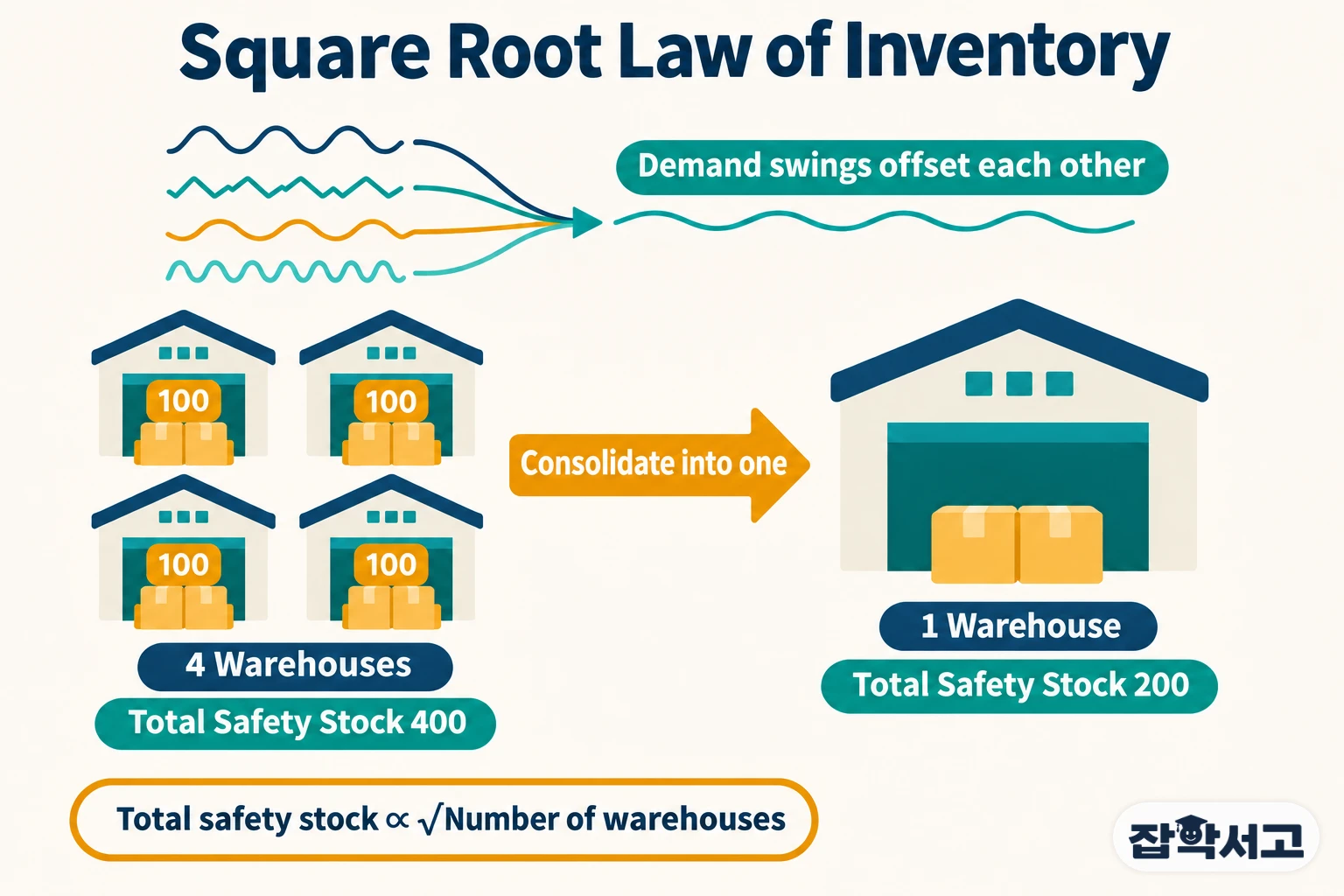
Why doesn’t safety stock simply add up when warehouses are combined? The secret is that demand in each region fluctuates on its own. On a day when orders flood the Seoul warehouse, the Busan warehouse may receive only a few. Once the warehouses are combined, these ups and downs partly erase each other, so the swing in total demand is smaller than the regional swings added together.
- Safety Stock: Extra inventory held above normal requirements to cover demand that runs higher than expected or replenishment that arrives late.
- Demand Variability: How far daily orders stray from the average, usually expressed as a standard deviation; safety stock is set in proportion to this value.
- Risk Pooling: The effect of combining uncertain demand from several places so that their fluctuations offset each other; it is the fundamental reason the square root law holds.
- Inventory Centralization: A strategy of gathering the stock of scattered warehouses into fewer hubs; it is how the risk pooling effect is applied to a real logistics network.
In statistical terms, when independent demands are added, their means simply add up, but the standard deviation is the square root of the sum of the squared standard deviations. Combining n demands of equal size makes the standard deviation grow not n times but only √n times, and that difference carries straight through to safety stock.
3. Following the square root law with numbers

The calculation is simpler than it looks. To get the new safety stock, multiply the current safety stock by the square root of ‘new number of warehouses ÷ current number of warehouses.’
(1) Merging four warehouses into one
Suppose four warehouses each hold 100 units of safety stock, 400 in total. If the four have similar demand and it moves independently, the safety stock needed after merging them into one is 400 × √(1/4) = 200 units. The number of warehouses falls to a quarter, while safety stock falls by half.
(2) Adding warehouses or merging two into one
Conversely, expanding from 4 to 16 warehouses requires √(16/4) = 2 times as much safety stock, or 800 units. Merging two warehouses into one leaves 1/√2, or about 71%, so safety stock can be cut by about 29%.
(3) Eppen’s 1979 proof
In 1979, Gary D. Eppen showed mathematically in a short paper in the journal Management Science that when the inventory of n locations with independent, normally distributed demand is pooled in one place, expected cost and safety stock fall to 1/√n. This result has become the classic example used to explain risk pooling in inventory management today.
4. When the law does not hold

The square root law is convenient, but it is an approximation that rests on several assumptions. When those assumptions break down, the actual reduction in inventory can differ greatly from what the law predicts.
(1) Demand that moves together
The law assumes that regional demand moves independently. When orders in every region rise and fall at once, as during holidays or cold snaps, the swings do not cancel out. Eppen also showed that the stronger the positive correlation between demands, the smaller the benefit of centralization, and that the benefit disappears when demand moves in perfect step. The offsetting effect also weakens when demand differs greatly in size from region to region.
(2) Higher transport costs and longer delivery times
Even if merging warehouses cuts inventory, transport costs rise and deliveries slow down when customers are farther away. For products where fast delivery matters, it may be better to hold a little more stock and keep warehouses close to customers. That is why the number of warehouses is decided by weighing not only inventory but also transport, storage, taxes and service levels.
(3) The impact of real demand and replenishment practices
In 2016, Kostas Bimpikis and Mihalis G. Markakis showed that for ‘heavy-tailed’ demand, where very large orders occasionally burst in, the benefit of centralization is much smaller than √n. In the same year, Bernhard Fleischmann found that the square root law does not hold as such under the common practice of replenishing warehouses one full truckload at a time. This is why, when reshaping a real logistics network, companies use the law to set the direction and then recalculate with their own data.
Despite these limits, the core lesson of the law is clear: scattered uncertainty eases itself the more it is gathered together. The simple idea that ‘when you bring warehouses together, the swings in demand cancel each other out’—that is the first step to understanding the square root law of inventory.