When you press the order button at an online store, a few hours later someone somewhere in a fulfillment center finds exactly the toothbrush, shampoo, and socks you chose and puts them in a box. This task of picking out only the items in your order from a huge warehouse lined with tens of thousands of products is “order picking.”
Put simply, order picking means “the work of taking the needed items, in the needed quantities, out of their storage locations and gathering them to match a customer order.” It may look like simple grocery shopping, but because it takes the largest share of warehouse operating costs, it is the first thing examined when evaluating logistics efficiency.
In this article, we will look in turn at the concept and cost structure of order picking, where working time leaks away, the main picking methods, and how robots and technology are changing picking.
How Order Picking Works and How to Make It More Efficient
What Is Order Picking?
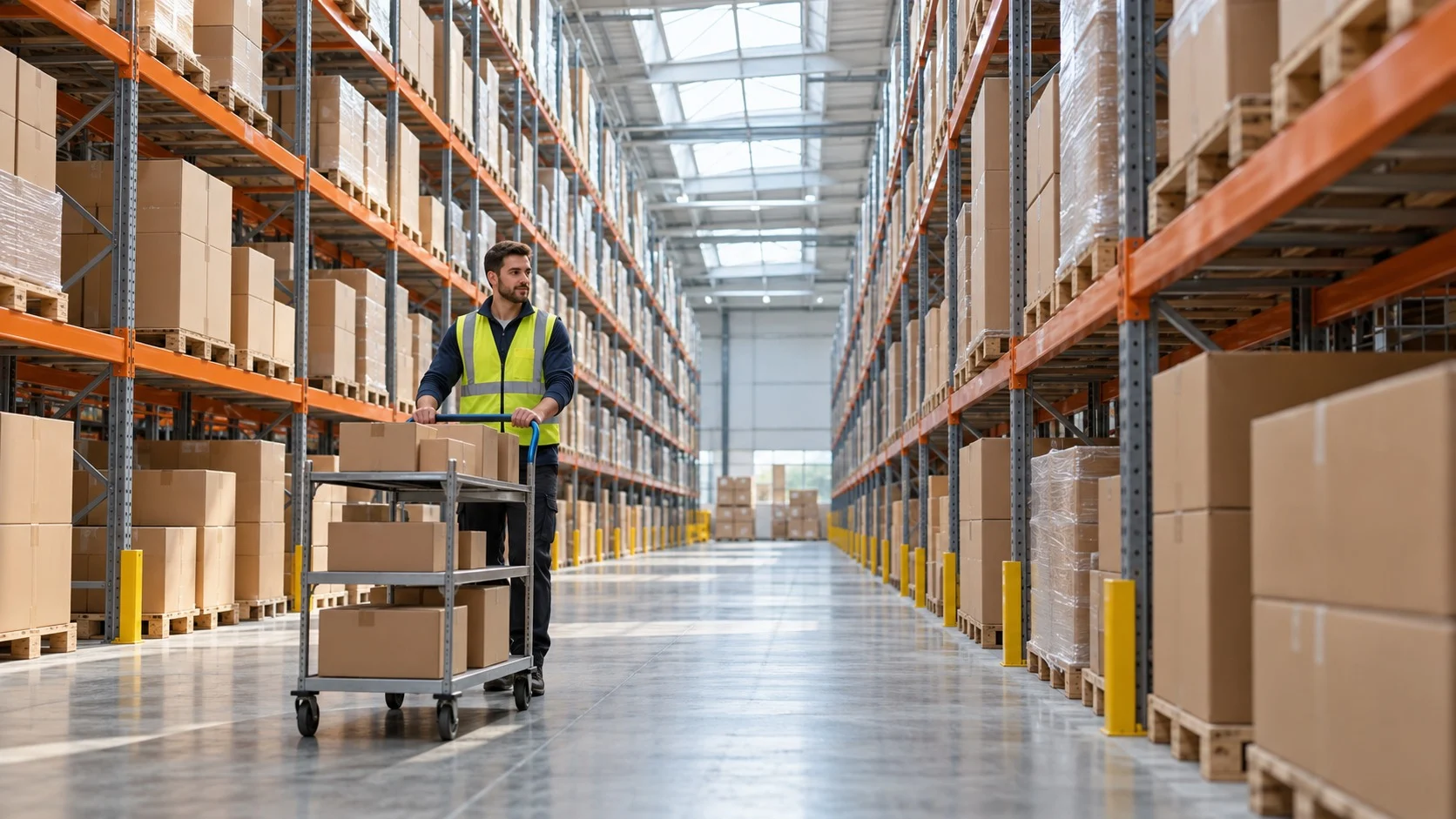
Traditional warehouse work is broadly divided into four stages: receiving, storage, picking, and shipping. Among them, picking is the link that regroups stored goods into orders and passes them on to shipping. Even if products arrive by the pallet, customers order single units or a few cases, so someone in the warehouse has to turn large lots into small orders.
The problem is that this task takes the most hands and feet. In logistics research, the estimate that order picking accounts for up to 55% of total warehouse operating costs is widely cited. If picking is delayed, shipping and delivery are pushed back one after another, and wrong picks add the costs of returns and reshipping, so the speed and accuracy of picking translate directly into the quality of customer service.
Where Time Leaks Away: The Components of Picking Work
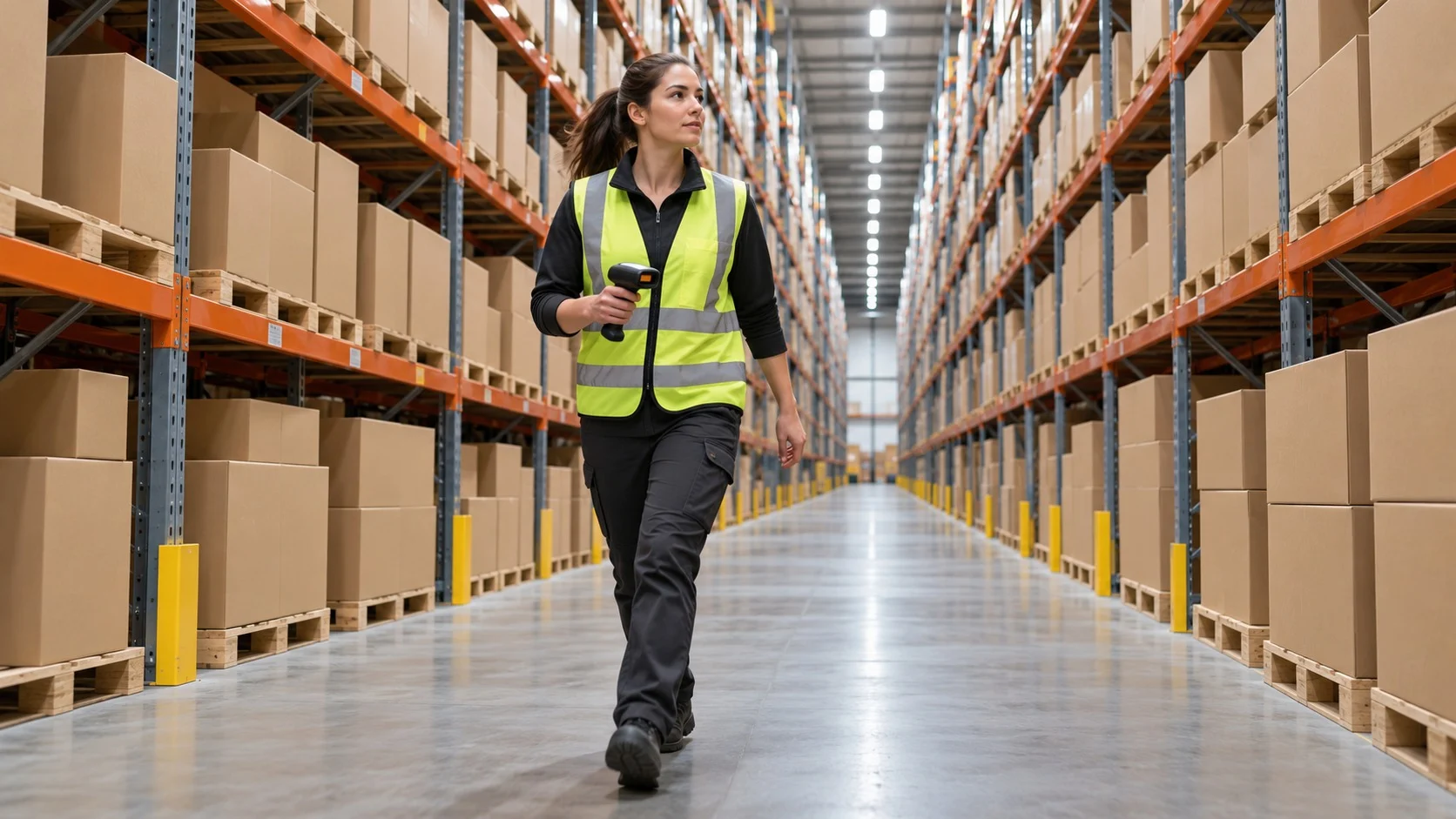
There is an analysis that breaks down where picking time goes in warehouses where workers walk between the shelves themselves. According to material by James A. Tompkins and colleagues, known for a well-known American textbook on facilities planning, picking time divides roughly as follows.
(1) Travel, about 50%
The time spent walking to where an item is and back. It adds no value yet eats up the most time, so it is the first target for improvement.
(2) Search, about 20%
The time spent confirming the exact slot and product after arriving at the shelf. The more similar packaging there is, the longer it takes and the more mistakes occur.
(3) Extraction, about 15%
The time spent grabbing the product, counting the quantity, and placing it in a container.
(4) Setup, about 10%
The preparation time spent receiving the pick list and getting the cart and containers ready. The remaining few percent goes to other miscellaneous tasks.
In the end, the key to more efficient picking is “making people walk less.” That is why it becomes important to place fast-selling products near the shipping area and to sequence picks so workers follow the shortest route.
4 Picking Methods to Choose by Situation
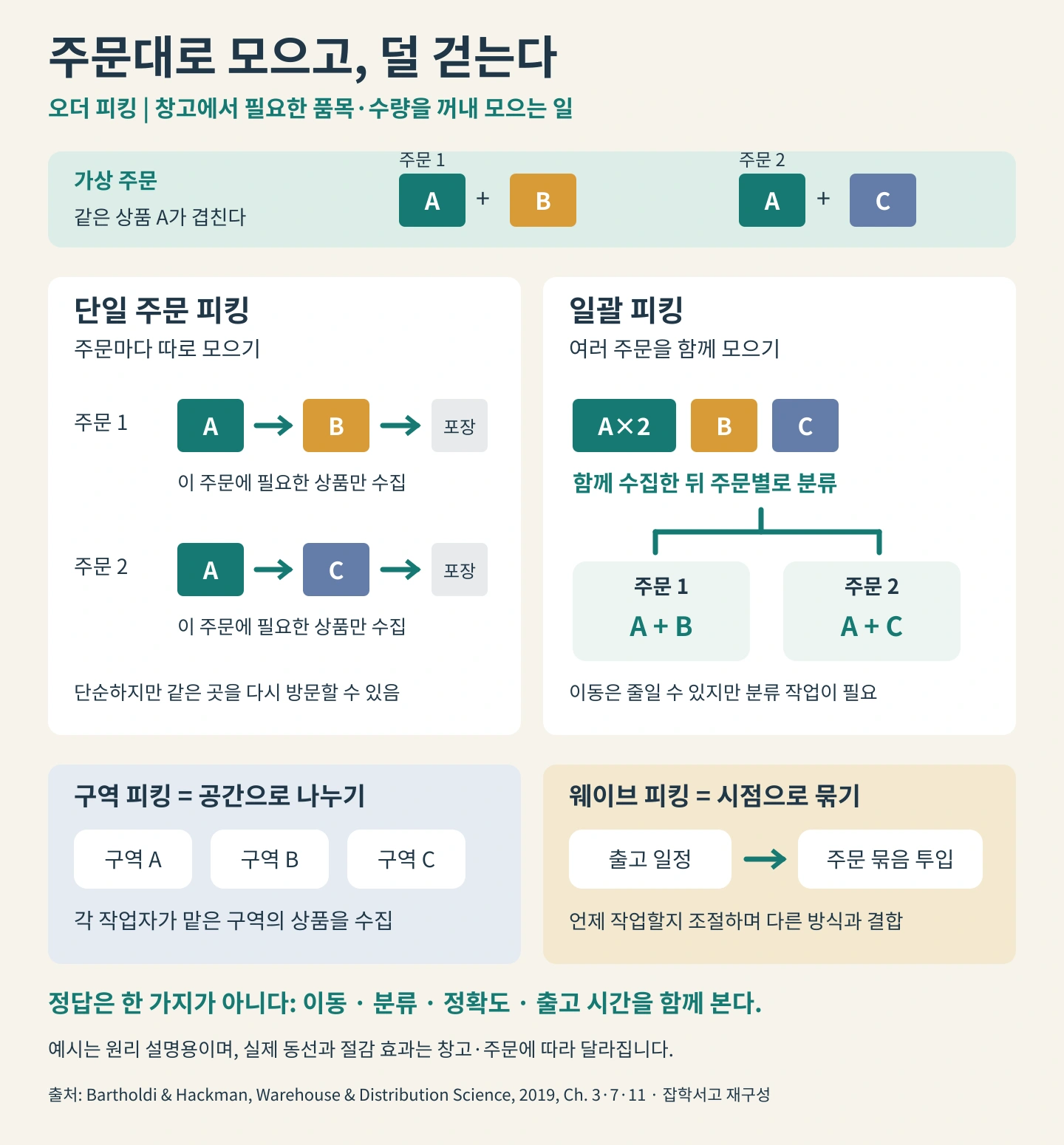
How picks are grouped and divided also varies with the volume and nature of orders. The main methods are as follows.
- Single Order Picking: one worker fills one order from start to finish. It is simple and has few errors, but travel distance grows sharply when there are many orders.
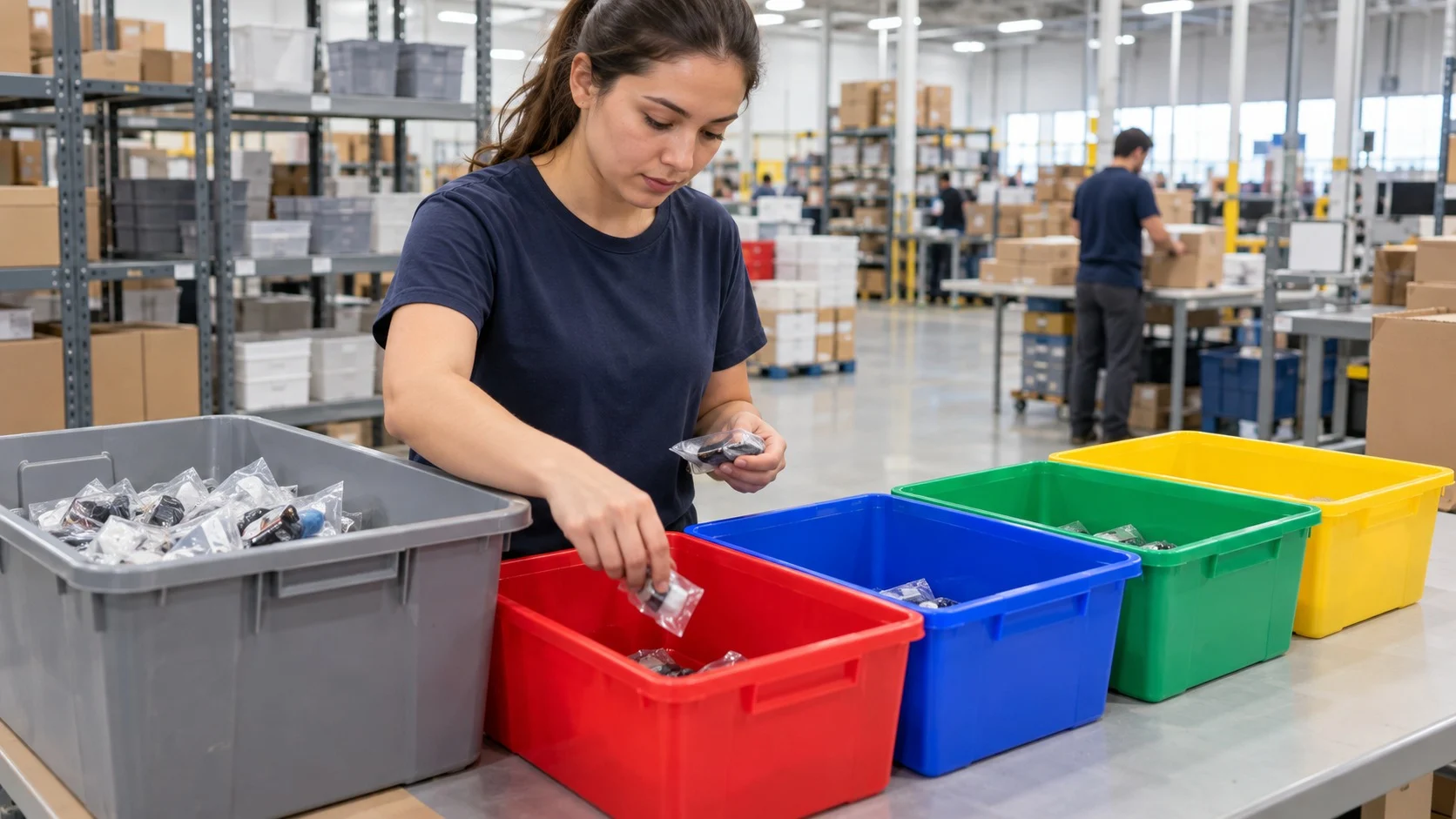
- Batch Picking: several orders are gathered together, the same product is picked all at once, and the items are later divided by order. It suits online shopping, which has many small orders.
- Zone Picking: the warehouse is divided into several zones and each worker picks only the products in their assigned zone. It reduces travel in large warehouses.
- Wave Picking: orders are released in time-based batches according to criteria such as delivery truck departure times. It helps align picking with the shipping schedule.
As a simple example, imagine you are in charge of the grocery shopping for a family of five at a big supermarket. If each person shops separately, you have to pass the same shelves five times, but if you combine the lists, make one round, and divide things up at home, it is much faster. This is the principle of batch picking.
From Warehouses Where People Walk to Warehouses Where Goods Come to Them
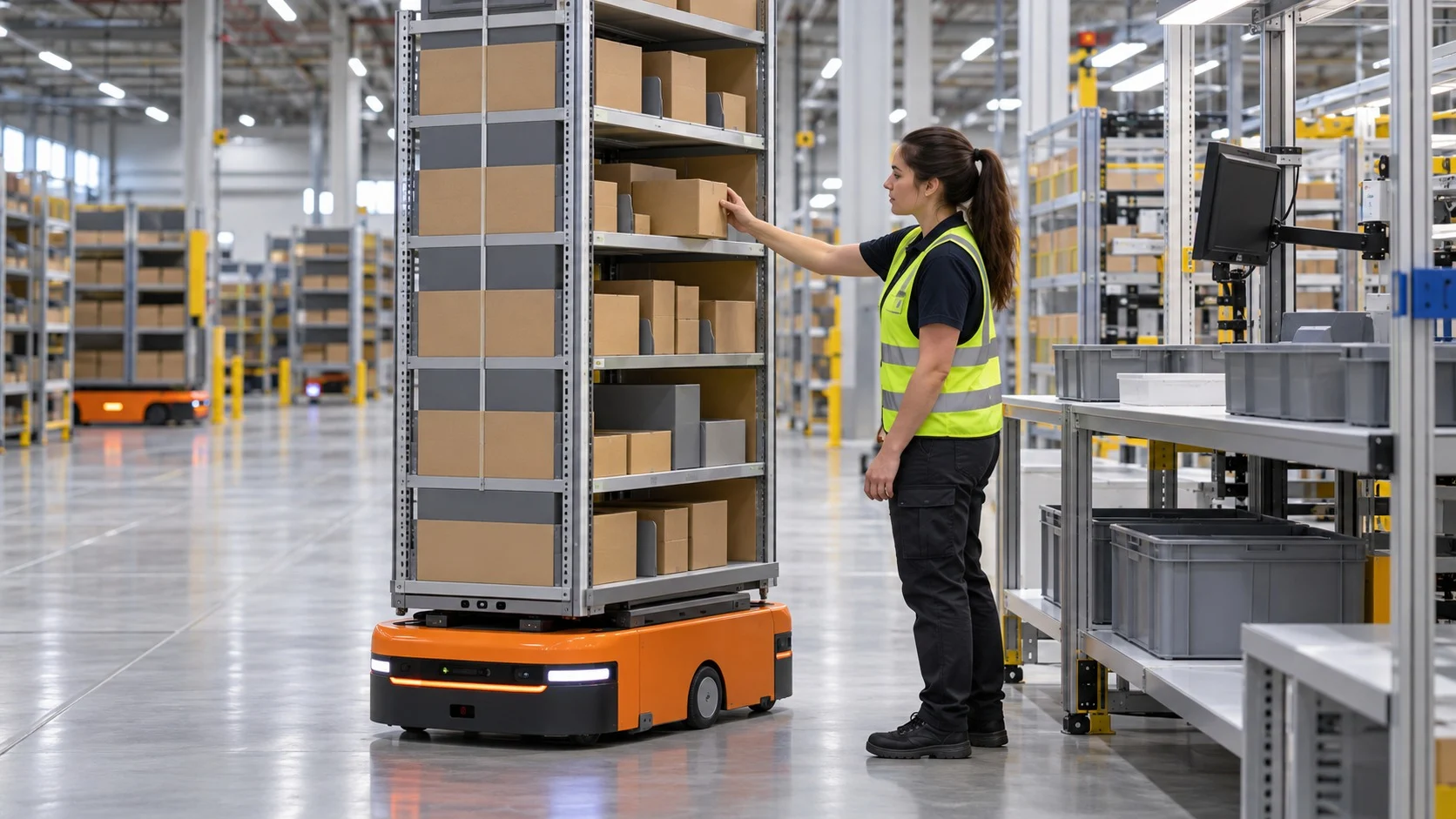
The traditional method is “Picker-to-Parts,” in which the worker goes to find the goods. Recently, the reverse, “Goods-to-Person,” in which the goods come to a worker standing in place, has been growing quickly.
A symbolic event was Amazon’s acquisition of the warehouse robotics company Kiva Systems in 2012 for about $775 million. Kiva’s robots lift entire shelves of products and carry them to the workstation, and the worker takes out only the needed items without moving. Amazon said that as of 2022 it operated more than 520,000 of these robotic drive units.
Even without robots, there are many technologies that help with picking.
- Pick-to-Light: a light turns on at the slot to pick from and shows the quantity, cutting search time.
- Voice Picking: workers hear the location and quantity through a headset and confirm by speaking, keeping both hands free.
- Barcode Scanning: each product is scanned as it is picked, catching wrong picks right away.
Order picking is rarely visible to consumers, but it is the core task of logistics, controlling nearly half of warehouse costs and determining delivery speed and accuracy. Efficiency rises only when layouts that reduce travel, methods that group orders, and technologies that assist people work together.
Finding the balance between “picking fast” and “picking accurately” will remain a challenge in logistics operations. Designing warehouses so people walk less and get confused less is the first step toward fast and accurate logistics.