The National Pension system has firmly established itself as an important social security system that provides security in old age in modern society. It provides people with an economic safety net and contributes to maintaining social stability.
This article aims to provide an in-depth analysis of the history and background of the introduction of the National Pension system, its main functions and operating methods, its social importance, and its economic impact and sustainability.
The History and Background of the Introduction of the National Pension System

The history of the National Pension system dates back to its formal introduction in South Korea in 1988. At the time, South Korea was experiencing rapid economic growth, which further highlighted the need for a social safety net. In response, the government introduced the National Pension system to provide security for people in old age. Initially, it covered workers whose incomes exceeded a certain level, but coverage was subsequently expanded to all citizens, making the system applicable to the entire population.
Background to the Introduction of the National Pension System
Various social and economic factors contributed to the introduction of the National Pension system. In the mid-1980s, economic imbalances in South Korea deepened as the country went through a period of rapid growth, leading to greater social instability. In particular, poverty in old age emerged as a serious social problem. Under these circumstances, the government introduced the National Pension system to stabilize people's basic living conditions and address poverty in old age.
The Influence of Pension Systems in Other Countries
The introduction of the National Pension system was also closely connected to international trends. At the time, many developed countries were already operating public pension systems to provide security in old age, and these had a major influence on South Korea. In particular, examples from countries such as Japan and Germany were used as references in designing a pension system suited to Korea. These international examples served as important reference materials for South Korea in designing its own pension system.
Government Policy Direction and the Introduction of the National Pension
When the National Pension system was introduced, the government made the expansion of social welfare, alongside economic growth, an important policy objective. This policy direction served as an important factor in promoting the introduction of the National Pension system. Through the system, the government sought to strengthen the social safety net and improve people's quality of life. This represented the government's efforts at the time to respond to people's social needs and expand public welfare alongside economic growth.
Initial Responses to the Introduction of the National Pension System
There was also some resistance during the introduction of the National Pension system. This was because some people who had to contribute to the pension fund perceived it as a new tax burden. Over time, however, the necessity and usefulness of the pension system gradually became recognized, and today most people understand its importance. The pension system has now become an essential social mechanism for providing security in old age, and its continued development contributes to social stability.
The introduction of the National Pension system resulted from a combination of factors, including economic growth, the need for a social safety net, examples of pension systems in other countries, and the government's policy direction. As an important social mechanism for ensuring a secure old age, the National Pension system has established itself as an essential institution for the sustainable development of South Korean society.
The Main Functions and Operating Methods of the National Pension System

Eligibility for National Pension Benefits
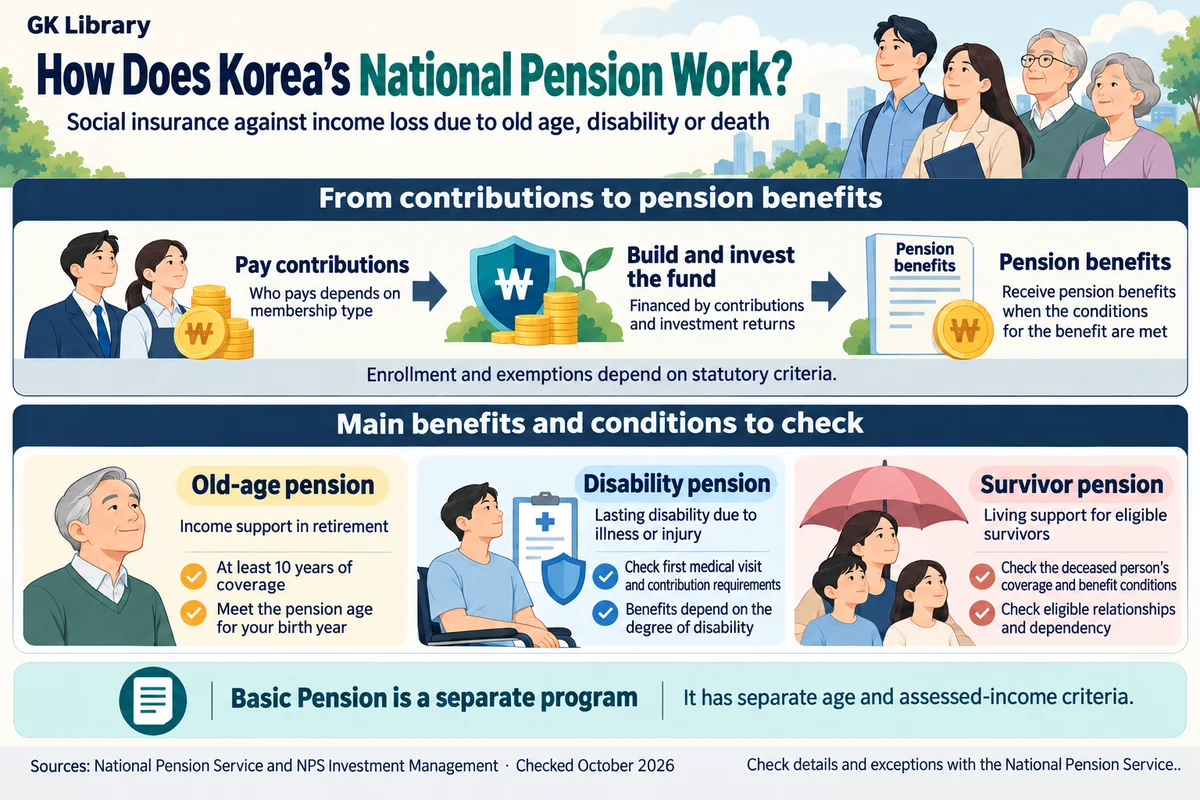
Certain conditions must be met to receive National Pension benefits. Basically, recipients must have been enrolled and paid contributions for a minimum period and must have reached a specified age. The age at which National Pension benefits can be received is currently being raised in stages, and pension payments generally begin between the ages of 60 and 65. However, the amount received may vary depending on the length of enrollment or the amount contributed, and options such as early or deferred pension payments are also available. These various eligibility criteria allow pension receipt to be adjusted flexibly to individual circumstances and support the effective operation of the National Pension system.
The Main Functions of the National Pension System
The National Pension system performs various functions to provide security for people in old age. First is its basic function of paying pensions. The National Pension is structured so that participants pay contributions for a certain period and then receive pension payments upon reaching a certain age. This plays an important role in providing an economic safety net when income declines or disappears in old age. This pension payment function is a key element in helping people maintain financial independence and ensuring stability in their later lives.
Second, the National Pension strengthens the social safety net through disability and survivors' pensions. The National Pension system provides more than just old-age pensions; it also pays disability pensions to people who develop disabilities due to unexpected accidents or illnesses. This is an important means of alleviating financial difficulties that may arise from a disability. In addition, when a participant dies, the system pays survivors' pensions to their surviving family members, supporting the family's livelihood and helping prevent social instability caused by a sudden loss of income.
Third, the National Pension is linked to various social welfare services. For example, through its connection with the Basic Pension system for low-income groups, it plays an important role in supporting people in poverty during old age. This goes beyond simply paying pensions and forms part of welfare policies intended to protect socially vulnerable people and improve their standard of living. The National Pension also contributes to participants' health management through cooperation with health insurance and plays an important role in improving the overall quality of life in old age.
How the National Pension System Operates
The operating methods of the National Pension system are broadly divided into contribution arrangements and benefit arrangements. Under the contribution arrangements, participants pay a certain percentage of their income as contributions. These contributions accumulate in the pension fund and become a source of financing for future pension payments. Under the benefit arrangements, the contributions collected in this way are used to pay participants a specified amount when they reach a certain age. The balance between these arrangements is a key element in maintaining the stability of the National Pension system.
The National Pension system also operates under government management and supervision. A dedicated institution called the National Pension Service was established to handle the accumulation and management of pension funds and the administration of pension beneficiaries. The National Pension Service employs various investment strategies to manage the pension fund stably, working to increase returns while minimizing risk. To enhance transparency and credibility, it also regularly discloses its operating performance and undergoes external audits and evaluations. Through these efforts, it secures public trust and maintains the fairness and transparency of the system.
Continuous Improvement of the National Pension System
The National Pension system is also improved through periodic reforms. Its rules, contribution rates, and benefit levels are adjusted in response to rapid social changes or shifts in economic conditions. These reforms aim to ensure the sustainability of the pension system and meet changing social needs and public expectations. For example, as population aging increases the number of pension beneficiaries, adjustments to contribution rates or postponement of the start of pension payments may be discussed. These are essential measures for maintaining the financial sustainability of the National Pension system and ensuring stable pension payments for future generations as well.
In conclusion, the National Pension system is an important social mechanism that provides security in old age, offering people financial stability and a social safety net through its various functions and operating methods. Continuous improvement and management are essential for the stable operation of this system, and transparent operation grounded in public trust is important.
An Analysis of the Social Importance of the National Pension System

Addressing Poverty in Old Age
The National Pension system plays an important role in addressing poverty in old age in modern society. As society ages, poverty in old age is emerging as a major social problem, and the National Pension system is a key means of alleviating it. By providing an economic safety net when income declines or disappears in old age, the National Pension helps older people lead stable lives. This reduces poverty in society and provides a foundation for older people to maintain dignified lives.
Enhancing Social Stability
The National Pension system plays an important role in enhancing social stability. Through the pension system, individuals can secure an economic safety net for old age, reducing financial anxiety and enabling them to lead stable lives. Financial stability serves as a factor that increases stability not only for individuals but also for society as a whole. When people can live without worrying about old age, anxiety across society decreases and a stable social environment is created.
Easing Intergenerational Conflict
The National Pension system also contributes to easing intergenerational conflict. When the parents' generation can enjoy financially secure later lives through the National Pension, the children's generation faces less of a burden in supporting their parents. This promotes financial and emotional stability within families and plays an important role in reducing conflict between generations. In particular, as the population ages, adjustments to the sharing of financial responsibilities between generations can help family members maintain more harmonious relationships.
Strengthening Social Solidarity
The National Pension system contributes to strengthening social solidarity. As a system that all citizens can join and benefit from, it serves as an important mechanism for building solidarity among members of society. Its universality reinforces the perception that the system is built collectively by society as a whole and contributes to a stronger sense of community. This strengthens social bonds and promotes mutual trust among members, playing an important role in creating a more integrated society.
Positive Effects on the Labor Market
The National Pension system also has positive effects on the labor market. When a stable pension system is in operation, workers can worry less about their financial circumstances in old age and participate more actively in current economic activities. This increases the vitality of the labor market and can contribute to overall economic growth. In particular, the stability of the pension system also positively affects workers' long-term career choices and job security, contributing to the development of a sustainable labor market.
Reducing Social Inequality
The National Pension system plays an important role in reducing social inequality. Its structure operates so that all citizens pay contributions according to their income levels and receive pensions in proportion to those contributions. This structure produces an income redistribution effect, helping narrow income gaps and reduce social inequality. In particular, by providing economically vulnerable groups with opportunities to prepare for old age, it plays an important role in creating a more equal society.
The Economic Impact and Sustainability of the National Pension System

The Economic Impact of the National Pension System
The National Pension system has various effects across the economy. First, it contributes to improving people's purchasing power. When pension recipients are assured of a stable income, they can participate more actively in economic activities through consumption. This raises individuals' living standards while stimulating consumption across the economy, positively affecting economic growth. Stable consumption plays an important role in invigorating the domestic market and supporting sustainable growth throughout the economy.
Encouraging Investment and Saving
Second, the National Pension system plays a role in encouraging investment and saving. When people can prepare for old age through the National Pension, they are more likely to save or invest funds left over after covering their living expenses. This is an important factor that strengthens individuals' financial security while promoting capital accumulation and increased investment in the national economy. Savings are reinvested in various economic activities through financial institutions, becoming an important driving force for economic growth.
Effects on Public Finances
Third, the National Pension system also has important effects on public finances. Through the National Pension Fund, the government can secure liquidity for its fiscal operations and use this as a basis for carrying out various social welfare programs. However, because the risk of depletion of the National Pension Fund is always present, it is important to manage and operate it efficiently. The government must pursue prudent fiscal policies to maintain fiscal soundness while ensuring the sustainable operation of the National Pension.
Effects on Financial Markets
Fourth, the National Pension system also has important effects on financial markets. The National Pension Fund invests in various financial assets, including stocks and bonds, thereby contributing to the stability and growth of financial markets. In particular, because the fund serves as a source of long-term investment capital, it plays an important role in supplying stable funding to financial markets and reducing market volatility. National Pension investments also promote the growth and development of financial markets, producing positive ripple effects throughout the economy.
The Need to Ensure Sustainability
Fifth, the sustainability of the National Pension system is emerging as a very important issue in an aging society. Population aging may lead to a situation in which the number of pension beneficiaries continues to rise while the number of contributors declines. Under these circumstances, various measures, such as adjusting contribution rates and raising the age at which pensions are paid, must be reviewed and implemented to ensure the sustainable operation of the National Pension. Through these measures, the financial soundness of the pension system must be secured so that future generations can also receive stable pension payments.
The Importance of Public Trust and Transparency
Sixth, public trust is essential to ensuring the sustainability of the National Pension system. Transparent and fair operation is necessary so that people can trust the pension system and reliably pay their contributions. The government and the National Pension Service must transparently disclose information about pension operations and continuously pursue improvements that reflect public opinion. Operating the pension system on the basis of public trust is essential to enhancing its sustainability and maintaining a stable social safety net.
The National Pension system plays an important role in providing security for people in old age and maintaining social stability. Its successful operation requires harmony among its history and the background to its introduction, its main functions and operating methods, its social importance, and its economic impact and sustainability. The importance of the National Pension system will become more pronounced over time, and continued attention and improvement are essential to support it.