If someone else decided what time you get up, who helps you get dressed and where you go in the evening, could you call that life independent? In the 1960s, students with severe disabilities in Berkeley, California, saw not being able to decide for themselves as a bigger problem than not being able to move on their own. The current that grew out of their question is the Independent Living Movement.
Simply put, the Independent Living Movement is a disability-led movement that seeks to turn the principle ‘even if I receive help, I make the decisions about my own life’ into social institutions. Its symbolic starting point is usually traced to 1962, when Ed Roberts, paralyzed almost entirely from the neck down by polio, entered Berkeley, and in 1979 the researcher Gerben DeJong organized the movement into an analytic framework.
In this article, we will look in turn at the Berkeley story where the movement was born, how it differs from the rehabilitation paradigm, the core principles that support it, and how it spread into laws and institutions today.
From Objects of Care to Masters of Their Own Lives: All About the Independent Living Movement
1. Dormitory Life That Began in a Hospital Ward

Roberts contracted polio in 1953 at the age of fourteen and could barely move anything below his neck; at night he slept inside a breathing machine called an iron lung. After attending a local college, he entered Berkeley in 1962.
(1) A Ward Used as a Dormitory
The university was so unprepared that, according to one anecdote, a dean remarked that the school had admitted disabled students before and it had not worked out. When no dormitory could hold his iron lung, an empty wing of the campus Cowell Hospital was offered, and Roberts accepted on the condition that it be treated as a dormitory rather than a hospital room.
(2) The Rolling Quads Appear
By 1967, twelve more students with severe disabilities had moved into Cowell Hospital. They banded together, calling themselves the ‘Rolling Quads’, and in 1970 they created their own Physically Disabled Students’ Program, offering attendant care, wheelchair repair, peer counseling and a campus shuttle.
(3) A Center Beyond the Campus
Because the same help was still needed after graduation, the Berkeley Center for Independent Living opened in 1972 in a rented two-bedroom apartment. The following February, based on its members’ surveys, the City of Berkeley passed a resolution for a wheelchair route with curb ramps along Telegraph Avenue.
2. The Rehabilitation Paradigm and the Independent Living Paradigm

In a 1979 paper, DeJong set side by side the ways traditional rehabilitation services and the Independent Living Movement view disability. For the same person, their answers were opposite.
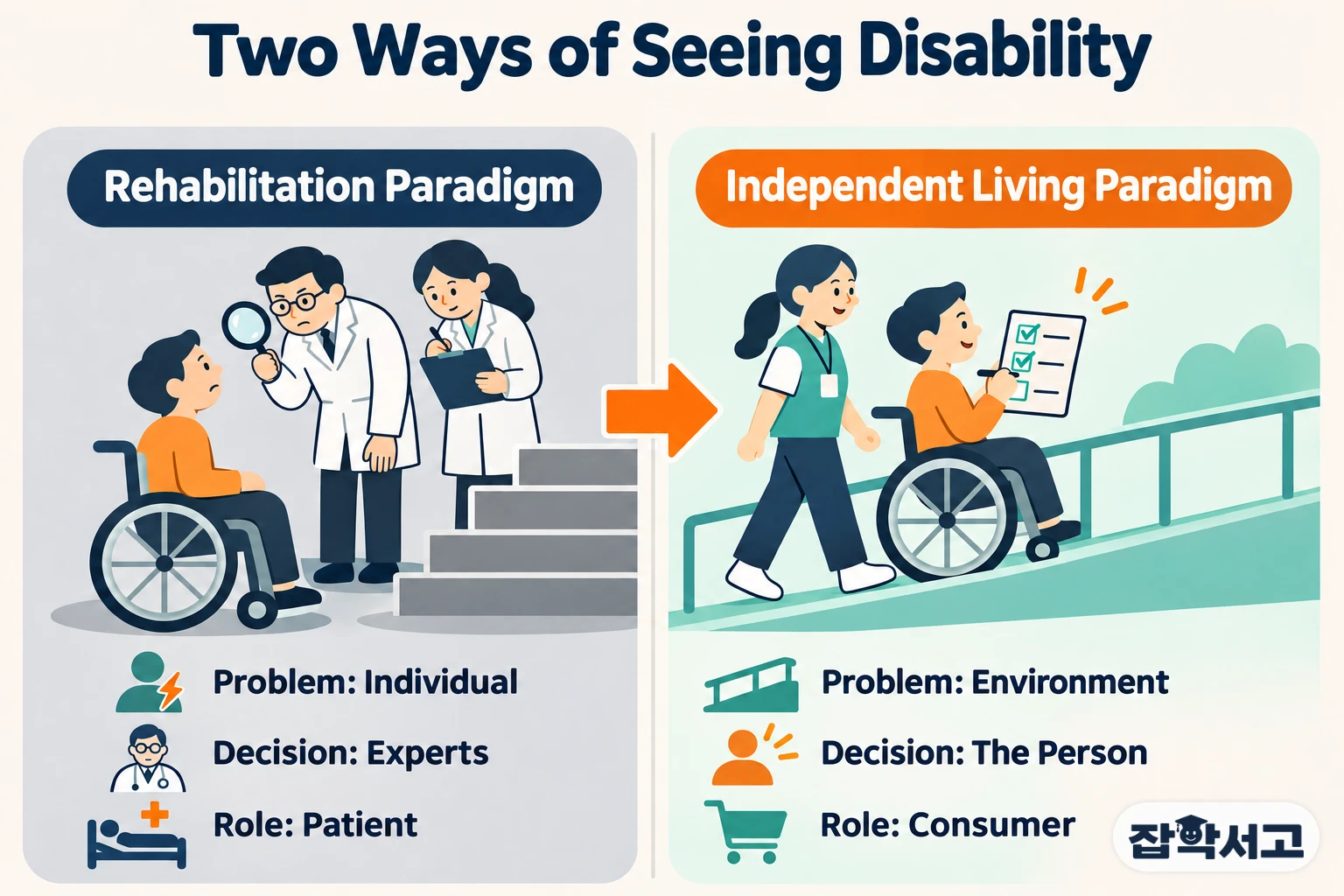
- Rehabilitation Paradigm: A view that treats disability as an individual impairment and tries to raise functioning through experts’ treatment and training.
- Independent Living Paradigm: A view that sees environmental barriers such as stairs, prejudice and institutions as the problem.
- Consumer Control: The principle that disabled people who receive services decide what those services contain and how they are run.
- Peer Counseling: A form of support in which people who have experienced similar disabilities offer advice based on their own experience.
- Personal Assistance: Receiving help with daily living from personal assistants whom the person chooses and manages directly.
(1) Where Is the Problem?
In the rehabilitation paradigm, the problem lies in the disabled person; in the independent living paradigm, it lies in the environment, the rehabilitation process and social and political conditions. It is the difference between blaming the legs or blaming the stairs when a wheelchair stops in front of a staircase.
(2) Who Solves It?
The rehabilitation paradigm solves the problem through procedures run by doctors and experts, and the disabled person becomes a patient or client who follows their decisions. The independent living paradigm solves it through self-help, peer counseling, barrier removal and consumer control, and sees the disabled person as a consumer who chooses services.
(3) What Is the Goal?
If the goal of the rehabilitation paradigm is physical independence and restored function, the goal of the independent living paradigm is a self-determined life.
3. The Principles Behind Independent Living
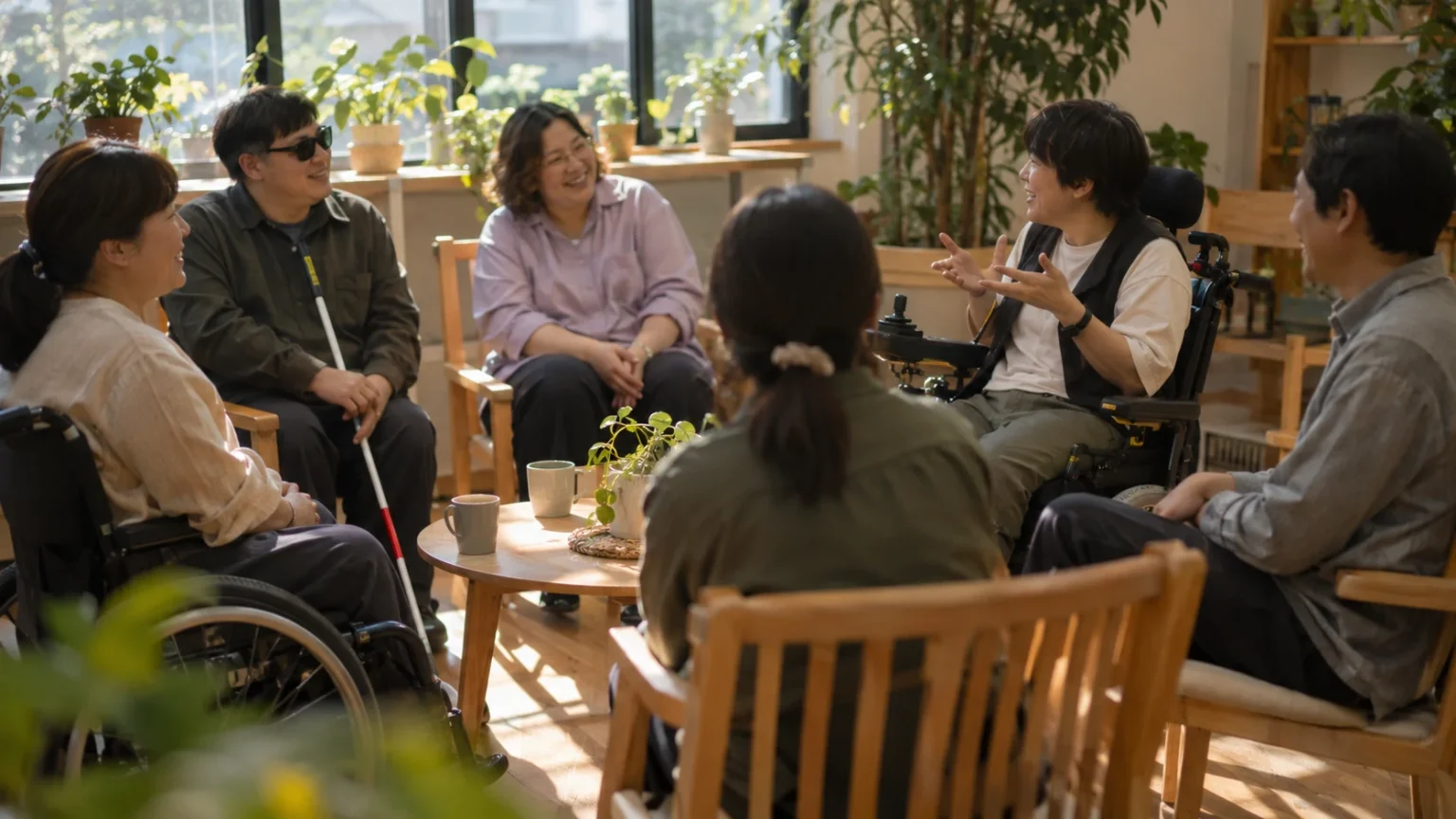
The Berkeley Center for Independent Living put forward dignity, peer support, consumer control, civil rights, integration, equal access and advocacy as its core values. The main principles are as follows.
(1) Organizations Led by Disabled People
Independent living centers are, in principle, led by disabled people. According to the U.S. Administration for Community Living (ACL), two-thirds of center staff today are people with disabilities, and people with disabilities hold 75% of decision-making positions.
(2) Experience as Expertise
How to ride a bus in a wheelchair or how to interview a personal assistant is best known by those who have been through it. That is why peer counseling became a basic service of the centers.
(3) Nothing About Us Without Us
In the 1990s, the disability movement widely used the slogan ‘Nothing About Us Without Us’. The American activist James Charlton said he heard it from South African activists and used it as the title of his 1998 book.
4. Independent Living Spreads into Law and Institutions

The movement soon turned into a fight to change the law. Section 504 of the Rehabilitation Act of 1973 prohibited discrimination on the basis of disability in programs receiving federal funds, but its implementing regulations went unissued for years.
(1) A 25-Day Occupation
On April 5, 1977, disability activists began sit-ins at offices of the Department of Health, Education, and Welfare in several cities. In San Francisco, more than 100 people refused to leave the federal building, and the occupation continued for 25 days, until May 4, after Secretary Joseph Califano signed the regulations on April 28.
(2) Centers Become Institutions
The 1978 amendments to the Rehabilitation Act brought federal support for consumer-run independent living centers, and the Americans with Disabilities Act followed in 1990. Today, more than 350 centers in the United States provide five core services: information and referral, independent living skills training, peer counseling, advocacy and support for transition into the community.
(3) To the State Government and Across the Sea
In 1976, Governor Jerry Brown appointed Roberts director of the California Department of Rehabilitation, the very agency that had once judged him too severely disabled to work, and he served until 1983. In Sweden, the Stockholm Cooperative for Independent Living (STIL), led by Adolf Ratzka, began a pilot project in 1987 and spread a model in which users hire their own personal assistants.
Fix the barriers instead of fixing disabled people, and let the person who receives help be the master of that help: that simple idea is the first step to understanding the Independent Living Movement.