Imagine a document introducing someone that lists only words like “unemployed, depression, debt, estranged from family.” A reader would easily picture that person as a bundle of problems. But if the same person walks an elderly neighbor’s dog every morning, knows how to fix old radios, and dreams of working again, the story changes. The idea of grounding help not in what a person lacks but in the strengths they already have is what we call the “Strengths Perspective.”
Put simply, the strengths perspective means “a social work practice approach that places the talents, resources, and hopes of people, families, and communities at the center of helping.” It does not ask us to ignore problems; it asks us not to define people by their problems alone.
In this article, we will look in turn at how the strengths perspective emerged and its core principles, the methods used in practice, and the criticisms and limitations surrounding it.
Help That Starts from Possibility Instead of Deficit
How Did the Strengths Perspective Emerge?

For a long time, social work and counseling were influenced by medicine and emphasized diagnosis and pathology. Finding out what was wrong and giving it a name came to be seen as proof of expertise, and as a result the people receiving help only learned to describe their own problems in ever greater detail.
(1) The Experiment at the University of Kansas
In the early-to-mid 1980s, Professor Charles Rapp and his graduate students at the University of Kansas in the United States tried a new way of helping people with severe mental illness who used community mental health centers. While providing case management to help them live in the community outside the hospital, they focused on the person’s wishes and abilities rather than on symptoms.
(2) 1989, the Year It Got Its Name
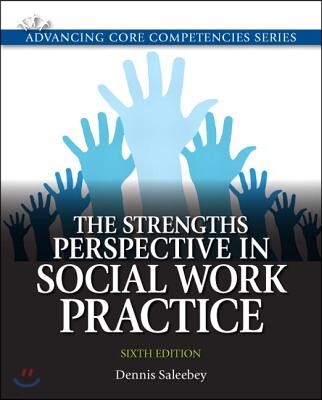
In 1989, Ann Weick, Rapp, W. Patrick Sullivan, and Walter Kisthardt published a paper in the journal Social Work that formally named this approach the strengths perspective for the first time. Later, Dennis Saleebey’s book The Strengths Perspective in Social Work Practice, first published in 1992, went through many editions and spread the perspective widely.
Core Principles of the Strengths Perspective

The principles summarized by Saleebey and the University of Kansas researchers come down to a few beliefs.
- Strengths: Every individual, family, group, and community has strengths and resources.
- Challenge and Opportunity: Trauma, illness, and hardship can be harmful, but they can also become sources of challenge and growth.
- Growth Potential: We do not assume in advance the limits of how much a person can grow.
- Collaboration: Goals are set by the person, not the professional, and help takes place through a collaborative working relationship.
- Environmental Resources: Every environment has resources that can be drawn on, such as family, neighbors, and organizations.
What stands out in these principles is that the professional’s role changes. Rather than being the one who knows the right answer, the professional becomes a companion who helps the person find the direction of their own life.
The Strengths Perspective in Practice

The strengths perspective is put into practice through concrete tools and questions.
(1) Strengths Assessment
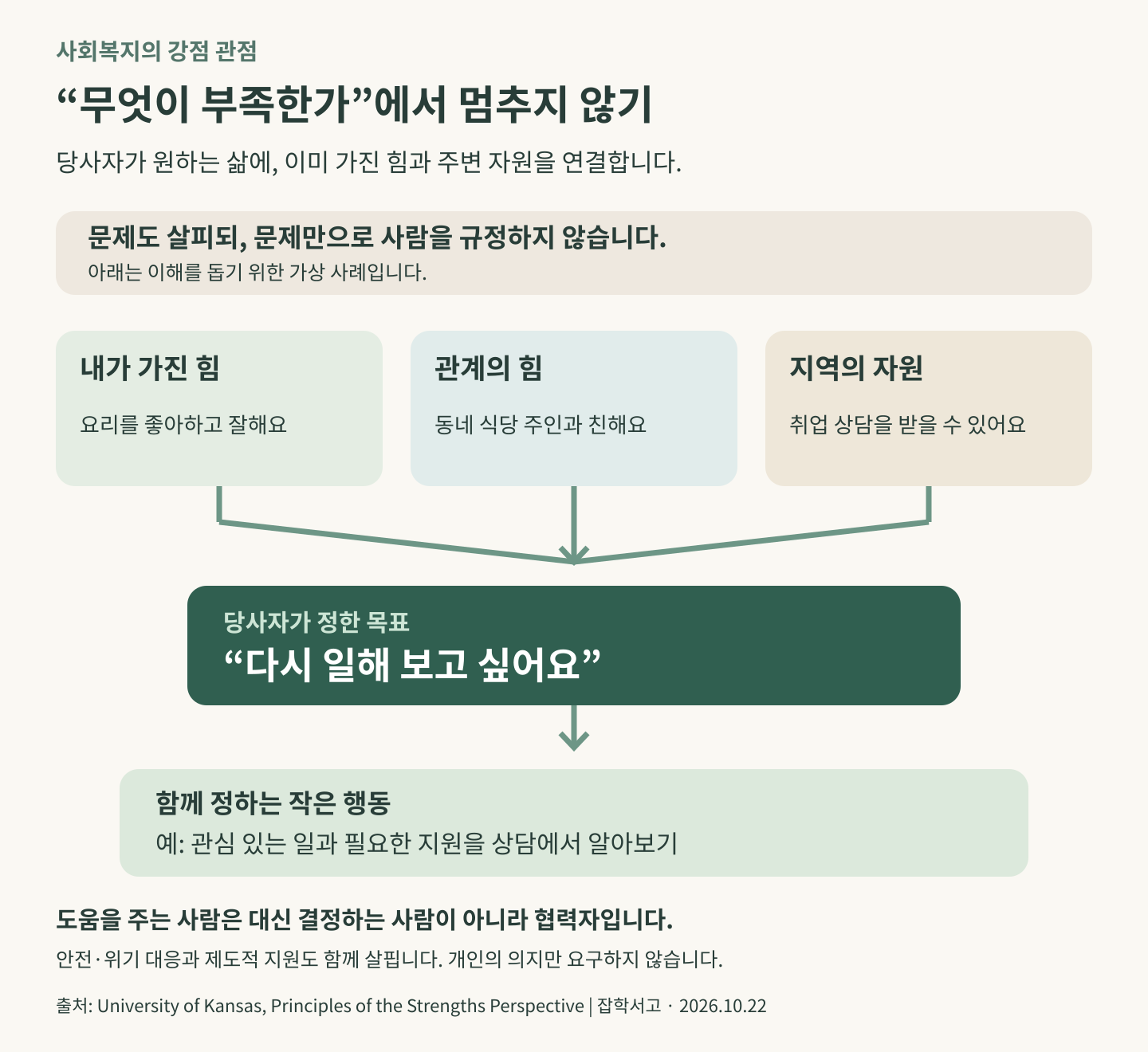
At the start of counseling, instead of making only a list of problems, the practitioner and the person also write down the person’s talents and interests, relationships, past experiences of overcoming difficulties, and surrounding resources. A common method is to lay out, side by side, what the person has now and what they want in each life domain, such as housing, work, leisure, and health.
For example, if it turns out that someone who has been out of work for a long time loves cooking and is close to the owner of a neighborhood restaurant, that relationship and skill can become the first stepping stone back to a job. It is a path that would have been missed if the same person had been seen only through the problems of unemployment and isolation.
(2) Questions That Draw Out Strengths
Saleebey proposed several kinds of questions. Typical examples are survival questions such as “How have you managed to get through until now?”, support questions such as “Who can you lean on when things are hard?”, and exception questions such as “When were the problems less severe?” Questions like these help people recall strengths they themselves had forgotten.
(3) Strengths Model Case Management
The strengths model developed by Rapp has become established as a way of supporting recovery in the mental health field. Case managers meet people in the neighborhoods where they live rather than in an office, and help them achieve the goals they have chosen by breaking them into small, doable steps and accomplishing them one at a time.
Criticisms and Limitations of the Strengths Perspective

The strengths perspective has been highly influential, but it has also drawn several concerns.
(1) The Risk of Downplaying Problems
Some point out that focusing only on the positive can cause practitioners to miss crises that must be dealt with right away, such as abuse or the risk of self-harm. That is why practitioners stress that assessing risk accurately and identifying strengths must go hand in hand.
(2) The Concern of Shifting Structural Problems onto Individuals
There is also criticism that it can turn into a message telling individuals to overcome, by their own strength, difficulties that arise from social structures, such as poverty and discrimination. This is why the strengths perspective also speaks of social justice and institutional reform.
(3) The Difficulty of Proving Its Effectiveness
Because strengths and hope are hard to measure in numbers, it remains a challenge to rigorously verify the effectiveness of the perspective itself.
The strengths perspective leads us to see people who need help not as objects to be fixed, but as agents with the strength to shape their own lives. Born in community mental health practice in Kansas, this approach is now widely used in child, elder, family, and community welfare. Of course, it truly shows its power only when accompanied by the care not to miss crises and a broad view that also takes in structural problems.
Finding together what people have instead of counting what they lack: that is the first step of social work that helps people.