Going to the hospital when you are sick, receiving unemployment benefits when you lose your job, and living on a pension when you grow old are taken for granted in many countries today. Yet just 100 years ago, such a safety net was a privilege granted only to some workers. There is a document that bundled the idea of the state taking responsibility for every citizen’s life from beginning to end into a single blueprint, and that is the ‘Beveridge Report.’
Put simply, the Beveridge Report means ‘a government report published in Britain in 1942, in the middle of the Second World War, that proposed redesigning the postwar welfare system around social insurance in which every citizen pays the same contribution and receives the same benefit when misfortune strikes.’ Its official title is ‘Social Insurance and Allied Services,’ and it is regarded as the starting point of Britain’s postwar welfare state.
In this piece we will look in turn at the background that gave rise to the report, its diagnosis of the five giants, the principles and assumptions that supported the plan, and how it led to real institutions along with the challenges that remained.
A Blueprint for the Welfare State: The Structure and Legacy of the Beveridge Report
A Report Born in the Middle of War

In June 1941, Arthur Greenwood, Minister without Portfolio in Britain’s coalition cabinet, set up an interdepartmental committee to survey the scattered social insurance schemes. The person who chaired it was the liberal economist William Beveridge. At the time, Britain ran health insurance, unemployment insurance, pensions, and workers’ compensation separately, so coverage and benefits were uneven and many people fell through the gaps.
Beveridge wrote a report that went beyond simple administrative tidying to set out a direction for postwar society. Declaring that “a revolutionary moment in the world’s history is a time for revolutions, not for patching,” he argued against being bound by the old framework.
(1) An Explosive Response
As soon as the report was released in early December 1942, it became such a sensation that people lined up to buy it. Counting the full text and the abridged version together, more than 600,000 copies were sold by February 1944, and in an opinion poll right after its release, most of the public said they had heard of the report.
(2) A Promise for War and Sacrifice
To a public that had lived through bombing and evacuation together, the report read like a promise that a better society would come once the war was over. The way evacuation exposed the dire living conditions of the urban poor also fueled public support for reform.
The Diagnosis of the Five Giants

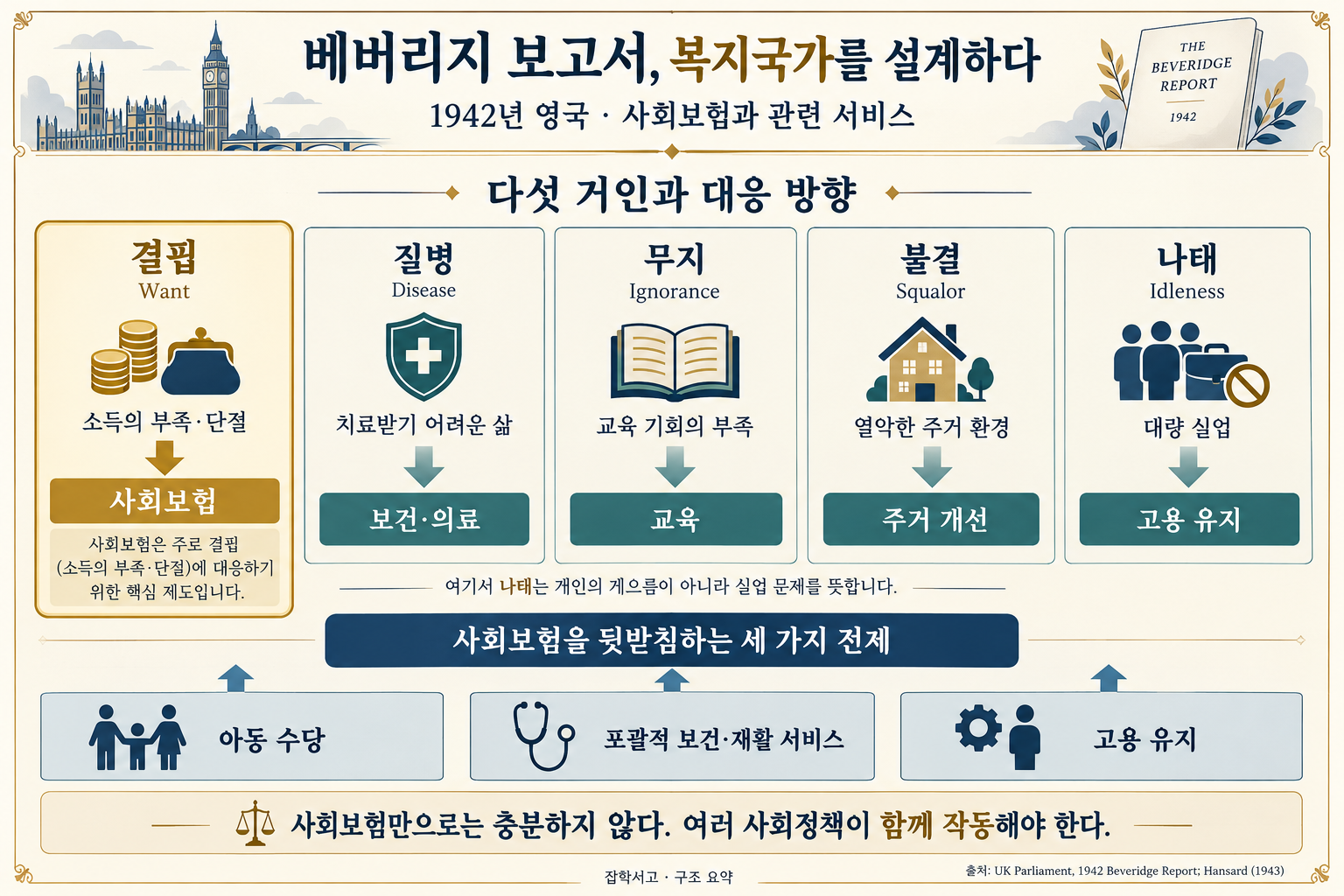
Beveridge called the five social evils blocking the road to postwar reconstruction the ‘Five Giants.’ He saw social insurance as the weapon for fighting the first of these giants, while the remaining giants had to be tackled by other policies working alongside it.
- Want: A state in which income is cut off or insufficient to meet basic needs, and the target that social insurance confronts directly.
- Disease: The problem of being unable to get treatment for lack of money, which calls for medical services for all citizens.
- Ignorance: A lack of educational opportunity, for which expanding public education is the solution.
- Squalor: Cramped and run-down housing, which is the job of housing policy.
- Idleness: Mass unemployment, in which people who want to work cannot find jobs.
Analyzing prewar poverty surveys from several cities, the report concluded that most want arose from the interruption of earnings, through unemployment, sickness, or old age, and the rest from income falling short of family size.
The Principles and Three Assumptions Behind the Plan

At the heart of the Beveridge plan was compulsory social insurance covering every citizen. He disliked the means test, which made people prove their poverty by checking their income and assets, and believed that anyone who had paid contributions should receive benefits as of right.
(1) Six Principles
The report put forward six principles: a flat rate of subsistence benefit, a flat rate of contribution, unification of administrative responsibility, adequacy of benefit, comprehensiveness covering all risks and all people, and classification of insured persons by their way of life. The state would guarantee only a minimum standard of living, leaving room for individuals to build more on top of it themselves.
(2) Assumptions for the Plan to Succeed
Beveridge argued that social insurance alone could not abolish want, and set out three conditions to go with it.
- Children’s Allowances: Allowances to prevent the poverty that arises from having a large family.
- Comprehensive Health and Rehabilitation Services: A medical system through which anyone can receive treatment and rehabilitation.
- Maintenance of Employment: Mass unemployment must be avoided for the insurance finances to hold up as well.
The Legacy That Became Real Institutions and the Challenges That Remained

In June 1945, near the end of the war, the Family Allowances Act providing children’s allowances was passed first, and when the Labour Party, which had promised to defeat the five giants, won a landslide in that year’s general election, the rest of the plan became actual law as well. Beveridge himself, however, lost his seat in that election.
From the Cradle to the Grave
The National Insurance Act and the National Health Service Act in 1946 and the National Assistance Act in 1948 followed one after another. On July 5, 1948, the National Health Service opened, letting every citizen receive treatment without worrying about medical bills, and the phrase ‘from the cradle to the grave’ came to symbolize the British welfare state.
Criticism and Limitations
Flat-rate benefits were criticized as inadequate to guarantee subsistence because they could not reflect differences in prices and regions, and in the end more and more people came to rely on means-tested public assistance. The fact that the scheme was designed on the view that married women depended on their husbands is also still cited today as a major limitation.
The Beveridge Report brought scattered social insurance schemes together and presented a blueprint for a postwar society that would confront the five giants of want, disease, ignorance, squalor, and idleness. Its design led to the National Health Service and National Insurance and became a model for welfare systems in many countries around the world.
Even now, 80 years later, debates over welfare systems ultimately return to Beveridge’s questions: to whom, how much, and in what way should protection be guaranteed.
Accurately diagnosing the giants a society must confront is the first step toward better welfare design.