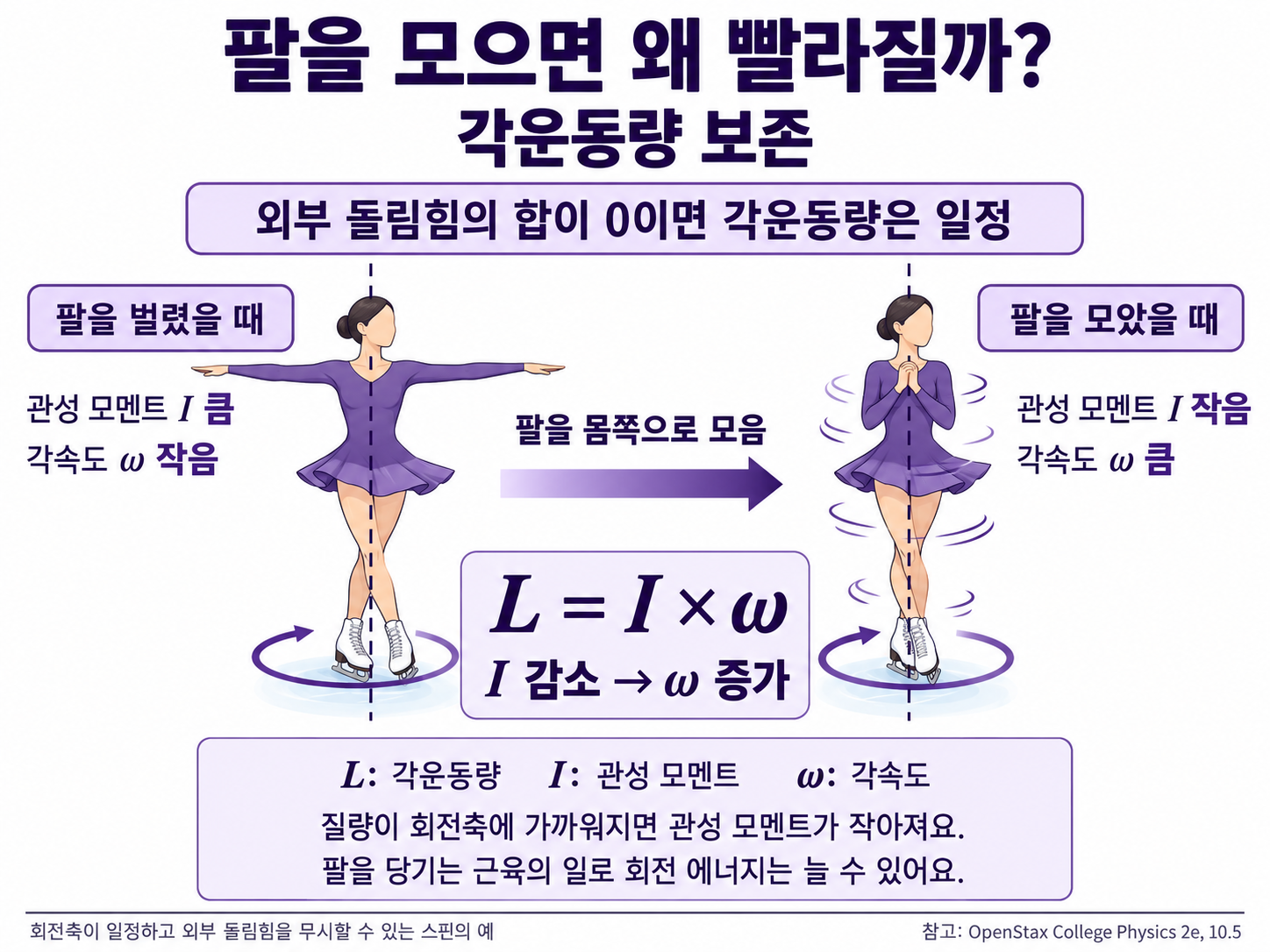
Picture a figure skater spinning in place. At first the skater turns slowly with arms spread wide, but the moment the arms are pulled in toward the chest, the spin becomes so fast that your eyes can barely keep up. No one gave a push, yet the spin speeds up on its own. The law of physics hidden behind this curious sight is ‘Conservation of Angular Momentum.’
Put simply, conservation of angular momentum means ‘if no outside force acts to change its rotation, the amount of rotation a spinning object has stays the same.’ Along with conservation of momentum and conservation of energy, this principle is counted among the most fundamental conservation laws in physics, and it applies to everything that rotates, from a small spinning top to planets and stars.
In this piece, we will look in turn at the concept of angular momentum and the principle of its conservation, examples from sports and everyday life, the vast rotations revealed in space, and the technologies that make use of this principle.
What Is Spinning Tends to Keep Spinning
What Is Angular Momentum?
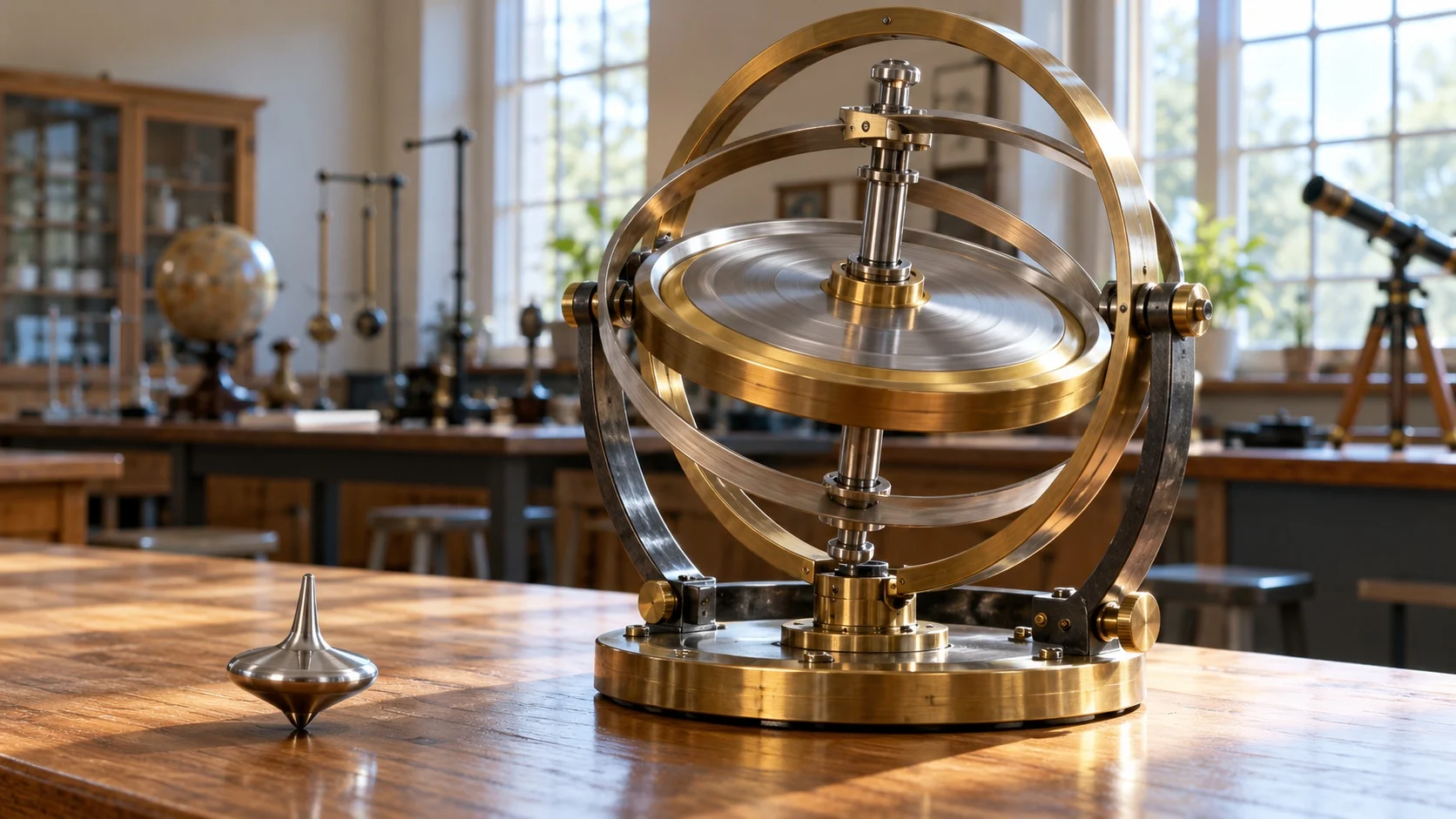
Just as an object moving in a straight line has momentum, a rotating object has angular momentum. Angular momentum is a quantity that expresses both how vigorously an object is spinning and in which direction.
(1) The Product of Moment of Inertia and Angular Velocity
Angular momentum (L) is the product of the moment of inertia (I) and the angular velocity (ω), written as L = I × ω. Angular velocity describes how fast something spins, and the moment of inertia describes how hard it is to change its state of rotation. The moment of inertia grows larger the greater the mass, and the farther that mass is spread from the axis of rotation.
(2) Conservation When There Is No Outside Torque
The effect of a force that speeds up or slows down rotation is called torque (Torque). When no outside torque acts, angular momentum stays constant. So when the moment of inertia shrinks, the angular velocity grows by the same proportion, and when the moment of inertia grows, the angular velocity slows. That is because the product of the two must always remain the same.
Conservation of Angular Momentum in Sports and Everyday Life

Conservation of angular momentum is easy to see with our own bodies, too.
- Figure skating spin (Figure Skating Spin): When skaters draw their arms and legs close to the axis of rotation, their body’s moment of inertia shrinks and the spin speeds up; when they spread their arms again, it slows. Skaters use this principle to control the speed of a spin and finish it steadily.
- Diving somersault (Diving Somersault): A diver cannot change the angular momentum gained at the moment of leaving the board while in the air. So divers curl up tightly to spin several times quickly, then stretch their bodies out straight just before entering the water to slow the rotation.
- Rotating chair experiment (Rotating Chair Experiment): If you sit on a swivel chair holding heavy objects in both hands, spin with your arms outstretched, and then pull your arms in toward your chest, the chair speeds up noticeably.
The fact that a cat falling from a height lands feet first is also related to this law. Even when it falls without rotating, a cat alternately tucks and extends its front and hind legs while twisting at the waist, turning the front and back halves of its body one after the other. In effect, it changes the orientation of its body while keeping the angular momentum of its whole body at zero.
Vast Rotations Revealed in Space

Conservation of angular momentum shows itself even more dramatically in the motion of huge celestial bodies such as planets and stars.
(1) Why Planets Speed Up Near the Sun
According to Kepler’s second law, the line joining a planet and the Sun sweeps out equal areas in equal times. This is a consequence of the conservation of the planet’s angular momentum, so a planet moves faster when it is close to the Sun and more slowly when it is far away.
(2) Neutron Stars That Spin More Than 700 Times a Second
When a massive star ends its life and collapses, it leaves behind a neutron star only about 20 kilometers across. As the enormous star shrinks to a small size, its moment of inertia falls dramatically, so its rotation becomes tremendously fast. PSR J1748-2446ad, the fastest pulsar known so far, rotates about 716 times per second.
(3) Lengthening Days and a Receding Moon
The Earth and the Moon exchange angular momentum through tidal effects caused by each other’s gravity. In this process, the Earth’s rotation gradually slows, so the day grows a little under 2 milliseconds longer every 100 years, and the Moon, which takes over the angular momentum the Earth loses, is moving away from the Earth by about 3.8 centimeters each year.
Technologies That Use the Principle of Rotation

Conservation of angular momentum is also an important consideration in designing machines and vehicles.
(1) Gyroscopes That Hold Their Direction
A rapidly spinning top or gyroscope strongly resists forces that try to change the direction of its axis. That is because angular momentum is conserved not only in size but also in direction. A bullet that spins as it passes through a rifled barrel, or a disc thrown with spin, flies steadily without wobbling for the same reason.
(2) The Helicopter’s Tail Rotor
When the engine turns the main rotor in one direction, the reaction tries to turn the airframe the opposite way. The tail rotor (Tail Rotor) pushes air sideways to cancel this torque, and the pilot adjusts the tail rotor’s thrust with the pedals to change the direction the aircraft faces.
(3) Reaction Wheels That Change a Satellite’s Attitude
In space there is neither air nor ground to push against. So satellites such as the Hubble Space Telescope spin an internal reaction wheel (Reaction Wheel) one way to slowly turn the body the other way. It is a way of pointing precisely in a desired direction without using fuel.
Conservation of angular momentum is a law that shows how a rotating object tends to maintain its own state. A figure skater’s spin and a cat’s landing, the orbits of planets and the rotation of neutron stars, and even the attitude control of satellites can all be explained by the same principle. If you remember that the speed of rotation changes just by changing how far the mass sits from the axis, the spinning things around you will look new.
Understanding why pulling in your arms makes you spin faster: that is the first step in physics toward reading a rotating world.