If you fill a glass to the brim, the water can bulge up slightly above the rim without spilling over. On a pond, water striders glide across the surface as if walking on it, without sinking. This property, in which the surface of a liquid holds firm like a thin film, is called "surface tension."
Put simply, surface tension means "the tendency of a liquid to shrink its surface area as much as possible." It arises from the forces with which the molecules of a liquid pull on one another, and it plays a part in more places than you might think, from the way water droplets form into beads, to how soap lifts away dirt, and even to the way we breathe.
In this article, we will look in turn at how surface tension arises, why water's surface tension is unusually high, the many everyday scenes where we encounter it, and the role of surfactants, which lower this force.
How Surface Tension Works and Where It Shows Up
What is surface tension?
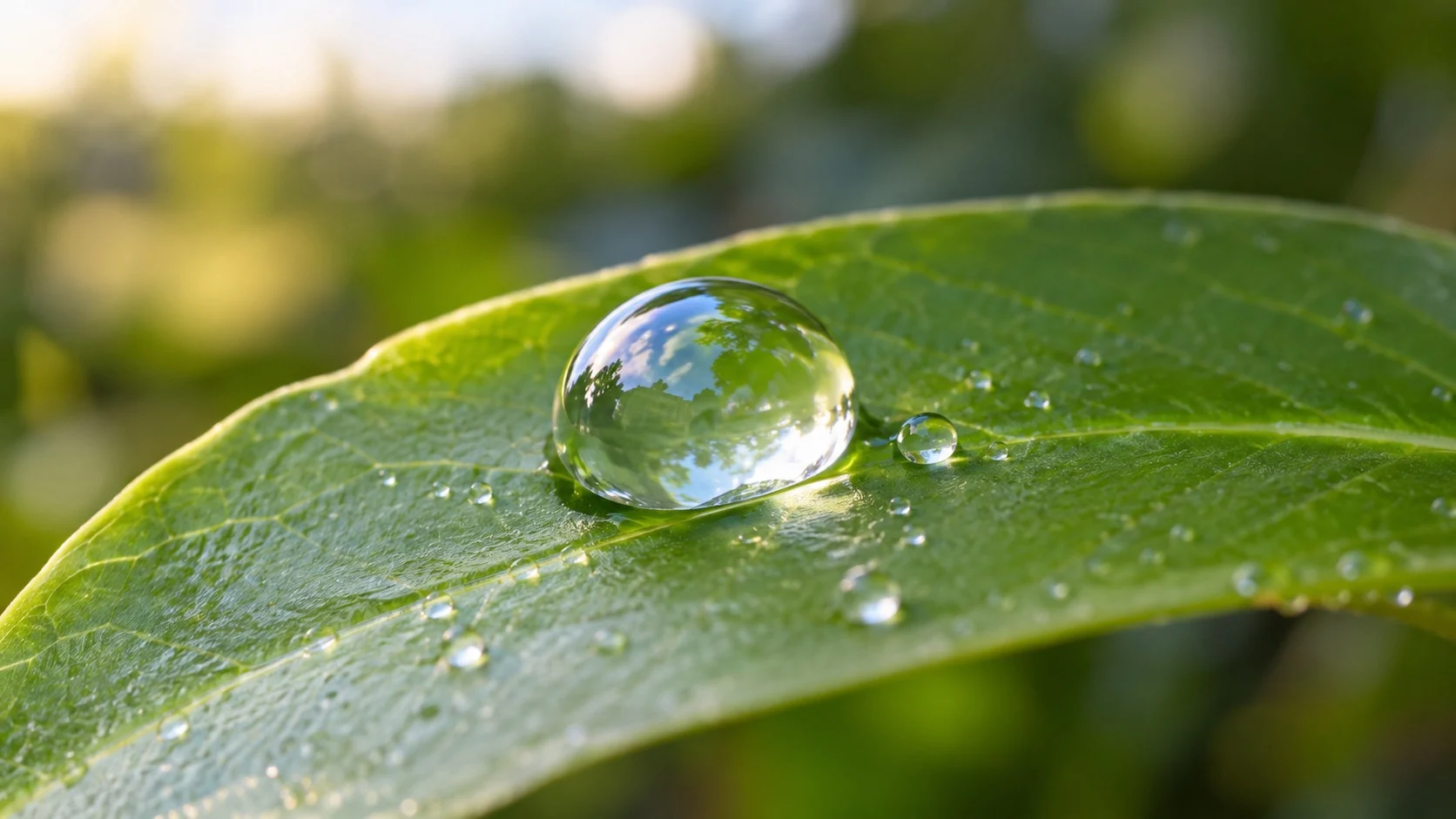
A molecule deep inside a liquid has neighboring molecules above, below and on every side, so the pulling forces on it cancel out evenly. A molecule at the surface, however, has almost no neighbors on the outside to pull it outward, so overall it is pulled inward toward the body of the liquid.
As a result, the surface of a liquid behaves like a tightly stretched rubber sheet, and enlarging the surface takes a corresponding amount of work. That is why surface tension is expressed either as "the force acting per unit length of the surface" or as "the energy needed to enlarge the surface by a unit area," and it is measured in newtons per meter (N/m).
- Cohesion: the force with which molecules of the same liquid attract one another, and the basis of surface tension.
- Minimum Surface Area: for a given volume, a sphere has the smallest surface area, so small water droplets and water in weightlessness take on a round shape.
This is also why morning dew on the tip of a blade of grass and raindrops clinging to a windowpane look round. However, the larger a droplet becomes, the greater the effect of its weight, so a large drop sitting on a surface spreads out and flattens at the bottom.
Why water's surface tension is unusually high
Every liquid has a different surface tension. The difference comes down to how strong the forces acting between its molecules are.
(1) The strength of hydrogen bonds
Water molecules are tightly linked to their neighbors by hydrogen bonds. As a result, the surface tension of water at 20°C is about 72.8 mN/m, which is very high among common liquids.
(2) Comparison with other liquids
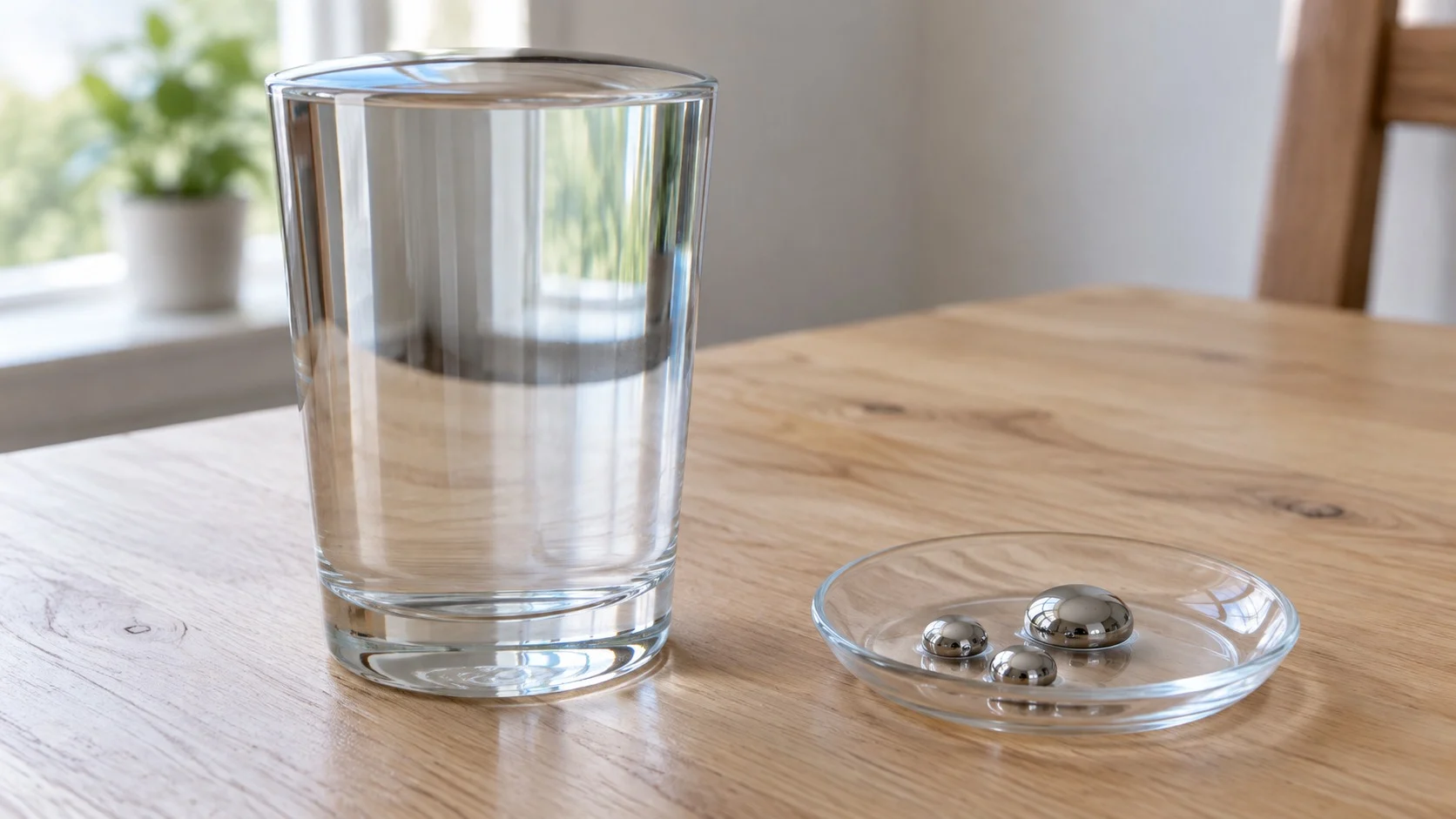
The surface tension of ethanol is only about one third that of water. Mercury, on the other hand, whose atoms are held together by metallic bonds, has a surface tension about six times that of water, so when dropped onto glass it does not spread out but rolls around like round beads.
(3) Changes with temperature
As temperature rises, molecules move more vigorously and the forces holding them together weaken. The surface tension of water, too, is about 75.6 mN/m at 0°C but drops to about 59 mN/m as it nears 100°C.
In this way, surface tension is not a fixed value; it changes depending on the kind of liquid, its temperature and what is mixed into it. Dissolving even a little soap in pure water lowers the value greatly, and this property leads to the principle of surfactants, which we will look at later.
Surface tension in everyday life
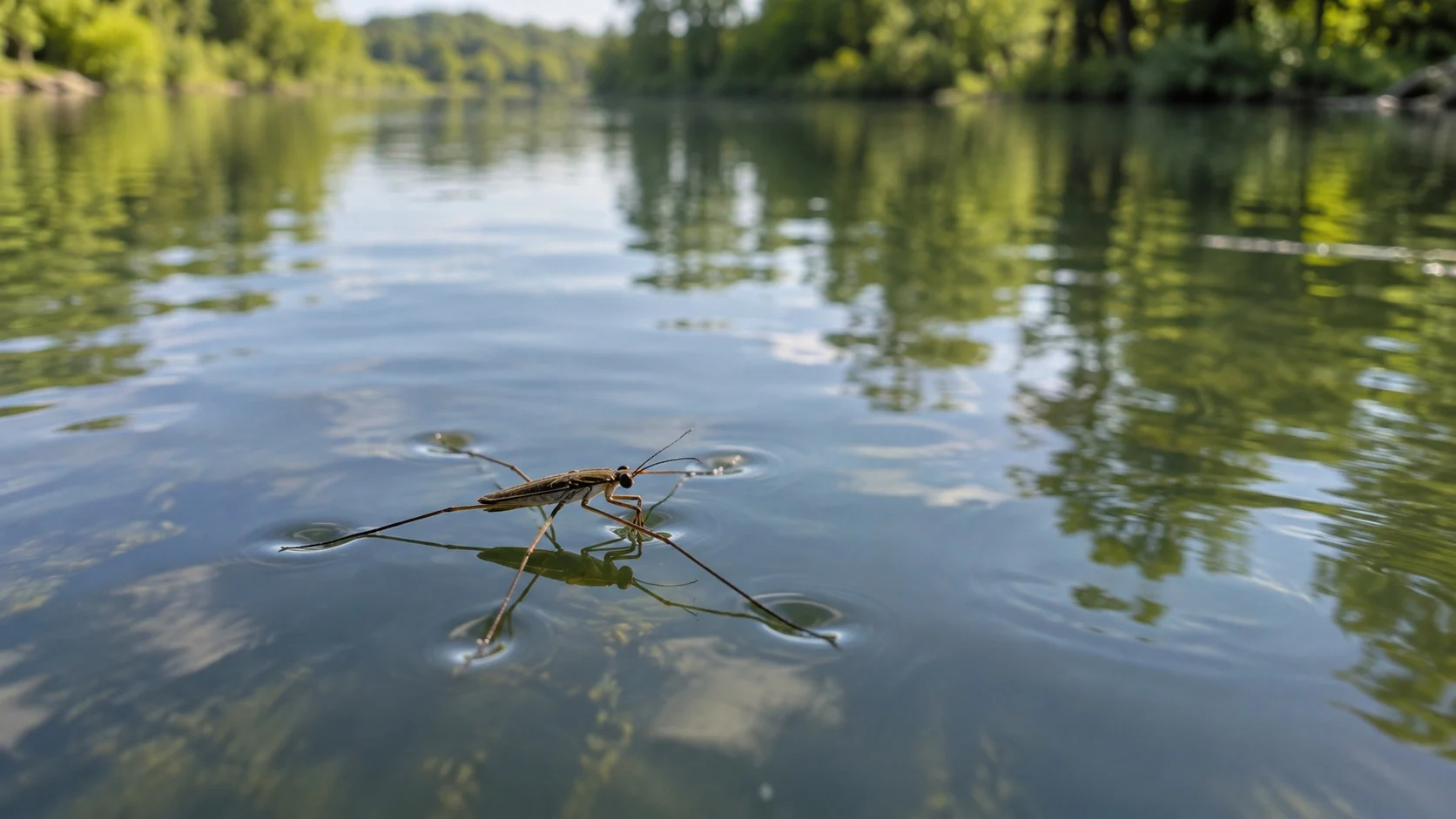
Surface tension shows itself more often around us than in the laboratory. If you look a little closely, you can easily find traces of it in familiar places such as the kitchen, the bathroom and the edge of a pond.
- Water Strider: its legs are densely covered with fine, water-repellent hairs, and when a leg presses the surface into a slight dimple, the surface's tendency to spring back flat holds up the insect's body.
- Floating Needle: even a steel needle or a paper clip, which is heavier than water, can float supported by the surface film if it is laid down gently on the water.
- Convex Water Surface: when a glass is filled to the top, the holding force of the surface lets the water swell above the rim without overflowing for a while.
- Capillary Action: in a thin tube or the gaps in a paper towel, adhesion, the force with which a liquid clings to the walls, works together with surface tension to draw the liquid upward against gravity.
Conversely, a liquid such as mercury, which does not cling well to glass, actually sits lower inside a thin tube. In other words, the outcome depends on which is stronger: the force pulling the liquid together or the force drawing it onto the walls.
Surfactants: lowering surface tension
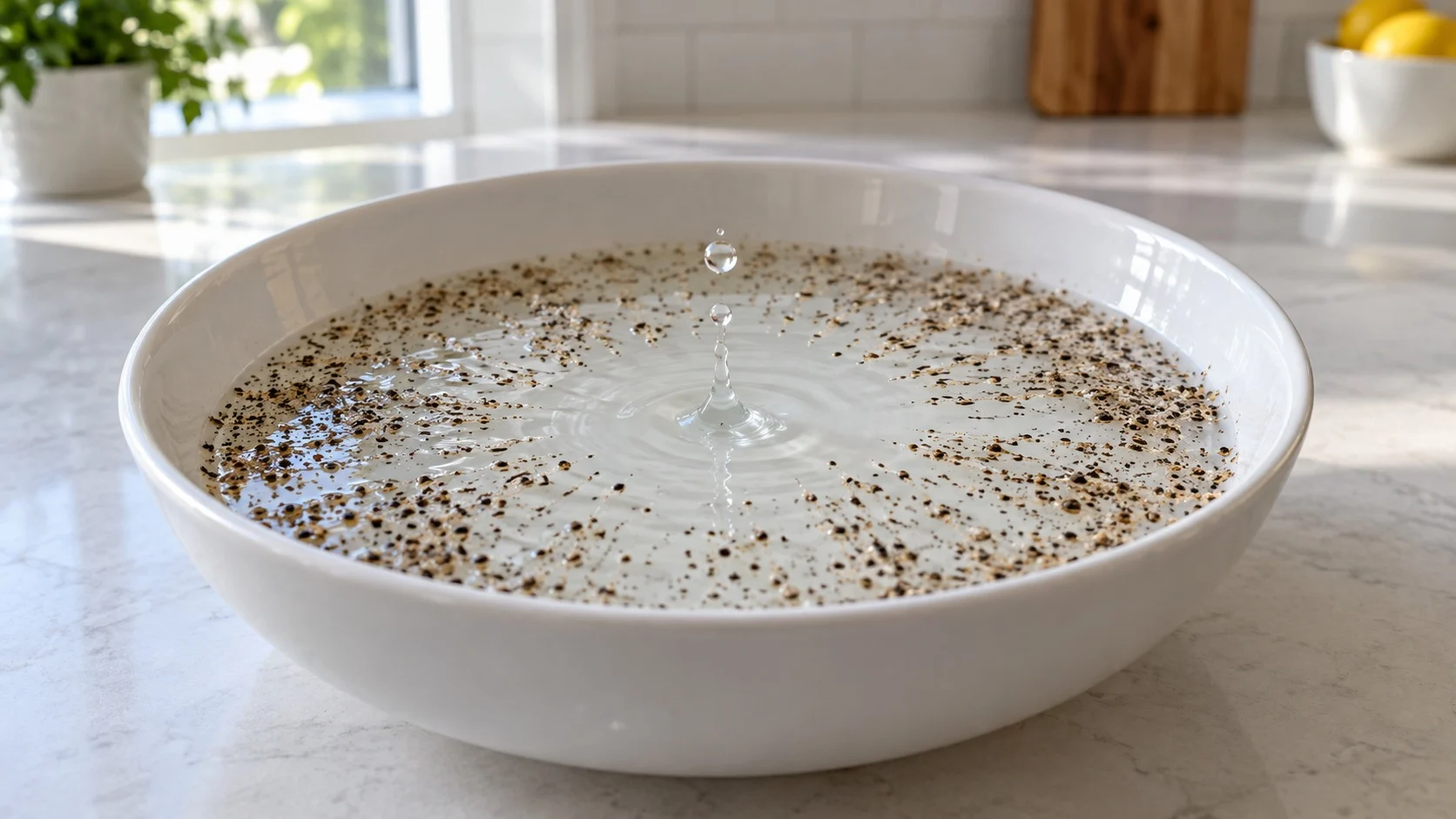
Surface tension is not always helpful. When water holds together too tightly, it cannot easily seep into the fine gaps in fabric or into greasy grime. The substances used in such cases are surfactants, which lower surface tension.
What surfactants do
- Detergency: soap and detergent molecules have both a water-loving head and an oil-loving tail, so they lower the surface tension of water and surround greasy grime, lifting it away into the water.
- Pepper Experiment: if you sprinkle pepper on water and drop a little detergent in the middle, the surface tension at that spot suddenly weakens, and the pepper is instantly pushed outward.
- Pulmonary Surfactant: the inner lining of the alveoli, the tiny air sacs in the lungs, contains a substance that lowers surface tension, helping keep small alveoli from collapsing and sticking together when we breathe out.
- Industrial Applications: products that need to spread evenly over a surface, such as ink, paint and pesticides, contain ingredients that adjust surface tension to the right level.
In particular, premature babies born before their lungs can produce enough pulmonary surfactant may have difficulty breathing, and treatments that supply it are sometimes used. The invisible force at a liquid's surface is connected even to life itself.
Surface tension is a phenomenon that appears when the small forces with which molecules pull on one another gather at the surface of a liquid. The round shape of water droplets, the steps of a water strider, the way a paper towel soaks up water, the cleaning power of detergent and even our own breathing are all connected to this force.
Picturing the invisible tug-of-war between molecules in a glass of water bulging above the rim is the first step toward exploring the science in everyday life.